
Musicians use creative approaches to help newcomers feel at home
In Newfoundland and Labrador, music plays a key role in preserving history and expressing the province’s identity and cultural heritage. Through their work, these musicians are helping newcomers connect with and become part of that cultural fabric.
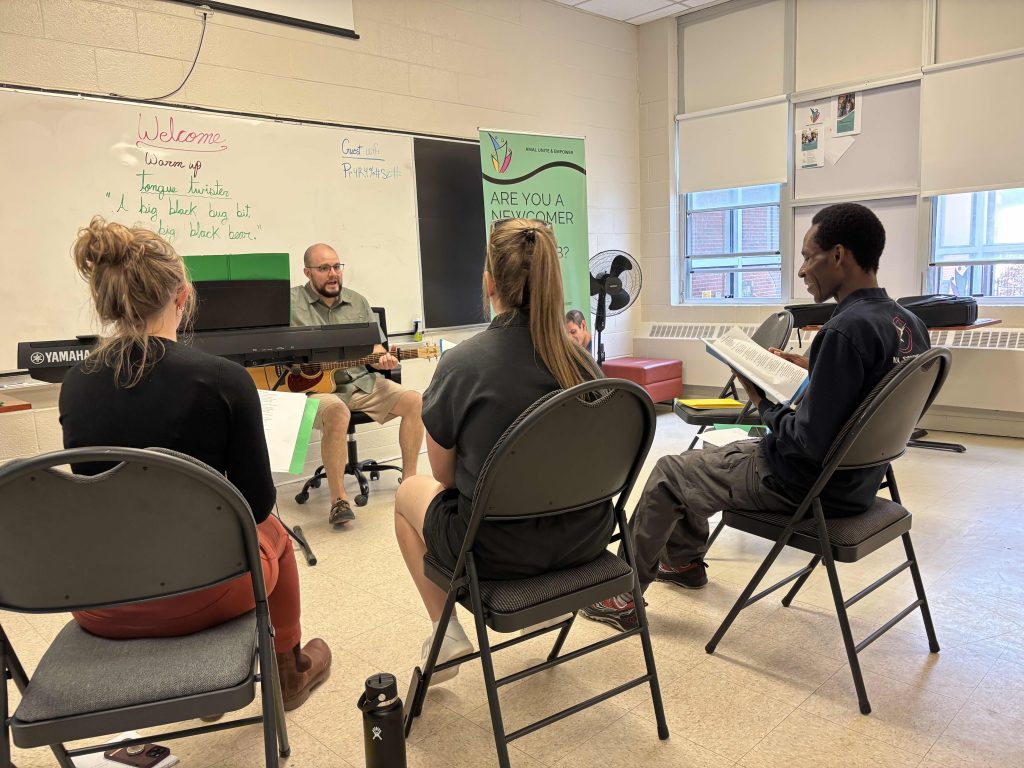
Irish wristwatch.
That was the tongue twister of the day when I met up with Julien Bouchard and Kristen English. It was a cold Tuesday night in March, and the two were setting their piano and guitar to get ready for their weekly choir sessions.
Bouchard, 34, and English, 33, host free choir nights for newcomers who want to learn English, make new friends, and sing or play games together. “It’s meant to be just a really joyful place to sing and meet people,” English says.
Their choir is part of the Newcomer Choirs Association of Canada — an initiative founded by Rachel Manko Lutz in Halifax to help newcomers learn English in a low-stakes environment. A third choir in London, Ont. was established in 2024.
Will you stand with us?
Your support is essential to making journalism like this possible.
“So when we say low-stakes, we really mean if you can come twice a year, like someone has thus far, like cool! Come on in. The door’s open,” Bouchard says.
Every class starts with a tongue twister. “Not only is it hard to say, but it kind of wraps your head around how strange English can be and gives you a chance to practice something really silly,” he adds.
Creating a sense of belonging
Bouchard and English moved to St. John’s in 2020 to pursue graduate studies. English applied for a Master of Music, while Bouchard enrolled in a Bachelor of Education program. “Just moving to a new place is jarring—and I can’t imagine doing that when you don’t speak the language or are terrified of the climate,” Bouchard says. “ And so we definitely sympathize with that sentiment.”
He says since everyone is familiar with music, regardless of their background, music can help mediate the impact of the culture shock that often comes from moving, “to a rock in the middle of the ocean.”
Charlie Wall-Andrews, an educator at Toronto Metropolitan University and executive director of the SOCAN Foundation—which supports music creators and publishers—hails from Whitbourne. She says music is deeply woven into the fabric of the province, playing an important role in amplifying the cultural traditions and everyday life of the community in which it is produced.
“Whether it’s trying to portray what mummering is, or a good old kitchen party, or the life of a sailor, which so many people from the province can really resonate with, and you know that that gives it a special sound, a special story,” she says.
Wall-Andrews says she is “delighted” to hear about the newcomer choir, adding that initiatives like this are powerful examples of how diversity and inclusion can be fostered. It’s not just about increasing representation, she says, but about making sure people feel truly included in the community and aren’t pushed to the margins.
“When our communities are brought together, they’re stronger and they’re more vibrant on every level,” she says. “That’s why we need to support—I would even say, invest in—arts and culture initiatives like this.”
Manko Lutz says she has seen newcomers grow both socially and professionally through their involvement in the choir. “We’ve had folks increase their networks. We’ve had folks join boards of directors of arts organizations and get jobs in arts organizations from their experience with us.”
Bouchard and English say they want their classes to do just that; create a sense of belonging and create a community that can help each other integrate into the province. They try to make the class a space where newcomers can ask questions about what they need, whether it’s help finding furniture or understanding confusing cultural norms.
For St. Patrick’s Day, the class explored Irish and Newfoundland folk music. Bouchard explains that, for many newcomers, it might be their first time seeing people dressed in green, “for seemingly no reason.” So, they used the opportunity to discuss the history and cultural ties between Ireland and Newfoundland and Labrador. “Kind of help them acclimatize to what this place is and how it became, how it came to be.” Bouchard says.
But the choir isn’t just for newcomers, Bouchard says. It’s a space where anyone is welcome — a place for newcomers to connect with other residents. For Newfoundlanders who are curious about foreign languages, interested in learning a few words from choir members, or talking about international foods, he says, “it’s a great place to do that.”
Helping newcomers stay
Manko Lutz, who worked with an immigrant-serving agency in Nova Scotia until 2022, often heard newcomers express frustration over long wait times for English classes due to high demand. Even when they managed to enroll, the lessons typically lasted only two and a half hours a day, she says.
After class, most English learners return home and resume speaking their native languages. Manko Lutz recalls people “bemoaning” the lack of opportunities to speak English outside the classroom. “They also often didn’t know many Canadians, and found it kind of hard to figure out, like, where do you meet these people? And how do you increase your sense of community?” she says.
Manko Lutz’s Master’s research focused on how choir singing can be used to teach English as another language. She teamed up with her music director friend, Rebecca McCauley, to create the choir. Manko Lutz grew up in Wolfville, N.S. and says the experience helped her recognize the vital role immigration plays in supporting population and economic growth in rural areas across the Atlantic provinces. “I understand, and have understood for a long time, that we benefit deeply from newcomers coming to our province.” She hopes the choir will help with some of the retention issues the Atlantic provinces face.
During the same time, English had been dreaming of starting a newcomer or outreach choir. That vision came closer to reality when English came across a Facebook post from Manko Lutz, asking if anyone in Newfoundland and Labrador was interested in launching a local branch of her choir initiative.
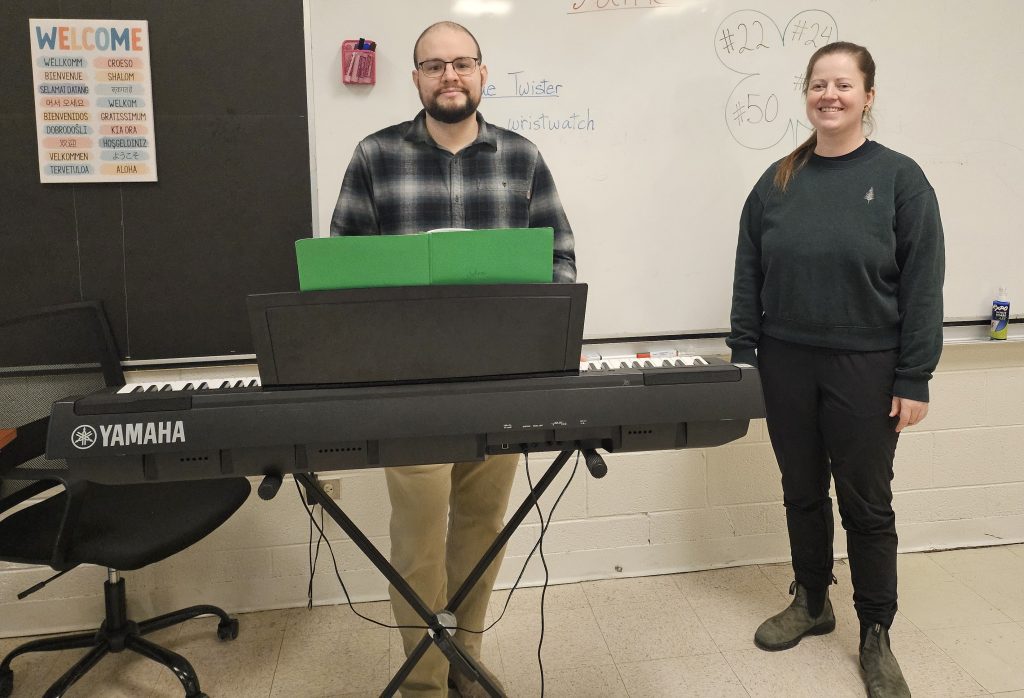
Since the classes began in April 2024, Bouchard and English have welcomed newcomers from countries like Ukraine, Brazil, Nigeria and Iran, as well as locals. They’ve formed such strong bonds with some participants that they’re even invited to birthday parties, Bouchard laughs.
It was during one of their lessons at the United Church that Laura Aguirre Polo, program manager at Amal Unite & Empower, happened to attend. She had heard about the choir from Manko Lutz and offered the two a space at the AMAL building in downtown. She told English that Amal’s clientele who come to the building for other services could benefit from the choir.
For each class, Bouchard and English bring folders filled with lyrics — everything from children’s songs and nursery rhymes to traditional Newfoundland tunes and contemporary pop music. Every time a choir member introduces a song, it gets added to the folder. Bouchard says Great Big Sea’s song Ordinary Day is a recent favourite, and when people learn that the song is from the same province they live in, “it seems to help them anchor themselves.”
Removing barriers
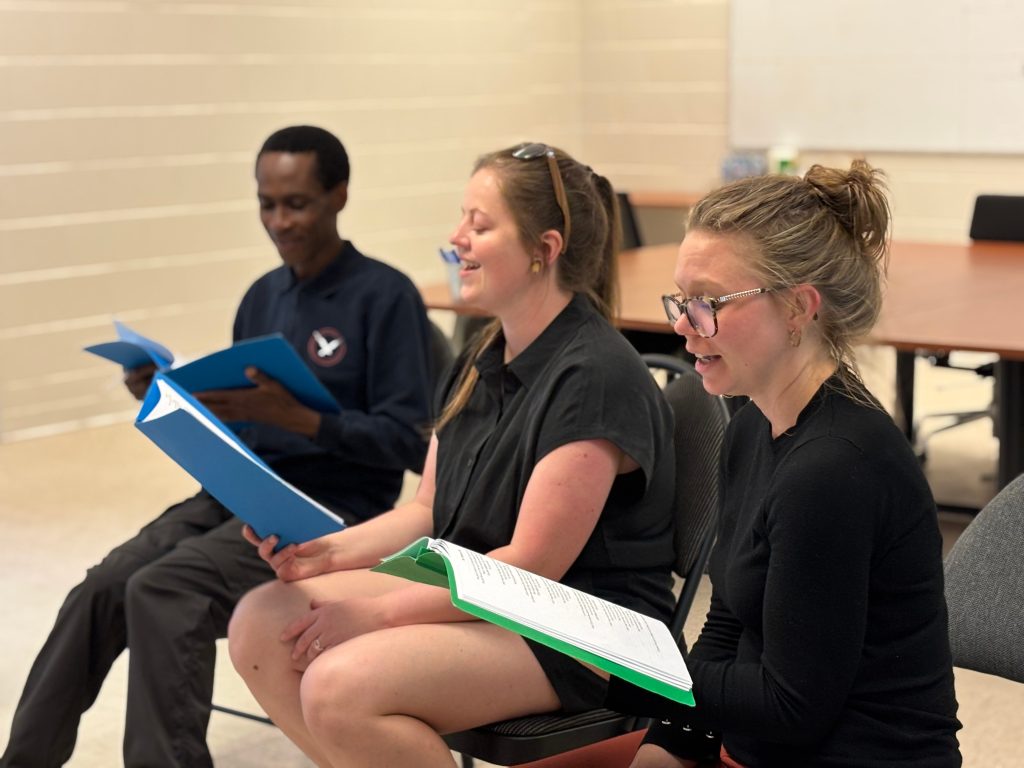
To encourage newcomers to attend, Manko Lutz knew she needed the class space to feel welcoming, so she focused on removing barriers that newcomers come across when trying to attend activities in a new country. For example, childcare is a common barrier to accessing English classes for many newcomers, so to overcome that hurdle she encourages parents to bring their children.
Transportation is another common barrier for newcomers learning English, so English and Bouchard wanted to find a location that would be easy to access—ideally close to areas where newcomers live in or at least near a bus stop. “The goal is to connect newcomers with other community members and just kind of help people access the resources that they need in a really low-stakes environment,” Bouchard says.
Newcomers are often hesitant to commit to membership-based programs, Bouchard adds, so the Newcomer Choir Association designed a format that’s free, doesn’t require registration, and is flexible in allowing people to join whenever they’re able. It’s simply something to do during the week — a reason to get out of the house, Bouchard continues. For some, it brings a sense of normalcy, and for parents, it’s a “bit of respite from the kids.”
While class sizes are currently small—between six and 12 people— Manko Lutz says she encourages Bouchard and English by reminding them that when she started the choir in Halifax, there were only five members. The group now averages 25 people and regularly performs at events. Manko Lutz explains the performances have helped the group grow close. “You do something where everybody’s kind of together for a bigger chunk of hours, and all of a sudden you get these different bonds forming.”

Author

Related Articles
N.L. education system struggling to meet the needs of newcomer students
Families and organizations are working to create safe spaces for refugee youth to thrive, stay connected with their roots and build strong community connections

Newcomers love N.L. and power economic growth, but lack of supports drive them away
The provincial government and settlement agencies must eliminate barriers that newcomers face when they arrive, say observers, or else the trend will continue
From snowbanks to finding community: Newcomers confront winter struggles
Winter blues can be especially hard on newcomers who are adjusting to a new country, new culture, new language and new weather. But a warm community can help the integration process feel less overwhelming.