
Evasion, erasure and protest: Advocates work to ensure Palestinian solidarity remains an election issue
More than 330 federal election candidates support a five-point Palestine-solidarity platform, but only five in Newfoundland and Labrador have signed on
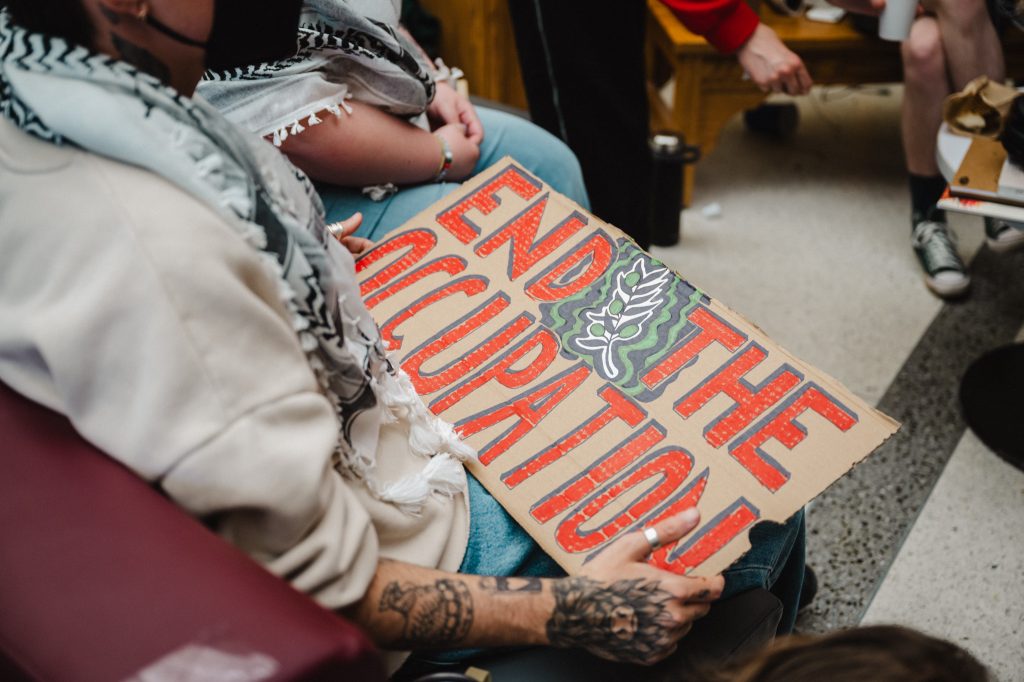
With the Canadian federal election days away, the issue of Israel’s ongoing occupation and genocide in Palestine has indelibly shaped the backdrop of the campaign. While tariffs and economic issues have dominated much of the mainstream media coverage, human rights advocates have been hard at work trying to force candidates to address the issue of Palestine.
On April 12, solidarity rallies were held across the country, including one on Parliament Hill described as “massive” by CTV News. Two weeks earlier, on March 27, charges were dropped against members of the ‘Indigo 11’, a group of protestors who defaced a Toronto Indigo Books outlet in November 2023, in protest over Indigo CEO Heather Reisman’s support for the Israeli military. The protestors were arrested at their homes in violent police raids that sparked controversy and condemnation and triggered an ongoing boycott of Indigo bookstores.
Other advocates have focused efforts on targeting federal election candidates. A group calling itself Vote Palestine issued a five-point Palestine-solidarity platform and asked candidates to sign on to it. The campaign has been endorsed by dozens of organizations, ranging from Toronto Jewish Families to the Canadian Federation of Students and the Canadian Union of Public Employees. To date over 330 candidates in the federal election have signed on to the platform, including at least 19 Liberals and hundreds of NDP candidates. No Conservatives have endorsed the platform.
In Newfoundland and Labrador, only five candidates have endorsed the platform. They include three New Democrats—Mary Shortall (St. John’s East), Sarah Parsons (Long Range Mountains), and Darian Vincent (Central Newfoundland)—and two Green Party candidates (Otis Crandell in St. John’s East and Kaelem Tingate in Cape Spear).
Will you stand with us?
Your support is essential to making journalism like this possible.
Yet the ongoing genocide in Palestine has been conspicuously absent from mainstream media coverage. “I don’t think the mainstream media has prioritized the question of Palestine,” says Heidi Matthews, a professor at Osgoode Hall Law School whose research focuses on international law. She takes this as a sign that issues of national concern are being increasingly interpreted in isolationist terms by Canadians. “It’s quite dangerous to think of Canadian concerns only in terms of what happens at home,” she warns.
“Newfoundland’s specific colonial history and sense of itself as a people that has often faced various forms of neglect or oppression within a broader federal context should actually be a really important reason why Newfoundlanders should want to reflect on Canada’s role—and by extension, the role of Newfoundland—in the violations happening in Gaza,” she says.

Matthews finds it intriguing that despite many Newfoundlanders’ close association with Ireland, a country with which many here share heritage, they haven’t followed Ireland’s lead in loudly condemning Israeli genocide, a stance rooted in that country’s protracted history of violent colonial occupation by England.
“I think that’s something we need to really think about in terms of connections between the political community in Ireland and the political community in Newfoundland, because in the Irish context being in favour of basic Palestinian human rights and national survival stems from the Irish experience of colonialism under the English and is not at all considered a fringe topic. This is a mainstream question of affinity and cultural solidarity. It’s kind of disturbing and interesting to me at the same time that that doesn’t resonate in Newfoundland.”
Liberal government has ‘failed’: Matthews
As a professor who studies international law and genocide, Matthews isn’t impressed with any of the parties when it comes to their platforms on Palestine.
“The Liberal government has failed to meet a wide range of international and domestic legal obligations with respect to Palestine,” she explains. “Canada has done very little to nothing in terms of putting pressure on Israel, in terms of sanctions, diplomatic isolation, arms embargo, et cetera. In terms of domestic law, Canada has a series of commitments under the arms trade treaty in particular which it is not living up to, insofar as it continues to facilitate Canadian-made parts reaching Israel via the United States. The Liberal government has failed on just about every international and domestic legal obligation and moral obligation that it has with respect to the occupation.”
But even candidates from other parties have demonstrated a “lack of understanding and curiosity and desire to learn more about the question of Palestine” that Matthews finds “astounding” and “indefensible”.
Sadie Mees was one of three Memorial University students arrested in July 2024 when Royal Newfoundland Constabulary officers raided a MUN Students For Palestine occupation at the St. John’s campus. In March, charges against the three students were dropped, and the students say they intend to pursue a charter challenge over the arrests. Speaking as a member of MUN Students For Palestine, Mees says the Memorial University’s complicity in the genocide is one of several reasons local residents ought to be concerned about the issue.
“Memorial University is invested in these weapons manufacturers, the Canada pension plan is invested, many local unions are invested in these companies,” she says. “We saw with apartheid South Africa how impactful divestment and boycott and union solidarity are. And we—people here in Newfoundland and around the world—need to show solidarity now with the people of Palestine. We have to stand up and end any and all forms of complicity, whether they be big or small, direct or indirect. We cannot allow this genocide to continue.”

“The gravity and urgency of the current genocide in Palestine demands that we act. This is a federal election, and it’s our federal MPs who are making the decisions to continue to allow the export of weapons and weapon components to Israel, including via the U.S. They are facilitating our continued contribution to the horrifying acts of violence being committed by Israel. The people we elect will either continue to allow our government to contribute to genocide, or make policy change to put a stop to it.”
It’s not just student activists who have been working to make Palestinian solidarity an issue in this province. Labour For Palestine St. John’s, a group comprised of union members, has drawn attention to the complicity of local companies like Kraken Robotics in Israeli military operations. Another local group, Palestine Action YYT, has organized regular solidarity rallies and marches through downtown St. John’s, and in November 2023 occupied Liberal MP Joanne Thompson’s office demanding a meeting over the issue. In 2024, St. John’s Pride also adopted a Palestine-solidarity programme and declared Palestine Action YYT that year’s Pride Parade grand marshals.
Yet by and large, N.L. federal election candidates have been silent on the issue, and Matthews says this is something voters ought to be deeply concerned about.
“I think Newfoundlanders in general just deserve better in terms of their representation in Ottawa,” says Matthews. “Across ridings the degree of entitlement to these positions that these candidates are in fact auditioning for doesn’t bode well for our democracy nationally but particularly with respect to Newfoundland and its concerns in Ottawa. If candidates are going to be so dismissive about a genocide in which Canada has been arguably complicit, I think we would want to have serious concerns about how our own internal issues would be represented in Ottawa as well.”
The Independent’s federal election coverage is supported by the Covering Canada: Election 2025 Fund.

Author
Related Articles

New play portrays barriers facing N.L. women in politics
Women won the right to vote a century ago but are still underrepresented in public office. St. John’s playwright Ruth Lawrence’s play tackles that head on.
Meaningful response to homelessness requires more than new builds, says NDP leader
Jim Dinn’s comments come in response to PC’s announcement of 10 new ‘micro homes’ in St. John’s
Muslim community commemorates 9th anniversary of Quebec City Mosque shooting
Anti-hate advocates say there’s still work to be done to combat Islamophobia in the province