
Experiencing Cape Spear as a parent with disabilities
Researchers hike to Cape Spear to explore how historic sites can be made more accessible for parents with diverse accessibility needs
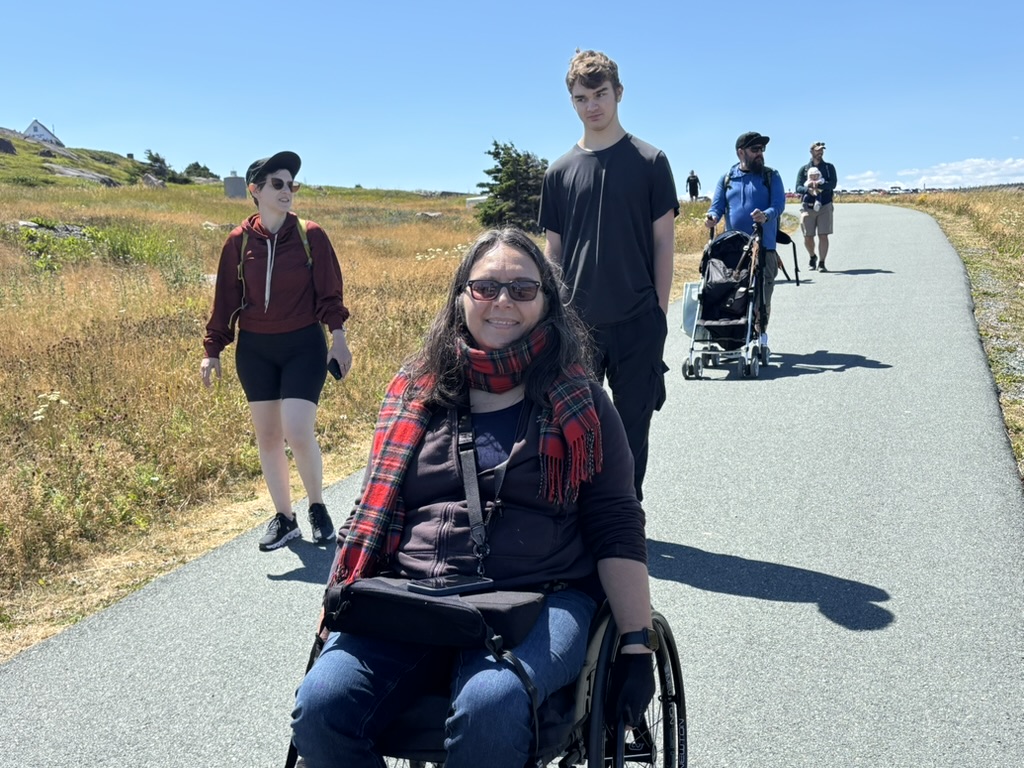
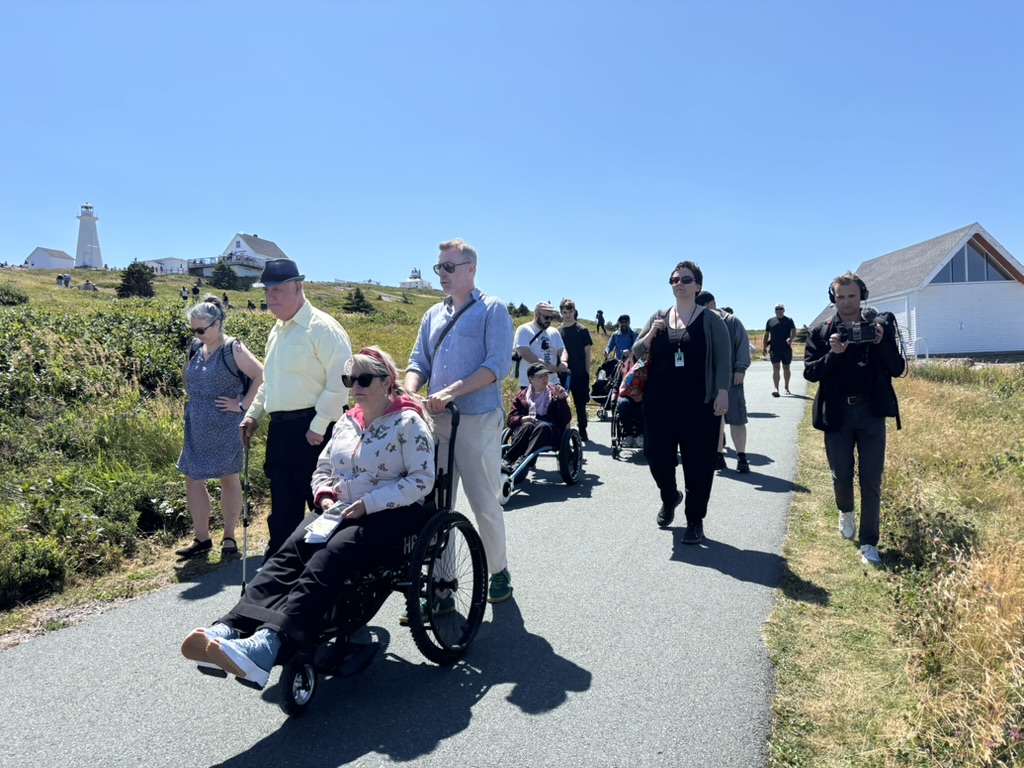
It’s a warm day with a light breeze — noon on a Wednesday in August. An ideal backdrop for a hike at Cape Spear. Researchers, persons with disabilities, and advocacy groups are gathered to experience recent improvements at the historic site which make it more accessible.
Lanie Woodfine, a social worker with cerebral palsy, shares that she has never seen several parts of Cape Spear until today. With the help of a Hippocampe all-terrain mobility aid provided by Parks Canada, friends to assist her, and a guide to lead the way, she is finally able to complete the hike — an excursion so central to the Newfoundland experience.
Researchers from across Canada organized the hike as part of a project to improve accessibility in outdoor spaces for families, especially those with parents or caregivers with disabilities. Funded by Accessibility Standards Canada, a federally-regulated corporation created in 2019 to help build a barrier‑free Canada by 2040. The research project involves interviewing 100 families as they visit federal sites—like government buildings, passport offices, post offices, and national parks. Using photos and short stories, families will share what works and what doesn’t. Researchers will use these insights to recommend accessibility improvements across Canada.
As the group makes its way down the path — some walking, others using wheelchairs — the conversations flow easily, touching on everyday topics like mobility equipment and the weather. When they reach the easternmost point of North America, just minutes from the trailhead, researcher Marjorie Aunos shares that this is the farthest she reached during her visit last year with her 15-year-old son.
Will you stand with us?
Your support is essential to making journalism like this possible.
“The rest of the trails are like dirt or boardwalks with stairs. And so […] it was not possible to navigate,” the psychologist says.
When the project received funding in April of this year, Aunos and Laura Pacheco, a researcher and Assistant Professor in the School of Social Work, began discussing the idea of bringing a group with diverse accessibility needs to Cape Spear. Their goal was to experience the site firsthand and better understand how research participants might navigate the space, capturing their experiences through photos.
Building more accessible and family-oriented spaces
In 2012, Aunos survived a car accident that resulted in a spinal cord injury, leaving her paraplegic. Her son was just 16 months old at the time. As a single mother adapting to life using a wheelchair, she was determined to give her son the same opportunities to enjoy the outdoors that any parent would want for their child. “I want to be able to access everything that Canada has to offer, this scenery and the experience of going camping and doing everything that I’ve hoped.”
But the 48-year-old says she also recognizes there is more work to be done to make Canada accessible; the research she and others are doing will contribute to that. “We’re really trying to speed it up, but also make it so that everybody is included in the conversation,” she says of their current project. This includes exploring what accessibility looks like in family-oriented spaces, places where a parent can confidently take their four-year-old or 14-year-old to safely enjoy an outdoor adventure together.
Aunos points out that people often overlook that individuals with disabilities can be parents too. Changing tables, for example, are often “super high, but that doesn’t help me when I’m in a wheelchair,” she says. “And if I was a little person, it wouldn’t help me either.”
Continuing to build
Pascale Gerdun McGuire, acting manager of National Historic Sites and Visitor Experience with Parks Canada, who led the tour, says the park is continually working to become more inclusive and accessible.
McGuire says several sites in the province have undergone accessibility audits to identify areas for improvement. As funding and opportunities arise, the parks work to implement those recommendations. In recent years, she notes, this has included upgrades such as the installation of ramps, improving washroom accessibility, paving sections of trails, and ensuring the new café is accessible to all visitors.
McGuire adds that at Cape Spear, visitors can access brochures designed with colorblind-friendly palettes. The site also recently piloted a digital guided tour available in both American Sign Language (ASL) and Quebec Sign Language (LSQ), expanding accessibility for visitors who are deaf or hard of hearing.
Woodfine, who had used the Hippocampe provided by Parks Canada, says she is very grateful that the mobility aid was available, “versus not being there,” but that it didn’t fully meet her needs. “In terms of comfort, it was very rigid so couldn’t allow for my very unique structure to sit as comfortably as I would have liked,” she explains. She says visiting the site independently would not have been possible, as the equipment requires the support of someone with strength, ability, and stamina.
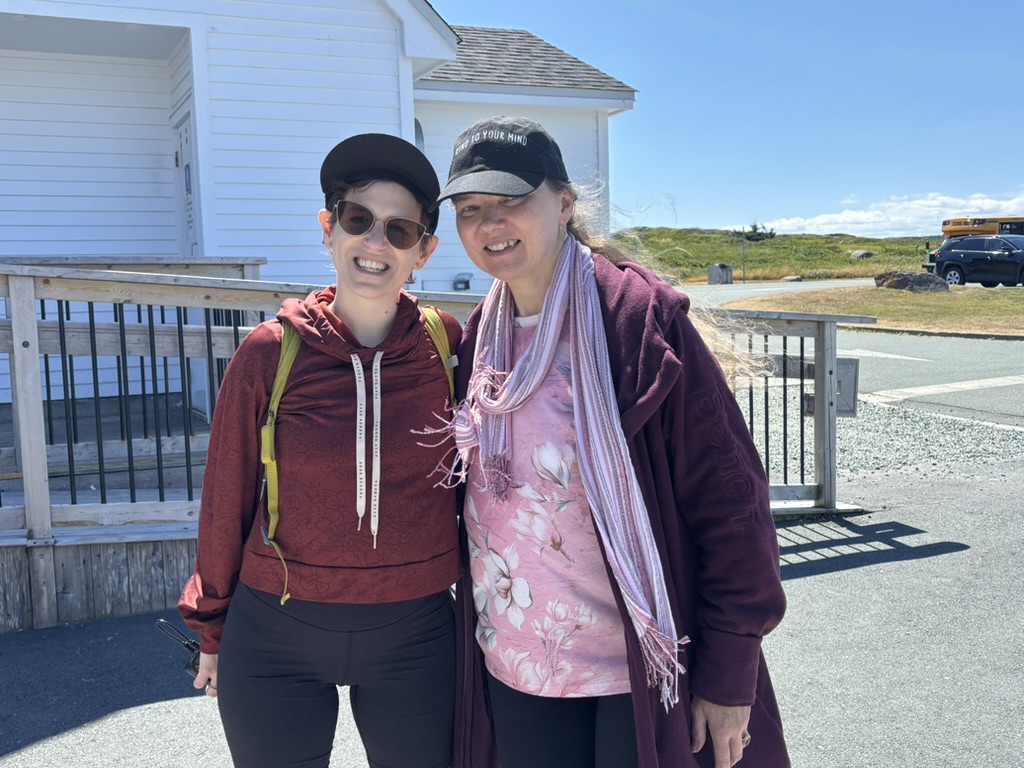
Coralie Mercerat, a professor at the University of Montréal and one of the project’s co-researchers, says input like Woodfine’s is vital because it helps the researchers think about the accessibility needs of parents. She gives the example of a couple, where one parent needs the Hippocampe, visiting Cape Spear with their four-year-old. “It could be really difficult to [be] pushing the wheelchair and then taking care of infants.”
Woodfine says research that helps make sites more accessible to parents is essential because disabilities and neurological differences affect each person in unique ways. Creating truly inclusive spaces takes time, care, and thoughtful effort to understand what changes are needed so that everyone has the opportunity to enjoy the site in a meaningful and equitable way. “The positive thing is that we’re still building.”
Correction: A previous version of this story stated all Parks Canada sites in the province have undergone accessibility audits. In fact, only certain sites have been audited, including Cape Spear Lighthouse, Signal Hill, Castle Hill, Ryan Premises, and Hawthorne Cottage national historic sites, as well as Terra Nova National Park.

Author

Related Articles
PCs under fire for ‘disappointing’ treatment of Black History Month
Celebrated Black community leader and anti-racism advocate target of racist comments after speaking out online
New play portrays barriers facing N.L. women in politics
Women won the right to vote a century ago but are still underrepresented in public office. St. John’s playwright Ruth Lawrence’s play tackles that head on.
Meaningful response to homelessness requires more than new builds, says NDP leader
Jim Dinn’s comments come in response to PC’s announcement of 10 new ‘micro homes’ in St. John’s