
FFAW St. John’s cod giveaway rallies support for federal petition
Fisheries union wants Ottawa to reverse DFO’s decision to reopen Northern cod to offshore trawlers
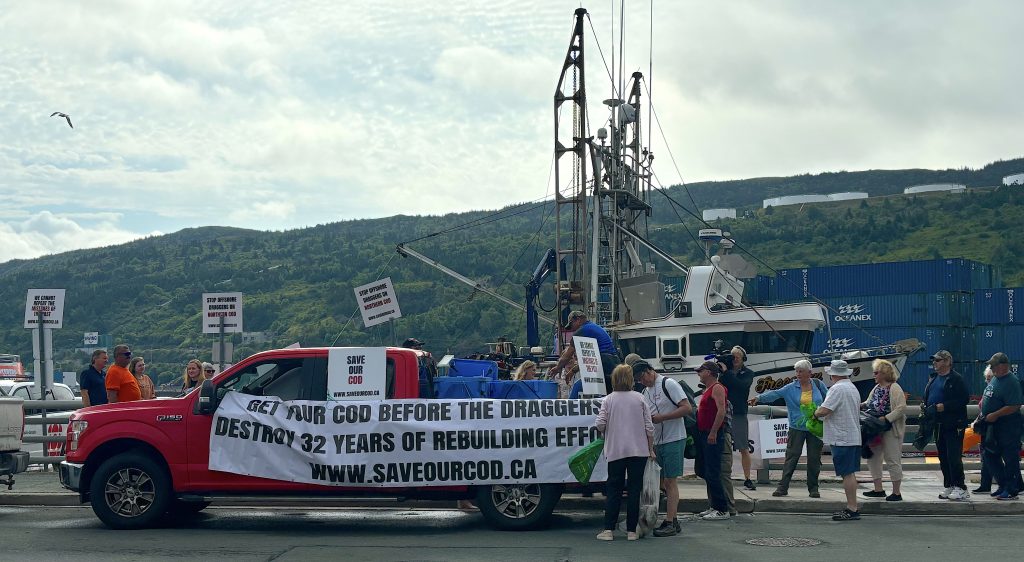
People stood in line along the St. John’s harbourfront, many of them holding containers and reusable bags too small for the catch they were about to be gifted.
Others pushed strollers, or lined up with their dogs, patiently waiting to get their hands on the fish that came to define the province.
More than three decades after the 1992 moratorium, Northern cod is in the news again. Last month the federal government lifted the moratorium and opened the commercial fishery to domestic and international fish harvesters.
That’s why the province’s biggest fishery union, the Fish, Food, and Allied Workers (FFAW), organized Wednesday’s free codfish giveaway — to rally support and protest
Will you stand with us?
Your support is essential to making journalism like this possible.
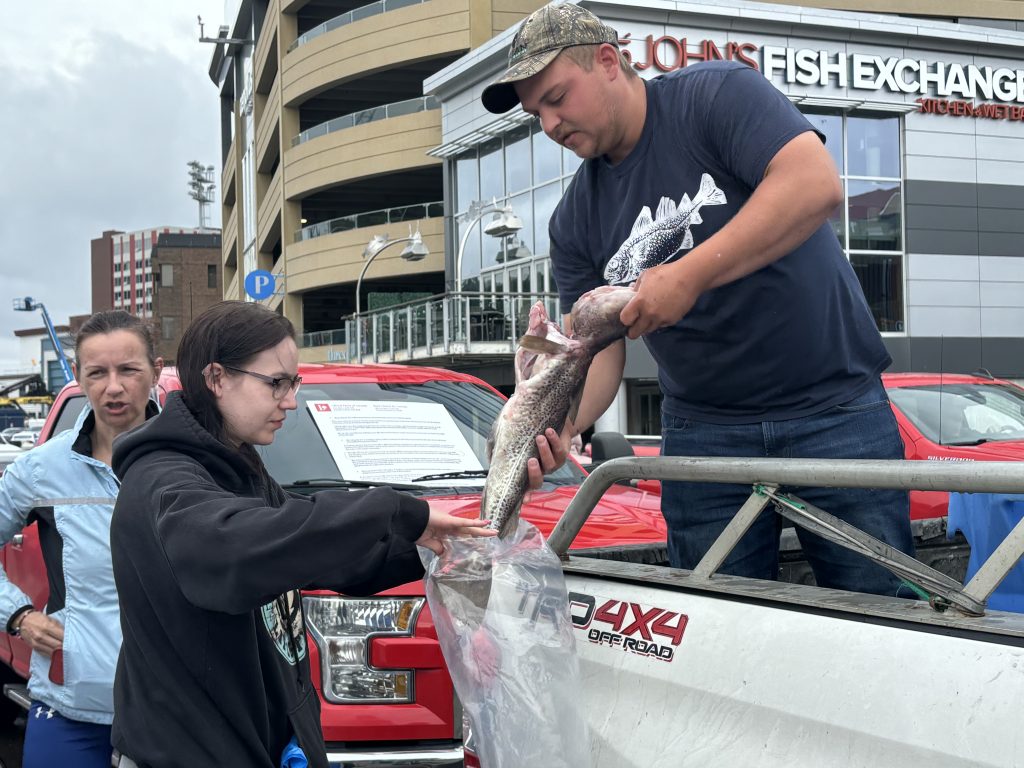
Christopher Pickard of St. John’s brought a small container but returned home with the empty container in one hand and a larger plastic bag containing a sizable fish in the other.
“The fear and worry of the overfishing coming yet again, the fact that local fishermen […] and so many people that I know definitely want to go out and catch a fish,” he said, pointing to the contradictions inherent in fishing Northern cod just months after Fisheries and Oceans Canada (DFO) reported the stock had moved out of the critical zone and into the cautious zone.
Despite the limited progress, all Atlantic cod stocks remain historically low and there are no guarantees of recovery. That’s why many oppose the federal government’s decision to reopen Northern cod to commercial fishing.
On June 26, DFO announced “the historic return of the commercial Northern cod fishery in Newfoundland and Labrador,” which amounted to a 6,000-tonne increase to last year’s approximately 12,000-tonne total allowable catch for the stewardship fishery.
Since 2006, DFO has permitted commercial fishing of Northern cod in Newfoundland and Labrador, but those quotas have been dedicated to inshore harvesters at a fraction of the historical numbers.
While some have argued against any increases to existing quotas — which exclude the recreational food fishery — the FFAW has two primary concerns.
First, that the federal government didn’t hold to its 42-year-old commitment to allocate the first 115,000 tonnes of cod to inshore harvesters if and when the commercial fishery reopened. The FFAW says the Trudeau government reaffirmed that commitment to the union in 2015.
Second, replacing the stewardship fishery with a commercial fishery opens Northern cod to Canadian and international offshore trawlers. Even though the offshore quota represents just six per cent of the total allowable catch of roughly 18,000 tonnes of fish, the FFAW says the stock can’t withstand any offshore trawling.
On Wednesday union representatives handed out pamphlets and talked to people in the lineup. One member shouted reminders to sign the FFAW’s new Save Our Cod petition, which asks the federal government to reverse its decision to reopen the fishery.
“Any allocation to offshore and international fleets is in clear violation of the 42-year federal commitment to inshore harvesters and their coastal communities,” the petition reads. “The Northern cod stock just entered the Cautious Zone and cannot withstand the fishing pressure of offshore draggers that fish unsustainably and during periods of pre-spawning aggregations while it continues to rebuild.”
The union also launched a new website, saveourcod.ca, to bring awareness to the issue. “Inshore fishing boats use less environmentally damaging techniques to harvest fish, such as handlines, longlines, and gillnets,” the website reads. “The offshore fleets, fishing in vessels greater than 100 ft and using bottom trawlers, targeted the last remaining aggregations of overwintering, pre-spawning, and spawning cod prior to the collapse.
“Because the offshore concentrated on these fish aggregations, their catch rates were the last to drop during the infamous northern cod collapse. These giant corporate vessels continued fishing long-after the inshore fleets saw drastic declines in catch rates and sounded the alarm on the state of the stock,” it continues.
“It is too risky to allow this type of fishery when the stock has just entered the cautious zone.”

Miranda Butler, an inshore staff representative for the FFAW, said the free cod event was intended to inform Newfoundlanders and Labradorians about the Liberal government’s decision and to gain support from the community.
“It’s actually been going over very well, and we’ve had a lot of support so far,” she said.
Pickard said he occasionally jigs cod with friends and is concerned about the Northern cod. “They are allowing trawlers from outside to come in and do what basically decimated the fishery years ago,” he said.
Passing cars honked in support of the fishers and in under an hour the bright blue containers in FFAW’s two trucks were 2,000 pounds lighter. By then the line had dwindled and a few people left empty-handed.

On July 10, union leadership met with DFO Deputy Minister Annette Gibbons to state its case. But the union said in a statement the following day it was “dismayed by Gibbons’ dismissal of the issue,” and that union representatives walked out of the meeting.
FFAW President Greg Pretty said the union presented the feds with a 1,300-page document laying out the government’s commitment to inshore harvesters.
“The amount of evidence is absolutely staggering at this point, and the fact that these elected representatives and bureaucrats can sit there, look us in the eye, and tell us that they have made the right decision for our province – it’s absolutely sickening,” he said on July 11.
“The evidence is overwhelmingly in our favour, and we have the public’s support to keep draggers out of our Northern cod fishery. We will not let this go, and we will hold our federal government, as well as all of our Newfoundland and Labrador MPs, to account,” Pretty said.

Authors


Related Articles
Access to information: N.L. failed to make public over 1,000 responses in a single year
Province says it’s dealing with an increase in requests, but NDP leader is concerned the mounting problems may be intentional
Memorial University student union walks back plan to close radio station amid backlash
‘I wish CHMR the best,’ Memorial University Students’ Union executive says ahead of vote to defund the campus radio station
INTERVIEW: Avi Lewis says N.L. is ‘ground zero’ for the biggest challenges facing Canadians
The federal NDP candidate says socialism and economic populism are the antidote to unfettered capitalism and the ‘epic market failures’ it has brought