
Fiona survivor contributes to climate exhibit in New York as world leaders descend on United Nations
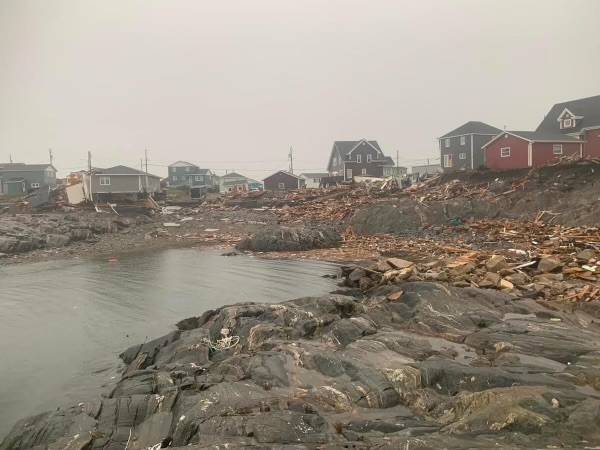
The 2022 post-tropical storm did more than destroy houses in Channel-Port aux Basques. It provided a stark reminder of how bad the effects of human-caused climate change are getting at home.

As waves crashed into his fishing stage and shook the building furiously, Mark Lomond could do nothing but watch in horror from his home in the Codroy Valley via a webcam he installed.
When the camera stopped working, he called his friend in Channel-Port aux Basques to ask whether hurricane Fiona had caused a blackout.
“Buddy, there’s homes floating in the cove now,” Lomond recalls his friend saying.
The fishing stage where Lomond spent many days and nights with his friends and neighbours was also swept to sea.
Will you stand with us?
Your support is essential to making journalism like this possible.
Today, exactly two years after Fiona devastated Channel-Port aux Basques, the red life preserver that once hung proudly on his fishing stage is being showcased in New York City as part of a pop-up exhibit by Sierra Club Canada highlighting the costs of climate change.
As world leaders travel to Manhattan for the United Nations’ General Assembly, Conor Curtis, a Newfoundlander and head of communications for Sierra Club, hopes Prime Minister Justin Trudeau and other Canadian political leaders will visit the exhibition and finally put a firm cap on oil and gas corporations.
In December, the federal government proposed regulations to cap emissions from the oil and gas sector, but Curtis says oil and gas lobbying, in part, has delayed the implementation of the regulations.
“Individual Canadians have actually done a really good job of lowering emissions. Other sectors have actually done a really good job of lowering emissions,” he says. “But these extremely wealthy oil and gas corporations have not even kept up with their own promises on emissions reductions.”
The oil and gas sector is Canada’s highest emitter of greenhouse gases, accounting for nearly a third of all emissions in 2022, a slight increase from the previous year.
Continued support for oil as province falls behind net-zero goals
While the Government of Newfoundland and Labrador has committed to achieving net-zero emissions by 2050, the province has also failed to meet its 2020 greenhouse gas emissions reduction target of 10 per cent below 1990 levels, and in December 2021 stated that “in the absence of additional actions in the coming years, the 2030 target may not be achieved.” The province’s 2030 goal is to reduce emissions by 30 per cent below 2005 levels.
Meanwhile, the current Liberal administration has vowed to double offshore oil production. The 2023 provincial budget included more than $60 million in subsidies for the offshore oil industry, $50 million to encourage further exploration and $13 million for seismic work.
Meanwhile, on Sept. 19 Progressive Conservative leader Tony Wakeham reaffirmed his “unwavering support” for the province’s oil and gas industry after visiting the West White Rose Project site in Argentia.
In June, Furey told industry leaders at the annual Energy N.L. conference in St. John’s that the province “will be all in on oil and gas for decades and decades to come — not because it’s what we need, but it’s what the world needs us to be right now.”
The International Energy Agency predicts global oil demand will peak in the next five years and decline as countries continue to invest in clean energy to reach global 2050 net-zero emission targets.
Experts say continued support for the oil and gas industry not only undermines the province’s efforts to curb greenhouse gas emissions, but also sets the stage for economic disaster as companies, governments and individuals with investments in long-term projects could be left with stranded assets.
Climate is impacting life in Labrador
Warming oceans are contributing to extreme weather events, and they’re forcing many communities to change their lifestyles.
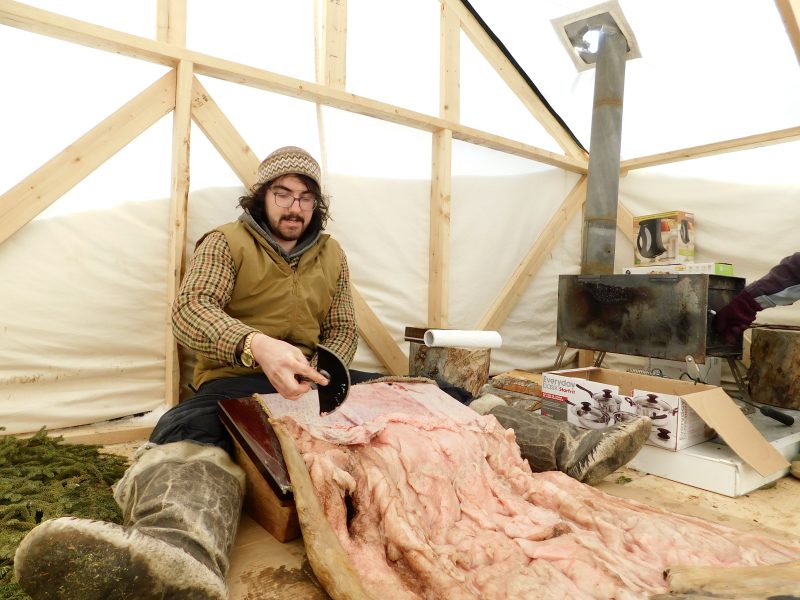
For generations, sea ice has defined the culture, transportation, and well-being of Inuit communities in Labrador, for instance, but rapid environmental change is leading to a host of problems. Accessing food is becoming increasingly difficult as Inuit are forced to confront unpredictable ice, while marine animals are facing their own threats due to climate change. The disruption to Inuit ways of life and identity are also leading to mental health impacts.
In recent years, Labrador has also seen more extreme wildfires which have caused air pollution, damaged infrastructure, and forced communities into emergency evacuations.

Climate survivors hope to spread awareness
Curtis says the artifacts at the pop-up exhibit were salvaged from wildfires, floods and hurricanes by climate survivors who will also be at the event to share their stories.
The exhibit, Project What We Love, is taking place today in New York. Sierra Club Canada also arranged for projections in Manhattan that it hopes will further pressure the Canadian government to enforce an immediate cap on oil and gas.
Lomond hopes attendees and viewers watching the events online will feel the urgency of curbing climate change and work to minimize the devastating impacts of disasters like Fiona. “It’s quite obvious to anyone living along the shoreline that the storms are getting more frequent and more intense,” he said.
The insurance costs associated with post-tropical storm Fiona were in the range of $800 million, making it one of the costliest extreme weather events in Canadian history.
The storm claimed the life of 73-year-old Thelma Leamon, who was swept to sea. More than 80 homes were destroyed, either washed away or later demolished because Fiona left them uninhabitable. Lomond’s relatives lost five homes, he says.
The disaster also displaced people who knew and supported one another for years. “Everyone was a neighbour down there for so long,” Lomond says. “So you’ve seen everybody a lot, and the community down there got, you know, split up. Everybody had to move.”
Correction: A previous version of this story stated that the province failed to meet greenhouse gas reduction targets for 2019 and 2024. The text has been corrected to reflect the actual target dates of 2020 and 2030. We have also included the actual targets. The incorrect information was added to the story during the editing process and we regret the error.

Author

Related Articles

INTERVIEW: Avi Lewis says N.L. is ‘ground zero’ for the biggest challenges facing Canadians
The federal NDP candidate says socialism and economic populism are the antidote to unfettered capitalism and the ‘epic market failures’ it has brought

LISTEN: Justin Brake talks Amber Bracken case & press freedom on CBC Radio’s ‘The Signal’ (with TRANSCRIPT)
An hour-long conversation led by CBC Radio host Adam Walsh, feat. Justin Brake, Geoff Budden, Karyn Pugliese, Brent Jolly and Ethan Cox
Cultural centre in Nunatsiavut is helping Inuit reconnect with culture and language
After winning the Arctic Inspiration Prize in 2024, Inotsiavik is offering Inuit in Labrador outdoor cultural programming, Inuttitut lessons, virtual programs, and more