

Photos by Tania Heath
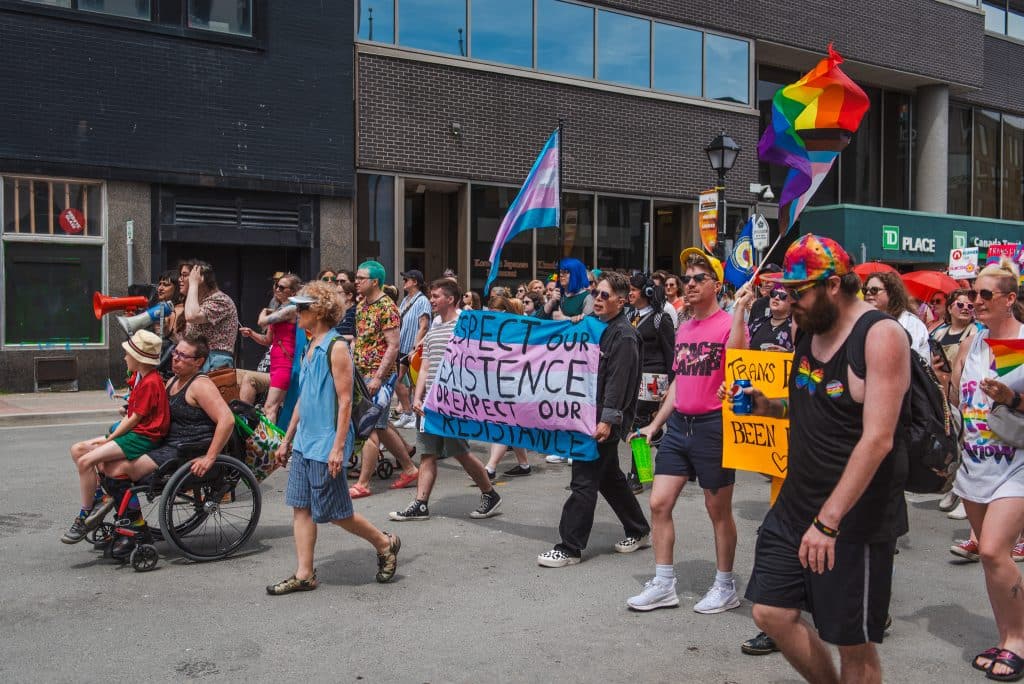
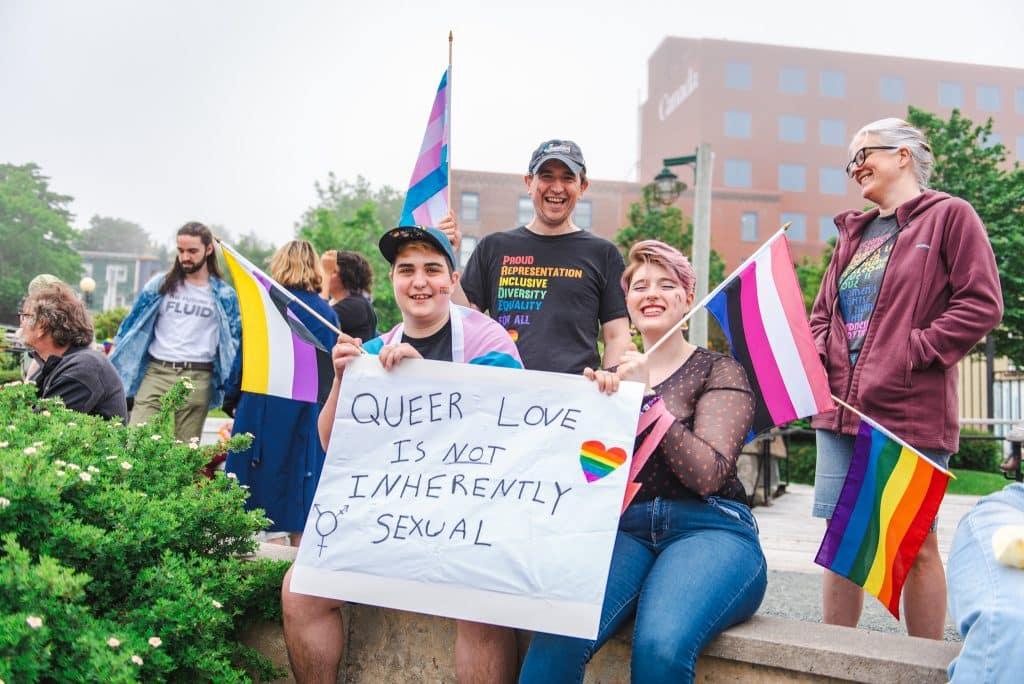
About 200 people gathered in St. John’s Sunday for the ninth annual Trans Pride March.
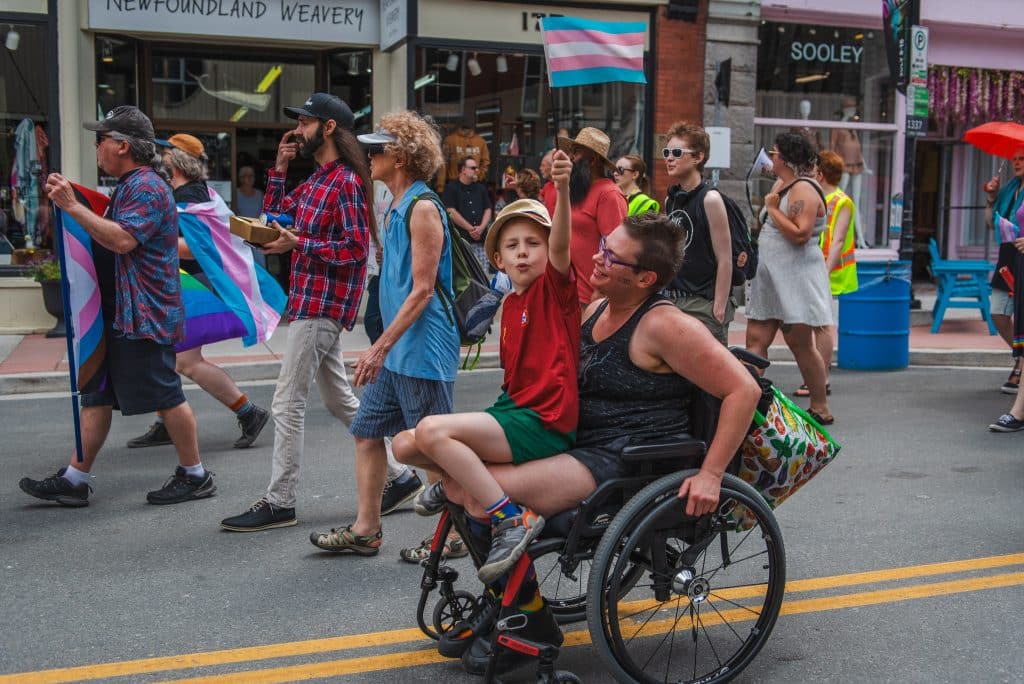
From Harbourside Park, the loud, colourful procession wove its way down Water Street and through the Downtown Pedestrian Mall before returning to the park. Chants addressed many of the priorities facing the trans community, such as a lack of access to gender-affirming health care and a rise in transphobic violence. Passing cars honked in support and pedestrians raised fists and cheered as the marchers passed by.
The event wasn’t all celebratory, though. At a rally preceding the march community members shared their frustrations with a lack of health care supports and protections for the trans and non-binary community.
“Recently transphobia has spread into all aspects of my life,” said Kaiden Dalley, one of the speakers. Dalley detailed a phone call they received at their workplace asking if their store sells Pride merchandise. When they responded affirmatively, the caller called Dalley and their coworkers “a bunch of groomers” before slamming down the phone.
Will you stand with us?
Your support is essential to making journalism like this possible.
“This is a normal thing,” Dalley said. “It’s actually not as vulgar as some of the other stuff that I’ve experienced at work alone. This is stuff we really need to talk about and say this is not okay, and I’m really tired of it.”
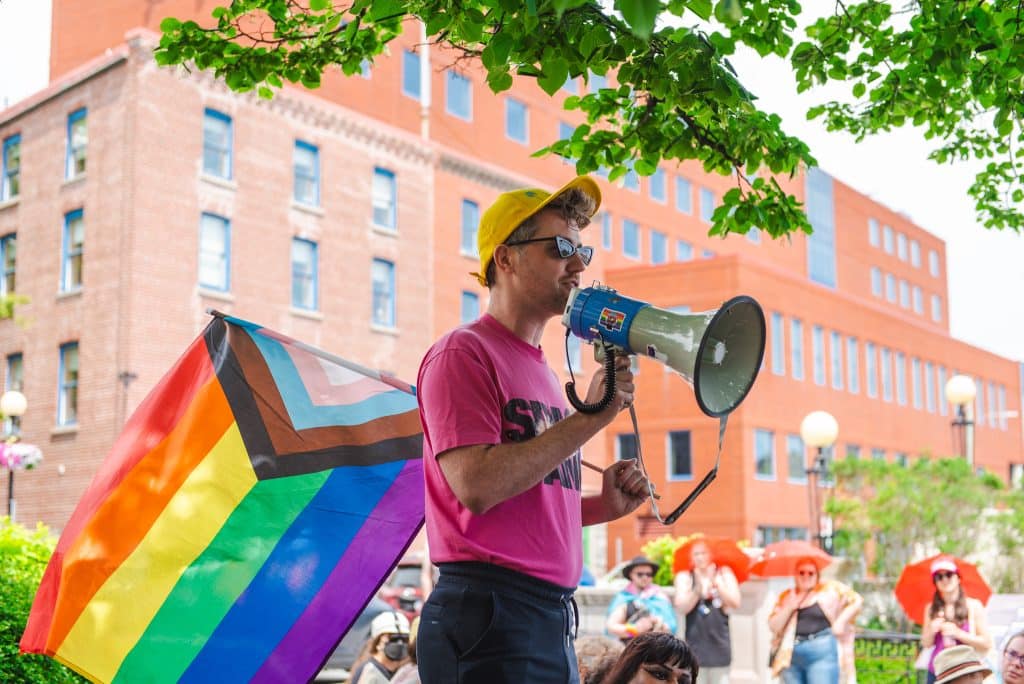
Melissandra Groza attested to the impact of recent transphobic violence in St. John’s. “There was a time where I felt comfort, I felt solace, to finally be free to be myself. I found that peace and I finally came out of the closet after losing 20 years of my life — 20 years,” she said. “I lost my childhood. I lost my teenage years. I lost them all [and] I didn’t get to enjoy the life I was supposed to. After I came out I promised myself that I would get back those lost years and live my life again.
“But now we’re feeling the fire of transphobia again, and I’m ashamed to say that I no longer feel safe in Newfoundland,” she continued. “I’m back in survival mode. I’m back in constant fear of getting hurt.”
Another speaker, A. Powell, said they came out in their mid-40s because they “never felt safe enough” to do it sooner. “And I still don’t feel particularly safe,” they said, explaining 2023 marked their first trans march. “I’m still very socially anxious but that alone shows how important it is that we have these—that people feel that it is not only safe but that it’s something to be celebrated. The fact that other people are doing it is really helpful and makes me feel that I can get there someday.”
Community allies, organizations turn out in support
Many supporters joined the event, too.
“The labour movement can play an important role in protecting and preserving rights and building on rights for trans workers,” Newfoundland and Labrador Federation of Labour President Jessica McCormick told The Independent. McCormick said trans workers’ rights can be built into collective bargaining, workplace training, and also by “using our collective power to educate and build collective support and allyship in the community.
“That’s why we’re here today and we’ll be here going forward for every event that happens in the community so that we can support our trans siblings both in the labour movement and outside the labour movement.”
Activist, educator, and former provincial Liberal candidate Hasan Hai said he felt it was important to “just show up” for the event. “I have the ability to walk generally unaccosted down the streets and there are a lot of communities including the trans community who cannot,” he told The Independent. “So I’m here to show love, show support, show solidarity. The trans community is a beautiful part of our community and I want to do every little bit I can by being here and showing solidarity and making people feel a little bit safer.”
Jawad Chowdhury is campaigns director with the Memorial University Students’ Union, which led a large contingent of student activists to the march. “We are seeing increased transphobia around campus,” he told The Independent. “Our trans student population needs to be protected, they need to be okay wherever they go — be it their classrooms, be it the streets. MUNSU sees visibility as a huge step towards equity and acceptance and love, so this is why we’re here. We’ve always supported the Trans March and trans visibility on campus and outside of campus and we think that it’s extremely important that society accepts it in a similar way.”
Services, supports for trans residents lacking in NL
Census data collected by Statistics Canada for 2021 revealed Newfoundland and Labrador to be one of the most gender-diverse provinces in the country, ranking fourth among respondents between 15-34. The province has the second-highest proportion of transgender women aged 15-34 in the country, and the third-highest proportion of transgender men in the same age group. St. John’s came in as the tenth most gender diverse urban centre in Canada proportionally, outranking cities like Toronto and Vancouver.
Yet services and supports for trans residents have been sorely lacking, say community advocates. Few gender-affirming surgeries are available in the province, forcing residents to fly out-of-province for treatment. The Medical Transportation Assistance Program is a cost-share program that covers 50 per cent of travel costs, leaving patients to pay the remainder out of pocket. While MCP overhauled its gender-affirming surgery policy in 2019, the range of surgeries covered falls short of what’s available in other provinces.
Transmasculine top surgery patients are left with thousands of dollars in surgery expenses for essential components of the procedure that aren’t covered by MCP. Top surgery for transfeminine patients was added to MCP under the 2019 policy, but included unusual restrictions not seen in other provinces which have resulted in patients being unable to qualify for it. Earlier this year the province amended the policy to reduce the timeline for eligibility, bringing Newfoundland and Labrador in line with other jurisdictions. However, the unusual requirement for breast aplasia (zero breast growth) on hormones renders the province an outlier. According to local trans health care expert Dr. Mari Lynne Sinnott, this requirement renders the policy “functionally inaccessible.”
Meanwhile, treatment and support options for transgender patients in Newfoundland and Labrador have become steadily worse. Local medical professionals have been frustrated by the fact many doctors in the province won’t treat trans patients and instead refer them to a small and shrinking number of trans health care specialists here. Those experts point out that most trans health care can be handled by any physician, yet local practitioners have been reluctant to take it on. Hormone therapy for trans patients is simple to prescribe and monitor, they say, yet many local physicians haven’t taken the simple steps to educate themselves in the area. The departure of one key trans health care physician from the capital earlier this year left a serious backlog of current and new patients for the remaining local experts.
In 2022 Dr. Sinnott and a team of local physicians, sexologists, public health experts and local support organizations submitted a proposal to the Department of Health for a Transgender Health Care Centre of Excellence and Primary Care for the province. The proposal would see the centre affiliated with Memorial’s medical school and provide ongoing training for clinicians and research in the field, as well as expand treatment for patients, through an interdisciplinary and collaborative team care approach. The goal is to help alleviate the trans health care crisis in the province and facilitate the training and recruitment of physicians to the province to help expand supports. There has not yet been a response from government beyond acknowledging receipt of the proposal.
Meanwhile, trans health care experts elsewhere in the country have also emphasized the urgent need for a gender-affirming care hub in Atlantic Canada. Currently, most gender-affirming surgical services for Atlantic Canadians are provided out of Montreal, with additional surgical hubs emerging in recent years in Ontario and British Columbia.
Providing surgical services closer to home would greatly reduce costs on the provincial government, and Halifax and St. John’s have been identified by experts as the two most likely candidates for a regional gender-affirming care hub.
Transphobic, homophobic violence a growing problem
Many of the speakers at the rally took aim at a small but vocal cohort of far-right organizers who have been targeting trans and queer Newfoundlanders and Labradorians in online attacks as well as in-person actions.
According to far-right news outlet Epoch Times, last week former Peoples Party of Canada candidate Dana Metcalfe (who previously organized anti-vaccine rallies) organized a “‘surprise’ convoy with smoke flares, flags, and megaphones” outside Premier Andrew Furey’s home.
Speakers at the Trans Pride rally emphasized that extremists are a small group but have become increasingly vocal and confrontational in recent months.
A “No Space For Hate” rally was held at Harbourside Park on July 9, coinciding with an anti-2SLGBTQIA+ protest by far-right organizers that had been scheduled for the same time and place. The far-right protest was subsequently rescheduled for St. John’s City Hall on the same day and time.
An estimated 200 people attended the event at Harbourside, including representatives of local labour and students’ unions. The event featured several drag performances as well as poetry and spoken word recitals. About 30 people attended the far-right protest at city hall. Several dozen counter-protestors also gathered at city hall, and chanted “No space for hate” in an effort to drown out the far-right activists, who left shortly after the counter-protestors’ arrival. The counter-protestors then took over the city hall steps and waved pride flags and placards to the supportive honking of passing vehicles.
The recent rise in transphobia culminated in online vitriol directed at St. Matthews School in St. John’s, after a video was shared online showing their Pride festivities, which included a dance party, rainbow decorations and a drag performance.
“There have been some crazy people out there weaponizing drag to attack trans people and to try to strip rights from trans people by saying […] drag queens are attacking children or whatever,” Jason Wells, known to many as celebrity drag queen Irma Gerd who appeared on Canada’s Drag Race in 2022, told the crowd at Harbourside Park Sunday. “But we’re not the ones who are giving children signs that say ‘indoctrinate’. That’s not us, that’s them. It’s so important that we march together, and tell people who have bigoted ideals that they’re not welcome here.”
The rise in hate hits hard for Jude Benoit, who says it brings back difficult reminders of their own childhood. They’re particularly concerned when they see far-right organizers bringing children to anti-2SLGBTQIA protests or refusing to let them participate in school-based educational initiatives.
“I grew up in a Christian home and went to a really religious school in a religious community,” Benoit said, adding they were about 11 years old when same-sex marriage was legalized and remember being brought to participate in protests against it.
“So my heart really goes out to their kids that they drag into this. I feel like they need to know that their kids are going to grow up to be whoever they are—as will anybody’s kids—and there is nothing they can do to stop it,” they added. “But they’re going to cause traumatic harm along the way.”
Benoit said they are aware of more harm and suicides of known trans people in the past year than in previous years. “Honestly, it’s heartbreaking.”

Trans Pride March growing with each year
The local Trans Pride March originated in 2013, when members of the trans community sought to have their own constituency within the St. John’s Pride Parade. Organizers said they received push-back from the St. John’s Pride organizers at the time.
“People were worried about us being divisive, they said fighting for trans health care and fighting for our rights didn’t belong in the parade because the parade was a celebration,” said Benoit, who got involved that year.
“So we decided the next year to do a separate one, for our own safety.”
Unlike the Pride Parade, the Trans March doesn’t apply for event permits from the City of St. John’s. Benoit said they made that decision in the beginning because they were told by city officials that road closures would require police presence, something organizers did not want.
“Some of us were experiencing things like homelessness and drug addiction and things that made us aware that people didn’t feel safe with cops being present,” they said. “Being Indigenous in particular, we thought it was important not to apply for these special event permits. We were told that in order for them to shut down any part of the street that they would have to have cops there, and not just traffic control but actual armed officers.”
They had about a dozen trans marchers during the 2013 Pride Parade, and about 50 during their first stand-alone march the next year, said Benoit. The march remains a community-organized event put together by different community volunteers every year, and attendance has grown steadily.

“In the beginning we were fighting for trans health care,” Benoit said. “That included everything from access to mental health services—which our community badly needs because we had a really high suicide rate—and we also needed gender-affirming care.
“We just wanted help and we were young and angry. I still carry that energy with me because I don’t feel like we’re there yet.”

Author

Related Articles

Accounting watchdog to investigate Deloitte over fake citations in $1.6M healthcare report
Chartered Professional Accountants N.L. is leading the investigation after Deloitte admitted AI was involved
St. John’s teen says community, activism helped her find her voice
13-year-old Nyala Adam was inspired by a local summer camp focused on social justice and cultural inclusion
PC’s minimum wage increase ‘far from a living wage,’ says NDP leader
NDP Leader Jim Dinn is calling on the PCs to legislate wage increases