
Labrador students vote in parallel federal election
Grades 4-12 students studied the Labrador candidates before casting their votes

While people across the province were electing Canada’s next government on Monday, students in eight Labrador schools and a host of others on the island were doing the same as part of an effort to learn about the federal electoral system.
The students were participating in Student Vote, a program run by the registered charity CIVIX Canada in partnership with Elections Canada, which empowers students to hold their own parallel votes during provincial and federal elections so they can learn about the process.
“It was kind of fun, kind of easy,” Hopedale Grade 7 student Jonathan Nochasak said of the process. Nochasak said he had the easiest job of checking the ballots, but that it was also boring waiting for students to come by.
Principal Nicole Mclean held the vote at Amos Comenius Memorial School with her Grade 7 homeroom students. Sixty-one students between grades 4 and 12 at the Hopedale school reviewed the platforms of Labrador’s three federal candidates, and each student then decided who to vote for.
Will you stand with us?
Your support is essential to making journalism like this possible.
Brooke Igloliorte was the information officer and scrutineer candidate representative who brought the different classrooms to the polling station when it was their turn to vote. Joel Kalleo and Sam Winters were at the table with the list of names and the ballots. Francis Dyson signed off on the ballots as supervisor. Students then went behind privacy screens to vote. Eden Gear was a co-deputy returning officer with Nochasak. The class counted the votes multiple times to ensure the numbers were accurate.
Liberal candidate Philip Earle won the school vote with 64 per cent of students voting for him, while Conservative candidate Ella Wallace came in second with 19 per cent of the vote, and NDP Marius Normore placed third with 17 per cent.

Addisyn Lane, the school’s information officer, said she hopes they do it again, “because it was fun and I thought it was easy.”
“It was fun, but kind of boring,” Gear said about being a returning officer. “I liked counting how many people voted in the school.”
“I think they should do it again so people can practice how to vote when they’re 18,” Gear said.
Mclean has been holding student votes for a number of years and said it’s really important to prepare the students for what they will experience in their future.
“I really wanted them to get as close as possible to the experience and be involved in those conversations with their families and their community,” Mclean said. “It asked a lot of really good questions and allows our students to start finding their voices in Canada.”
It also allows the students the time to dig into the platforms and promises of the different parties and see how the platforms and promises change over the years, and how the student preferences change in the years to come, Mclean said.
Mclean said students were also watching the candidates on the campaign trail. She said they noticed when candidates didn’t travel to Hopedale in person, and when candidates refused interviews with different media organizations.
“They’re noticing what matters to them. I think that’s really important.”
Of the roughly 250 schools in Newfoundland and Labrador, 158 of them registered for Student Vote during the federal election, with more than 19,600 students participating, according to the CIVIX website. As of May 1, CIVIX was reporting that 914,540 valid votes were reported from 6,272 schools nationwide, with results from all 343 federal electoral districts. Canadian students elected a Conservative minority government, handing the Tories 36.4 per cent of the popular vote and 164 seats in Parliament. The Liberals won 31.8 per cent of the vote and 146 seats. Under the student vote, the Bloc Québécois won 18 seats, the NDP won 13 (which means, unlike in the actual election, they retain party status), and the Greens won two.
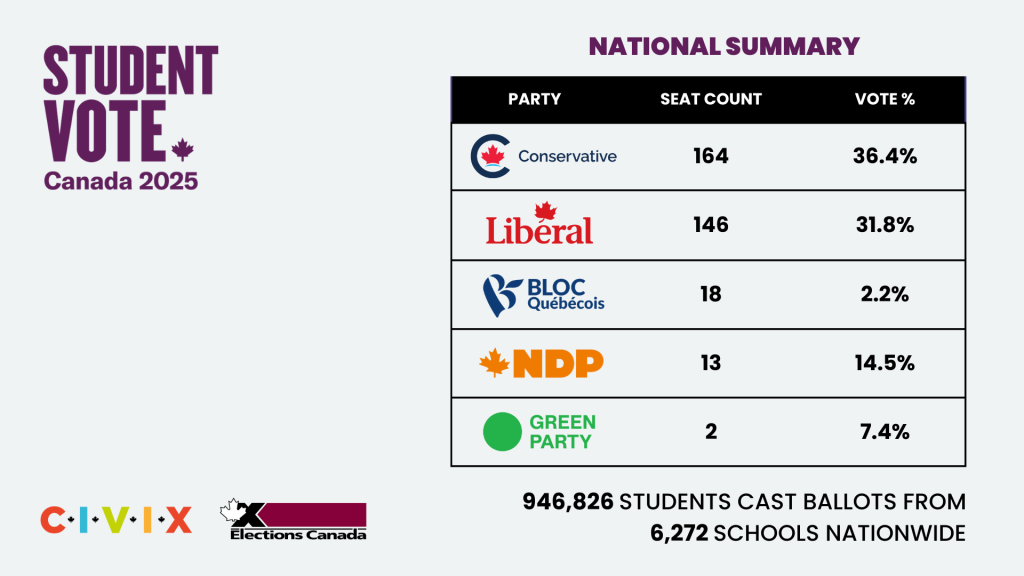
In Newfoundland and Labrador, the Liberals took four seats while the Conservatives won three — the difference being the Terra Nova–The Peninsulas riding, where Liberal candidate Anthony Germain squeaked by Conservative candidate Jonathan Rowe with 12 votes. In the student vote, Rowe won handily with 1,400 votes compared to Germain’s 890.
With a provincial election on the horizon for 2025, Mclean recommends all educators take a look at Student Votes and consider running the program in their own schools.
“I’m hoping for [students] that they get familiar with this process,” Mclean said. “And they’re going to walk in with confidence, so it’s not so scary, because sometimes the unknown is keeping people from doing things that they can absolutely do.”
The Independent’s federal election coverage is supported by the Covering Canada: Election 2025 Fund.

Author

Related Articles
The RCMP vs. the media: Bracken trial approaches its endgame
This court case could decide the future of press freedom — and police oversight — in Canada

Accounting watchdog to investigate Deloitte over fake citations in $1.6M healthcare report
Chartered Professional Accountants N.L. is leading the investigation after Deloitte admitted AI was involved
St. John’s teen says community, activism helped her find her voice
13-year-old Nyala Adam was inspired by a local summer camp focused on social justice and cultural inclusion