
Liberals Quietly Pitch Province as “World’s First Net-Zero Potential Energy Super Basin”
The scheme includes expanded fossil fuel development, carbon capture and storage, and a hydrogen pipeline in Labrador. But Grand Chief says not without Innu consent.

The provincial government has covertly embraced a new energy framework developed by a consultancy firm for the purpose of strategically extending fossil fuel production.
The Independent has obtained documents from the Department of Industry, Energy and Technology that reveal the Liberals are using a scheme developed by energy consultant Wood Mackenzie that puts oil and gas at the centre of the green transition necessary to avert the worst impacts of climate change.
The documents, obtained through an access to information request, show that department officials prepared materials for government delegates to the World Hydrogen Summit in the Netherlands last May.
“Energy Super Basins”
Will you stand with us?
Your support is essential to making journalism like this possible.
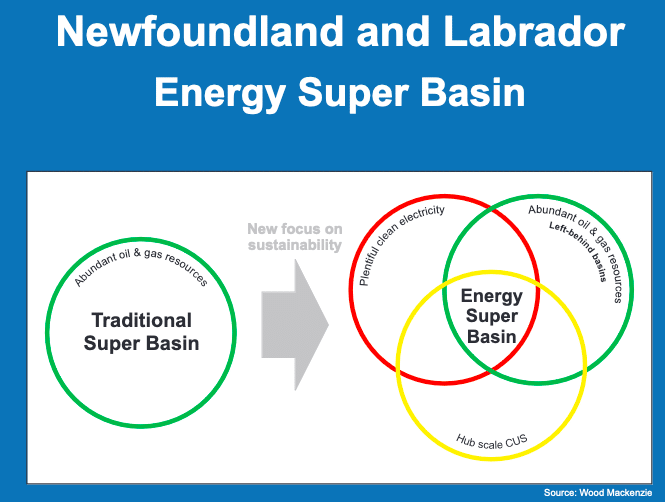
Those documents refer to Newfoundland and Labrador as the “World’s First Net-Zero Potential Energy Super Basin”. They suggest the province’s emerging hydrogen industry could facilitate the expansion of fossil fuel development, including offshore oil and liquefied natural gas.
On its website, Wood Mackenzie describes Energy Super Basins as regions with fossil fuel resources “that are co-located with both plentiful clean electricity and [carbon capture and storage] potential.” Amid climate breakdown, countries and industries worldwide are racing to lower carbon emissions in an effort to limit global warming to 1.5 C.
“[T]he world’s demand for much lower emissions is forcing change on this legacy industry. Some basins are fit for the future and some are not,” Wood Mackenzie’s website says. “The current geographic footprint of the oil and gas industry largely predates such concerns about sustainability and carbon, and it shows. Advantaged resources – low cost and low carbon – must become the future of oil and gas.

“Some traditional super basins will evolve into the energy super basins of the future. These will use renewables and [carbon] sequestration to improve sustainability. Making disadvantaged barrels advantaged is a huge opportunity and will be a key investment theme. But other traditional super basins will be harder to decarbonise and face being left behind.”
In an “Energy super basins map,” Wood Mackenzie does not list Newfoundland and Labrador or any part of Atlantic Canada as an “energy super basin” or a “potential energy super basin”.
An official with the Department of Industry, Energy and Technology said Minister Andrew Parsons was “not available” for an interview. But in a written statement the department stressed the government’s embrace of Wood Mackenzie’s framework and its representation of the province as a potential Energy Super Basin “is not an initiative that is being pitched to investors, nor is it a new policy from the Provincial Government.”
They’re not pitching, they are ‘signaling’, the department said.
“Identifying that Newfoundland and Labrador has many of the characteristics to be a future Energy Super Basin signals to investors – for both oil and gas and renewables – that NL is an attractive place to do business.”
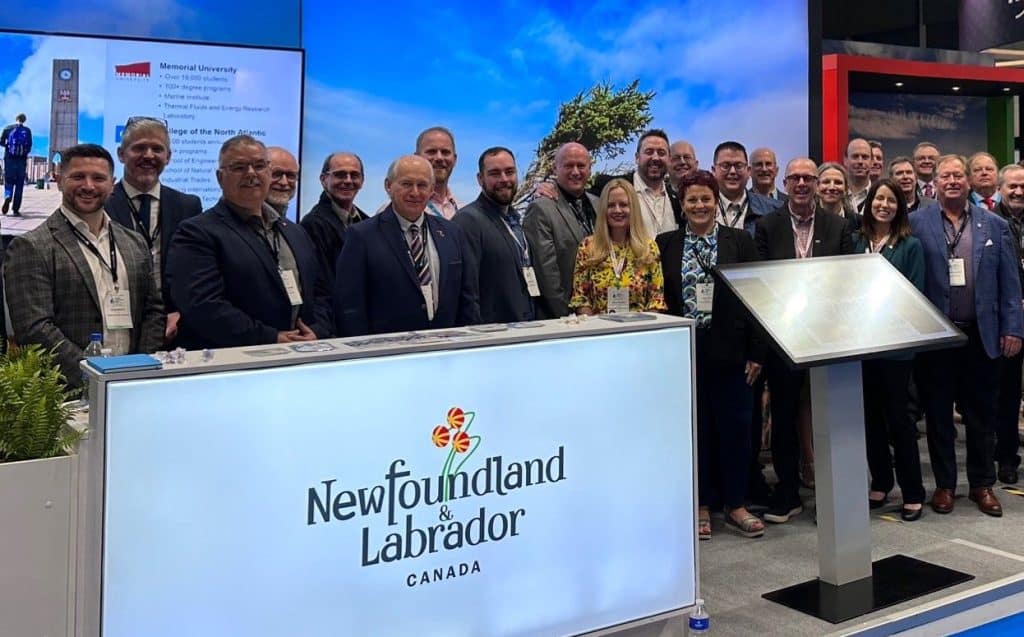
Opposition House Leader Barry Petten said options for the province’s energy sector “should be discussed in the House of Assembly,” not at industry conferences.
“Those issues should be brought to the people of the province,” he said. “And we’re the last ones to find out.”
NDP Energy Critic Jordan Brown is also concerned that the Liberals haven’t made the Energy Super Basin framework public. “It seems like they’re just trying to find who wants to invest money into what, without actually having a real strategy,” he said.
Brown said that following the private market’s lead will result in the province “losing control of our resources [and] opportunity.”
No pipeline without Innu consent, says Grand Chief
A handout prepared for the department’s marketing team also suggests the potential for hydrogen production at the Churchill Falls, Muskrat Falls, and proposed Gull Island hydroelectric dams, which the government suggests could be transported via pipeline to the island.
The proposed pipeline route appears to cross unceded Innu territory, though the handout—shared with industry representatives during the three-day summit—does not mention the Innu Nation’s outstanding land claim. Instead, it says the government “is committed to developing projects that consider the rights and perspectives of Indigenous government and organizations. It believes in the principle of early and meaningful engagement with Indigenous Governments and organizations as being essential in developing hydro projects.”
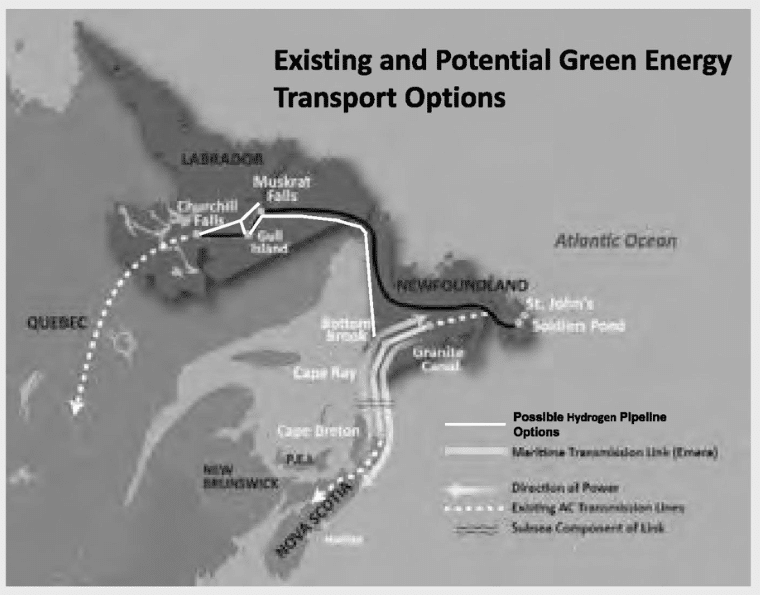
The Independent shared the handout with Innu leadership.
“Our Aboriginal rights are not merely to be considered, they must be honoured,” Innu Nation Grand Chief Simon Pokue responded in a written statement. “Any new hydroelectric, green hydrogen or wind energy development in Innu territory, including green hydrogen production plants, potential pipelines or transmission lines, will require the agreement of the Innu Nation.”
Documents also show that Parsons gave a presentation on the second day of the summit, during which he touted the province’s land mass. “We have a lot of Crown land,” his speaking notes read, “350,000 square kilometers to be exact.”
However, that number isn’t exact, the Department of Fisheries, Forestry and Agriculture confirmed.
“Historically, it has been estimated that approximately 85 per cent of land in Newfoundland and Labrador is Crown lands,” a spokesperson wrote. “The figure 350,000 km2 of Crown lands is a general estimate based on the entire geographic footprint of Newfoundland and Labrador, which is 405,720 km2.”
The Innu Nation’s 2011 land claim agreement-in-principle references tens of thousands of square kilometers of lands on which Innu will have various rights and degrees of authority once the land claim is finalized. Pokue says Innu Nation and the provincial and federal governments “are very close to finalizing the agreement,” and that “concluding our treaty has to come first.”
The treaty, he says, will “lead to creating a stable environment for major new developments that the Province and the Innu Nation can both support.”
Will NL oil and gas survive the transition?
The premise of building renewable energy industries that support fossil fuel development is flawed, says Conor Curtis, a Newfoundlander and head of communications for Sierra Club of Canada.
“If we are looking at a world that is transitioning from dependence on oil and gas to renewable energy […] you can’t continue to develop oil and gas in tandem with renewable energy. We’re past the point where that’s possible,” he said. “We know it doesn’t fit within the carbon budgets that we have.”
In its statement, the Department of Industry, Energy and Technology spokesperson said the province’s commitment to net zero by 2050 “includes responsible development of oil and gas as long as there remains a global need.”
But Curtis says counting on the fossil fuel industry’s survival through the transition isn’t “a realistic thing to bet on.”
“The whole point of diversifying the economy away from oil and gas is to provide people with options that aren’t oil and gas,” he says.
“If you build your renewable energy around the proposed continuation of oil and gas […] even if we don’t meet our climate targets I do not think that the provincial oil and gas industry in Newfoundland and Labrador will survive the transition that’s happening.
“You really want to be developing those renewable resources as the alternative, as the thing that people can make the transition to, not as the thing that props up the industry that’s going the way of the dinosaur.”

Author

Related Articles
The RCMP vs. the media: Bracken trial approaches its endgame
This court case could decide the future of press freedom — and police oversight — in Canada

Accounting watchdog to investigate Deloitte over fake citations in $1.6M healthcare report
Chartered Professional Accountants N.L. is leading the investigation after Deloitte admitted AI was involved

St. John’s teen says community, activism helped her find her voice
13-year-old Nyala Adam was inspired by a local summer camp focused on social justice and cultural inclusion