
Can N.L. have oil and gas, and climate targets too?
Finance minister says yes, but ATI requests show there’s no plan for how to do both — and reveal significant unpublished emissions estimates
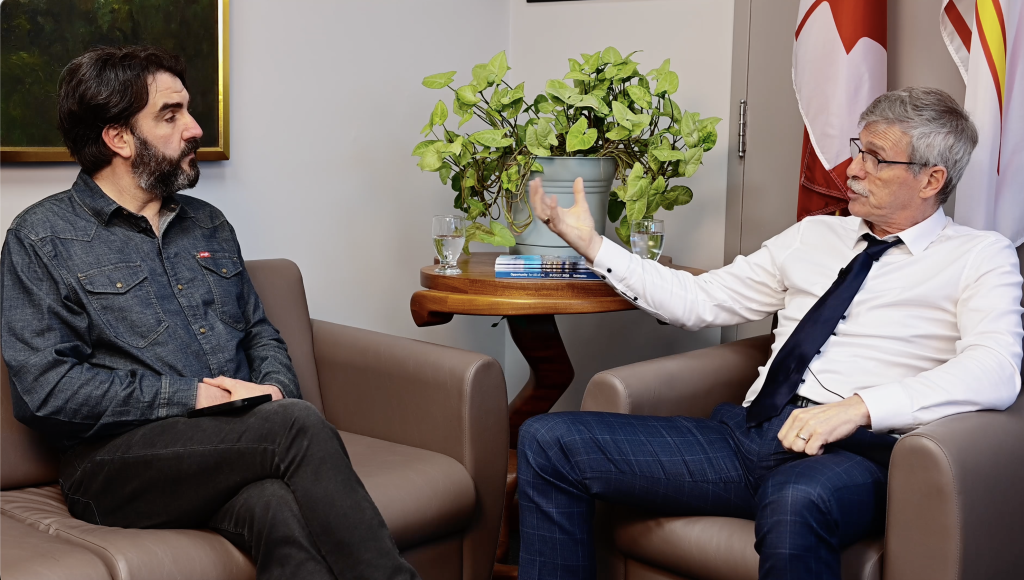
Newfoundland and Labrador is continuing on its path of extractivism without any evidence it will be able to meet its climate targets. But the province’s finance minister isn’t worried and says his government “can do both at the same time” — working toward a just transition while expanding fossil fuel production.
“Our entire belief has been that we can’t dismiss oil and gas because somebody is going to have to supply it for the transition,” Finance Minister Craig Pardy said in a May 7 sit-down interview with The Independent and Ricochet. “Our contention was, why not us in order to provide it for the transition?”
Successive Liberal and PC governments in Newfoundland and Labrador have justified ramping up fossil fuel production by arguing the province has “lower-carbon” oil than other jurisdictions, the revenues from which will fund its transition to a renewable energy economy. The problem is, no government has produced the numbers to prove the province can meet its climate targets while expanding fossil fuel production.
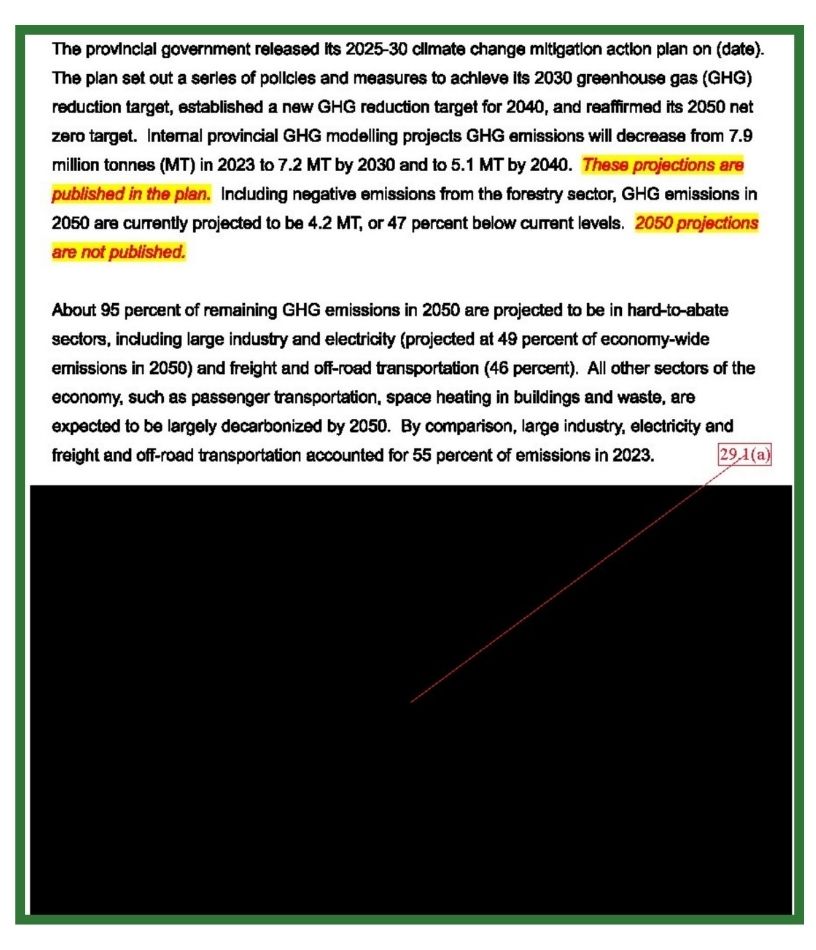
Newfoundland and Labrador has never released its greenhouse gas projections for 2050, the critical deadline by which Canada and countries around the world have committed to achieving net-zero emissions. However, an access to information request by The Independent and Ricochet for this story revealed that number to be 4.2 megatons.
Will you stand with us?
Your support is essential to making journalism like this possible.
Compared to other oil-producing provinces like Alberta, British Columbia and Saskatchewan, Newfoundland and Labrador’s emissions from fossil fuel extraction are relatively low. But on a per capita basis the province ranks high given its smaller population and the size of its offshore oil industry, which, along with the growing mining sector, accounted for upwards of one-third of Newfoundland and Labrador’s total emissions in 2023.
“We are dedicated to making sure we’ve got a plan going forward for that transition,” Pardy said, sitting in his Confederation Building office in St. John’s. His language marked a stark contrast from his pronouncement two weeks earlier, when he stood on the provincial legislature floor and announced in his first budget speech that Newfoundland and Labrador was “back in the oil and gas business,” while offering no vision or investments for a just transition.
Still, the Bonavista MHA assures Newfoundlanders and Labradorians it’s coming, and that it will include the development of the controversial Gull Island hydroelectric megaproject. “We’ll do it, and while it didn’t come out in the first budget, I would think that in the subsequent budgets we ought to see movement towards […] a good initiative.”
Excerpt of our interview with Newfoundland and Labrador Finance Minister Craig Pardy. Stay tuned to The Independent and Ricochet Media for the full interview!
Is N.L. pursuing ‘false solutions’?
On the same day Pardy delivered the budget, which projects 20 per cent of the province’s 2026 revenues will come from the four offshore oil projects currently in production, Angela Carter was on a plane home to St. John’s from Colombia.
A Memorial University professor, author of the book Fossilized: Environmental Policy in Canada’s Petro-Provinces and Canada Research Chair in Equitable Energy Governance and Public Policy, Carter was chosen as one of just a handful of climate researchers to inform policymakers attending the First Conference on Transitioning Away from Fossil Fuels in Santa Marta, Colombia.
The message she brought to the representatives from Canada and 56 other countries assembled as part of a self-described “coalition of the willing” interested in ending fossil fuel extraction? Beware the kinds of “false solutions” Newfoundland and Labrador is betting on.

As the climate crisis claims hundreds of thousands of human lives each year, the 36 oil companies responsible for roughly half of the world’s carbon emissions are facing mounting pressure to wind down production. In 2021, the International Energy Agency released a groundbreaking report warning that the development of any new fossil fuel projects would be incompatible with the goal of achieving net-zero emissions by 2050.
Since that time, governments sitting on oil and gas reserves have been rebranding their fossil fuels as “greener” or “lower-carbon” than those of other jurisdictions. Part of producing what Prime Minister Mark Carney has called “decarbonized oil” is a gamble on the undetermined capacity of carbon capture, utilization and storage (CCUS) technologies, which climate advocates quickly point out are still being developed and have not proven effective at the necessary scale. Together, Canada and provinces like Newfoundland and Labrador and Alberta have invested billions in CCUS development with the goal of prolonging oil and gas extraction.
But these are the kinds of false solutions Carter and her colleagues from around the world cautioned decision-makers about in Colombia. She says governments’ talking points around carbon capture and storage and other purported solutions stem from “lobbying” and “public relations efforts that the oil and gas sector has created to try to allow for continued extraction and deepening exploration.” In reality, she says, “none of these are real. There’s no scientific basis. It is a physics impossibility to have low carbon oil.”
N.L. can’t prove it will meet climate targets while expanding fossil fuel production
Last year Newfoundland and Labrador’s Liberal government released a five-year climate action plan for 2025-2030, its strategy to “reduce the province’s greenhouse gas emissions by 30 per cent by 2030,” while committing to “reducing emissions by 60 per cent by 2040, which will help meet the [existing] commitment to reach net zero by 2050.”
According to the provincial government, Newfoundland and Labrador’s total GHG emissions for 2024 surpassed nine megatons. The province’s current population sits somewhere around 540,000.
The Independent and Ricochet asked Newfoundland and Labrador’s PC government for evidence the province can expand offshore oil production — which it will do later this year when the West White Rose Project comes online, bringing in an estimated additional 80,000 barrels of oil per day — and still meet its climate targets.
In an April email, a spokesperson from the Department of Environment, Conservation and Climate Change noted the province’s climate modelling “incorporates potential growth in the offshore and includes the Bay du Nord project.” If it comes to fruition, Norwegian energy giant Equinor and partner BP’s Bay du Nord would be Canada’s first deepwater oil project (500 km off the coast of Newfoundland and in 1,200 metres of water), and produce an additional estimated 430 million barrels of oil.
The climate plan doesn’t disclose how the province developed its modelling, the access to information request asking for the details turned up no formulas or calculations, and the government did not provide the details of its modelling in its emailed response.
The government’s projection that Newfoundland and Labrador will be emitting 4.2 MT in 2050 is highlighted, with a note that the “2050 projections are not published.” If that projection is correct and Newfoundland and Labrador continues on its current trajectory of ramping up fossil fuel extraction — including a proposed new offshore “natural gas” project — and mining, the province would need to offset those four-million megatons of emissions through a combination of CCUS, implementation of “negative emissions” technologies (also shrouded in doubt), and the rapid expansion of renewable energy.
According to the new climate plan, Newfoundland and Labrador intends to “[e]xplore opportunities for carbon capture, utilization, and storage appropriate for the offshore region.” In other words, the province is banking on technologies that have yet to be scaled to size, and on outcomes it has no evidence or certainty such technologies can achieve.
Lessons from Colombia
Though countries in attendance at the First Conference on Transitioning Away from Fossil Fuels vary in their political will to end fossil fuel extraction, the meeting was unprecedented. It allowed countries serious about ending fossil fuel extraction to break free from the impediments of powerful petro countries at the annual Conference of Parties global climate negotiations. Those summits, Carter points out, have been driven by political and economic factors that water down climate policies to accommodate countries unwilling to align with climate science.
Frustrated by the lack of progress at the COP summits, last fall Colombia and The Netherlands agreed to co-host the “coalition of the willing” conference to explore science-based policies which don’t downplay or disregard the scientific consensus that fossil fuel extraction must end if the world hopes to mitigate the worst impacts of climate change.
The conference “was truly starting from the science first — social science and natural science — and then moving from there,” Carter explains. “So a really credible science-based, evidence-based process.”
Upon her return to St. John’s, however, Carter was dismayed but unsurprised to see another provincial budget relying heavily on oil and gas revenues, which rise and fall amid global instability and against the backdrop of the global transition to renewable energy. But she was surprised by a key admission in the PC’s budget.
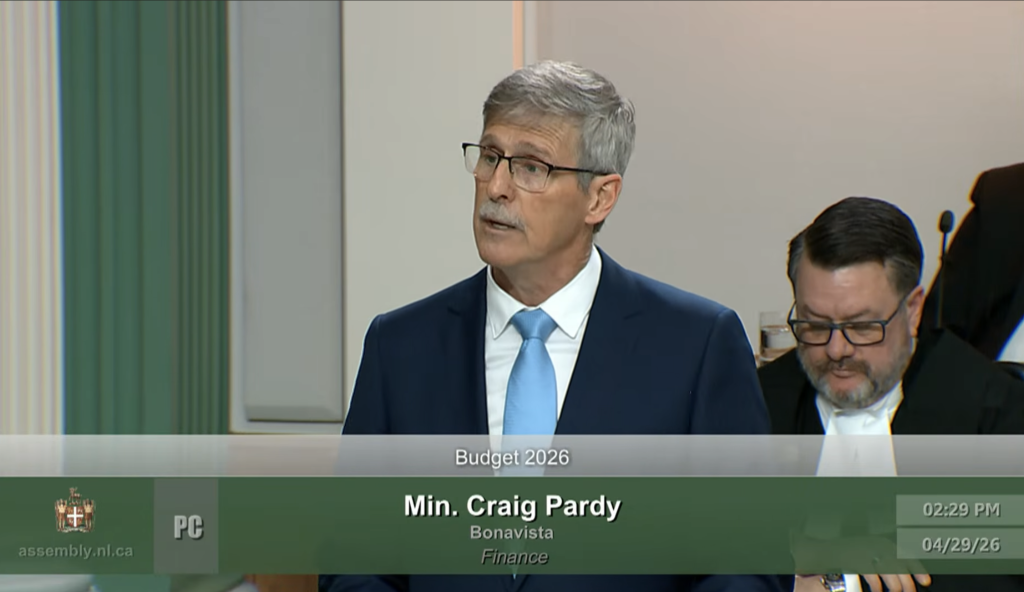
Toward the end of his budget speech, Pardy addressed the volatility of oil prices and the danger of depending on such a commodity. “Government revenues track against Brent Crude oil prices, which have certainly been on a roller-coaster ride,” he said. “Predicting the next move in the Middle East or other geopolitical issues is a task I leave for others. I don’t think many people expect oil prices to spend a prolonged period of time above $100 USD per barrel or return to $60 USD a barrel anytime soon. But the answer to this question is worth hundreds of millions of dollars to the province’s books. The best we can do is turn to the consensus views of expert forecasters.”
In its estimates for 2026-2027, the province projects Brent crude oil prices at $79 USD per barrel, even though the per-barrel price at the time of the budget was around $113 USD and some forecasters are projecting an average of $85 USD per barrel. “But for our part,” Pardy read from his speech, “we will continue to stay very prudent and fiscally conservative with our estimates of oil prices.”
That acknowledgement is “very telling,” Carter says. “I actually am relieved that the provincial government is able to take this perspective because it’s going to be really important in the long term.
“The government is admitting that government revenues — basically our ability to fund all the things that we need in our province — are pinned on oil prices. This is great to acknowledge, but this is a very big warning sign for the province,” she explains. “Anybody who studies oil-dependent jurisdictions in the world will say that — and this is research proven from decades of work — it’s very dangerous to base the stability of an economy, the stability of a jurisdiction, on oil.”
Carter says while governments have long understood the volatility of oil prices, there are often political ramifications for talking about it too much. In oil-dependent jurisdictions like Newfoundland and Labrador, she says, “oil interests start to infiltrate the state, to sway the state so that it can’t look at other options for diversification.” That, in turn, she says, turns oil-dependent economies into “one-trick ponies.”
That reality is dangerous given oil’s volatility, “but looking into the future, it’s particularly dangerous,” she says, citing the “economic exposure” that comes from oil dependence. While global conflicts like Russia’s invasion of Ukraine and the United States’ war on Iran often drive up oil prices, which Carter acknowledges may temporarily benefit oil-producing jurisdictions, it’s what happens next that could devastate jurisdictions like Newfoundland and Labrador.
“The evidence tells us that when oil prices surge, that is actually a motivation for countries and citizens to get off of oil, to try to protect themselves from those high prices and to have some kind of energy security — more affordable, more accessible energy,” she says, citing the surging oil prices following Russia’s invasion of Ukraine in 2022. “And then what was the EU’s immediate response? They redoubled their efforts to decarbonize their energy systems. So this incredible growth in renewables over just the last few years in the European Union — that was all in reaction to the oil price spike from that conflict.
“Spiking oil prices, that’s not an invitation; I wouldn’t take that as an invitation to expand oil and gas extraction or exploration,” Carter continues. “If anything, it’s another warning sign that there’s going to be an even stronger move towards renewables to undercut oil demand in the long term.”
That’s why it’s vital to consider not only the intermittent spikes in oil prices, she adds, but to take the potential long-term trends seriously. “And those long-term trends indicate that because of [the desire] for economic security and safety, as well as climate safety, there is now a global move — even in the largest producers — to get off of oil.
“I’m relieved to see that they’re being prudent about the per-barrel price of oil on which they’re pegging economic estimates — that is the right thing to do. But there is a larger danger here. There’s a bigger issue here that I don’t think has been fully confronted or accepted by the government.”
Justin Brake is a Local Journalism Initiative reporter based in Newfoundland, on a new beat covering Atlantic Canada for Ricochet Media and The Independent. Contact him with tips and story ideas at justin.brake@theindependent.ca.

Author

Related Articles

May Day Rally Shows New Face of Today’s Labour Movement
Turnout for May 1 march and rally in St. John’s one of the biggest yet in this province

Recimply the Best: Pitch and Pick Competition Winner Aims to Reduce Paper Waste
Recimply won big at Genesis’ annual Pitch and Pick competition last week. The startup is solving the problem of non-recyclable paper receipts.

Coming Home Queer for the Very First Time
For three days in July, queer Newfoundlanders and Labradorians from all over the world celebrated a rural homecoming 30 years in the making.
N.L. faces ‘serious liability questions’ over Ithaca Energy’s entry into province’s oil sector, legal expert warns
Premier Tony Wakeham won’t comment on Ithaca’s ‘political things’ but law professor says Newfoundland and Labrador could face legal risks based on company’s ties to Israel’s illegal occupation of Palestine
N.L.’s offshore oil could help bankroll a company linked to Israel’s illegal occupation of Palestine
Ithaca Energy’s impending takeover of Suncor’s stakes in three oil projects comes after PM’s promise to ban trade with Israel’s illegal settlements, while Ithaca’s majority owner is named on a UN blacklist for its alleged activities supporting settlements in the occupied Palestinian territories

Gander didn’t protest U.S. ambassador during 9/11 visit, but still sent a clear message to Trump
There were no boos when Pete Hoekstra appeared at the 25th anniversary commemoration. Instead, Newfoundlanders kept their focus on the nearly 3,000 lives lost — and reminded America that Canada will not bow to anyone