
Head of Memorial University’s EDI office leaving role
In an interview with The Independent, Delores Mullings spoke candidly about challenges with the equity, diversity and anti-racism position
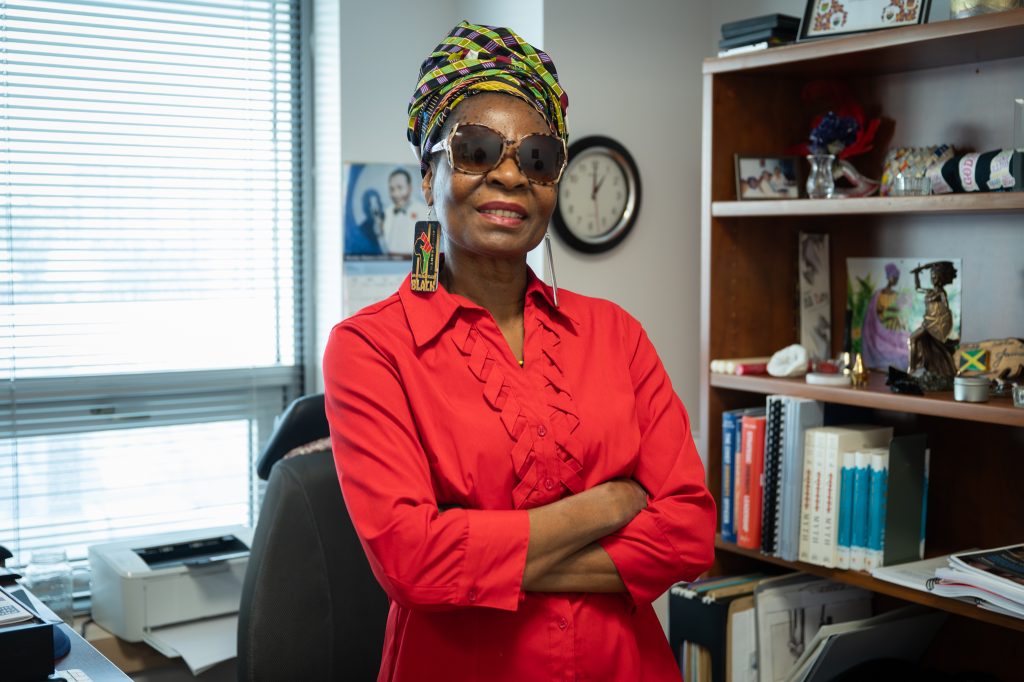
Memorial University’s Vice-Provost of Equity, Diversity, Inclusion and Anti-Racism (EDI-AR) has ended the position’s inaugural term eight months early.
According to the university, Delores Mullings “has decided not to begin the review process for a second term,” spokesperson Chad Pelley said in an emailed statement.
Mullings, whose term as MUNL’s first-ever vice-provost of EDI-AR began in August 2021, spoke with The Independent last week. While a non-disclosure agreement with the university prevented Mullings from addressing the specific circumstances that led to the decision, Mullings spoke candidly about the experience of the past four years in the role and the associated challenges.
“I feel like I’m growing my wings back,” says Mullings, sitting in the EDI-AR office surrounded by packing boxes. “I still have some things that I would have liked to see to the end, but that’s okay — I have started some great work here at Memorial and it’s okay to pass the baton to somebody else to cross the finish line with some of those things.”
Will you stand with us?
Your support is essential to making journalism like this possible.
The Vice-Provost of Equity, Diversity, Inclusion – Anti-Racism position was created by Memorial’s Board of Regents in 2019 following years of calls and reports highlighting the gap of such a position in the university’s senior leadership team, and for greater attention to human rights and equity issues.
“I was excited to start something new and different, to lay tracks, equity-related tracks. I think I was a little bit naive as well […] because I actually thought more people had an equity lens and an understanding of what an equity lens is. And that was not the case at all. A lot of people actually didn’t understand and still don’t understand what equity is, even after four years.”
Different ideas about equity, diversity, inclusion and anti-racism
Mullings encountered tension and pushback in the position, and attributes some of this to “role ambiguity.” Mullings entered the position with an expectation that the role was to help shape Memorial’s policies and programs at the highest level, injecting an equity lens. Instead, Mullings says a lot of people expected the position to simply serve as “a glorified trainer, or somebody who would raise the Pride flag.”
“I think they really misunderstood what I was supposed to be.”
This mismatch manifested exclusion from important decision-making spaces, Mullings claims. Instead of being invited to participate in the development of policies or documents, Mullings would be shown already-crafted documents and asked to review them after the fact. Sometimes Mullings would only be shown brief EDI-related excerpts without broader background context.
“To me, the whole document is EDI-AR, not just the section that says it,” Mullings explains. “So when I pushed back on that, quite often people just felt that I was being unreasonable, that I was just not a good team player.”
There’s an extra burden faced by minoritized members when they’re the only ones in a meeting or decision-making body. Ever since Mullings arrived in Newfoundland and Labrador in 2009 as Memorial’s first Black faculty member in the School of Social Work, Mullings has “almost always” been the only one at the table.
“So there was that burden, that emotional labour,” Mullings explains. “I would say it was lonely. It was something more far-reaching than alone-ness. It was the feeling of always just being on my own. Just being the only one always saying the same thing.
“The thing is, while I’m the one in the role, it doesn’t mean that I’m the only one that needs to be talking about equity issues. Everybody is responsible for equity issues, especially those at the highest level of the institutions. So it was daunting to be the only person.
“And it was equally daunting to see people say certain things in public and get a photo opportunity, and then in private their narrative was very different—and in fact they actually didn’t understand. So because of my very bold personality and character traits, it wasn’t long before people stereotyped me as the angry Black woman. It came very quickly, and it continued to morph. I got pushback, saying it was my attitude or my tone.
“That has been so hard to deal with. Very, very difficult. And yet I continued, because I knew I was on the right path.”
Mullings says Memorial University President Janet Morrison, who commenced her position in August 2025, never once reached out to meet in an official capacity.
Memorial spokesperson Michelle Osmond told The Independent that MUNL’s “reporting relationship of the EDI-AR office is to the provost, and as such, one-on-one meetings with the president are not typical,” and that “all members of the community were, and are, invited to reach out proactively to set up meetings with President Morrison.”

Mullings had the security of a tenured academic position to fall back on, but cultivated other mechanisms to cope with the mental strain of the role. Mullings has been writing poetry for over 30 years and has a published collection coming out in the spring. Mullings meditates and takes long walks but also relies on a cadre of close friends and colleagues, spread over the world, from whom to seek advice and support.
Mullings is aware others will face isolation in positions like this in future, and reflected on what advice to share.
“I stay true to my values, and I was never shaken, no matter what anybody said. What I realized was that in these positions you can quickly become a puppet, if you allow that to happen.
“And I would say, fear is natural. Feel the fear and work through it. The greatest athletes in the world are fearful — about whether they’ll succeed, whether they’ll fall down, whether they’re going to drop their baton. The greatest doctor, neurosurgeon, social worker, whatever — they’re fearful about whether they’re going to do the best job possible. But the fear doesn’t stop them. They have to work through the fear. They still have to do what they want to do, even though they’re afraid. So work yourself through it and come out on the other side.”
Proud of accomplishments
Mullings is proud of the work Memorial’s EDI-AR office has accomplished during its few short years of its operation. “I started an office from scratch,” said Mullings. “I worked for 18 months all by myself, starting from scratch.”
Mullings cites the range of consultations the office took on, including a strategic plan that involved engaging with over 2,000 people from Memorial’s campuses, conducting an anti-Black racism consultation, and an international and racialized student consultation, to name a few. The office produced a report on employee resource groups across Canada and has been spearheading the development of a Human Rights Policy for Memorial, which will be reviewed by the university’s Board of Regents. Mullings feels a twinge of regret at not being around when the policy is eventually adopted but is pleased with what’s been developed and has faith in the EDI-AR office to complete the process of putting it in place.
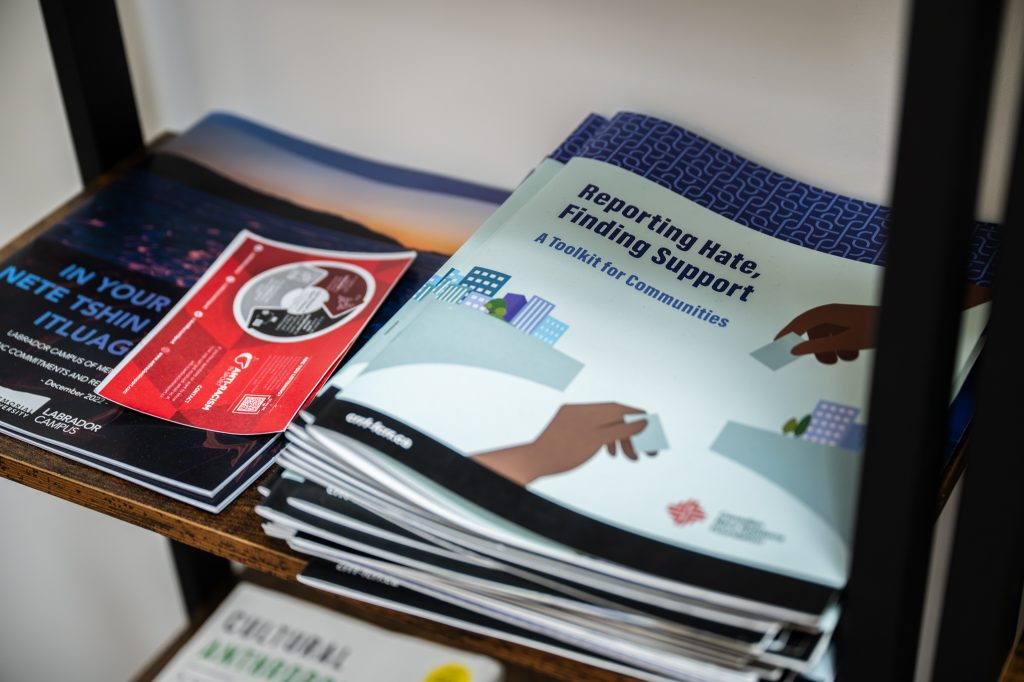
The EDI-AR office also developed programming around special awareness occasions at Memorial, including Pride Week, Black history and liberation, women, and employment disability. Mullings also said an important component of the office’s work was integrating activities across Memorial’s campuses in St. John’s, Corner Brook, and Happy Valley-Goose Bay. The office also put off two international EDI-AR conferences, with a third in the works for 2026. And it developed a digital resource database accessible via Memorial’s library.
Mullings said another of the office’s priorities was developing partnerships with community groups like the YWCA, The Rooms, and the Anti-Racist Coalition of NL. Mullings said working with student groups was a particular highlight and cited the strong support EDI-AR work received from student groups.
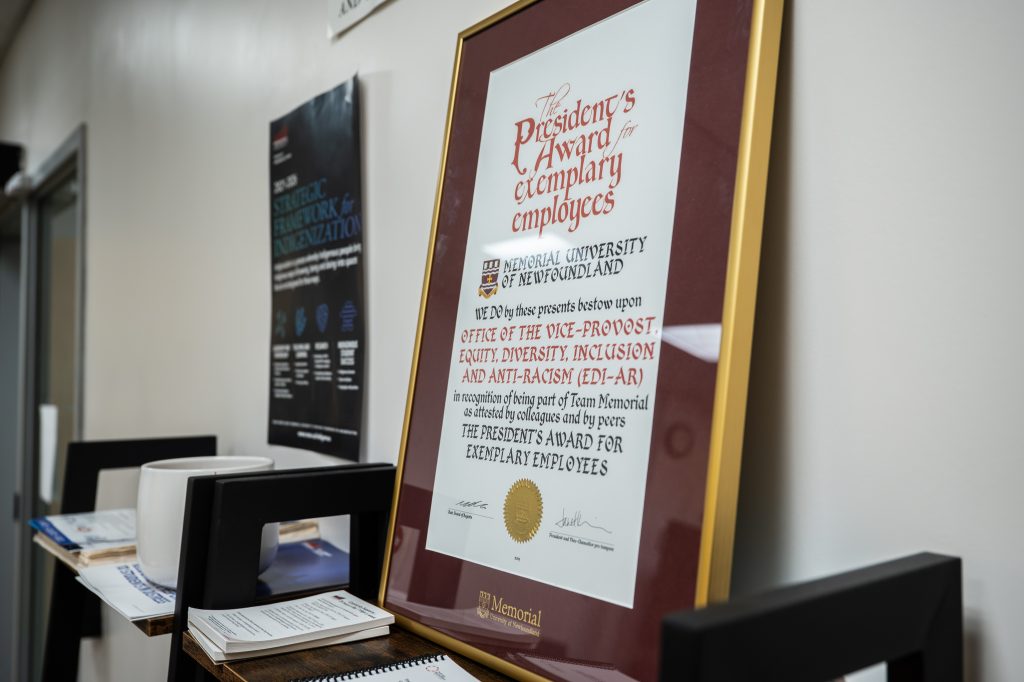
In the final week of Mullings’ role as vice-provost, the EDI-AR office was recognized with the President’s Award for Exemplary Employees, a recognition of its work as a team.
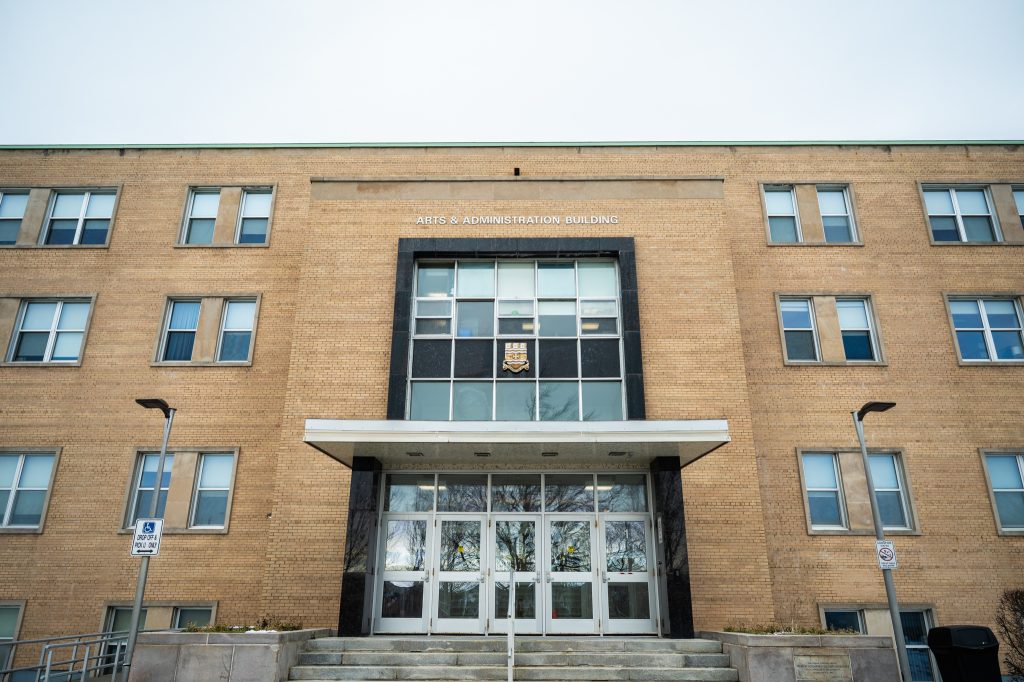
One of the things Mullings reflects on are the Palestine solidarity protests that erupted on campuses across the world in 2024. At Memorial, a tent encampment on the university’s lawn expanded into an occupation of the first floor lobby of the Arts & Administration Building, which was raided by the RNC in July 2024. Three students were arrested and the charges were later dismissed. Mullings was not consulted about the actions the university undertook against the protestors.
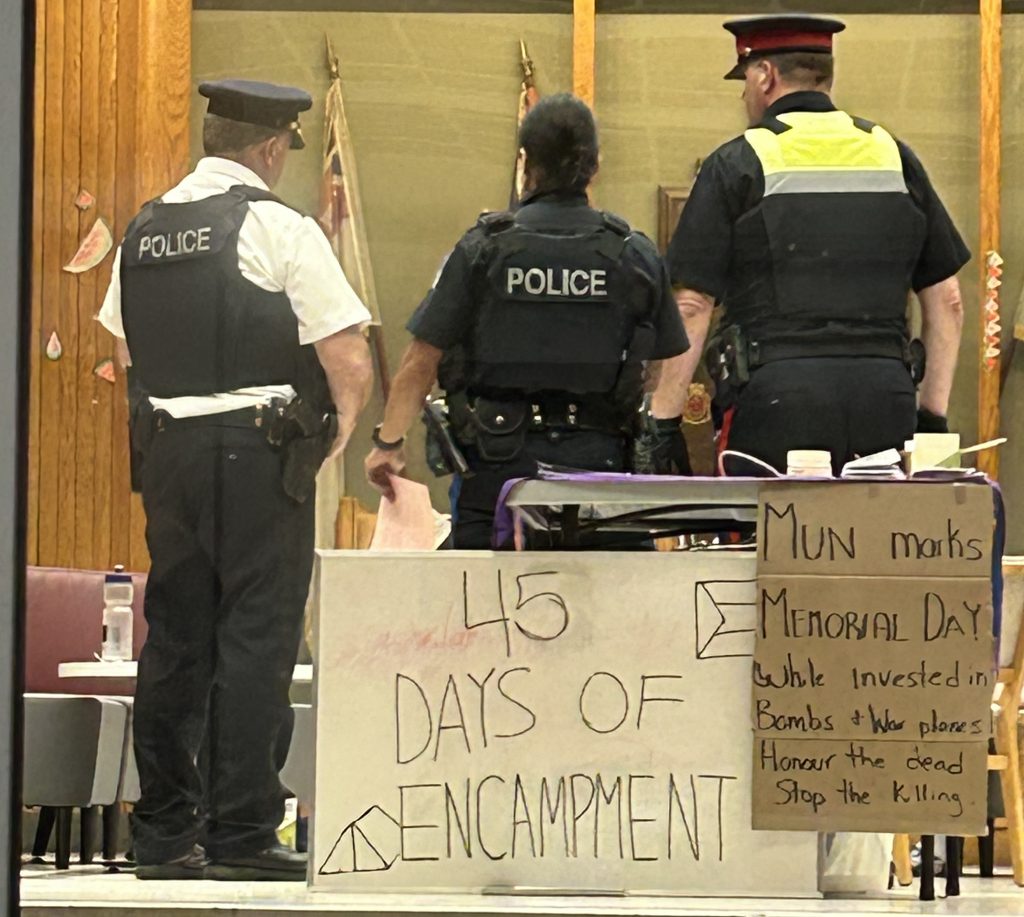
In private, Mullings tried to impress upon other university administrators that, “actually we needed to be proud of the students because we taught them. So they were giving us back what we taught them. I think this was a missed opportunity for Memorial to bring in an equity lens. I was really sad when the police were called and the students arrested. And yet because of my senior administrative position, I was not able to responsibly speak publicly about my own thoughts.”
Mullings drafted an article on behalf of the EDI-AR office addressing the situation, in the hopes it could be posted to the university website. Some administrators supported it, but it created tensions with others and wasn’t approved. Mullings drafted an internal memo after the fact, telling senior administrators things could have been done differently.
Action requires resources
Mullings says the work done by the EDI-AR office over the past four years has identified the priorities for change that could improve student and employee lives, but this work still requires the university to commit resources to follow through.
“If resources are provided, we can see a whole lot of things happen,” Mullings says.
One priority is more funding for student services, and especially for mental health supports. Mullings says that was a priority that emerged in every single one of the campus consultations: students desperately need and want more mental health support. Mullings said there’s also a significant problem with Black, racialized and Indigenous students not seeking out mental health supports, “because they’re not seeing people who understand what they’re speaking about. So we need to hire people, we need to train them, we need to provide trauma-informed training so that we’ll have more students going in for support.”
Mullings says there’s a strong need for mentorship on campus, especially for international students, and that there’s a problem with professors not providing the same level of support to international students that they provide to Canadian students. This leads to international students taking longer to complete their degrees, and the problem is especially evident at the graduate level, Mullings says. Because the lack of support results in their taking longer to complete programs, it also means they’re paying more money, a form of financial penalty that hits international students on top of their already inequitable fees.
“So the recommendations that come in these reports, if people take them up and resource those recommendations, we’d see a whole lot of changes in terms of physical health, mental health, academic success, and what all that looks like for students.
“We also need more [diversity] representation in senior administration.”
Adding AR to the EDI rubric
When Mullings was hired, the job ad was for a vice-provost EDI. It was Mullings’ idea to add the anti-racism part. “Whenever we talk EDI—equity, diversity, inclusion—what happens is that the bodies we tend to focus on are those that are systemically marginalized, but are white. So I thought it was important to also be talking about racism and anti-racism as well.”
Mullings was pleased that the university agreed to change the job title, but as time progressed Mullings noticed backlash emerging in the form of complaints that there was too much focus on race.
“It’s interesting because when a white person is doing equity work and only focusing on gender or disability, that has a white lens—they’re normally not accused by the masses of only focusing on those things, right?” Mullings reflects. “Or if [a white person] is working on issues of anti-racism, they’re not targeted or criticized for working on racism. That’s considered acceptable. But when you are living the experience of racism and you actually speak about it, then it becomes a problem.
“As a Black woman, my entry point to all of this work is race, right? That’s what shows up first for me. But a lot of people here didn’t understand that. When you live with racism and you have all the other intersections on top of it, if we work from that place then we can actually move mountains. But if we only look at one intersection, like gender, it means we leave everybody else and everything else out. But people didn’t really understand that. When I said my entry point to this was race, they just thought I was only talking about racism.”

Will Memorial continue its commitment to EDI-AR?
Mullings is concerned that in the new year, with the Vice-Provost EDI-AR position vacant, there will be a serious lack of diversity representation among Memorial’s senior leadership. Furthermore, Memorial’s future commitment to EDI-AR remains a question mark.
EDI has been a very direct target of President Donald Trump’s Republican administration in the United States, which has been forcibly dismantling EDI infrastructure and persecuting institutions that deploy EDI principles or concepts. Some Conservative politicians in Canada have followed suit. Mullings is calm and reflective about what this means for EDI-AR.
“This is not new,” says Mullings. “And this too shall pass. Nothing lasts forever, and [the attack on EDI] is very organized.”
But what’s problematic about this moment, says Mullings, is that those in positions of power who should know better and who should be standing up against censorship and discrimination, are remaining silent and becoming complicit in the attack on equity. In this context, money and funding often gets used as a sort of shield, or excuse, for what are really ideological attacks.
“The people that you think would be speaking up are not speaking up, for whatever reason,” Mullings says. “Sometimes people are afraid. But they’ve also doubled down and are now saying they have to go this route [of eliminating EDI] because they don’t have enough money.
“Money is never the reason why people cut programs — it’s philosophy, and it’s values. Because while they’re cutting equity programs, they’re increasing other programs. And while they’re not creating capacity for systematically marginalized people—particularly those along racial lines—they’re still hiring other people. They’re hiring people that are whiter than ever, under the guise that they have to shore up certain offices.”
Mullings emphasizes that in these situations the hiring of white women or white queer people is often used to claim that equity values are still being followed. “This is how people say that they’re supporting EDI-AR — but that EDI-AR turns out to be very white.”
In 2023, the Dimensions program—dedicated to removing barriers for marginalized populations in Canada’s major academic grant-funding programs—was cut, sparking outcry from researchers and EDI officers across the country.
Meanwhile, Alberta’s United Conservative government has put forward Bill 13 in an effort to ban mandatory EDI training and prevent employees from being disciplined for bigotry or discriminatory acts they commit off the job. This year the University of Alberta, which appointed its first Vice-Provost EDI-AR in 2020, announced it was dismantling that office and switching to a framework of “access, community and belonging.” University President Bill Flanagan said earlier this year it’s “not the university’s role to take ideological positions,” but critics argue the university is buckling under the Conservative attack on EDI.
Equity initiatives have been targeted at other universities. In 2025 York University in Toronto—where Janet Morrison previously worked as a vice-provost—became the first Canadian university to impose widespread program cuts, including to Gender Studies and other equity-centred programs. Critics charged that cuts to these popular programs were ideologically-driven.
These types of cuts are “values-driven,” says Mullings, “a reflection of people’s philosophy and their values about what an education is, who should get it, and what it should look like in terms of who’s at the front of the room and what kind of research should be done.
“We’ve seen this shift coming,” Mullings continues. “We’ve seen fascist governments elected in different parts of the world. This is not new.”
Despite the current climate, Mullings believes “there is hope” for the future of equity and diversity.
“What happens is, you will see people start working together. That is what I said when Trump was elected again, that this is an opportunity. We have to get ourselves together as groups of people in order to stop this, and to challenge this. And we’re seeing pockets of people, like the uproar amongst academics of all kinds. I think there are lots of opportunities for us to work together to make sure that these things don’t happen.”
Mullings is not quite as certain about the future of Memorial’s EDI-AR office. There has been no announcement of a hiring process for Mullings’ replacement, and a statement from the university suggests the office may be restructured.
“The Office of the Provost is working on a plan for leadership in the portfolio going forward and will meet with the team in the unit immediately after the holiday break to share details,” Pelley said in an emailed response to The Independent’s inquiries.
What do all of these things say about Memorial’s commitment to EDI-AR?
“There is a vague line in a letter that says they’re committed,” said Mullings. “So I don’t really know what that looks like. What I can say is, we’ve not had a president that has understood what equity looks like, and the benefits of equity.
“There are some champions in the senior leadership area who talk about it and challenge ideas that need to be challenged. We do have some very strong people here who understand that,” Mullings continues.
“But among senior administrators, at the very highest level, that’s where I would want to see more public demonstration of support for EDI-AR. Because until it happens at the highest level, it means that people like myself will always be the one person doing all of this work. And EDI-AR is not a single person’s work — it’s everybody’s work. The senior administrators absolutely must take some responsibility and demonstrate that very clearly. And that has not happened yet.”
While Memorial University has an opportunity to be a leader in EDI-AR, the province as a whole also needs to reflect on its commitment to these values, says Mullings, who has witnessed first-hand the slow pace of change in the province over the past 15 years.
“There are more bodies here that look different, but things haven’t changed that much,” Mullings says. “What I’m happy about is that we’re finally talking about our similarities and differences; we’re talking about it more because there are more people speaking about it.”
Mullings says an urgent priority for the province is the same one faced by Memorial University: more diverse representation and commitment to EDI-AR at the senior leadership levels.
“We need leadership that makes it transparent that everyone is welcome here, that Newfoundland and Labrador is a home for everybody.”

Author

Related Articles
The RCMP vs. the media: Bracken trial approaches its endgame
This court case could decide the future of press freedom — and police oversight — in Canada

Accounting watchdog to investigate Deloitte over fake citations in $1.6M healthcare report
Chartered Professional Accountants N.L. is leading the investigation after Deloitte admitted AI was involved

PC’s minimum wage increase ‘far from a living wage,’ says NDP leader
NDP Leader Jim Dinn is calling on the PCs to legislate wage increases