
Mothers, grandmothers call for action on drugs in Natuashish
Aldea Piwas has organized a group of 15 women calling for drastic action on drugs in the Innu community; RCMP says there are ongoing investigations

Innu are losing their lives to drugs and not enough action is being taken, says Aldea Piwas, a mother and grandmother in Natuashish. “The community is in crisis [and] only the chief and council can do something about it.”
Piwas has lost loved ones to drug overdoses, while others have come close to death following substance use and addiction. “There’s a lot of dealers in Natuashish,” she says. “Nothing is being done to them. They posted on social media what they’re selling and how much they’re selling. It’s like they run the community and nothing is being done.”
The Mushuau Innu First Nation (MIFN) government isn’t taking action and dealers have been operating without consequences for years, Piwas says, explaining dealers don’t care about age and will sell to anyone with money. “I saw a boy, maybe eight or nine years old, high.”
“If they don’t do anything now, it’s going to get worse,” she says. “What are the youth going to do? Who’s going to stand up for them if chief and council don’t do anything?”
Will you stand with us?
Your support is essential to making journalism like this possible.
Cocaine, crack, ecstasy, and marijuana are the drugs Piwas says are circulating in the community of about 1,000 people.
In a written statement, the RCMP says drug investigations are a normal part of their operations and many begin based on information from the public, but that they’re unable to speak to investigations already in progress.

On Feb. 24, Piwas held a meeting for parents and grandparents concerned about drugs in the community. Two women councillors attended and listened to the group. Piwas says the group came up with a set of recommendations for MIFN.
Here’s what they are asking for:
- Chief and Council to call an emergency meeting on the drug situation;
- An Assembly General Meeting called on the situation so residents can voice their concerns directly;
- MIFN to speak to a reserve lawyer to understand their specific powers on reserve;
- A band council resolution to ban non-Innu people convicted of drug trafficking;
- A band council resolution to fine Innu convicted of drug trafficking;
- Community safety officers (CSOs) to be given extended powers to search Innu-owned homes in the community with RCMP to be called if the CSOs see drug use or trafficking;
- Community safety officers to be given extended powers to search coat and clothing pockets at the airport under RCMP supervision;
- A land-based detox option to be offered for Innu who struggle with addictions.
“Chief and council should hear the worried parents and the young parents who have saw everything in their houses,” Piwas says. “They give them food and they say, ‘Stop doing what you’re doing. Stop buying drugs, buy food,’ and they get upset, really mad, angry.”
Piwas has asked repeatedly for an emergency meeting but says she still hasn’t heard from the chief or council.
Mushuau Innu First Nation Chief John Nui was not available for an interview for this story.
One of the most challenging aspects is seeing public advertisements from dealers in the community, Piwas says, explaining there are posts on social media from people advertising what drugs they are offering and the prices.
When she flagged those posts to MIFN or the RCMP, Piwas says she was asked for proof. “The proof is there — it’s written there,” she says. “What about the people who died? That’s the proof. People who overdosed? That’s the proof. How much proof do they need?”
The RCMP says social media posts may offer some evidentiary value to criminal investigations but the information would need to be further qualified. The posts on their own aren’t enough to obtain a warrant or search a property, since police need to make the case for a warrant to the courts.
Airport changes could result in less drugs moving to Natuashish
Natuashish is a dry community and community safety officers routinely check bags people bring in off of airplanes. Piwas says drug dealers have an easy workaround by simply carrying drugs in their pockets, since CSOs don’t have the authority to make people remove their coats or check personal pockets.
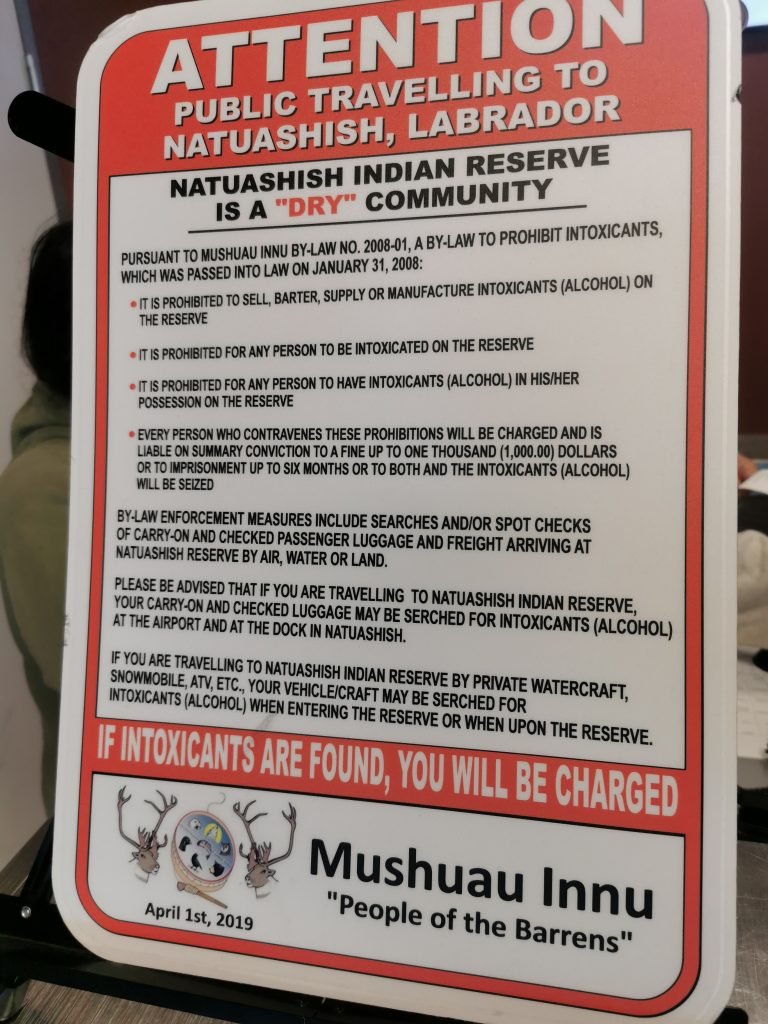
Having security at the airport in Goose Bay would also drastically decrease the amount of drugs flowing into Natuashish, Piwas says. There’s currently no security screening for flights from Happy Valley-Goose Bay to the north coast.
In a statement, Goose Bay Airport CEO Rex Goudie says the airport corporation is open to working with local, government and regulatory agencies as part of a joint effort to help address issues with drug trafficking in northern communities. Goudie says Indigenous Service Canada is working with communities in northern Ontario with different options the group could consider as well.
When it comes to security, the Goose Bay Airport’s flights to coastal communities are categorized as an “other” or “non-designated” aerodrome, Goudie explains. Federal regulations state there are no regulations or interim orders mandating screening on those flights, which Goudie says is why there is no screening for coastal flights out of Goose Bay. Though he says it’s something governments could explore.
“The parents, grandparents are crying for help,” Piwas says. “They feel helpless because we can’t do anything to the dealers — nothing is done.”

Author

Related Articles
Student federation calls for investigation into racism at Memorial University following head of E.D.I. and anti-racism’s departure
The Canadian Federation of Students wants an investigation of MUNL’s ‘upper administration with regards to all forms of racism within the institution, specifically as it relates to anti-black racism.’
Labrador town building 40 more homes for seniors amid housing crisis
Happy Valley-Goose Bay’s Housing and Homelessness Coalition launched 32 seniors apartments last summer; now it’s building more
Muslim youth donate 600 pounds of food to Avalon food bank
As the province continues to see high rates of food insecurity, communities are coming together this holiday season to make sure households have food on the table