
Will gender parity and a comparatively diverse slate of candidates pay off for the provincial NDP?
Political scientist Amanda Bittner says research shows more diverse legislatures lead to better policy-making
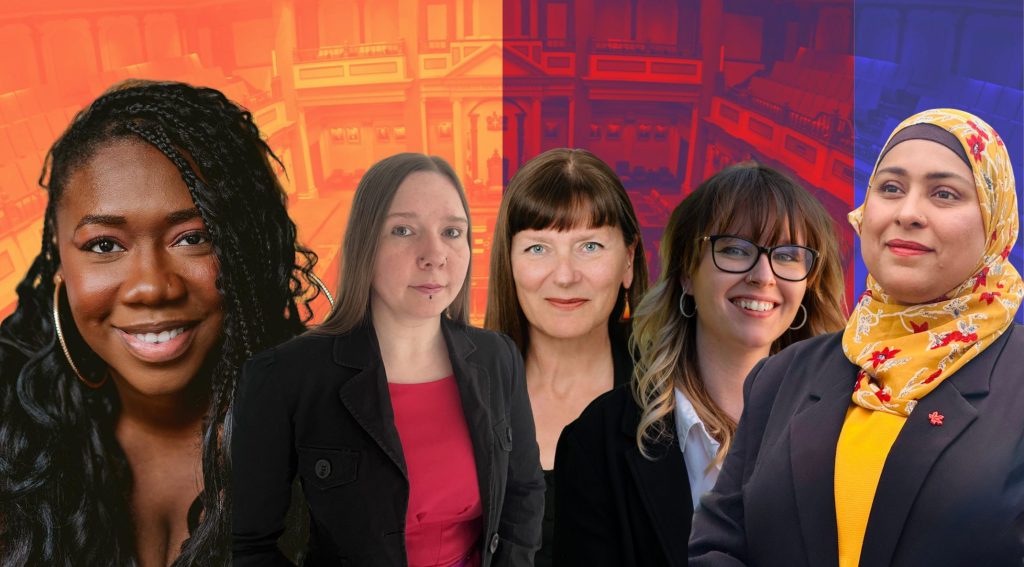
Like so many others in Newfoundland and Labrador, Laurabel Mba has struggled to make ends meet.
During her campaign as the NDP candidate for Mt. Scio in St. John’s the 33-year old mother, advocate and Rogers TV host has talked openly about living near the poverty line. “I’ve had income support forms on my dining room table to figure out, how am I going to afford to pay my bills?”
Personally and professionally devoted to anti-racism work—she runs her own small private consulting firm—Mba recognized the need to expand her advocacy beyond racial equality. “I looked at our legislature, I looked at the people who happen to sit in positions of power right now,” she recalls, “and realized that there seems to be a very large gap between [MHAs] and the people they make the policies for.”
Like most Canadian legislatures, Newfoundland and Labrador’s House of Assembly has historically been dominated by white men. While some parties have gradually improved the involvement of women in politics, only the Newfoundland and Labrador NDP has achieved gender parity in this year’s election, which it says is the first time in the province’s history any party has done so. The NDP is also making history by having Mba on the ballot. The Nigerian-born candidate is said to be this province’s first-ever Black person to run for public office at the provincial level.
Will you stand with us?
Your support is essential to making journalism like this possible.
With former Wabush town councillor Shazia Razi running as the NDP candidate in Labrador West, voters there also have the opportunity to elect the province’s first hijab-wearing Muslim candidate, CBC has reported.
The Independent attempted to verify Mba and Razi’s status as the province’s first Black and first hijab-wearing Muslim candidates but neither Elections NL, nor the House of Assembly’s legislative library, actively keep data on the racial or ethnic backgrounds of candidates.
Diversity leads to better policy-making, says prof
It’s “remarkable” this data is not tracked, says Memorial University Political Scientist Amanda Bittner, explaining “evidence suggests that when legislatures are more diverse—which includes gender diversity, racial diversity, and other markers of diversity as well—what we see is often more policy innovation as people bring forward their life experience and insights into the legislature.”
Bittner says diversity in legislatures also leads to better policy-making, explaining “parental leave policies and childcare policies and things like this emerged largely because women’s presence was there.
“We also know from American data that a lot of cross-party collaboration to achieve certain goals tends to happen amongst racialized legislators,” she explains.
“Having more different types of people working in the legislature can lead to better policy outcomes, which is particularly important in a time like this where we have some really intractable, very challenging policy issues.
“Thinking about climate change, thinking about poverty, homelessness, food insecurity, thinking about the incredible cost of living, thinking about the challenges with even getting women to run in elections — these are all things [where] solutions exist, but we may need to actually think outside the box. And it’s easier to think outside the box if you have new people than if you try to regurgitate the same old, same old. So the more we see diversity in legislatures, the more potential I think there is for policy innovation.”
Bittner says while it’s important to celebrate progress on more diverse political representation in the province, there’s a risk that focusing on candidates’ racial or ethnic backgrounds could overshadow the ideas those candidates are putting forward.
While she’s proud to be breaking down barriers, Mba says she wants to keep the focus on the policies she and the NDP are promising ahead of Tuesday’s election.
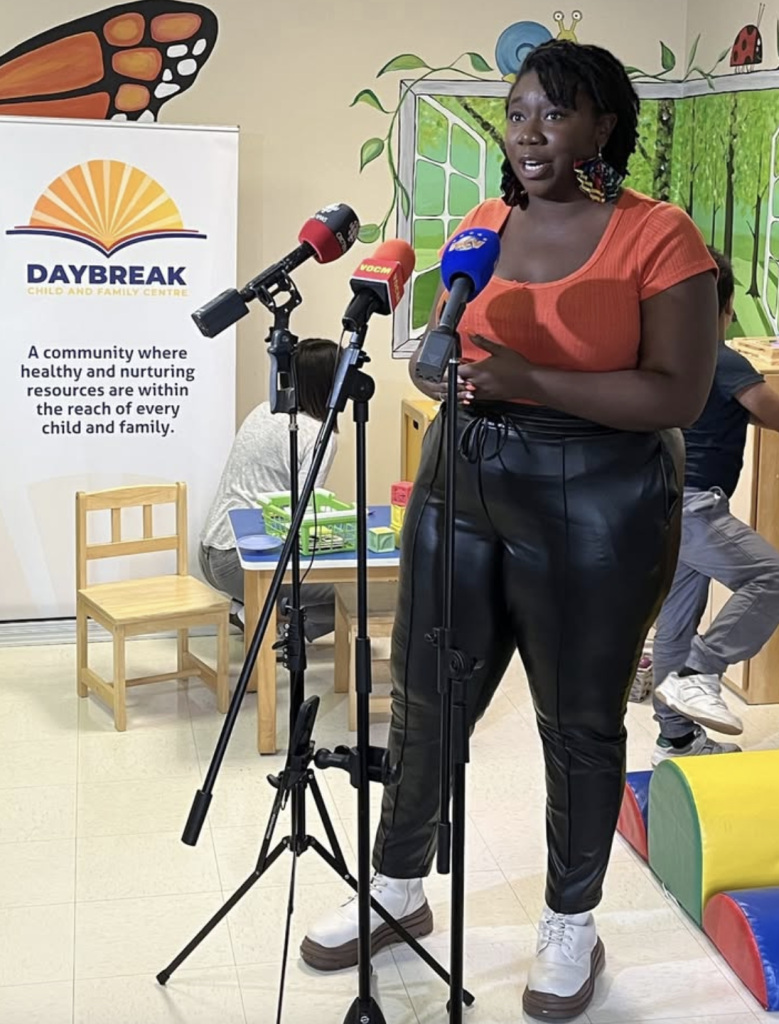
A former Memorial University student, she says the province’s accessible post-secondary education brought her here. Now, she says, the dramatic increases in tuition fees are driving students away.
The NDPs’ promise to roll back tuition fees to 2022 levels and freeze them there “makes the ability to attend post-secondary more accessible to anyone who wants to,” Mba says. “That was something that was very near and dear to my heart.”
She’s also enthusiastic about the NDP’s commitment to end unpaid work terms for students in social work, education and healthcare.
Mba says while she was attending Memorial she had friends in nursing and social work who were “putting in close to 3,000 hours of coursework working in the field without being compensated for their labor, [and] that always confused me.”
She is happy the party values the “labour of love that those [students] are putting forward, and wanting to compensate them equitably for what they were doing, is essential to me.”
In Labrador West, Shazia Razi is attempting to make the move from municipal to provincial politics. The NDP claims Razi was the “first person from a visible minority community to be elected to municipal office in Newfoundland and Labrador” when she won a seat on the Wabush town council in 2021.
For more than a decade Razi has served on the boards of local organizations like the Housing and Homelessness Coalition and the First Steps Family Resource Centre, as well as that of the J.R. Smallwood Middle School in Wabush.
“She has been a strong voice on issues like housing, healthcare, childcare, and public transit,” the NDP says on the party’s website. “She brings a powerful vision of inclusion, hope, and progress to her candidacy—one rooted in her lived experience and her unwavering belief in putting Labrador West first.”
Diverse representation takes effort
Bittner says the NDP putting forward 21 women in its full slate of 40 candidates is “an important achievement,” noting the party has “worked hard not just in the province but across the country to develop policies to increase representation of traditionally marginalized or sidelined groups.”
She points to British Columbia, where that province has a “historic legislature with lots of women as well, largely because of these types of quota-style regulations that parties have instituted.” She says parties have the “power to recruit more women, more racialized candidates, more of whatever parts of the demographic and the population that they want,” but that some parties still don’t make the effort.
By comparison, the Liberal Party of NL has 14 women—accounting for 35 per cent of its candidates—running in this election, while the Progressive Conservatives have just 10—or 25 per cent of its slate.
“When we see, you know, 20 per cent, 15 per cent, 25 per cent, [parties are] not trying very hard,” Bittner says. “We know that statistically and traditionally it takes more work to recruit women and other folks from across the population who don’t have traditional access to power and don’t often have the kinds of social networks with money that is really helpful in an election.”

Author

Related Articles
PCs under fire for ‘disappointing’ treatment of Black History Month
Celebrated Black community leader and anti-racism advocate target of racist comments after speaking out online

New play portrays barriers facing N.L. women in politics
Women won the right to vote a century ago but are still underrepresented in public office. St. John’s playwright Ruth Lawrence’s play tackles that head on.

Meaningful response to homelessness requires more than new builds, says NDP leader
Jim Dinn’s comments come in response to PC’s announcement of 10 new ‘micro homes’ in St. John’s