
Memorial president treading in murky waters of university’s conflict of interest policy
Professor says Memorial University President Neil Bose, who supervised one of two candidates vying for senior administrative position, should recuse himself from hiring committee.

A Memorial University of Newfoundland and Labrador (MUNL) professor is speaking out amid growing concern among faculty members around President Neil Bose’s role in hiring the next vice president (academic) and provost.
The university, still reeling from scandals and governance issues in recent years, has been working to fill top administrative positions amid high turnover rates. But it continues to anger faculty, staff and students with processes which some say continue to elude transparency and accountability — the very things required for Memorial to repair its reputation.
Last week, Bose, who chairs the hiring committee for Memorial’s next vice-president (academic) and provost, participated in a public job talk with one of the two short-listed candidates for the position, Rehan Sadiq, who Bose supervised when Sadiq completed his PhD in civil engineering at Memorial in 2002.
Memorial says Bose followed its conflict of interest policy and declared his conflict with Sadiq on two occasions, but it’s not clear to what extent Bose participated in, and potentially influenced, the hiring process to this point.
Will you stand with us?
Your support is essential to making journalism like this possible.
MUNL’s conflict of interest policy states, as an example of a conflict: “Participating in the recruitment, appointment, re-appointment, tenure review, hiring, promotion review, performance evaluation, renewal of contracts, discipline matters, compensation or benefits decisions, committee decisions, leave requests, expense claims or other personnel decisions or recommendations involving or regarding a person where the Member […] is or has been an Academic Supervisor for that person.”
The university doesn’t believe Bose has acted outside of the policy.
“Dr. Bose is chair of the search committee for the provost and vice-president (academic) because the search process is guided by The Policies and Procedures Governing the Appointment, Review, Promotion and Tenure of Academic Administrators (April 2014), which vests the authority for the search for the provost and vice-president (academic) to the president,” Memorial’s Manager of Communications and Media Relations Chad Pelley said in an email Thursday.
“Upon receipt of the long list of candidates, Dr. Bose immediately declared a conflict of interest in relation to several candidates on the list to the search committee,” Pelley said. “Once the shortlisted candidates were chosen by the committee, Dr. Bose declared those conflicts of interest to the Board of Regents chair, as his unit head, and indicated he would not be voting in the final search committee decision, in order to mitigate any perceived conflict.”
MUN Political Science Professor Russell Williams says Bose should have recused himself from the hiring committee entirely, and he should not be involved in the longlist or shortlist selection processes.
“The standard response to a hiring situation like this, when you have this kind of a fairly glaring conflict of interest […] would be to step off the committee completely,” says Williams. “You can’t be involved in longlisting. What we call a longlist is often, you know, maybe there’s 20 or 30 credible applicants. The long list might be seven or eight people. That’s already a winnowing down to a smaller number of candidates that might then either be pre-interviewed or might be interviewed publicly.”

Williams says Bose and Memorial’s board of regents should have found a solution to the conflict of interest “before the discussion of the files occurred” regarding the applicants and candidates.
“Senior leaders must be seen to be acting in a clearly ethical way that complies with conflict of interest rules, or it has an impact on the entire culture of conflict of interest across the institution and across the public service more broadly,” he says, pointing to the provincial government’s recent scandal involving public officials renting properties to travel nurses hired by the province.
Government officials “seem to not understand it’s a problem for them to rent properties they own to people that they’re hiring,” he continues. “This highlights the fact that we have a poor local culture around conflict of interest, so people don’t seem to understand their responsibilities.”
In Memorial University’s case, he says, “there’s a particularly high onus on the president to manage this conflict of interest in a way that reduces any appearance that his connection with one of the candidates may be influencing the search — and the way to do that is to not be on the committee.
“That committee is stuffed full of vice presidents, deans, other senior administrative leaders who are more than qualified to chair a search. Putting himself in the position where he’s still on the committee, still chairing meetings, attending interviews with the candidates and asking questions in public of the candidates […] is not a good look. That to me suggests conflict of interest is not being taken as seriously as it should by leadership of the university in that particular instance.”

The Independent asked Memorial University if Bose participated in the selection of the longlist of candidates; how many individuals were on that list; how many of those individuals he declared a conflict of interest for; whether Bose voted or had any influence in choosing the shortlisted candidates; how many candidates were on the original shortlist; and how many candidates on that list he declared a conflict of interest for.
The university did not respond by the time of publication but promised a response to the questions on Monday. We also asked for a recording of the Nov. 12 job talk, during which, multiple sources have told The Independent, Bose and Sadiq spoke to or about one another. We did not receive a response to that request but will update the article if new and relevant information is provided.
The Independent also reached out to Sadiq, who presently serves as vice-president (academic) and provost at the University of British Columbia’s Okanagan campus, for comment. He did not respond by the time of publication — nor did Memorial’s student and faculty unions.
“It would be really, really nice if MUN was out of the headlines for governance problems at the university, and instead what was in the news is all the interesting research and teaching that’s going on on this campus, and we were all kind of working together to kind of re-establish the reputation of this institution,” says Russell.
“This is another story that I don’t think we all want to be hearing, but it reflects on the fact that we have some problems with governance of the university, and they seem to be re-occurring, and they have not been fixed.”
Author

Related Articles
INTERVIEW: Avi Lewis says N.L. is ‘ground zero’ for the biggest challenges facing Canadians
The federal NDP candidate says socialism and economic populism are the antidote to unfettered capitalism and the ‘epic market failures’ it has brought
LISTEN: Justin Brake talks Amber Bracken case & press freedom on CBC Radio’s ‘The Signal’ (with TRANSCRIPT)
An hour-long conversation led by CBC Radio host Adam Walsh, feat. Justin Brake, Geoff Budden, Karyn Pugliese, Brent Jolly and Ethan Cox
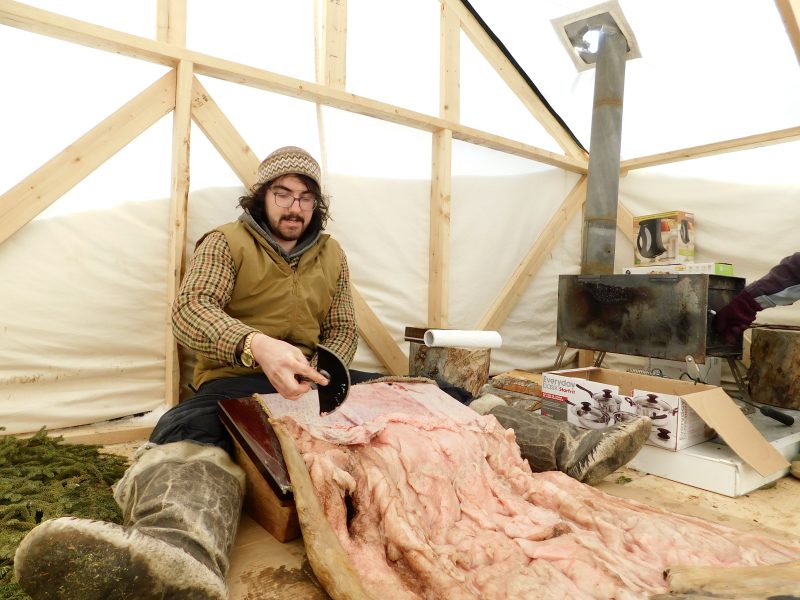
Cultural centre in Nunatsiavut is helping Inuit reconnect with culture and language
After winning the Arctic Inspiration Prize in 2024, Inotsiavik is offering Inuit in Labrador outdoor cultural programming, Inuttitut lessons, virtual programs, and more