
MUNL encampment demands divestment of funds tied to Israel and arms manufacturers
Students join international movement confronting the ongoing genocide in Palestine

They arrived before sunrise, cars quietly pulling into a parking lot at Memorial University. Some students arrived on foot, toting oversized bags; one glided in on a bicycle, a tent strapped to their backpack. At 5 a.m. the streets were still empty; the only onlooker was a curious fox that watched the gathering from a perch near the steps of the Arts building before it dashed across the road and vanished into a backyard.
The students were organized and went to work quickly. A large folding table went up with clearly-labeled kits stacked around it: first-aid kits, tent pegs, bins of food, twine and other materials. Out came the sheets and tarps. Tent poles snaked through the wet dewy grass as they were linked together.
“There’s always a learning curve with a new tent,” an organizer commented wryly while wrestling with the poles.
By 6 a.m. the initial group of a half dozen students had doubled in size and six tents were up in the stretch of grassy field between Elizabeth Avenue and the university’s Arts & Administration Building. There was still no sign of campus security, but a curious duck waddled over to investigate, eliciting cheers from students who offered it pieces of muffin.
Will you stand with us?
Your support is essential to making journalism like this possible.
With the initial tents up, organizers turned their attention to two large banners which they tied to the pine trees facing the road. One hand-painted banner read “Students For Palestine” in large colourful letters. The other read “Yazan’s Yard.” Encampments in other parts of North America have been dedicated to the memory of Palestinians; Memorial students dedicated theirs to the memory of Yazan, a nine-year-old child who died of starvation in Rafah following Israel’s invasion.
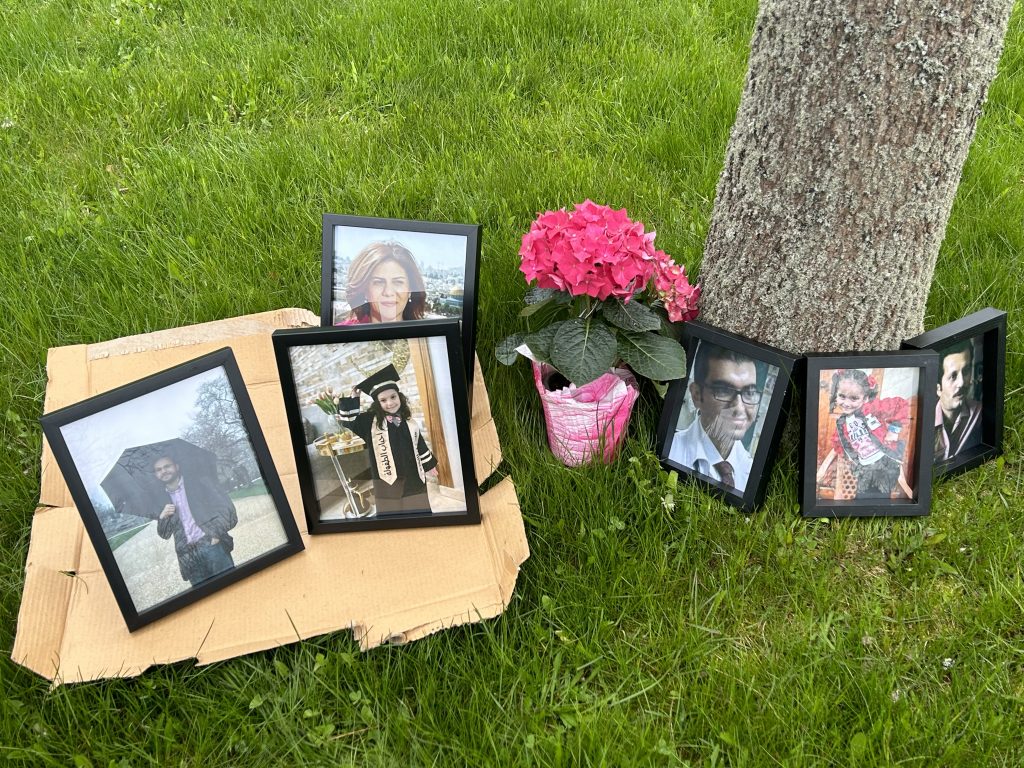
On the other side of the encampment, organizers set up a small shrine to the memory of other slain Palestinians. Framed memorial photographs of writers, poets, journalists and young children who have been killed by the Israeli army were interspersed among candles and laid around a vase of red flowers which organizers intend to plant at the encampment site.
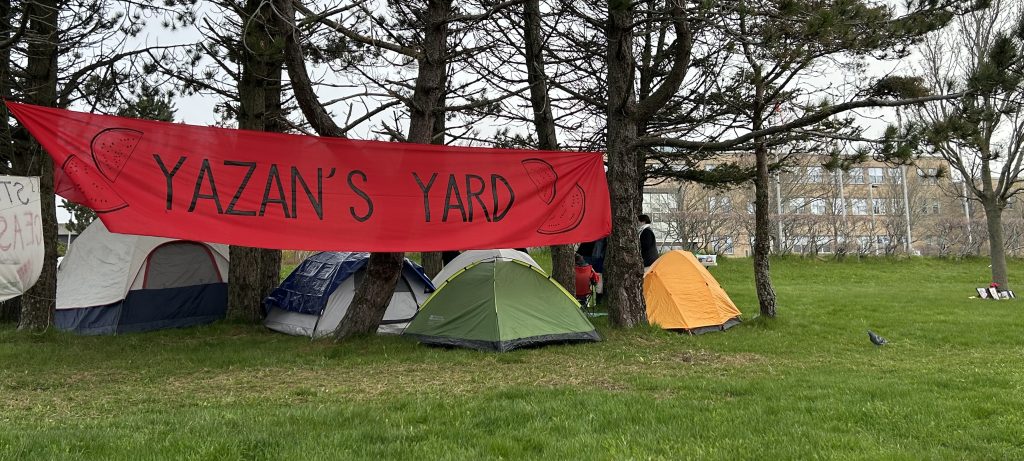
By 7 a.m. the initial set-up was complete. A campus enforcement car finally made an appearance, circling the encampment before driving on. By then the streets had come to life with morning traffic. Taxicabs slowed to a crawl as drivers studied the scene unfolding in front of the university. Encampment members cheered in response as several passing cars honked their support. One car swung into the laneway beside the camp, and rolled down a window, offering to go and buy the students coffee. They declined the offer since another coffee delivery was already on its way.
“I’m proud of you guys!” yelled the driver, who drove off honking.
Not long after, a large van pulled up. Two burly men got out and began pulling a sofa out of the back.
“Do you guys want it? It’s in great shape!” they yelled over the hedges.
Students applauded the offer, but after some deliberation declined that as well, since they weren’t sure how to keep it dry or dispose of it after the encampment ends. The men put it back in the truck, waved and drove on.
More tents were up at this point, and more students were arriving to campus. One of the first students on site was Nicolas Keough, director of external relations, communications and research with Memorial’s student union (MUNSU). On May 17, MUNSU unanimously passed a resolution of support for any future encampment at Memorial.
“I’m excited,” Keough said, surveying the encampment. “I think we see students taking action, taking things into their own hands.
“There’s a lot of Palestinian students on our campus, and a lot of Arab students on our campus, and a lot of Muslim students on our campus, and it’s really, really important for them and it’s really important for anyone who knows them — and it’s honestly important for all of us because no one is liberated until everyone is,” he continued. “I don’t see how we can all sit around while we see tens of thousands of people being murdered. We want to make sure that our money and our tax dollars are not being used to fund apartheid.”
Student encampments across North America
As Israel’s devastating bombing campaign and ground invasion of Gaza continues, student encampments have gone up across campuses in the United States, Canada and other countries around the world. They’re part of a boycott, divestment and sanctions (BDS) campaign designed to pressure post-secondary institutions to drop financial, cultural, or educational partnerships with Israel.
The BDS campaign was launched in 2005 by a coalition of Palestinian civil society groups, calling on supporters around the world to impose boycotts and divest funds from companies and groups affiliated with Israel. The campaign, launched in the wake of an International Criminal Court ruling against Israel the year prior, was modeled after a BDS campaign that helped bring pressure to bear on apartheid South Africa in the 1980s.
Organized by students, the encampments have been joined by faculty and community members and have been met with a variety of responses. In some cases, university administrations or local politicians have called in police to violently suppress the largely peaceful encampments. On April 24, riot police stormed an encampment at University of Southern California, arresting 93 people. A second camp quickly sprung up in its wake; it was raided by over 100 riot police backed up by helicopters on May 5. On May 10, police in tactical gear raided an encampment at the University of Arizona, firing pepper balls and tear gas at the students. On May 21, police raided an encampment at University of Michigan, also using pepper spray. Similar police raids have occurred throughout the U.S., with over 2,600 people arrested as of May 10.
The draconian responses of university administrations have pitted administrators and governing boards against faculty as well. On May 20, faculty voted to censure the president of Dartmouth College after she called on police to dismantle an encampment; it was the first time in the university’s history that faculty censured a president. At Columbia University, faculty passed a motion of non-confidence in their president on May 16, while the Senate at University of Southern California censured their president on May 8. These are largely symbolic gestures, but indicate the unprecedented scale of anger toward universities that are turning to police to quell student protest.
In Canada, Calgary police attacked an encampment at University of Calgary on May 9, using batons and flash-bang explosives; five people were arrested in that raid. On May 11, Edmonton police raided an encampment at University of Alberta, attacking protestors with batons and arresting three people. Protestors said one person was sent to hospital and accused police of using tear gas, which police have denied.
An encampment has been in place at McGill University in Montreal since April 27. On May 10 a Quebec Superior Court rejected the university’s application for an injunction to have it removed; courts also rejected a previous injunction application by a group of students to have the encampment removed. McGill vowed to keep trying. On May 20, Quebec police raided an encampment at the Université du Québec campus in Montréal, using batons and tear gas grenades, which students say led to several injuries. Students at several university encampments, including University of Toronto, have been threatened with suspension or expulsion over their participation. But encampments continue in several other parts of the country, including University of British Columbia, University of Ottawa, Dalhousie University in Halifax and elsewhere.
Despite the repression, encampments have produced momentum and victories too. Student encampments at Trinity College in Dublin, Goldsmiths University in the UK, and Brown University in the United States have all succeeded in forcing their universities to disclose and divest, or to hold votes on divestment. On March 28, the faculty association at Université de Montreal became the first Canadian faculty association to vote to divest. According to some sources, dozens of Canadian student unions and other organizations have voted to divest in recent years.
BDS campaign grows at Memorial
The ‘Free Palestine’ movement in Newfoundland and Labrador has been loud, creative and organized over the past seven months. Weekly marches have been held in St. John’s, while one-off events have been held in Corner Brook. Meanwhile, support organizations have emerged in recent months, including Labour For Palestine, NL Teachers For Palestine, Profs For Palestine, and others.
Protests have targeted local companies like Kraken Robotics for its connections to Israel’s military, and on May 18 a protest targeted a U.S. naval warship in St. John’s Harbour that organizers said was en route to Israel. A gathering last week in Bannerman Park commemorated the 75th anniversary of the Nakba, one of the early mass deportations of Palestinians following the dispossession of their homeland by Israel.
A BDS campaign has steadily grown at Memorial University in recent weeks. On May 10, dozens of students participated in a ‘die-in’ organized by MUN Students For Palestine on the steps of the University Centre.

That same day, the group outlined four key demands to the university’s administration: full disclosure of Memorial’s financial investments, full divestment from all arms manufacturing companies, divestment from holdings in entities that sponsor or are complicit in “Israeli occupation, apartheid and the current genocide in Gaza,” and a university boycott and cutting of ties with “all institutions and corporations complicit in Israeli war crimes, breaches of international law and human rights violations across Palestine, including Israeli universities.”
In response, the university stated that it has no partnership agreements with Israeli universities and no study-abroad relationships either.
On the matter of financial divestment, the university issued a noncommittal statement explaining that it had a large number of investment funds supervised by a variety of fund managers and committees.
Students requested a meeting for May 21 to discuss disclosure and divestment, but were told the earliest President Neil Bose could meet with them was May 27.
On May 17, MUN Students For Palestine held an afternoon sit-in at the Arts & Administration building. The same day, MUNSU unanimously passed a resolution of support for the BDS campaign, committing its support for any future encampment that might happen at Memorial.
Ara is one of the organizers with MUN Students For Palestine. She explained that the encampment is a way to pressure the university administration to stick to the May 27 meeting, and to adopt the policy proposals submitted by the student group. Those proposals outline a detailed plan for disclosure and divestment, which would see disclosure of direct investments by June 5 and disclosure of indirect or pooled investments by June 12. It would see the university sell off stocks and bonds held in arms manufacturers or other complicit funds, the adoption of an investment policy statement committing to avoid investments that facilitate human rights violations or violations of international law, and to work with university fund managers to divest pooled investments. The proposal also outlines additional dispute resolution clauses and a commitment to support the rebuilding of Palestinian universities and scholarship.
“Students don’t want our tuition going to fund the deaths of students in Palestine,” Ara said. “MUN has a lot of funding from our tax dollars and so it’s not just students that should support this, it should be everyone, because all of our money is funding a literal genocide.”
For Ara, what’s going on has a very personal connection. Her brother-in-law is Palestinian, as are her nephews.
“It’s really close to my heart. I love my family and it’s really hard to imagine my nephews’ whole family in jeopardy right now.”
She acknowledged that organizers were concerned with how Memorial might respond to the encampment, seeing the violent repression of other encampments and the harsh penalties imposed on students, including expulsion. But she says they feel it’s their right to protest and occupy space at Memorial.
“It’s our money that goes into the grounds here and this university – Memorial in particular – was made as a memorial to the fallen in the world wars. I believe it is our right as Newfoundlanders to go to Memorial and to stick up for what we believe in. This university was started as an institution so that Newfoundlanders could have an education to better themselves. And we are educating ourselves – this is what we believe in.”
On Tuesday afternoon Memorial issued a statement appearing to indicate it would not take action against the encampment. “Memorial fully supports freedom of expression and the right of members of our community to express themselves through peaceful protest,” the statement reads. The news cheered student protestors, who said they were also told the university might try to expedite the date of their meeting.
Education student Meg Scott was one of the volunteers who helped set up the encampment.
“I’m anxious and excited,” she said. “I’m really hoping that we won’t be here too long, that MUN will listen to student demands and at our meeting will come to us and say [they agree to divestment]. That’s what I’m hoping for, but I also hope that we can build community while we’re here.”
Luca, who’s planning to pursue a Masters degree in counselling psychology, agreed.
“I’m feeling excited,” she said. “We’ve seen a lot – over 76 years of occupation of Palestinian people in Gaza, the occupied territory, the massacres – and we want it to stop.”
Keough said he’s optimistic their efforts will bear fruit. “We know that when students protest, that’s what gets results. We know that this will work.”

Author
Related Articles
The RCMP vs. the media: Bracken trial approaches its endgame
This court case could decide the future of press freedom — and police oversight — in Canada

Accounting watchdog to investigate Deloitte over fake citations in $1.6M healthcare report
Chartered Professional Accountants N.L. is leading the investigation after Deloitte admitted AI was involved
St. John’s teen says community, activism helped her find her voice
13-year-old Nyala Adam was inspired by a local summer camp focused on social justice and cultural inclusion