
NDP hopes housing will resonate with voters in St. John’s by-election
Provincial NDP arms political newcomer Nicole Boland with party housing plan ahead of Waterford Valley vote

When Nicole Boland visited the Tent City for Change homeless encampment in St. John’s last winter, she had an “eye-opening” experience that she says helped lead her to provincial politics.
Ahead of a February snow storm expected to wallop St. John’s with 30-50 cm of snow, Boland appealed to the Liberals for help to keep those living in tents safe through the winter weather. But, she says, “nothing happened.” So she did what she could with community volunteers.
A registered social worker, Boland says she brought blankets, sleeping bags, soup, and as much as she could “physically pack into my car,” she recalls. Still, there was a sense of helplessness when she had to offer parting words to Tent City residents: “‘I really hope you’re okay for the next 48 hours.’”
When appeals to the government failed, she called NDP leader Jim Dinn’s office, “two or three times a week,” she says, “because we couldn’t get anywhere — we couldn’t get people what they needed.”
Will you stand with us?
Your support is essential to making journalism like this possible.
That’s how she came to appreciate what Dinn and the New Democrats were doing to advocate for unhoused people.
As the Tent City for Change encampment and protest gained public support, the NDP leader and his party affirmed their position that housing is a human right, as recognized in national and international law — something newly minted housing minister Fred Hutton would not say publicly at the time.
“Housing is a human right, and that’s where we have to start from until we accept that and cement it and get everyone on the same page,” Boland told The Independent in a recent phone interview. Otherwise, “it’s going to be really hard to make any progress.”
With the rising cost of living and lack of affordable housing pushing more people into precarious living situations, including homelessness, Boland and the NDP hope the issue will resonate with Waterford Valley voters in the August 22 provincial by-election, triggered by the recent resignation of MHA and minister Tom Osborne, who held the seat since 1996.
NDP releases housing plan
Last week the NDP released its housing plan, effectively equipping Boland with a policy package to sell voters on the way the party will deal with one of the province’s most pressing issues.
Boland points out the plan begins with a housing-first policy, a model that provides people experiencing homelessness with immediate, permanent housing. She says the party would bring together community partners to build a rapid response system.

The party’s plan also includes expanding funding for the First-Time Homebuyers Program. The province’s current program offers 50 per cent of the legal closing costs up to $500, and a repayable loan up to five per cent of the purchasing price. It is capped at 150 applicants.
The NDP also promises changes to the Residential Tenancies Act to stop landlords from charging fees to apply for, view, or hold rentals during the application process. They also want to end no-cause evictions. Newfoundland and Labrador, and Yukon, are the only provincial or territorial jurisdictions in Canada that have not prohibited no-cause evictions.
Renovictions are another problem the NDP wants to end by tightening loopholes in the current legislation, Boland says. Renovictions are when landlords evict renters in order to renovate the rental, and then put it back on the market with increased rent.
Boland says one of her favourite points in the plan is self-financing affordable houses through the Newfoundland and Labrador Housing Corporation. “If we finance these builds, we own them,” she says.
The plan states that because the housing corporation is publicly owned, it does not need to account for large profits, which would result in lower rent costs for tenants.
Lastly, the plan includes setting up a land bank exclusively for municipalities, community organizations, co-operatives and co-housing projects so they can use provincially owned land and Crown land to increase the affordable housing supply.
The Liberals’ position on housing
The Furey government released its five-point plan for housing last fall as public support for Tent City for Change grew. A roughly $65 million investment, the plan incentivizes the private sector to build roughly 500 new affordable housing units.
The NDP and PCs both criticized the Liberals’ approach and track record.
“For the eighth time since taking office, the Liberal government has made a promise to fix the housing crisis in our province. Eight years, eight promises, no action,” PC Leader Tony Wakeham said last October.
Meanwhile, Dinn called for an emergency debate to declare a housing crisis in Newfoundland and Labrador.
“The Liberal government has been promising a comprehensive housing plan since 2015, and failed,” he said. “Their inaction to address and ignorance of the crisis has led to tents being put up on the lawns of the Confederation Building.”
Dinn told reporters he felt the five-point plan was “cobbled together.”
When the Liberals defeated the NDP’s motion for an emergency debate, Dinn said the move “confirms that this government does not care that vulnerable people are living in tents, seniors are being forced out due to exorbitant rent increases, or that minimum wage workers are taking on multiple jobs to afford rent.”
The PC and Liberal candidates
Jamie Korab, the Liberal candidate for Waterford Valley, has the most political experience among his rivals. Since 2017, the former Olympic curler has served on St. John’s City Council.
In an email to The Independent, Korab, a real estate agent for RE/MAX, said that “access to safe, stable, and affordable housing is a major factor in personal well-being,” adding the Furey government has made significant efforts to improve access to affordable public housing, and to make market housing more affordable.
Jesse Wilkins, the candidate for the Progressive Conservatives, is a former police officer who worked for the Royal Newfoundland Constabulary and RCMP. The PC Party has not released a housing plan but Wakeham has publicly acknowledged that housing is a human right.
For his part, Wilkins told The Independent that “every person should have a clean and warm place to lay their head at night,” and that assistance with housing should be contingent on their own efforts.
“Be that through their own working, and working hard, every day to pay the bills and get their house. And if those people that are in dire special needs, then we have an obligation as well to look after those people.”
Wilkins added that if the PCs win the general election, anticipated next year, the party will release housing legislation that will “address the needs of both responsible renters and diligent landlords, to encourage landlords to keep rents stable.”
The party’s plans would include promoting home ownership among renters who could qualify for a mortgage, which he says would then open up their rentals for others.
It would also implement a home-ownership tax credit for people who were previously renters as an incentive to help renters purchase a house, breaking down those barriers, and making housing more affordable, Wilkins said.
Like the NDP, the PCs would also release government-owned lands to create affordable housing.
“We could pressure the municipalities to bring down the barriers, to help open up this land so that we can get more affordable housing available for people,” Wilkins said.
Housing as a human right
In 2019, Canada recognized housing as a human right for the first time in federal law. The new legislation included the creation of a Federal Housing Advocate, an independent, nonpartisan watchdog to hold the government to account on its progress toward realizing Canadians’ right to housing.
In a report on homeless encampments released last winter, Marie-Josée Houle called on provinces and territories to “adopt provincial or territorial legislation recognizing the human right to adequate housing as defined in international law.”
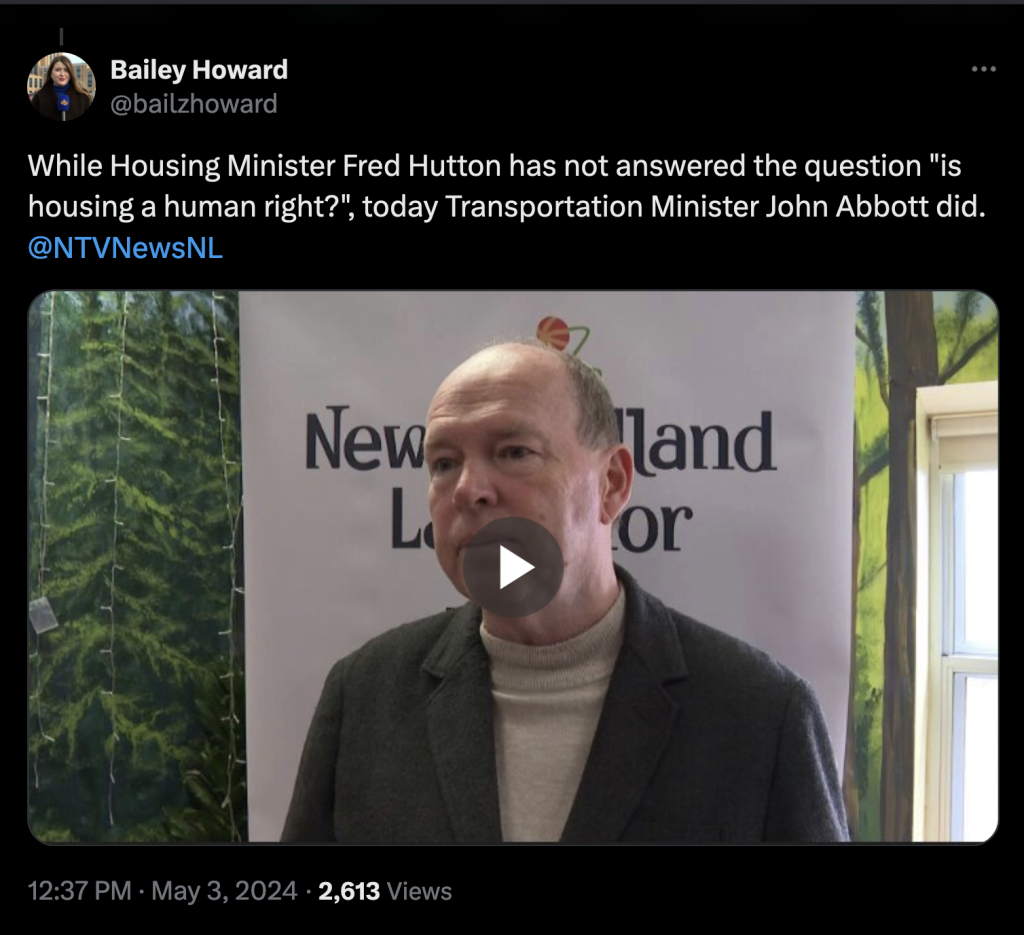
To date, the provincial Liberals have not publicly stated that housing is a human right. The only exception came in May, when then Transportation Minister John Abbott awkwardly admitted to NTV that he shares the federal housing advocate’s view. That only happened when reporter Bailey Howard asked him point blank. “Yes I do,” he replied. “Yep.”
The federal advocate also urged governments to end forced evictions of encampments “and put in place alternatives that are designed following meaningful engagement with encampment residents,” while ensuring encampment residents “have access to the basic necessities they need to survive and live in dignity.”
In April, Abbott oversaw the province’s eviction of Tent City residents from the Colonial Building grounds at Bannerman Park. Then, in a July cabinet shuffle, Furey appointed him as the new housing minister.
Building more homes only part of the solution
Canada Mortgage and Housing Corporation estimates that provinces need to build 60,000 homes by 2030 to tackle the housing crisis. That’s roughly 10,000 new homes per year, far beyond the province’s annual average and likely impossible in the current context, according to experts.
But the solutions needed to tackle housing instability go beyond new builds, say advocacy groups.
A recent report from the National Right to Housing Network (NRHN), a collaborative effort among experts and advocates to eliminate homelessness in Canada, says the financialization of housing has led to the rapid loss of affordable and available housing.
The NRHN recommends incentivizing the construction of new affordable housing and providing funding to non-market housing providers to acquire, renovate, and operate existing housing rentals.
The report also recommends decision-makers engage “meaningfully” with affected communities, address “underlying systemic racism, colonization and socioeconomic inequality, especially the rights of Indigenous peoples,” and better collaboration between federal and provincial or territorial governments.
The network says “the biggest barrier to implementation of the right to adequate housing in Canada is its jurisdictional divides.”
While the NL Liberals’ five-point plan prioritizes the construction of new rentals and repurposing existing spaces, critics have said it doesn’t do enough to protect renters currently being displaced by landlords in pursuit of greater profit margins.
The NDP plan acknowledges the role policy and regulation play in addressing the housing crisis. In addition to calling for an end to no-cause evictions, it also proposes a cap on annual rent increases based on inflation, municipal taxes, and the consumer price index, and a “tightening” of existing loopholes that landlords use to justify renovictions.
Boland says she wants to fix current programs and policies and invest in public-owned land rather than housing projects that benefit developers first and foremost.
“We want to work with what we have,” she says. “We want to change this legislation, change the laws, keep people supported, and then any money we do spend, we want […] that going into the community.”

Author

Related Articles

Harlow operating within budget before Memorial decided to sell it: former head of U.K. campus
Emails show President Janet Morrison ‘inundated’ with messages over sale of Harlow Campus, while documents suggest former campus head was making progress at reducing costs

Watchdog says it can’t investigate Deloitte over use of AI in $1.6M government report
Internal emails reveal Deloitte helped craft government’s response to The Independent’s investigation
Mother of incarcerated youth calls for dedicated addiction care at new St. John’s prison
Government scant on specifics but health authority says new prison will have two new mental health units and larger clinical space for psychiatry and opioid dependency