
‘Not factual’: RCMP has no evidence to support MP Clifford Small’s allegations of crimes in Central Newfoundland riding
The Conservative MP’s depiction of crime in Coast of Bays—Central—Notre Dame was used to support Pierre Poilievre’s controversial reform policies
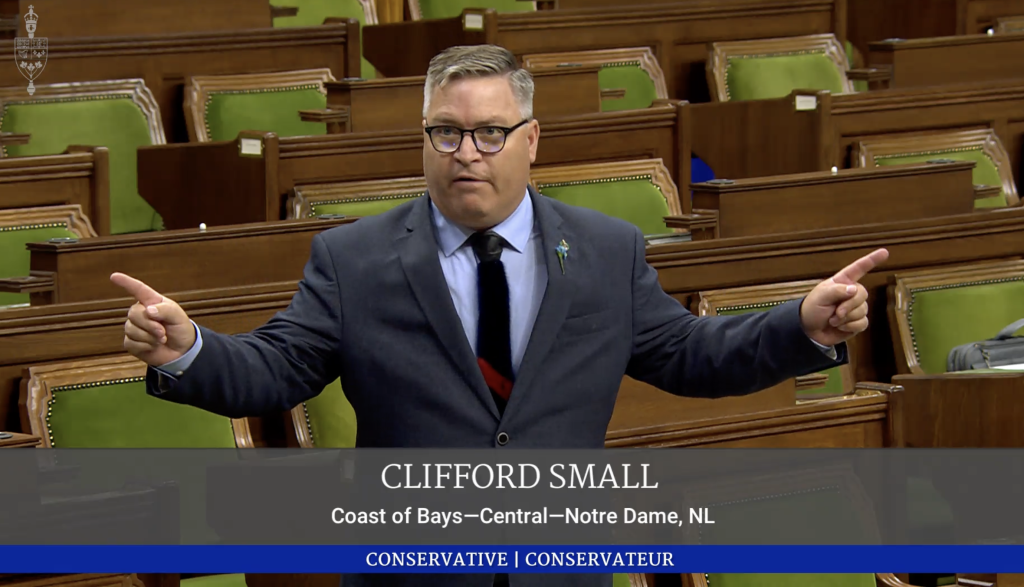
If Clifford Small’s recent claims about crime in his Central Newfoundland riding are true, the RCMP would appreciate some details.
The federal police, who have jurisdiction in most rural parts of the province, say they’re not aware of any reports that would support some of the Newfoundland and Labrador MP’s recent claims in the House of Commons, including a shocking allegation that teenage girls are being sex-trafficked in small communities in his riding.
The Conservative member for Coast of Bays-Central-Notre Dame told his fellow Parliamentarians there are “towns of fewer than 1,000 people in my riding with five crack houses operating, where teenage girls are being sold into prostitution.”
Small made the claim during a Sept. 26 debate on his party’s first non-confidence motion to bring down the Trudeau government and force a federal election.
Will you stand with us?
Your support is essential to making journalism like this possible.
“These are children of the people we represent. It is time to stop the crime,” he added.
But the RCMP say they “have no matches of crime reported that would support this statement.”
The force “has resources to investigate incidents of human trafficking,” RCMP Media Relations Officer Jolene Garland told The Independent in a Sept. 27 email. “Anyone having information about crimes being committed in their community is encouraged to report the information to their local police detachment.”
During his statement, Small also claimed that “terrified seniors” in the community of Stoneville told him at a town hall event they have “been threatened that they would be burned out of their homes or burned in their beds.”
The RCMP confirmed it’s investigating “two reports of threats uttered in the community” that are “related to one another,” Garland said in an email. “Charges have not yet been laid and the investigations are continuing,” she said. “These investigations are involving two specific families and are not a general issue in the community.”
Meanwhile, in Lewisporte, Small claimed, “an RCMP squad car was vandalized” and “spray-painted with the words ‘back off’ by criminals in rural Canada.”
The RCMP says Small’s statement “is not factual,” and that they “did not have any recent incidents of a vandalized police car in Lewisporte.”
Small also claimed that “seventy-five-year-old retirees who worked hard all their lives for a safe Canada are sleeping with baseball bats next to their beds in Gander.”
Gander Mayor Percy Farwell says while it’s possible Small has heard of seniors in the community sleeping with bats next to their beds, it’s not a situation he’s aware of.

“I don’t know why they would be,” Farwell says. “We don’t have much reporting—or any reporting, really—of home invasions or violent crime, that kind of stuff.”
The Independent reached out to provincial MHAs whose ridings overlap with the federal Coast of Bays-Central-Notre Dame riding, asking what they think of Small’s characterization of crime in their constituencies.
Progressive Conservative members Jim McKenna, Pleaman Forsey, Chris Tibbs did not respond, nor did Liberal MHA Derek Bennett.
Digital Government and Service NL Minister Elvis Loveless represents the provincial riding of Fortune Bay-Cape La Hune, which sits in the southern part of Small’s federal riding. In an email to The Independent, Loveless said that “without a doubt I have not heard that in my district, as described by MP Small.”
The Independent left multiple messages for Small inviting him to clarify his statements but did not receive a response by the time of publication.
Crime is up, but the solutions aren’t so simple
On Sept. 26 Small accused the Liberals and NDP of letting “this rot and this crime creep into rural Canada,” parroting Conservative leader Pierre Poilievre, who has revived the old conservative talking point of getting tough on crime.
Poilievre has blamed the Liberal government for causing a “crime wave” in Canada “with policies that allow the same repeat violent offenders loose in our streets to terrorize innocent people,” he said in April 2023.
Trudeau and the NDP, he said, “have given us crime, chaos, drugs, and disorder. It is a simple cause and effect. You let the same violent people back on the street the same day they’re arrested, they will do more violence. And that’s why the data shows that when common sense Conservatives were in power, crime went down 23 per cent. When this crazy coalition of Trudeau and the NDP have been in power, crime is up 32 per cent. Simple cause and effect.”
Poilievre claimed that, in a single year in Vancouver, “the same 40 people were arrested 6,000 times […] that’s 150 arrests per offender per year.” He refers to Canada’s bail policies as “catch and release,” while offering Canadians a more “common sense” plan to “bring jail, not bail” for repeat offenders.

To some, the tough-on-crime proposal may sound like common sense policy, as Poilievre puts it, but in reality things aren’t that simple.
Michael Spratt, an Ottawa-based criminal lawyer who often appears as an expert witness before the House of Commons and the Senate, has argued in response to Poilievre’s claims that crime data is “notoriously complex,” and that “arbitrary endpoints, cherry-picked data, and small sample sizes can all be exploited by political grifters looking to stoke fear.
“What is clear is that historically speaking, we live in one of the safest periods in history. Canada’s Crime Severity Index, a measure of the seriousness of police-reported crime, has decreased by 6 percent in the last decade and a staggering 31 percent since 2000,” he wrote last year.
“This reality can be lost when we focus too narrowly on monthly or yearly numbers,” he continued, pointing out “there was an increase in national violent crime from 2018 to 2019, but the crime severity index also increased by more than 5 percent the last year the Harper Conservatives were in power.”
Spratt also called Poilievre’s claim that the same 40 people in Vancouver were arrested 6,000 times “bullshit.”
“If true, this would mean that, on average, these people were arrested 150 times in one year, almost once every other day,” he said. “I have never seen anything like this in criminal court over two decades. No one has. Even 150 charges per year, assuming multiple charges per arrest, is unheard of. At this rate, anyone who is committing violent or any criminal offences is not getting bail.”
Spratt believes Poilievre misrepresented data by conflating actual arrests with police interactions, which “does nothing to support [his] contention that there is a ‘catch-and-release’ problem driving violent crime.”
Poilievre has promised, under a Conservative government, to deny repeat violent offenders access to bail. But critics say that proposal ignores both research and Canada’s constitution.
Last year Nicole Myers, a Queen’s University sociologist, told CBC Poilievre’s suggestion that repeat offenders should automatically be denied bail “completely ignores the foundational principles of our criminal justice system,” pointing out that the right to be released on reasonable bail is protected by the Charter of Rights and Freedoms. “It’s a right [that] has been repeatedly affirmed by the Supreme Court.”
Last spring Poilievre also suggested a Conservative government would take the unprecedented step of invoking the notwithstanding clause, which has never been used at the federal level, to sidestep court decisions around bail.
Trudeau shot back, saying the Tory leader “just proposed to override the fundamental freedoms and protections of Canadians,” and to “override the Charter that is there to protect women, minorities, [and] 2SLGBTQ+ communities. That’s not right, and it’s not responsible.”
Poilievre, for his part, has insisted his policies would be constitutional.

Legalities aside, many have argued the Tory leader’s tough-on-crime approach won’t work and isn’t supported by evidence.
Last February he said a Conservative government would impose mandatory minimum sentences on people convicted of extortion and auto theft. The announcements prompted law professor and former Stephen Harper advisor Benjamin Perrin to write an op-ed detailing why mandatory minimum sentences represent “a grave policy failure and cheap politics.”
Once a proponent of mandatory minimum sentences, Perrin says years of research and evidence show that mandatory minimum penalties “are ineffective at reducing crime, may actually increase recidivism, are highly vulnerable to being struck down by the courts as unconstitutional, can increase delays in an overburdened system and perpetuate systemic racism.”
He says Poilievre’s plan “may actually backfire, leading to more crime in the long term.”
To an extent, Poilieve’s pressure on Trudeau has worked.
In December 2023 the Liberals introduced new bail reforms that apply a “reverse onus” on certain repeat offenders, who will now have to prove to a court why they should be released on bail. The new provision replaces the previous standard of a Crown prosecutor having to convince the court why a person facing charges should remain incarcerated until their trial.
In January last year the Canadian Civil Liberties Association and Elizabeth Fry Society penned a joint letter to Trudeau and then-Justice Minister David Lametti cautioning the Liberals against the legislative amendment.
Reverse onus provisions “fail to acknowledge the inequality in power and resources between an accused person and the state. They also invert the foundational principle of the presumption of innocence,” they wrote.
“When a person’s liberty is at stake, the state should bear the onus of proving that detention is justified – rather than an accused person bearing the onus of demonstrating they ought to be released.”
In their letter, the groups urge the government to base legal and policy decisions “on evidence, not anecdote.”
“To enhance public safety, the evidence urges us to invest in what we know has an impact on crime rates,” they write: “supporting people experiencing poverty, precarious housing, mental illness and substance use; enhancing social welfare supports; increasing investments in education and health care; keeping people in the community; and improving reintegration programs and supports for those who have been incarcerated.”
‘Playing politics in the worst kind of way’
Despite the Conservatives’ misrepresentation of crime data and their oversimplified policy responses — or perhaps because of them — Poilievre’s talking points are resonating with many Canadians.
An Abacus Data survey last month found that if an election were held in early September, 43 per cent of committed voters would have supported the Conservatives, 22 per cent would have voted Liberal, and 18 per cent would have gone with the NDP. The data showed a four-point increase in the gap between Liberal and Conservative support from August to September.
The same poll found that crime is an important issue for many. “Areas where more Canadians think things would improve rather than get worse under a Conservative government are economic growth, the deficit, crime, management of immigration, and Canada’s reputation around the world,” Abacus CEO David Coletto said.

But Small’s statements about crime in Central Newfoundland reveal how the Conservatives are manipulating crime data and generating fear — and support — among residents who see crime happening in their communities but lack familiarity with crime research and policy.
Amanda Bittner, a professor of political science at Memorial University, says the socio-economic conditions most Canadians are living in today is a better place to start when thinking about solutions to crime.
“I do believe that crime is up. I believe poverty is up. I believe desperation is up. And the solution to those things is not more police. The solution to those things is dealing with the roots of the problems, which I’m not hearing [from politicians]. I’m not hearing a lot of solutions on that front, whether locally or nationally or internationally,” she says.
“Just existing right now is hard. The cost of living is so high, the housing shortage, the cost of housing, the cost of food — all these things are really, a lot,” she continues. “Even those who are most privileged can feel that squeeze. And therefore, imagine if you’re not [privileged] and what that is like. What are your solutions, and how do you deal with this? How do you feed your family? It’s a lot. So I think that it’s really easy for political parties to seize on that, to make political hay.”
Mayor Farwell agrees, saying he wants to see concrete, evidence-based solutions put forward.
“If someone wants to paint a very dire picture, then in the next breath I want them to tell me what they’re going to do to fix it — not just to keep repeating it so I keep feeling more nervous about it,” he says.
Bittner says that by omitting evidence-based solutions and relying on rhetoric to get votes, then politicians are “playing politics in the worst kind of way, by spreading misinformation and disinformation and fear.
“Fear mongering is not great for democracy.”

Author

Related Articles

New play portrays barriers facing N.L. women in politics
Women won the right to vote a century ago but are still underrepresented in public office. St. John’s playwright Ruth Lawrence’s play tackles that head on.

Meaningful response to homelessness requires more than new builds, says NDP leader
Jim Dinn’s comments come in response to PC’s announcement of 10 new ‘micro homes’ in St. John’s
Muslim community commemorates 9th anniversary of Quebec City Mosque shooting
Anti-hate advocates say there’s still work to be done to combat Islamophobia in the province