
Students march to legislature, protest rising cost of post-secondary education
Ahead of the provincial election, they praise NDP policy, note PCs have ‘caved a little,’ and say the Liberals need to do a lot more to earn the student vote
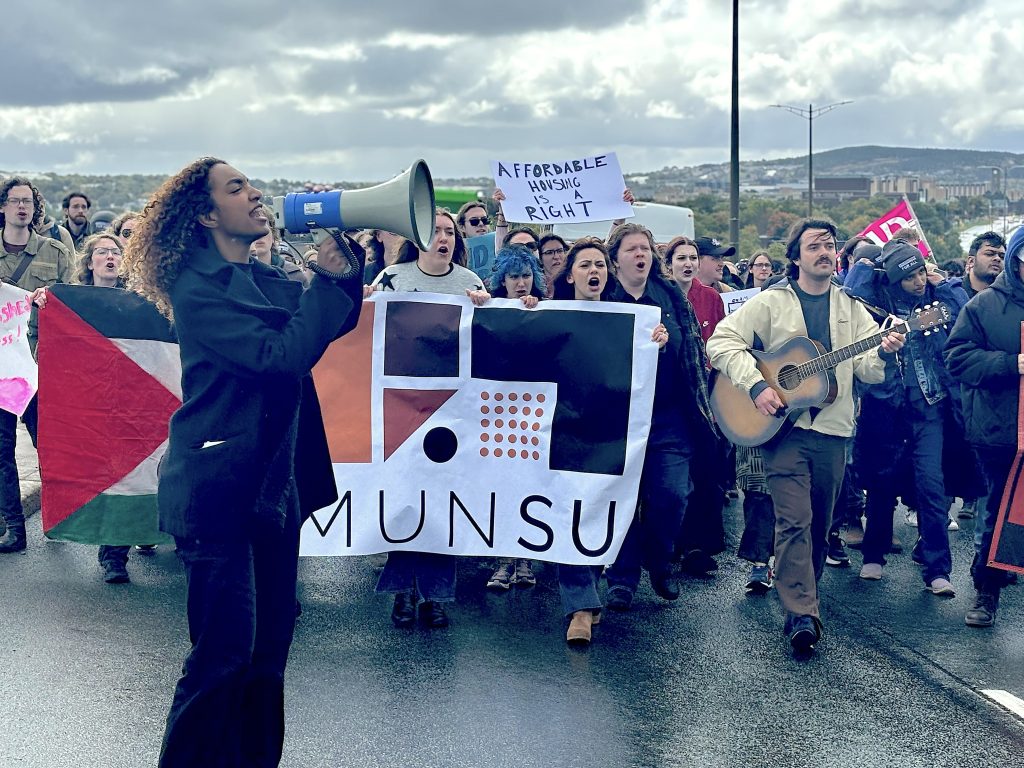
Memorial University students braved the downpour, wind, and cold temperatures in St. John’s Wednesday to call for a tuition freeze, paid work terms, and affordability during their annual post-secondary day of action.
“The reason why people still showed up is because we’re frustrated. Whether it rains, there’s a storm, or whatever, people are always going to show up because these are things that we’re directly affected by. These are our realities,” Memorial University Students’ Union Director of Campaigns Rana Abuidris said.
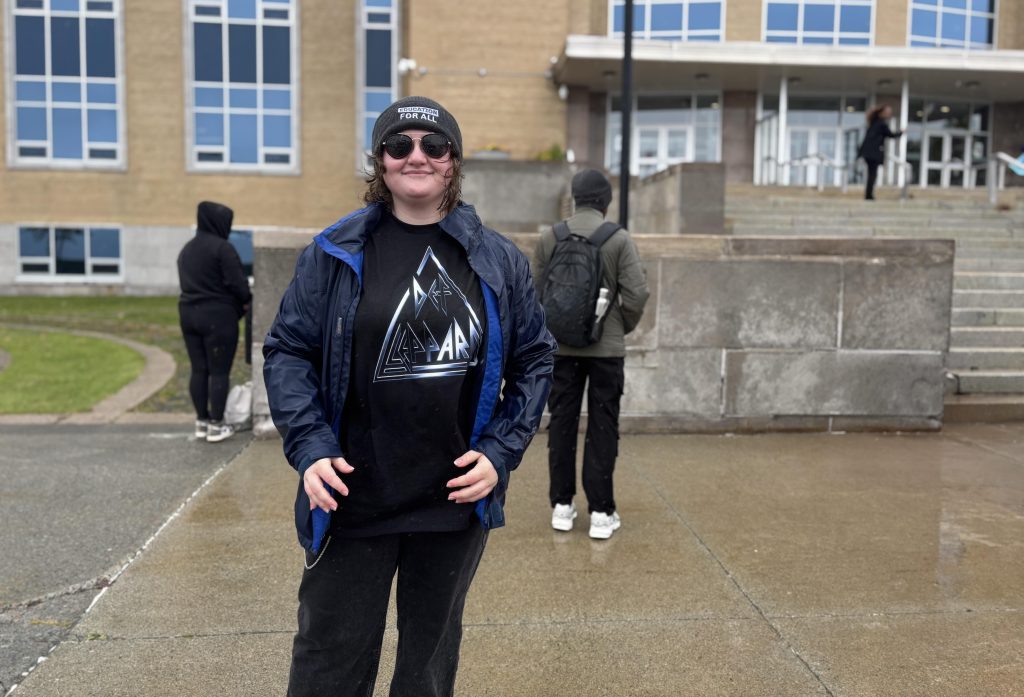
Sophia Lydiate, a first-year student who suffers from scoliosis, said she will have body pain after walking in the rain, but that it was important to be at the rally. “For people with disabilities, it is so impossible to see a future in a university when you have to support yourself completely and pay the tuition,” she said.
The 19-year-old said she doesn’t know if she could have attended university without her parents’ financial support, adding that if tuition hikes continue, students with disabilities who are unable to work while studying may be pushed out of the system.
Will you stand with us?
Your support is essential to making journalism like this possible.
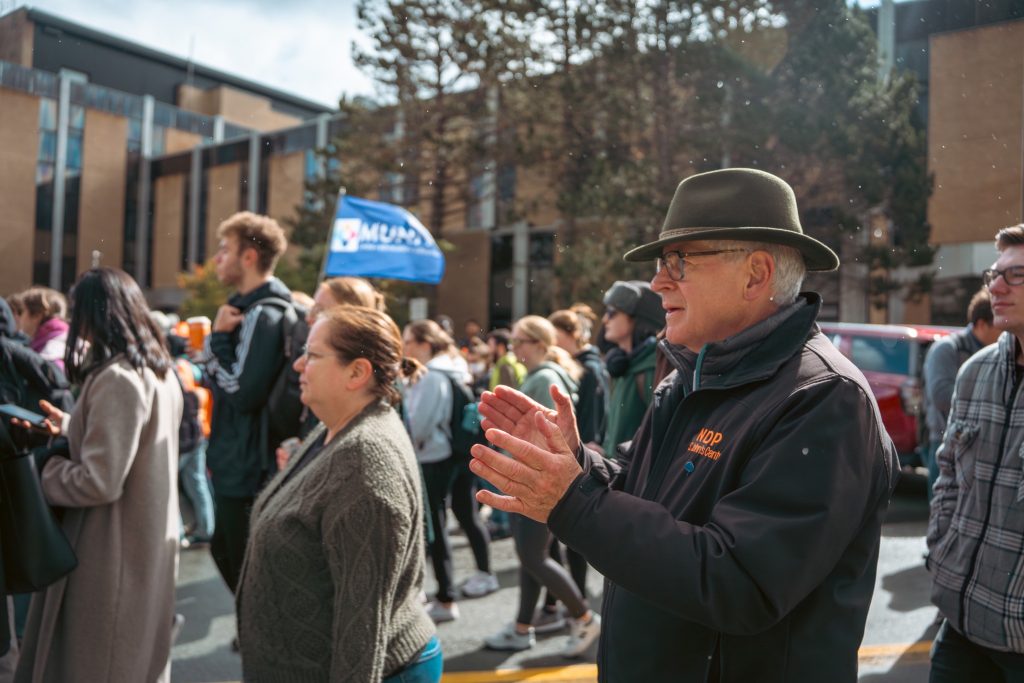
The protest, dubbed “1999’s Unfinished Business,” draws parallels to the 1999 student protest that resulted in a 22-year tuition freeze. The march started at the MUNL Clock Tower, with speeches from Abuidris, Canadian Federation of Students NL Chairperson Nicolas Keough, and others.
With two weeks remaining until the provincial election, students expressed disappointment over the lack of promises from political parties regarding tuition freezes, paid work hours, and other student-related issues. “The government has been bleeding students dry, and we’re not taking it anymore,” Keough said as the crowd cheered on. “They raise tuition, they cut funding, they expect us to work for free, and then they have the nerve to ask us for our vote.”
Keough said the efforts students have made with the ‘Bring Back the Freeze’ campaign have prompted some politicians to make promises in response. The initiative, organized by the Canadian Federation of Students – NL, calls for a tuition freeze and a return to pre-2022 tuition rates. “This is all because we forced their hand, because students have proven themselves to be an important voting block that cannot be ignored,” he said.
Where the parties stand
Provincial NDP leader Jim Dinn has pledged to freeze tuition and return fees to pre-2022 levels, which the party says will cost $49 million in the first year.
Keough said the Progressive Conservatives also “caved a little”. Party leader Tony Wakeham has promised a tuition freeze until issues relating to maintenance and governance are resolved.
The PCs have also promised to retain healthcare workers in the province by offering paid work terms, job offers at the beginning of their studies, and a tuition refund.
There was particular dissatisfaction with the Liberal Party, though. “The Liberals have been silent,” Keough said to boos from the crowd. “We called, we wrote, we asked, and they gave us nothing, no plan for tuition.”
While standing on the steps of Confederation Building after the protest ended, Abuidris said things have become harder for university students during the Liberal Party’s decade in office. Drenched and shivering from the cold, she said: “John Hogan, you failed us students, you really did, and if you want our vote this election year, do better.”
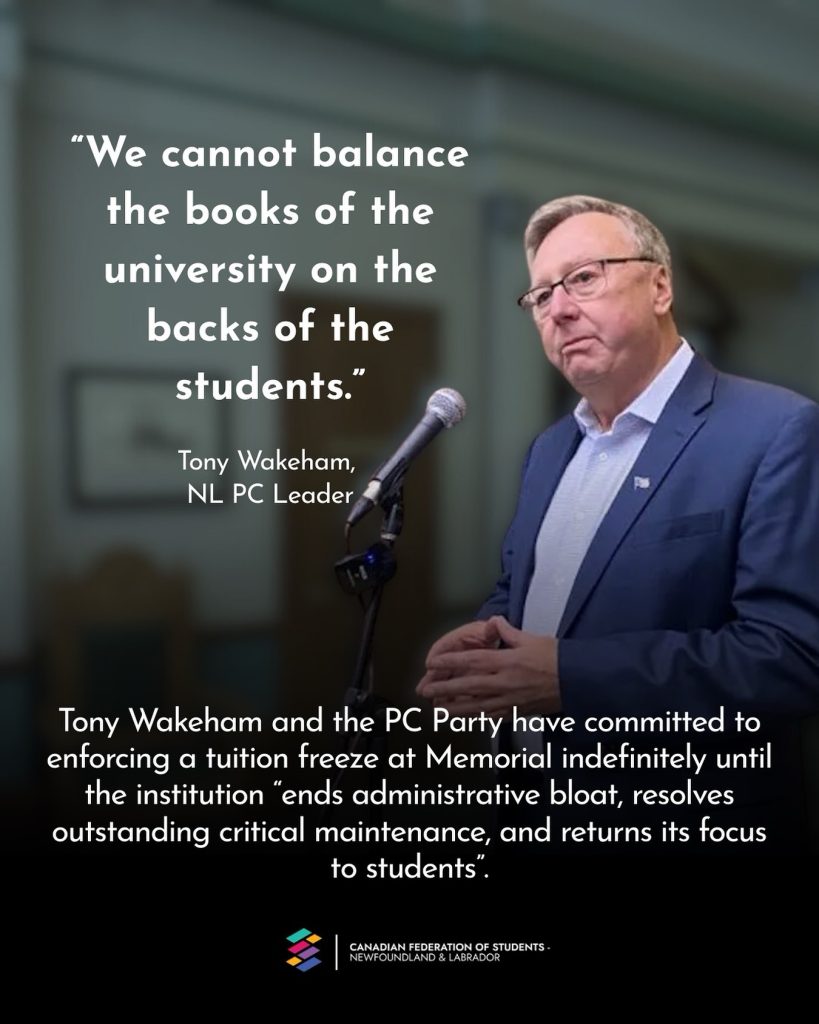
In 2021, Memorial University announced it was ending the 22-year tuition freeze due to government cuts. At the time, the Furey government said it would reduce MUNL’s budget by $68.4 million over a five-year period, with an annual reduction of $13.7 million beginning in 2022. The following year, the province announced it would provide $10 million to the university to help offset renewal fees for 2023.
In 2025, the Liberals announced a pause on the $13.7-million cut to the tuition offset grant for the 2025-2026 year. Memorial students had requested that the 4 per cent tuition hike planned for the year be paused in light of the government’s announcement. Instead, MUNL announced it was directing the funds elsewhere to create “a more learner-centric, sustainable and efficient institution.”
Tuition hike and unpaid work fuel voter frustration
Protestor Gailene Evoy said the NDP has some of the strongest policy commitments for Memorial University students and encourages voters to reconsider their perception of the party as a “throwaway vote.” If enough people voted for the party, Evoy said, their votes would not be wasted.
The 22-year-old said her younger brother, who recently started at MUNL, pays nearly triple what she did when she enrolled. “It’s ridiculous […] we’re lucky enough [that] our parents saved up the same amount of money for both of us to go to school. And he’s gonna drain it so much quicker than I did because of how much tuition has gone up.”
In 2021, a three-credit course cost $255; in 2022, the same course for a new student cost $600. In 2025, a new Canadian student pays $675 while international students pay $2,250 for the same course.

Morgan Penny, another protester, said she had previously viewed the Liberals as “a safe vote,” but has decided to shift her support to the NDP this election. “I can’t just keep playing safe, because it’s not really playing safe. There’s no change, it’s not better,” she said. Penny is studying education, and said she is concerned about the unpaid work she will eventually have to complete.
Evoy said she was surprised to hear Amy White, the Memorial University representative for the Canadian Association of Pharmacy Students and Interns (CAPSI), mention at the protest that pharmacy students work 1,760 unpaid hours and pay roughly $13,200 to do that work.
“It’s unfair,” Evoy said. “You’re doing the same amount of work as anybody else in the field and you’re going into debt, or, like, you’re really having to pay to work. I think it’s ridiculous.”

Author

Related Articles
May Day Rally Shows New Face of Today’s Labour Movement
Turnout for May 1 march and rally in St. John’s one of the biggest yet in this province
Recimply the Best: Pitch and Pick Competition Winner Aims to Reduce Paper Waste
Recimply won big at Genesis’ annual Pitch and Pick competition last week. The startup is solving the problem of non-recyclable paper receipts.

Coming Home Queer for the Very First Time
For three days in July, queer Newfoundlanders and Labradorians from all over the world celebrated a rural homecoming 30 years in the making.
As Innu exhibit opens in Labrador, Grand Chief says truth must come before reconciliation
Innu Nation Grand Chief Jodie Ashini says it’s disappointing to open the Innu Pakassiun exhibit without the provincial government’s participation, but Innu know their history and who they are

Liberals’ Bill C-39 a wake-up call for Canadians: Avi Lewis
‘Cracks starting to show in the Carney consensus,’ Lewis tells N.L. NDP convention in St. John’s
As NDP convention gets underway in St. John’s, will N.L.’s third party prioritize growing rural support?
Former party candidates say it’s a steep hill to climb, but there are ways