
Trans March 2024: ‘The struggle is more important than my fear’
Amid a rise in right-wing hate and repressive policy shifts, community marches in St. John’s for trans rights
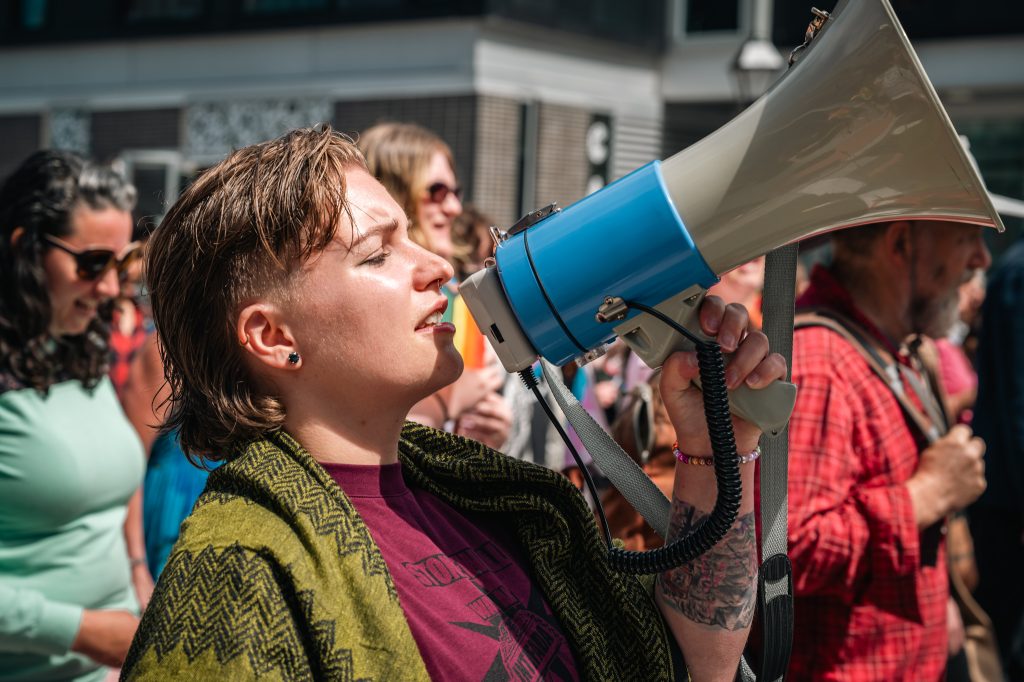
Photos by Tania Heath
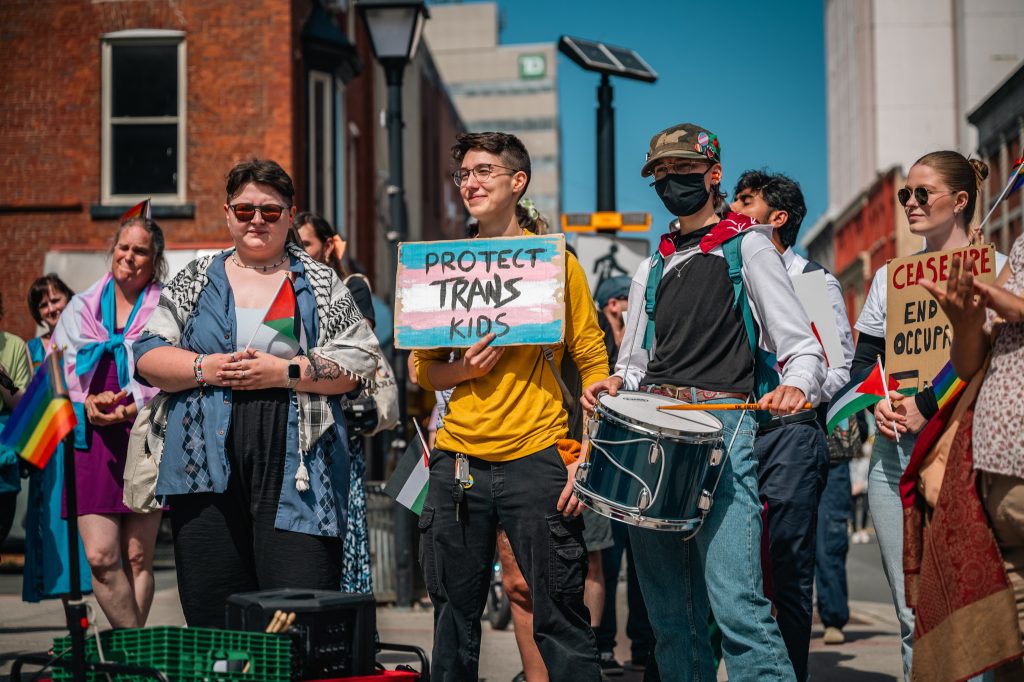
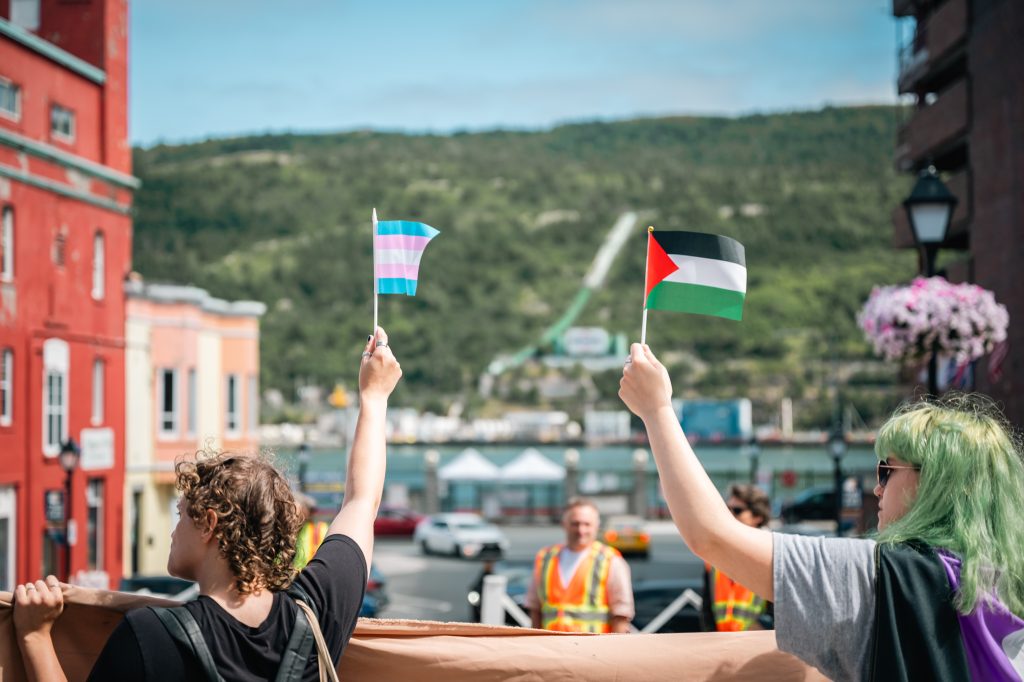
On July 27 about 150 activists and community members gathered at Harbourside Park in downtown St. John’s for the 10th annual Trans March. For many, the event comes at a fraught time, with Conservative politicians in several Canadian provinces following their U.S. Republican counterparts in targeting rights of trans, gender-diverse and queer people. But for those who attended Saturday’s march, the event was a positive reminder of the importance of building queer and trans community.
Vanessa Strang went to her first trans march two years ago, not long after coming out.
“It was kinda scary,” she told The Independent. “I wasn’t sure what I was going for yet so I was wearing, I think it was a dress and bad makeup, just stuff when you don’t know what you’re doing and you’re experimenting. But everyone was so nice and welcoming. Queer community —- it’s the first time I really felt it. I was thinking: ‘Maybe this isn’t for me,’ until then, and that kind of solidified it.”
Will you stand with us?
Your support is essential to making journalism like this possible.
She’s come back every year since.
“I think it’s important to be here for people who are new to this community,” she said. “Being trans is really really hard, and you need a community around you, and a lot of people don’t have that, especially in Newfoundland, especially in a lot of rural places. So an event like this where we’re being loud and saying ‘Hey everybody who’s trans, come here!’ is really good for community-building, to build connections that will support you through the rest of your life.”
This year’s march, held in collaboration with Palestine Action YYT, saw plenty of cis allies in attendance as well. Liz Ohle was one of them, and says it’s important for cis allies to show up at trans events.
“None of us, especially in this current climate, is going to make it without allies and so I’m here as an ally,” she told The Independent. She’s concerned by the rising anti-trans rhetoric coming from right-wing politicians in the country.
“I think it happens merely as a vote-getting scheme, not because of actual beliefs that people have,” she said. “It’s a good way for them to mobilize people into their corner. It’s not like it’s done in an honest way even, it’s done specifically to share misinformation.”
Attending the rally was personal for her too, as a gesture of support for a non-binary relative.
“I’m putting up a flag for my [relative], who’s non-binary, and I think it has meant a tremendous amount in their life that they have a queer aunty, and a queer aunty that supports them in who they are. It makes a difference in their life. They live in Colorado. They could have been at that nightclub that night. Blessedly they weren’t.”
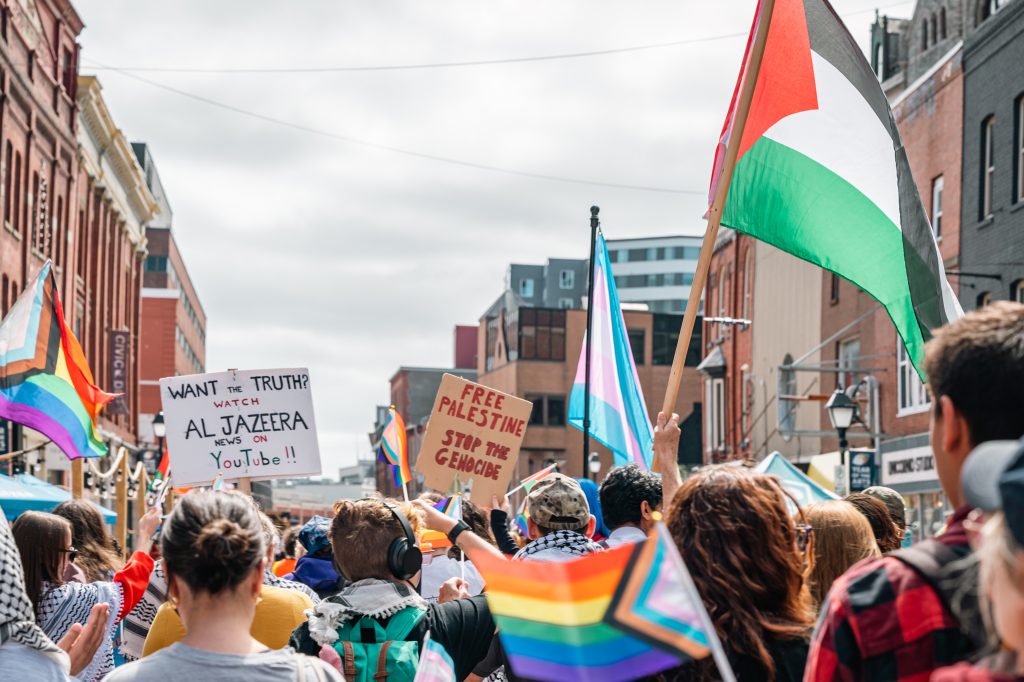
A. Powell attended the march with their child.
“We call it a trans march, but I really feel like it’s so much more than just that,” they told The Independent. “We’re taking up space as trans people, to say, ‘We’re all humans, and one of the only things we actually own is our bodies.’
“I’ve spent most of my life trying to make other people comfortable and listening to them about who I should be and what I should do with my body and how I should look and what I should wear, and I’m sick and fucking tired of it. I’m about to be 51, so everybody can go fuck themselves and I’m going to be who I am and I’m going to support other people to be who they are.”
Liz Fagan has also been attending the Palestine solidarity marches since they began, and said they were drawn to the support and inclusion they’ve found at the weekly gatherings.
“It felt like my first Pride,” they said. “It was like immediate community, and everyone, even if you don’t know who they are, the fact that we’re all here means like we share really similar values, and I couldn’t get over how moved I was by a sense of witnessing.”
Fagan said that as a trans person, the hostile rhetoric of right-wing politicians is not new.
“I’ve never felt safe. I’m used to feeling threatened and scared all the time. So this is not new to me. The only compliment I ever accept is when somebody tells me that I’m brave. I go: ‘Yes I am.’ I’m always terrified and I do it scared. So it doesn’t matter, even if I weren’t trans I would still be here and just as vocal, because we’re already targeted anyway, so it doesn’t matter if you’ve got two or three targets on your back, I have nothing to lose. And actually it’s a privilege to be able to fight, to fight for all these people.
“Because in the grand scheme, my fear doesn’t matter. The struggle is more important than my fear. So it’s very easy to put aside.”
The rally included brief speeches from some of the original Trans March organizers, including Jude Benoit.
“While we’re here in solidarity with Palestine this year we’re also fighting for a lot of things including safety in schools and trans rights and trans health care,” they told the crowd. “It’s exhausting, the fight for multiple movements really is. But look at the turnout, and look at how we’re doing, supporting each other and holding on to each other. It’s incredible.”
One of the speakers at the rally was 10-year old Olive Thorbrook, who confidently addressed the crowd to repeated cheers and applause.
“I want to tell you a story,” they said. “Last month I was in Toronto at a fundraiser for the Toronto Community Defense Fund, a group that is supporting those who face charges for protesting in defence of Gaza. When I and a friend were graffitiing on some of the bathroom walls, with drawings of people chanting pro-Palestinian chants, a woman came in and started to argue with us. Not about the graffiti but about what it said. She told us: ‘You know they hate gay people and women there, right?’ And my response to anyone who says that will be the same as it was to her: ‘They hate gay and trans people in America too, they don’t give women abortion rights, gay marriage isn’t legal in multiple parts of the States, trans people are murdered, kids aren’t allowed to choose their pronouns and being non-binary means you get accused of being infected with a woke-mind virus. Yet even that is not an excuse for genocide in America, and still Israelis are committing genocide in Gaza and trying to pinkwash it using queer and trans lives as a justification.’

“I am non-binary and I’m here standing for the liberation of Palestine and the rights of gay and trans people. I’ve grown up in a loving community with fantastic teachers and family members who respect my pronouns and I wish for all Palestinians to be able to grow up like that, learning about themselves, who they want to be and the ways they identify themselves in both sexuality, gender and more. And the only thing standing in the way of that is not being Palestinian, it is the genocide of the Palestinian people that Israel is actively committing in its illegal and oppressive occupation that has been ongoing since 1948 and planned dozens of years before. Which is exactly why we are here today to call for an end to the occupation, a true arms embargo and an immediate permanent ceasefire from the river to the sea. Trans liberation is a part of that and every other struggle because no one is free until everyone is free.”
Trans March in solidarity with Palestine Action YYT
Like the previous week’s Pride Parade, the Trans March was held in partnership with Palestine Action YYT. Following the speeches at Harbourside Park, the boisterous crowd of about 150 marched along Water Street to the Supreme Court building, where they paused for more speeches, including a joint address from two Palestinians living in St. John’s.
“As queer and trans people we understand what it means to fight for our rights, to be excluded from the discussion on our freedoms and our bodies, to have to constantly stand up to ignorance and oppression,” said Jen (who requested her last name be withheld). “We understand and know how important it is to be a part of a community that supports us and fights alongside us.
“Now these same rights that we fought for are being exploited by the very systems that oppress us as queer and trans people to justify the genocide of Palestinians.
“Queer and trans liberation cannot be separated from Palestinian liberation, the fight for self-determination and our freedom. These oppressors attempt to silo the oppressed. They want us to believe that we have to compete against one another for our liberation. They say there isn’t room for Palestine at Pride because they know we are louder together. But we are all fighting the same systems of oppression, the same systems and the same people that endanger trans and non-binary lives, the systems that strip people of their reproductive and bodily autonomy, deny our communities housing as a human right, empower racism, exploit the resources of Indigenous peoples. They are the same ones colonizing and supporting the genocide of Palestine.
“Queer Palestinians in Palestine exist and the biggest threat to their lives, to their dreams and to their futures is the Israeli occupation, funded by the west, that continues to murder and displace them, the same as it does to all Palestinians.”

Zayd Khraishi evoked the memory of the Stonewall riots, and the important role played by queer and trans people in fighting back against police repression.
“As queer people we cannot forget our history,” he said. “We cannot forget that the gains we’ve made, the rights we’ve secured, began as a fringe movement. We cannot forget the activists who gave everything to the cause of our collective liberation. We cannot forget the way the media smeared them, the way their employers punished them, and the way the state discriminated against them. We cannot forget the AIDS crisis which claimed the lives of far too many. And today, we cannot ignore the echoes of this history, the marginalization and smearing of pro-Palestine voices and the pathetic indifference of our government in the face of an unimaginable humanitarian catastrophe. We also cannot forget that trans people continue to be persecuted.
“If you would defend my right to live as a gay man, I hope you would defend my right to live as a Palestinian man. To take my life because I am gay would be appalling. Why is it that so many would defend the taking of my life because I am Palestinian? My identity, my existence cannot be so neatly dissected.”
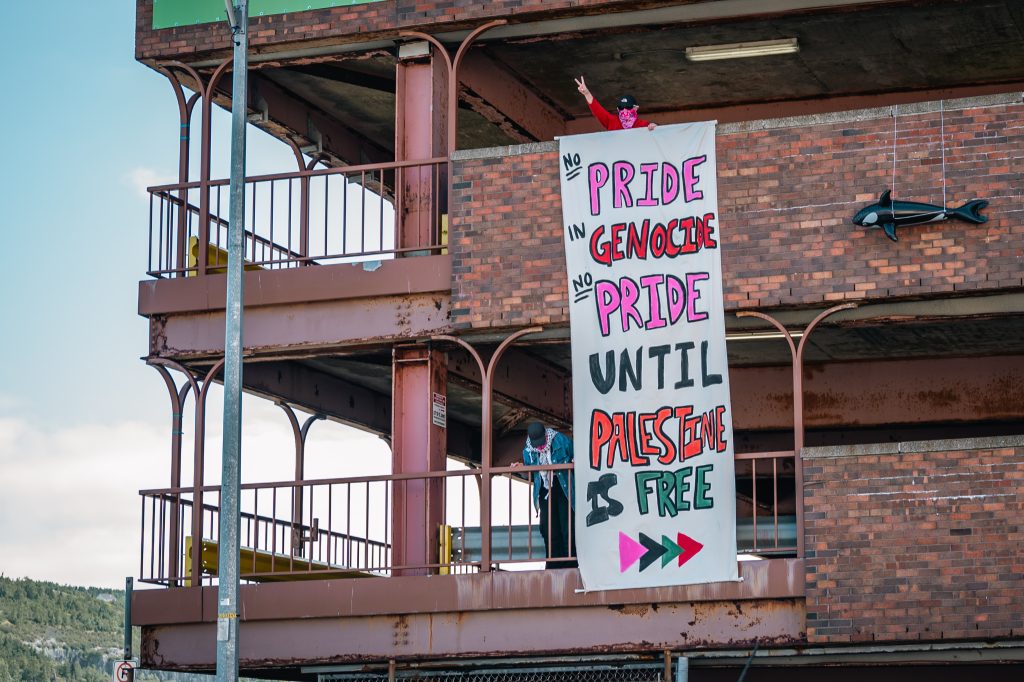
The Trans March wound its way from the Supreme Court to Eastern Edge Gallery on Harbour Drive, where it concluded with a ‘community feast.’ Along the way, activists dropped an enormous Palestine solidarity banner from the Atlantic Place parking garage.
Trans March takes place amid stark rise in transphobic hate crimes
Statistics Canada data released this year revealed a 12 per cent increase in police-reported hate crimes targeting sexual orientation between 2021 and 2022, on top of a 64 per cent increase in sexual orientation-based hate crimes the previous year. Over half of these hate crimes were violent in nature. StatCan is not presently able to disaggregate data on transphobic hate crimes as these are split between multiple hate crime categories (sexual orientation and gender).
Commentators and advocates, including Egale Canada, have attributed some of the blame for this rise in hate crimes to growing attacks on trans and queer people by politicians in this country. Earlier this month Toronto Star columnist Justin Ling warned that federal Conservative leader Pierre Poilievre “is playing politics with the lives of trans Canadians.”
At their September 2023 policy convention, federal Conservative Party delegates voted in favour of a hard-right suite of policies emulating U.S. Republican stances on several topics. Delegates voted in support of banning trans health care for minors, as well as policies targeting trans women’s access to sports, washrooms, shelters and other spaces. While those policies aren’t binding on a future Conservative government, in February of this year Poilievre also spoke out in favour of barring access to trans health care for minors and barring access to women’s spaces and sports for trans women. Poilievre and other Conservatives have also adopted language denying trans identities (for instance, discredited terms like “biological” male and female). Poilievre has spoken out in support for provincial Conservative governments that have targeted trans rights and trans youth.
The Canadian Pediatric Society, like most other professional medical associations, has spoken out against these Conservative policies and warned they will have “direct and real negative impacts” on children and youth. In March 2024 a coalition of 13 Canadian medical associations – including the Canadian Medical Association and NL Medical Association – issued a joint statement condemning government initiatives to interfere with access to gender-affirming care. And in February 2024 Amnesty International issued a statement denouncing Poilievre’s anti-trans rhetoric as “a dangerous distraction.”
“Not only does this shameful rhetoric put trans and gender-diverse people at further risk; it obscures the realities of gender-based violence in Canada,” the statement reads. “Amnesty International Canada wholeheartedly condemns any attempt to scapegoat members of the 2SLGBTQQIA+ community to score political points. We call on all political leaders to end the spread of harmful disinformation.”
There is also no credible research backing claims that trans women athletes have an unfair advantage in sports. Recent research by journalist Michael Waters has revealed that the controversies surrounding trans and intersex athletes date back to the 1930s and were fueled in part by fascist politicians and eugenicists in advance of the 1936 Olympics held in Nazi Germany.
It’s unclear what steps a federal Conservative government could or would take to implement the sorts of anti-trans policies Poilievre has been promoting.
Ray Critch, a local lawyer with McInnes Cooper who has worked with trans advocacy groups, notes that Canada has a legal structure that’s very distinct from the U.S.
“My thought is that they’d have to rewrite the Human Rights Code to include a definition of woman that excluded trans-women, and then adopt regulations or policy directives applying the policies on federal institutions,” he told The Independent.
“It would then likely come up against a charter challenge. How that would go is anyone’s guess but my expectation is that the government would argue that there is a compelling reason why they need to exclude trans women from women-only spaces, something like safety. I think it’s likely the government would lose these challenges since the indignity being foisted upon trans women grossly outweighs the alleged policy objective, but you never know for sure. On the plus side, only the province could ban anyone from bathrooms, except in federal spaces like post offices or national parks.”
Provincial Conservative governments in several provinces have also stepped up attacks on health care and supports for trans and gender-diverse people. Conservative and right-leaning governments in New Brunswick, Saskatchewan and Alberta have all proposed legislation targeting the rights of trans youth to exercise autonomy over their names and pronouns. Alberta’s United Conservative Party also proposed legislation to bar trans youth access to gender-affirming health care, and to ban trans women from women’s sports.
All of these policy proposals have led to political uproar and legal challenges. Saskatchewan was forced to invoke the notwithstanding clause to suspend portions of the Charter of Rights and Freedoms, although legal challenges related to its policies are still ongoing.
In New Brunswick, the provincial government has gone to court in an attempt to dissolve a Moncton-area school board which launched a legal challenge and refuses to follow the new restrictive pronoun policy. A recent CBC investigation revealed that although the N.B. government attributed its review of pronoun policies to parental complaints, in fact the only emails it received were criticisms of drag storytime and 2SLGBTQ-inclusive education (some of which also cited anti-vaccine rhetoric and other fringe theories), neither of which are even addressed by the pronoun policies it introduced.

Thirteen-year-old Oakley, whose parent requested his last name not be published, was one of the speakers at the July 27 march. Oakley is entering Grade 8 next year and said he’s worried about what will come of his rights in the coming years.
“I’m worried about the future,” he told The Independent. “As a trans person I find there’s just so much hate here, everywhere, and even though I’m a young person I want to be able to make a difference, even if it’s just small. It’s still important. There’s so many injustices in the world, including hate against trans and queer people, and it’s hurtful for so many people when they have to experience it daily.”
Author
Related Articles
PCs under fire for ‘disappointing’ treatment of Black History Month
Celebrated Black community leader and anti-racism advocate target of racist comments after speaking out online
New play portrays barriers facing N.L. women in politics
Women won the right to vote a century ago but are still underrepresented in public office. St. John’s playwright Ruth Lawrence’s play tackles that head on.

Meaningful response to homelessness requires more than new builds, says NDP leader
Jim Dinn’s comments come in response to PC’s announcement of 10 new ‘micro homes’ in St. John’s