
Uber’s screening process in NL ‘very disturbing,’ says lawyer
Internal emails reveal government approved Uber’s operating licence amid concerns from RNC, government staff

The Furey government issued Uber’s license to operate in the province under apparent pressure and at the risk of passenger safety.
The ride-hailing giant was officially licensed to run in Newfoundland and Labrador on April 5, but in the weeks prior to that, and in the days that followed, government officials went back and forth about whether Uber’s criminal record check was sufficient, and whether the company had met its application requirements.
Emails obtained by The Independent through an access to information request reveal the Royal Newfoundland Constabulary cautioned the government of “inconsistencies” between the RNC’s own records check process for taxi drivers, and Uber’s process for screening drivers.
The communications call into question the province’s handling of Uber’s licencing ahead of a busy tourist season in St. John’s.
Will you stand with us?
Your support is essential to making journalism like this possible.
New legislation for ride-hailing companies
In November 2023 government amended the Highway Traffic Act to require ride-hailing—also referred to as ride-sharing—service providers to acquire a Transportation Network Company licence to operate in the province.
The following month, the Transport Network Company Regulations were created to require ride-hailing companies to provide, among other things, “a list of the drivers affiliated with the transportation network company at the date of the application for a licence,” along with “proof satisfactory to the registrar that the transportation network company […] obtained a certified criminal records check satisfactory to the registrar from the Royal Newfoundland Constabulary, the Royal Canadian Mounted Police or another organization approved by the minister for all drivers affiliated with the transportation network company at the date of the application for a licence.”
Emails reveal concerns around both of these requirements when it came to Uber’s application.
Uber’s screening process
On March 8, 2024 Digital Government and Service NL Assistant Deputy Minister Gail Boland emailed Stephanie Lagace of the RNC to explain Uber’s screening process, thanking Lagace for her “quick attention to this matter.”
Boland explained that Uber contracts a third party company called ISB Global Services to conduct criminal record checks, which Boland says “will search the following national databases,” but the national databases are redacted under Section 35(1)(d) of the province’s access to information legislation, which allows government to withhold information, “the disclosure of which could reasonably be expected to result in the premature disclosure of a proposal or project or in significant loss or gain to a third party.”
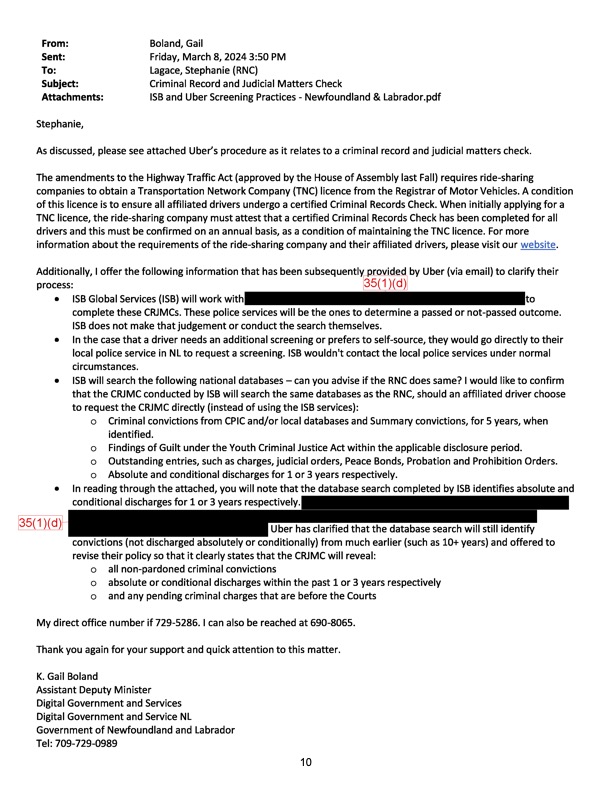
Boland asks Lagace to “advise if the RNC does same,” and that she would “like to confirm that the CRJMC [Criminal Record & Judicial Matters Check] conducted by ISB will search the same databases as the RNC, should an affiliated driver choose to request the CRJMC directly (instead of using the ISB services).”
Boland tells Lagace that “Uber has clarified that the database search will still identify convictions (not discharged absolutely or conditionally) from much earlier (such as 10+ years) and offered to revise their policy so that it clearly states that the CRJMC will reveal: all non-pardoned criminal convictions; absolute or conditional discharges within the past 1 or 3 years respectively; and any pending criminal charges that are before the Courts.”
In a March 5 email to Boland, Uber Canada’s Head of Regulatory Operations and Safety Joseph Dunbar explained that once ISB gathers information from an applicant driver, it “takes this information to one of their Canadian police service departments to query the national database(s) for criminal records and judicial matters to complete a Criminal Record & Judicial Matters Check,” which Dunbar says “reveals all non-pardoned criminal convictions, absolute or conditional discharges within the past 1 or 3 years respectively, and any pending criminal charges that are before the Courts.”
Dunbar explained that applicant drivers have a second option for their criminal records check — to visit a police station “for a detailed CRJMC.”
A “specialised team at Uber” then “adjudicates these documents due to the sensitive nature of the information.” Uber’s internal adjudication process is redacted in the document but Dunbar notes that Uber’s “criteria are informed in part by regulations in other jurisdictions, such as British Columbia, Alberta, Saskatchewan, and Toronto.”
On March 8, Boland emailed Dunbar to say the province’s “policing services is coming back with a few questions,” adding “the RNC is looking for clarification on whether ISB Global Services will be contacting our police stations directly to query the national databases, or does ISB Global Services have the authority to conduct this search themselves?”
RNC identifies ‘discrepancies’
On March 11, RNC Director of Information Services Division Darren Green emailed Lagace to explain the Constabulary’s process for criminal record checks. He says in the email that the RNC offers two “Criminal Background products” — a Criminal Record Screening Certificate, and a Criminal Records Screening Certificate with Vulnerable Sector Check.
Vulnerable Sector Checks in Newfoundland and Labrador, Green says, include a “check for pardoned sexual type crimes” with the word after “crimes” redacted.
Green noted in the email that, “if a submitted application identifies a vulnerable sector (i.e. Taxi driver) the vulnerable sector (VS) check is completed,” and that “only Police Agencies can complete VS checks.”
Legislation in Newfoundland and Labrador does not require taxi or ride-hailing companies to acquire Vulnerable Sector Checks for drivers. But the RNC confirmed in an email to The Independent that “applications received by taxi drivers and rideshare drivers are processed by the RNC as a Vulnerable Sector Checks.”
The force explained it conducts Vulnerable Sector Checks for those “applying for a position with a person or organization responsible for the well-being of one or more children or vulnerable persons, if the position is one of authority or trust relative to those children or vulnerable persons and the applicant wishes to consent to a search being made in criminal conviction records to determine if the applicant has been convicted of a sexual offence listed in the schedule to the [federal] Criminal Records Act and has been pardoned.”
The Independent asked the RNC if it conducts vulnerable sector checks for taxi and ride-hailing drivers as a matter of RNC policy.
The force said in an emailed statement it completes criminal record checks and vulnerable sector checks “at an employer’s request and an applicant’s consent.”
Asked for clarification about whether vulnerable sector checks are automatically processed by the RNC when individual drivers are requesting their own checks, or whether those checks are completed only when the applicant requests them, they said that “employers request of their employees — the employees submit an application to the RNC or the police of jurisdiction.”
The RNC did not respond to a follow-up request for clarification about the contradictory statements, so it’s unclear whether the Vulnerable Sector Check is RNC policy or if it only conducts them for taxi or ride-hailing drivers upon request.
But the force did point to Section 6.3(3) of Canada’s Criminal Records Act, which defines a vulnerable person as “a person who, because of his or her age, a disability or other circumstances, whether temporary or permanent, is in a position of dependency on others; or is otherwise at a greater risk than the general population of being harmed by a person in a position of trust or authority towards them.”
Vulnerable sector checks are required in a number of jurisdictions where Uber operates, including Winnipeg, Ottawa, Windsor, Ont., Regina and Saskatoon. Keerthana Rang, the company’s corporate communications lead for Canada, said Vulnerable Sector Checks are only provincially legislated for ride-hailing companies in British Columbia and Alberta, where drivers in a combined 29 municipalities where Uber operates are required to submit or consent to those checks.
Advisory Council on Status of Women recommended Vulnerable Sector checks in 2019
In 2019, Newfoundland and Labrador’s Provincial Advisory Council on the Status of Women (PACSW) produced a jurisdiction scan of taxi regulation in Canada for the provincial government.
In the report, the council cites a 2016 CBC investigation into lack of oversight for taxi companies operating in St. John’s and recognizes women’s “right to feel safe when accessing taxicab services in our province.”
The CBC investigation, which notes there were five sexual assault complaints involving taxi drivers in St. John’s in 2016 and five in 2015, found among other things that the RNC had flagged a lack of regulations and municipal oversight of taxi drivers to the City of St. John’s.
The PACSW report found that at the time just four provinces—British Columbia, Manitoba, Ontario and Quebec—had developed provincial legislation for the taxi industry.
Outside those provinces, the report found that capital cities in provinces without provincial taxi legislation—Alberta, New Brunswick, Newfoundland and Labrador, Nova Scotia, Prince Edward Island, and Saskatchewan—had developed their own municipal by-laws around the taxi industry.
St. John’s, the report notes, was “the only capital city in the country without a municipal police force which provides a major distinction between other cities’ taxi legislation. This creates concerns for the city of St. John’s legislators.”
The 2016 CBC investigation reported that the City of St. John’s website “indicated that council regulates taxi drivers,” but that following an access to information request by the network, “the city said that is not actually the case,” the story reads. “It instead only licences taxi companies and vehicles. That means the onus falls on the taxi companies themselves to ensure drivers are up to spec.”
To date, the St. John’s taxi by-law does not require drivers to pass a Criminal Record Check or a Vulnerable Sector Check.
The requirement for a Criminal Record Check exists in provincial law, but the province has not made Vulnerable Sector Checks mandatory.
That’s despite the PACSW report recommending in 2019 that provincial and municipal legislators require taxi drivers to obtain a “clear criminal record check and vulnerability sector check” before being licenced, and for licence renewals.
“The policy gaps in NL require provincial and municipal legislators to review taxi operations and consider new legislation to protect passengers who buy a service in the Province’s municipal environments,” the report says.
Not doing Vulnerable Sector Checks ‘very dangerous’
Lynn Moore, a high-profile lawyer in St. John’s, says it’s “very disturbing” that Uber doesn’t do Vulnerable Sector Checks for drivers in Newfoundland and Labrador, “because once upon a time […] it was very easy to get a pardon. You just waited the [amount] of time, and then you asked for it, and you got it. And there was no assessment as to what you were doing.”
Moore, who has been involved in several high-profile sexual assault cases in the province, says a Criminal Record Check “is just a snapshot of a moment in time, and it’s not a thorough look at whether or not the person is safe […] to have vulnerable people in their care.”

She says there are many instances where someone charged with a sexual crime could be pardoned, but that doesn’t mean they are qualified to have people in their care.
“There might be times when someone, a child, complains of a sexual assault, and the police are ready to lay charges, and then the parents will say to the police officer, ‘I don’t think my child is well enough to withstand court. And then the police officer will say, ‘Okay, well, I’m going to speak to my boss,’ and they will agree not to lay charges.
“Another instance might be that the charges are laid and then the Crown decides for the same reasons not to proceed. Or they proceed and he’s found not guilty and the judge says something like, ‘I think you probably did it, but I have to find you guilty beyond a reasonable doubt, and I’m not convinced beyond a reasonable doubt.’
“So there’s a whole grey area of activity which doesn’t meet the standard of beyond a reasonable doubt that they take into account when they’re issuing a Vulnerable Sector Check.”
Moore cites her time working for the RNC, during which she says there was a case where a man who had “violently assaulted a woman” was charged with multiple offences. She “couldn’t believe that the Crown had agreed to his release based on his record.
“When I called the Crown, I found out that his record had been expunged, so he had all these serious offences of violence against women that he had been pardoned for; and now he was charged with another offence of violence against a woman and he was being treated as a first offender.
“So not doing the Vulnerable Sector Check is very dangerous.”
Moore says that without requiring Vulnerable Sector Checks, companies don’t go far enough in screening their workers.
“I don’t think it’s fair for an employer to say, oh, there’s no criminal record. There we have, and that’s it — now this person’s character is fine. We don’t have to do any further searching to see if this person poses a risk to people that we’re putting in their care.”
Uber facing potential class action lawsuit
In March 2024 Consumer Law Group initiated a country-wide class action lawsuit against Uber “on behalf of passengers that were sexually assaulted, assaulted, battered, raped, kidnapped, forcibly confined, stalked, harassed, otherwise attacked or subjected to other sexual misconduct by an Uber driver with whom they had been paired through the Uber App,” according to the law firm’s website.
“The class action is based on allegations that as early as 2014, Uber became aware that Uber drivers were physically and/or sexually assaulting and raping female passengers. Yet, Uber has failed to implement meaningful safety measures that would help to prevent, or at least mitigate, these crimes from occurring.”

The lawsuit stems from allegations by a Winnipeg woman, identified as “C.K.” in the class action statement of claim, that in December 2023 she was assaulted by her driver once they arrived at her residence. The claim alleges the driver “physically grabbed the Plaintiff by her shoulders and forced himself upon her by kissing her on the mouth,” and that he “grabbed her a few times to kiss her and she kept saying no and trying to push him off of her. He kept following her and trying to block her from getting away.”
None of the allegations have been proven in court. According to the Manitoba Court of King’s Bench website, statements of defense have not yet been filed by Uber.
According to Uber’s own data, there were 20 fatalities reported in 2019-2020 ‘in a total of 19 physical assault incidents in relation to Uber” in the United States. During the same period, Uber reported 3,824 incidents of sexual assault, in 57 per cent of which drivers were the accused parties.
The 2019-2020 U.S. report is the most recent available report on Uber’s website.
Last December, an Uber driver in Whitby, Ont. was arrested and charged with two counts of sexual assault after a 19-year-old woman alleged he assaulted her while driving her home.
Earlier this month, a Toronto Uber driver was sentenced to five and a half years in prison in connection with three separate cases of sexual assault against young women who, the judge said during sentencing, “were vulnerable, alone at night.”
Uber does not produce safety reports in Canada because, Rang said in an emailed statement to The Independent, “Canada lacks the consistent datasets or taxonomies required to support a national safety report. For example, we do not have a Canadian equivalent to the US National Highway Traffic Safety Administration’s Fatality Analysis Reporting System (FARS), which is critical for the US Safety Report.”
Asked if Uber tracks the number of sexual assaults or fatalities that occur in an Uber-affiliated vehicle or involving an Uber-affiliated driver, Keerthana did not respond by the time of publication.
Province under pressure to approve Uber’s application?
In August 2025, St. John’s will host the Canada Summer Games. Government emails reveal that, in March 2024, Canada Summer Games CEO Karen Sherriffs spoke with Boland to enquire about the status of Uber’s licencing in the province.
The Canada Games Council was “looking to partner with Uber for the Games,” 2025 Canada Games Host Society Co-Chair Kim Keating told The Independent in an email. Sherriffs’ “enquiry at the time was to check on status with Uber in the province.”
During a March 8 call, Boland told Sherriffs “things were not finalized, but Minister Stoodley had publicly announced that Uber would be coming in May.” A month later, on April 5, the government approved Uber’s Transportation Network Company licence.
Keating told The Independent that Canada Games Council “was not able to secure Uber as a National Partner.”
On March 5, Uber shared information about its screening process with the provincial government. Two days later, Dunbar followed up, asking Boland if she had “an estimate for when you’d have a response for us by chance?
“For context,” Dunbar added, “we are planning on opening our driver funnel (the ability for drivers to sign up) on Monday, March 11 and if we have a positive response from you, we would also look to apply for our licence and inform prospective drivers of our application on Monday as well.
“That being said, please take as long as you need to get back to us,” he concluded.
Over the ensuing days, the government, Uber and RNC exchanged emails about Uber’s and the RNC’s screening processes.
Uber then submitted its Transportation Network Company licence application to the province on March 14. Boland confirmed receipt of the application the same day, saying “the documents will be reviewed within 2 business days and staff will contact you accordingly should any additional information be required.”
Two days later, on March 16, Krista Cull, a deputy registrar with Motor Vehicle Registration, emailed Boland to inform her that Uber’s application was missing multiple items, including a list of drivers and their driver’s licence numbers, “confirmation that a Certified Criminal Records Check has been received for all affiliated drivers,” and “confirmation that the company has a completed consent for for the collection, use and disclosure of any personal information for each driver.”
Your ride-share is here, as Newfoundland and Labrador officially welcomes @Uber! Thank you to Uber, Min. @SarahlStoodley, the @stjohnsbot, and everyone who worked hard to bring locals and visitors alike another transportation option. pic.twitter.com/0MojryEAm8
— Andrew Furey (@FureyAndrew) April 23, 2024
Cull noted that Uber had just begun to accept driver sign-ups so didn’t have a list of drivers to share yet, and they “advised that they will share a list of drivers that have passed requirements for approval prior to launching.”
Cull also pointed out that the Transportation Network Company regulations specify that an application for a licence has to include “a list of drivers affiliated with the transportation network company at the date of the application for a licence,” as well as a “[Certificate of Clearance] for all drivers affiliated” with the company “at the date of application,” with the words “at the date of application” highlighted in yellow in both cases.
She also cited Section 4(2)(a) of the regulations, which state that a TNC “is required to notify the Registrar of any change in the information provided under section 3,” and that Section 4(f) says a TNC is required to “submit to the registrar monthly a list of all drivers affiliated” with the company — with the word “monthly” highlighted and underlined.
The remainder of Cull’s email is redacted under Section 29(1)(a) of the province’s access to information legislation, which permits withholding information “that would reveal advice, proposals, recommendations, analyses or policy options developed by or for a public body or minister.”
The following week, on March 21, Boland emailed Cull to say Uber advised they would share a list of drivers by the end of the week. “And they will continue to provide us updated lists as they get closer to their launch date; and of course will provide a list of drivers on a monthly basis.”
Though the regulations state TNC licence applicants must submit the driver information at the time of their application, Gina MacArthur, Digital Government and Service NL’s media relations manager, said in an email to The Independent that “in cases where an initial application is incomplete, department officials provide the applicant with appropriate guidance toward meeting the required criteria.
MacArthur said Uber provided the list of drivers on March 27, and that Uber’s licence was issued “once it was determined that all the terms and conditions of a licence, including a list of drivers, had been met.” She also said Uber provided updated driver lists on April 17 and April 23.
Minister considers Uber’s screening process ‘acceptable’
The RNC told The Independent it won’t comment on Uber’s case specifically, but an email from Darren Green at the RNC to Boland on April 9, just four days after Uber’s TNC licence was granted, asks Boland to “please advise how/if the discrepancies” the RNC laid out in a March 13 call with government officials “were addressed prior to the approval being granted?”
Those discrepancies, which are redacted in a March 13 email from Green to Boland, “were considered,” Boland replied to Green on April 10. She did not offer Green any other information in the email.
On April 12, one week after Uber’s licence to operate in the province was granted, Digital Government and Service NL Minister Sarah Stoodley wrote to the Registrar of Motor Vehicles authorizing the use of Uber’s screening process via ISB Global Services “as acceptable to be included with an application for a Transportation Network [Company] Licence.”
In an email to The Independent, Rang said Uber’s screening process, along with technology built into Uber’s app, “provide a very high standard of safety,” and that “Uber has a firm stance against sexual assault and sexual misconduct, and violating these standards will result in a user losing access to their Uber account.
“Uber works closely with law enforcement in investigating alleged criminal behaviour on the platform.”
Rang went on to say that since the Stephen Harper government’s criminal justice reforms in 2012, which included eliminating pardons for certain criminal offences, “it has been virtually impossible to receive a pardon (a.k.a. record suspension) for a sexual crime, meaning the Vulnerable Sector Check (VSC) database would not be updated.
“In addition, the Criminal Records Act requires that a VSC only be performed when a role involves authority or trust over children or vulnerable persons, since the VSC is such an intrusive, expensive, and time-consuming process. Public Safety Canada’s Screening Handbook details which type of police check is required for various positions. And the RCMP notes that it is illegal for the police to conduct a VSC if the position does not meet the Criminal Records Act requirements.”
The RCMP in Newfoundland and Labrador confirmed that it conducts Vulnerable Sector Checks “if the employer requests it or if the applicant completes the vulnerable sector section” on an application form. “Those who are working with youth, elderly or vulnerable persons are required to complete that portion of the form which would lead to the check being done.”
Moore calls Uber’s claim that pardons are virtually impossible now “nonsense,” adding that while it has been harder to get a pardon in recent years, “the fact remains that […] if you have convictions prior to that, that you were pardoned for,” it’s something that passengers “would want to know.”
She adds, “there is case law which says that a taxi driver is a person in a position of trust. And since a taxi driver and an Uber driver perform the exact same function, then it stands to reason that an Uber driver is also in a position of trust.”
Moore says that if ISB Global Services “doesn’t have access to a pardoned records [database], then they’re not a suitable screener.”

Author

Related Articles

Cultural centre in Nunatsiavut is helping Inuit reconnect with culture and language
After winning the Arctic Inspiration Prize in 2024, Inotsiavik is offering Inuit in Labrador outdoor cultural programming, Inuttitut lessons, virtual programs, and more

What a Newfoundland community can learn from B.C.’s first major LNG facility
As talk about developing an LNG export project in Newfoundland and Labrador continues, residents have questions — and the answers might be on the other side of the country
N.L. chief medical examiner has begun tracking gambling as a risk factor in suicides
The OCME’s policy change came nearly a year after an Independent investigation into gambling-related suicides