
Under John Hogan, will the Liberals finally create a Disability Advocate Office?
Disability advocates say they want a government representative whose sole focus is the disabled community
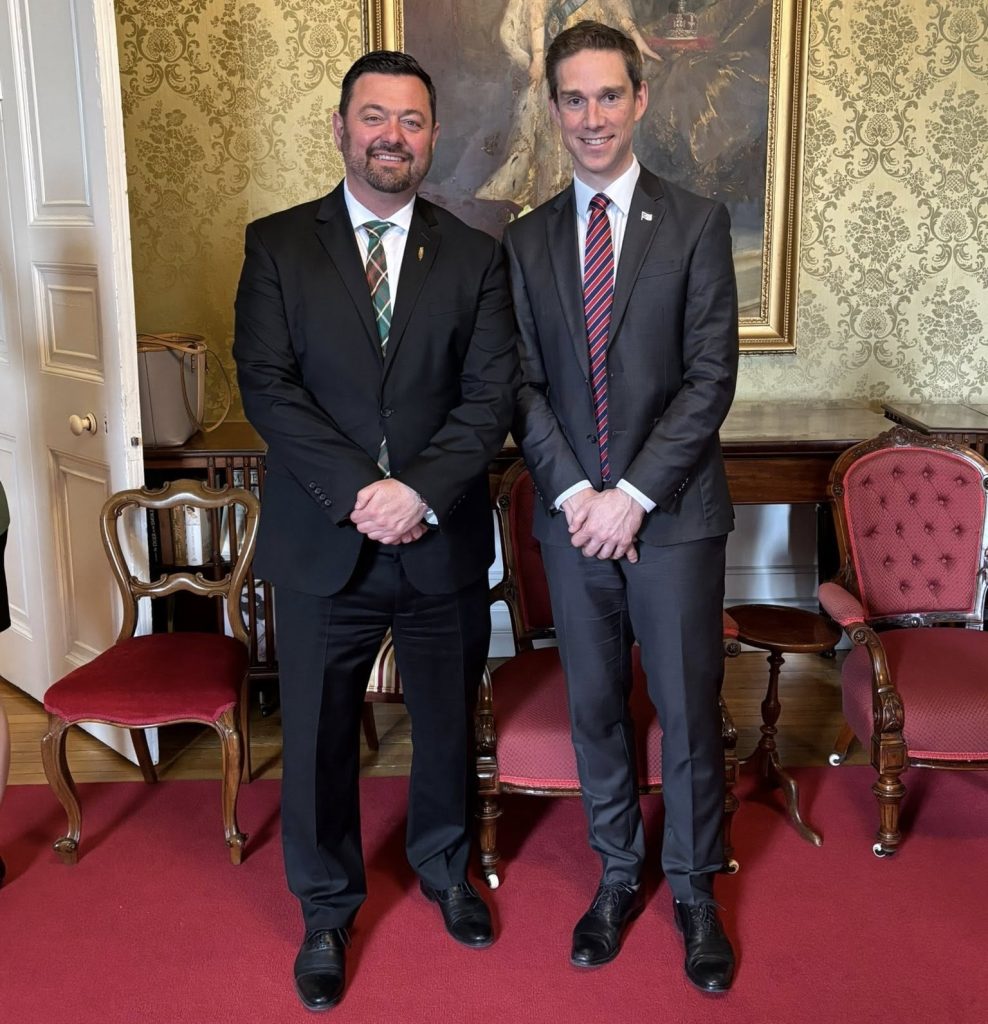
On Monday, newly-minted cabinet minister Jamie Korab indicated the Liberals have not made any progress on a decade-old recommendation to create a disability advocate office — the same position former Premier Andrew Furey tasked his Minister Responsible for the Status of Persons with Disabilities to “work toward” creating in 2020.
Korab, who was appointed by Premier John Hogan as the province’s new Minister Responsible for the Status of Persons with Disabilities, was responding to questions from Harbour Main MHA and Deputy Opposition House Leader Helen Conway Ottenheimer.
The Waterford Valley MHA told the House the Liberals are considering a 2023 report that recommended combining the province’s Seniors’ Advocate role with that of a disability advocate. “Justice Robert Fowler […] looked through and said that the Office of the Seniors’ Advocate should also include people with disabilities,” Korab said Monday. “So that’s something going forward when we look at how we do the advocacy groups, we’ll look at how that folds into it.”
In his 2023 Report of the Structural Review of the Statutory Offices of the House of Assembly, Fowler suggested the “Seniors’ Advocate’s mandate should be reconceived to focus on those who are unable to advocate for themselves due to age, health, or disability,” and that there “should be a single advocate for seniors and persons with complex needs.”
Will you stand with us?
Your support is essential to making journalism like this possible.
It’s an idea that’s already been flatly rejected by the Coalition of Persons with Disabilities, Newfoundland and Labrador. Executive Director Nancy Reid says the coalition is “very much opposed” to a disability advocate being created and “lumped” into the role of the Seniors’ Advocate. Reid, 50, says not everyone with a disability is a senior, and disabled people are not complex. “We face complex barriers in the community. We are persons with disabilities,” she says, adding she hopes Korab will be able to differentiate between the two. “That shows a sign of respect to address us appropriately and to validate our existence.”
The disability advocate needs to be independent and someone whose “sole duty” is to be concerned with the needs of persons with disabilities, Reid says. She says folks with disabilities face many barriers—such as accessing the community, home supports, and adaptive technology—and have diverse needs. An advocate is essential for releasing reports and recommendations, pushing for policy changes, and safeguarding rights.
Reid says that in her role as a coalition member, she sees many people slipping through the cracks, and that an advocate can take on work that community-based organizations often struggle to handle due to overwhelming demands for their services and support. “Look at the Seniors’ Advocate, for instance, and we see papers. We see studies. We see things that she has done, and we hear it going to the Confederation Building,” Reid says. “We hear it talked about in the House of Assembly. We see response. And we see action on the part of government to respond to the things—to the studies—that are brought forward by the Seniors’ Advocate. We need the same thing for our community.”
Korab said Monday he is “getting up to speed” on the calls for a disability advocate.
Over a decade in the making
According to Statistics Canada’s 2022 data, about 31 per cent of Newfoundlanders and Labradorians live with a disability. “The Seniors’ Advocate is in place and does incredible work. The Child and Youth Advocate is in place and does incredible work,” Reid says. However, there’s no advocate to represent the roughly one-third of the province’s population living with a disability.
Reid notes people have been calling for a disability advocate since at least the mid-2010s. “It feels like we’re being disregarded,” she says. She served on the Provincial Advisory Council for the Inclusion of Persons with Disabilities for six years and says the council raised the need for an advocate with the Department of Children, Seniors and Social Development, “over and over again”.

In Furey’s 2020 mandate letter to then Minister Responsible for the Status of Persons with Disabilities Brian Warr, the former premier asked Warr to “continue to engage, support, and partner with the diversity of stakeholders who support individuals living with disabilities and who promote inclusive and accessible communities.” He also mandated Warr to “[e]nsure that all policy and legislative work is grounded in the principle of ‘nothing about us without us,’” and to “work toward the establishment of an Advocate for Persons with Disabilities in our province.”
Almost a year later, in August 2021, Warr’s successor, MHA John Abbott, was tasked with the same job. As of May 13, 2025, Korab had not received his mandate letter so it’s unclear whether Hogan will ask him to create the position. “It feels like the population of persons with disabilities is not treated with the level of respect or the consideration that it needs,” Reid says.
The 2025 budget
Following the province’s 2025 budget, released in April, Reid said she was “disappointed” to see “so little” for persons with disabilities. Reid and Syd Wilanksy, the coalition’s president, applauded the provincial government for its Disability Benefit fund, which supports eligible low-income persons with disabilities with up to $400 per month and a $1,200 annual contribution to their Registered Disability Savings Plan. But Reid says the process of accessing the benefit is flawed. “There will be many people with disabilities who have barriers to employment based on disability that will not be eligible for the disability benefit simply because the application process will not allow them entry,” she says.
Eligibility for the provincial disability benefit is contingent on existing approval for the federal Disability Tax Credit, and applicants must have an income below $42,404. To access the disability tax credit, medical practitioners must fill out forms on behalf of the patient. “For many people with disabilities, people who don’t have family doctors, or people whose family doctors are unwilling to complete the form, [they’re] often not able to access funding,” Reid says.
Reid says there’s also a lack of information and transparency around how organizations can access core funding, which refers to financial support that helps cover an organization’s essential operating and administrative expenses, including rent, equipment, and staff salaries. In 2022, the Liberals promised that “a new application and assessment process will be implemented for core funding.”
Reid says the new application process was never announced, and core funding for organizations has been left to the minister’s discretion. When she asked Finance Minister Siobhan Coady during the 2025 budget why the new application process wasn’t announced, she says Coady told her organizations “can make a request to the Minister responsible for core funding requests.”
Reid says accountability is lacking because there is no due process for organizational core funding. She says the minister responsible for allocating funding has no clear way to show the public or the organizations that they understand the community’s needs or which organizations are effectively meeting those needs. “There is no accountability visible. There’s no understanding outside of how decisions are made by the minister.”
Budget 2025 included a promise of $100 million for community-based organizations. “I need to see accountability for that $100 million,” Reid says. For his part, Wilanksy says a lack of government funding is already causing “damage” to organizations that support people with disabilities. In late 2023, the Brain Injury Association stopped offering programs due to a lack of funding.
Reid is “anxious” to see Korab’s plans for people with disabilities and is in the process of contacting the minister. “We want him to know our community and need to express to him that the disability community is a very large, proud, strong community.”

Author

Related Articles
LISTEN: Justin Brake talks Amber Bracken case & press freedom on CBC Radio’s ‘The Signal’ (with TRANSCRIPT)
An hour-long conversation led by CBC Radio host Adam Walsh, feat. Justin Brake, Geoff Budden, Karyn Pugliese, Brent Jolly and Ethan Cox
Cultural centre in Nunatsiavut is helping Inuit reconnect with culture and language
After winning the Arctic Inspiration Prize in 2024, Inotsiavik is offering Inuit in Labrador outdoor cultural programming, Inuttitut lessons, virtual programs, and more
What a Newfoundland community can learn from B.C.’s first major LNG facility
As talk about developing an LNG export project in Newfoundland and Labrador continues, residents have questions — and the answers might be on the other side of the country