
Both Sides Now
From up and down, science and folklore offer two different vantage points on the weather, and still–it remains unpredictable.

Photo by Julia Weihe on Unsplash.
“What do you think this winter will be like?” I asked my mother absently as we wandered through the grassy labyrinth of our backyard this past fall. I was trying to make conversation so I did what anyone might do: I reached for the weather.
“What do I think this winter will be like?” She echoed.
Winter was on my mind. Although it was a warm evening, I could already feel the tell-tale chill of winter in the air. The leaves were slowly turning red after a warm summer. Part of me was worried that our mild winters weren’t going to last and that maybe this winter, it would happen again–Snowmageddon.

Will you stand with us?
Your support is essential to making journalism like this possible.
Three years ago, in 2020, a historic snowfall led the city of St. John’s to declare a State of Emergency from January 17-25, 2020. Nearly a meter of snow had fallen with winds gusting at 150 km/hr. It resulted in Canadian soldiers showing up to dig residents out of their homes.
“I think it will be a mild winter,” my mother said, after a moment. “No snow this Christmas.”
“Why do you think that?” I asked, wondering how she could be so certain.
“There are not many dogberries on the trees,” she replied. “When the winters are bad, the trees will grow more dogberries for the birds to eat.”
It turns out, mom was right: we didn’t have a white Christmas.
Her answer relied on the folklore deeply embedded in Newfoundland culture, the type that can forecast the weather.
Weather Lore
“Weather lore,” it’s called, according to Nicole R. Penney, Assistant Archivist with Memorial University of Newfoundland’s Folklore and Language Archive (MUNFLA). It’s a genre of folklore that focuses on forecasting the weather by using rhymes, proverbs, verses, and tales. These forms rely on being able to recognize distinct patterns and behaviours in the natural world.
Terra Barrett, an Intangible Cultural Heritage Researcher from Heritage NL, knows all about such folk knowledge. According to her, Newfoundland’s oral history includes a variety of wisdom about the elements, from red skies in the morning, to the behaviour of cats in the evening. One of its most well-known lore is that of “Sheila’s Brush.”
Sheila’s Brush is the last storm of the winter season; it usually happens after St. Patrick’s Day. The titular Sheila, according to Barrett, refers to St. Patrick’s mother or his wife. Either way, she’s the woman who cleans up his wintry mess. The arrival of Sheila’s Brush makes it clear, Barrett says: there will be no more snow after March 17.
Some weather lore can be based on animals. For example, a “horse or cow running about in a field is a sign of a storm,” according to Penney. “I can’t say whether every weather predictor here is very accurate. But some of it is based in reality,” she adds, “and people [had to do the best with what they could] see in the patterns in the world around them.”
Newfoundland weather in particular is hard to predict, but trying anyway is a national pastime. Barrett says that young children sometimes try to summon snowstorms to get days off school by performing folkloric rituals such as sleeping with one’s pajamas inside-out, sleeping with spoons, or putting ice cubes down the toilet.
(I remember doing that as a kid to get a day off school, but from my experience, that kind of folklore did not seem to work, no matter how much I wanted it to.)

The practice of forecasting the weather is like trying to predict the future. It’s an impossible task, but it doesn’t keep us from attempting to do it nonetheless . Legends about red skies, dogberries, or groundhogs are hard won wisdom. While they might feel true, they are still imprecise.
Meteorology, on the other hand, positions itself as a modern scientific method, one that seems to provide more validity and reliability–but does it?
The meteorologist’s crystal ball
Predicting the weather involves informed speculation. When I asked Brian Walsh, a local meteorologist now based out of Edmonton, about the process, he said he’s often heard the joke, “what other profession, besides a meteorologist, can you be wrong 50% or 90% of the time and still get paid?”*
While no one wants to give a bad forecast, there are limits to the computer models.
As for people who tune into weather reports, “They seem to forget that we are forecasting the future,” Walsh said. Forecasts can only do so much.
Jianghua Wu, assistant professor at Memorial University, Grenfell Campus, agrees, “The future is not… one state we can predict,” Wu says “We’re not able to see the future.” Climate change is also making the weather and its forecasting even more unpredictable.
The science of predicting the future

Eddie Sheerr, chief meteorologist for NTV news, says generally he looks at satellite and radar imagery and surface analyses to search for cold and warm fronts. He hunts for pressure patterns and consults computer model parameters to foresee the next 5-10 days.
But meteorologists are not ancient oracles–even if people expect them to be–they just read the data. Each meteorologist can come to different conclusions, Sheerr explains, “interpreting the data is part of the forecast.”
Is there anything to folklore forecasts?

If science has such a hard time unraveling the weather’s secrets, how can folklore hold water?
Surprisingly, Wu says there might be something to it. People who live in close relationship to the land, especially Indigenous communities, have a lot of traditional knowledge about the weather and the climate. This knowledge has been learned, and passed down over time.
All our lives depend on nature, but we don’t always pay close attention to it. When we do, we can pick up on things we may not otherwise, feeling even the slightest changes as they unfold.
For a girl who grew up hearing, “Red sky at night, Sailor’s delight; Red sky in morning, sailor’s take warning” – I was happy to hear it wasn’t just a cute rhyme.

In fact, according to Walsh, the reason for the red skies at sunrise or sunset is that the air is very dry at those times. The rhyme isn’t always correct, it really depends on where the weather system is coming from. However, if there is a red sunset, then it means there’s dry air to the “west and that should maintain good weather that night and the following day,” says Walsh.
Of course, this doesn’t necessarily mean all folklore can be validated by science.
Science for example, doesn’t back folklore about icebergs bringing cold weather with them. Sheerr says he’s told many people that no matter how big an iceberg is, it cannot cool down the entire avalon peninsula. Days and days of north-easterly winds and easterlies are more likely to drop the temperatures, and they are also what bring the icebergs in the first place. The observation isn’t wrong per se; just the explanation. Correlation doesn’t mean causation.
I asked Sheerr if one can predict how bad the winter might be based on the number of dogberries a tree produces. What does science say about that?
Sheerr admits to having heard of this before, but isn’t sure it’s true. “I’ve also heard it has to do with the previous winter being cold or warm,” Sheerr says. “So, I don’t know on that one. The jury’s out.”
“What do you think this winter will be like?”

“This winter has been well below normal for snowfall in St. John’s,” Walsh notes, “especially since one storm skewed the number with around 60 cm of snow in the second half of January.
According to Sheerr, if January 21, 2023, was a little colder, the snowfall would have rivaled Snowmageddon.
“The snow was super wet, dense,” Sheerr says, “and heavy, which prevented us from seeing an even bigger snowfall.”
I wondered why we had no snow for Christmas but ended up having snow storms later. Sheerr explained this is not happening all over the province. In Eastern Newfoundland, on the avalon in particular, much like the last two winters, we experienced extensive cold and warm weather, but not a lot of sustained cold or snow.
This winter, and the last two, were what’s called “La Niña winters.” Sheerr says they are mild winters with less snow early on in winter with more snow later. The only exception has been for those few weeks in January 2020 when Snowmageddon hit, but since then it hasn’t been all that snowy in St. John’s.
Trying to make sense of a chaotic world

Newfoundland’s weather is chaotic and hard for science to predict. Popular folklore endures, but the patterns that inform them are perhaps not as consistent as they used to be. Climate change might be making a challenging endeavour even harder.
That hasn’t stopped people from rising to the challenge, noticing patterns, and predicting the weather anyway.
Newfoundlander and Labradorians are deeply affected by the weather–it can mean life or death. It determines the conditions and the qualities of our lives. Relying on inherited wisdom and guidance is one way to help manage the stress that weather variables add.
On February 2, 2023, Canada’s groundhogs saw their shadows, and if you believe in folklore – there is indeed more winter left. As for how much snow we’ll get–maybe that’s something only the trees can know.
* Correction: A previous version of this article misattributed the source of this joke to Brian Walsh (updated February 21, 2023).

Author

Related Articles
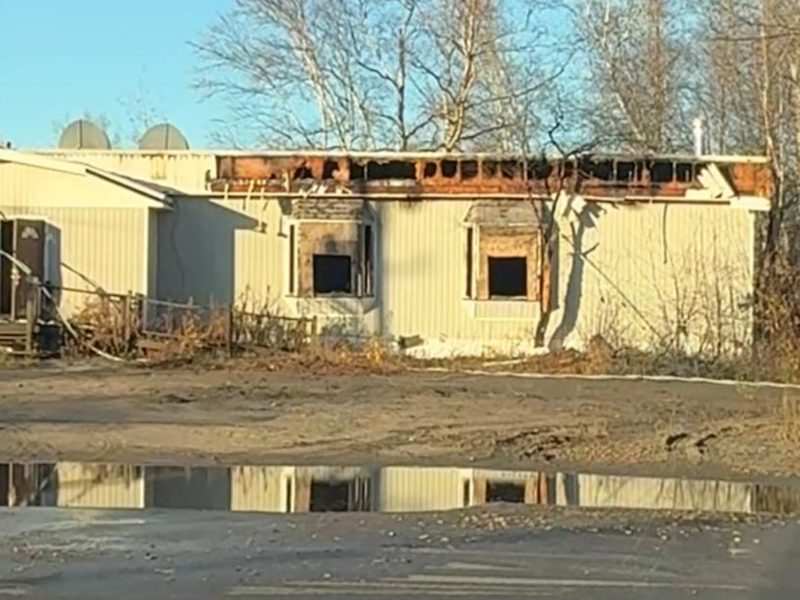
Arson suspected following series of fires in Happy Valley-Goose Bay overnight Friday
Four fires spanning just over six hours resulted in what the community’s fire chief called the ‘busiest night’ of his career

Workers’ issues sidelined by parties, say labour groups
As election day approaches, labour leaders say provincial candidates aren’t addressing people’s “everyday troubles”

Ignoring climate change in the provincial election will have ‘devastating consequences’, say youth and labour leaders
Who in this election is talking about climate change and a just transition? Community and youth groups are, but not the candidates in any meaningful way