BLOG: Occupy Newfoundland | Day One
Occupy Movement protestors set up camp at Harbourside Park in St. John’s and share views, experiences and life stories.
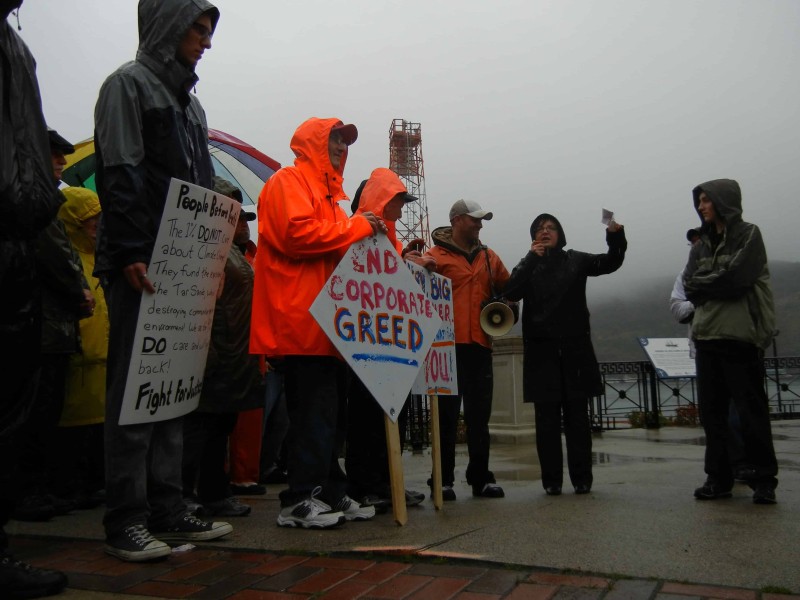
It’s a warm, rainy fall Saturday morning down at St. John’s Harbourside Park and about 50 people are gathered to hear each other speak and experience what it’s like to be heard and respected when they have something to say.
Democracy is in the air, but unlike most protests it wasn’t just an idea that brought people together. It’s a shared experience of seeing and feeling the consequences of an economic system that perpetuates inequality and is widening the gap between the rich and the poor, both at home and across the globe. All of us are affected in some way, people are pointing out, some worse than others. And those who’ve gathered here, including several who are camping out, are embodying true compassion. Despite the diversity of concerns, not one person I’ve spoken with seems to have harmful motives — they are here for themselves, their families, their neighbours and fellow citizens.
Without exaggeration, we could be in the early stages of the biggest worldwide movement ever.
The Occupy Newfoundland protest was inspired by the Occupy Wall Street movement that began last month when hundreds, and eventually thousands, occupied a Manhattan park near the city’s banking district. Today, protests were initiated in dozens of Canadian cities, in hundreds of cities and towns across the United States, and in countries around the world. Without exaggeration, we could be in the early stages of the biggest worldwide movement ever. Certainly, with the Internet and social networking, what happens in St. John’s today can be known in Ireland, Brazil, New York, London and Ottawa instantaneously.
The stigma typically attached to those who challenge the status quo is felt to an extent today, evidenced by the fact that many of those donating food and supplies are asking not to be identified. They fear the potential consequences of affiliation with those who have the courage to take a stand against banks, corporations and government, and both demand and embody true democracy. But the sheer diversity of the people here, including the ones dropping by to express solidarity, is more powerful than stigmas and stereotypes. People from all walks of life have visited, some to satisfy their curiosity, some to have someone to talk to about their own problems. There is solidarity here, genuine interest in the well-being of all (read: compassion), and out of the shared frustration and anger, a unified spirit of hope and determination.
For the first update from the Occupy Newfoundland protest, it was agreed among people here that it would be best to share the informative, passionate and inspiring Saturday morning speeches by and interviews with those who showed up, including union leaders, university professors, students, seniors and citizens from different walks of life. In the next update we will explore how democracy is unfolding within the spontaneous community here, see a working list of the group’s demands and hear more of people’s concerns and their early impressions of what’s happening here and around the world.
Thomas Jordan, protestor:
“Although we may have different opinions, in a free society people are respected and people are capable of voicing their opinions. We will not be censored, we will not be stifled, we will not be silenced.”
Dr. Robert Sweeny, Memorial University history professor:
“Recently the press, including CBC, has suggested that the Canadian government and Canadian banks are quite different than the banks in the United States, and that we didn’t bail out our banks and that they aren’t involved in the sorts of financial shenanigans that the American banks are. So then the logic of the one per cent versus the 99 per cent of Occupy Wall Street shouldn’t really apply here in Canada, and people like ourselves are misguided. Well that’s part of a deliberate misinformation campaign that has been carried on by both the government and the banks.
“During the recession the Canadian government established something called the Extraordinary Financing Framework. They set aside $200 Billion to bail out the banks and insurance companies in Canada who were exposed to the problems of the sub-prime mortgage crisis and from their own speculations on international markets. It turned out that the banks only needed $120 Billion of that $200 Billion to meet their obligations. To put that into perspective, the total income of Newfoundland in wages and salaries is about $11 Billion a year, so more than 10 times the total income of everybody living in Newfoundland and Labrador was given to the banks in 2008 and 2009. It’s the largest single financial program in the history of Canada.
“When the Organization of Economic Cooperation and Development (OECD) looked at how the major capitalist countries around the world have responded to the crisis they identified bailing out of banks by central governments as a major element in the programs, and that Canada actually spent eight per cent of our Gross National Product (GNP) bailing out our banks. Only two other countries in the world, the United Kingdom and Norway, spent more of their GNP bailing out their banks in 2010 than Canada did. We spent eight per cent of our GNP and the United States, which everybody says did a lot of big bailouts—and of course they did—they actually spent six per cent. So in proportion to our economy, we actually spent more money than the Americans did in bailing out the banks. So when they say we’re facing a different situation here in Canada, they’re right — we’ve actually spent considerably more money supporting our banks than they have in proportion to our economy.
“And when they said that the one per cent-99 per cent logic of Occupy Wall Street doesn’t apply in Canada, they’re also deliberately misleading us. Recently the Religious Social Action Coalition (RSAC), which brings together many different faiths here in Newfoundland, conducted a questionnaire of the parties during the election campaign and they asked them what their policies were on eradicating poverty in Newfoundland and Labrador. The Dunderdale government responded by saying that our most important policy has been the tax cuts introduced by the Williams government and continued by the Dunderdale government, and they estimate that those (policies) since 2007 have accumulated $1.6 Billion in tax cuts. $500 Million of those tax cuts are this year alone, 2011 — they were phased in over time. So we’re now beginning to see the full effect of those. If you use Canada Revenue Agency figures…and you look at how much taxes are paid and who got the tax cuts, it turns out that over $160 Million of this year’s tax cuts went to the 2,700 people—that’s one per cent of everybody who actually paid income taxes in Newfoundland—making more than $175,000 a year in Newfoundland and Labrador. They received $160 Million dollars! What can you do with $160 Million? You could have publically-funded daycare, you could eliminate childhood poverty, you could do some quite concrete things to improve our society. But the Dunderdale administration thinks that the best thing they could do to eradicate poverty—because that was what the question was—is to give $160 Million to people who are already earning $175,000 in taxable income or above (each year). And some of them, like Danny Williams, is making a very considerable amount above that.
“Just to conclude, I’ve met a lot of people who are big fans of the Dunderdale administration, and they’ve obviously convinced a lot of people (because) they were re-elected with a majority of the popular vote. And many people have considered the Dunderdale administration as an appropriate legacy of the Williams administration. Many people like the fact that Danny Williams didn’t accept a salary while he was in office because he didn’t need the money. He didn’t accept a salary — that’s quite right. But Danny Williams’ tax cuts means that Danny Williams himself (has paid) probably about $10 Million less in taxes since those tax cuts were instituted in 2007 than he would have had those tax cuts not been instituted. So when we talk about the one per cent in Newfoundland we’re talking about people who are very powerful in our society, who are often leading political figures in our society, and who shape public policy to their benefit and not ours. Thank you.”
Thomas Jordan, protestor:
“Speaking of bailouts, how about we bail out the students who are drowning in debt so they can have an education to continue the progress of this province and this country?”
Lana Payne, president of the Newfoundland and Labrador Federation of Labour, which represents 65,000 workers across the province in 28 affiliated unions:
“It’s really important that we do in Newfoundland and Labrador what is being done in hundreds, if not thousands, of cities across North America today. And that’s making a statement about what’s really going on with our economy, our economic system, and how the top one per cent are the ones who are really benefitting from that system. I just came from speaking with a group of about 250 childcare workers. They’re part of the 99 per cent who are not benefitting from this system — they have some of the lowest wages in our society and I can tell you they’re not benefitting from the wealth that we’re creating in Newfoundland and Labrador.
“A couple points that I’d like to say, besides the fact that I think this is incredibly inspiring and the fact that our 65,000 members of our federation are with you in solidarity today — we have now a prime minister in Canada who has repeatedly day in and day out made decisions to side with the one per cent. In the last four months we have a prime minister that has interfered with collective bargaining four different times. He has taken the right to strike away from four groups of workers, and every time he does that he sides with the one per cent over the 99 per cent. We just had a federal budget that allotted $6 Billion in tax cuts to some of the wealthiest corporations in the country—banks, mining companies, oil companies. $6 Billion in tax breaks, money that they don’t need, but money that could be used to do some really great work in our society, including keeping our rescue centre open, including building childcare, and including keeping the incredibly important public services that are now on the chopping block by the federal government. Also, with that $6 Billion, we could lift every single senior our of poverty in Canada and make a down payment on a national childcare system. That’s how much $6 Billion can buy in our country.
“In our own province, we too have a problem of inequality. When you look at how much of our GDP or our economic wealth is being siphoned off into corporate profits, when you compare what’s happening in our province to other provinces, a larger share of our economic wealth is going to corporate profits than any other jurisdiction in the country, than any other jurisdiction in North America. This is a shameful fact and it must change. We have the smallest share of our GDP going to workers in Newfoundland and Labrador than in any other province in the country. This too must change.”
Thomas Jordan, protestor:
“An astoundingly large percentage of our population has no idea that if the (banks) want to loan out seven dollars (people) only have to have one dollar physically in their bank. So that means that six of every seven dollars that they loan out is created out of debt. Our money system is debt. Debt is servitude. If we paid off all debt there would be no money left in circulation. It’s a problem that we really have to address, and that’s why we’re here today, to have people understand some basic, fundamental information on how these systems work. We’ve been kept in the dark for too long.
“How is it that the most influential parts of our lives, the money system, is the least understood? That should be something for everybody to ask themselves: Why has the most influential part of our lives been kept the most secretive? We’ve passed the point of no return — people are waking up to the point that we are not free. There’s no one more helplessly enslaved than those who cannot see the bars that imprison them. But we’re waking up, we’re coming past this, this is evolution and this is progressional, people themselves. We are in a war for information, they are in a war for our minds. But we are winning this war. We have hope, we have aspirations, we have dreams. No amount of greed or corruption can ever topple the aspirations of man and all of the great things that we have always stood for. They will lose. They have had to act secretly and covertly for a very long time to accomplish their goals. They have shown their face. The beast has risen and it is our opportunity in this happening to strike them down. We have now identified our oppressors.
“Only an educated and aware public can topple this problem and that’s what this is all about, bringing people together to share information and work together as people. I gotta tell you guys, six people met at Bannerman Park two weeks ago, and look at what six people with no money or no specialized education had managed to pull off. The residual effects of these actions will change the course of history from this moment on. Believe that we have the power. Because we do.”
Michael Walsh, director of external affairs for Memorial University’s student union and treasurer of the Canadian Federation of students for Newfoundland and Labrador, which represents 25,000 public college and post-secondary students in the province and 600,000 across the country:
“Students are here today to voice our opposition to a system that puts profits before people and the bottom line before the human condition. Our federal government lacks a vision on post-secondary tuition. Across the country tuition fees are increasing and student debt is skyrocketing. In Canada right now our average student debt sits at over $27,000. How is it that our federal government feels that it’s okay to have our students indebted to the government, to banks and credit card companies? How is it that our federal government feels it’s okay to have over $15 Billion in accumulated student debt?
“We know that in today’s society over 75 per cent of new jobs will require some form of post-secondary education, so why is it that we’re not ensuring that education is accessible to everyone with an ability and a desire, regardless of your socioeconomic background? Why are we not ensuring that everybody has an opportunity to learn? The reason is because for far too long universities and colleges have been run as corporations with the mentality that only the user benefits and, therefore, the user must pay. But the 99 per cent disagree with this current view of putting corporate greed over educating our society. The 99 per cent want a system where, regardless of your socioeconomic background, everyone has the opportunity to pursue post-secondary education without having to get buried in debt to do so.
“I speak today from a student’s point-of-view about issues of education because that’s what I know. This movement is about so much more than student debt and student issues. This movement is about showing our dissatisfaction for an economy that excludes so many. It’s about finding a way to use our common wealth for the common good. It’s about showing that we no longer want to see profits put before people and the bottom line before the human condition. We are the 99 per cent and we will be heard!”
Barbara Burnaby of the Refugee and Immigrant Advisory Council:
“I want to talk about who the 99 per cent are. I want to talk particularly about aboriginal people, about immigrants and newcomers, and I want to talk about people who are stuck on welfare generation after generation. And we’re talking about racism, sexism and classism here. So when we talk about this we talk not only about the corporate problems but government problems as well. They all fit together.
“What I want to talk about is services that would make a big difference, the kind of activities that only people would be involved with if they had really good services. Now the government and corporations pay a lot of lip service, and we need to look at lip service really seriously so that when we talk about the kind of things that actually happen it’s not the (things) that go on top that look like something’s being done. We’re looking at really, really high quality services that need to be put in place at the bottom. My interest, in particular, is in communication, and when you run all of government and all of businesses by web sites and phone-in telephone numbers, then this isn’t happening. I’m concerned particularly about people who don’t speak English, who aren’t literate, and who don’t have access to that kind of communication. Thank you.”
Thomas Jordan, protestor:
“We’re wearing orange, red and blue…as a symbolic gesture that this transcends political ideology. Realistically in a free society, yes, we’re all capable and should be free to voice our opinions in how it is governments should function, but there is a greater good. This is much bigger than one person or one community or one city or one province. It’s an entire global issue. So I’d just like to remind people that there are going to be some heated topics and people may not agree directly with everybody, but find the common ground, the uniting factor amongst people. We are all humans, we have much more in common than we will ever have in difference, despite what some institutions would like us to believe.
“Now if anybody else would like to say a word and keep addressing the problems, feel free. Once again, no onus or pressure on anyone. We welcome anyone who would just like to listen and learn, and I would just like to remind people that this is not a one-day event. I can guarantee you the wheels have been set in motion where this will be perpetual. One small action can make a profound difference in the world and, in my opinion, in my adult life, this is one of the defining days of my life. I am so passionate about the fact that people can come together, and we have. This is a small population but in two weeks we had 107,000 views of an Occupy Newfoundland page. We had people from over 22 countries supporting us, who are standing in solidarity directly on our page. There are over 1,600 cities today that are acting in synchronization in the world’s first global protest. Thanks to everybody for being here.”
Travis House, protestor setting up his tent:
Why are you here and how long do you plan to camp out?
“I want to stay all night and into tomorrow but I’ve got to go back to work on Monday so I won’t be able to stay much longer than that. But I definitely wanted to come down and show my support and hold up some signs. This doesn’t happen very often, especially with this kind of group, so you’ve gotta seize the opportunity.”
What do you think of an Occupy protest in St. John’s in the context of what’s going on everywhere else?
“I know a lot of people are saying, is this really relevant in Canada? We’re not in as bad of a crisis as the States and, you know, we’re kind of more regulated in terms of our financial industries. But it’s totally relevant because there’s no countries, no borders — we’re all people and we have to look out for each other. And if that means that all countries stand together and do the Occupy protests, then that’s a great thing.”
What do you hope to accomplish by camping out tonight at Harbourside Park?
“To show that we actually do care. We’re not as apathetic as everybody might think. We’re definitely committed, and that’s important to show everyone else, that the issues cannot just be brushed under the table. We’re serious about this. We’re setting up our tent in the bloody rain. We want to make this clear: We care.”
Piotr Trela, protestor:
“Hello. I just want to make a short point. Harper, in the last election, got 39.6 per cent of the vote. He now wields 100 per cent of power for four years. So what’s wrong with this picture? We need proportional representation because otherwise this is not democracy.”
Crowd, in unison:
“Show us what democracy looks like! This is what democracy looks like!”
and “The corporate attack we gotta beat back! The corporate attack we gotta beat, beat back!”
Female protestor, speaking about the content of an economics university-level text book:
“Firstly, it tells you that our economic system is based on self-interest. Self-interest is the core of our current economic model, and altruism is considered irrational behaviour. This is text book economics. Secondly, looking at where money comes from—yes, it is created out of thin air. It is based on nothing. And that process has been privatized. Private banks create money out of nothing as debt and loan it into existence at interest. It’s a system that is bound to fail and bound to collapse while those who have the power to create money grab up all the world’s resources.
“There is a movement around the world for communities to create their own money. It can be done — money is just a unit of measurement, just like an inch or a pound or a foot. To say that we don’t have enough money to provide for our community’s needs is like saying we don’t have enough inches to build a house. It’s that absurd. There are many examples of complimentary currency systems around the world that are working. In fact, even at the large scale corporate level, there are international barter networks that are doing billions of dollars worth of trades between corporations. So it’s not a fringe idea, it’s very mainstream and it works. In Switzerland there is a business-to-business community currency that has been in operation since the Great Depression. It’s been on the go for about 60 yeas, but it’s credited with stabilizing the entire Swiss economy because it acts as a shock absorber for the global economy — people have an alternate means of exchange of goods and services. The (local community currency project) has been on hiatus for a few years but we’re hoping to bring it back in the near future.”
“When we look at reforming the system and allocating money and policies and all that, that’s all great. But we have to go deeper, we have to look at where the money comes from, and how can we exchange goods and services with each other using our own community-based medium of exchange.”
Protestor on recap of day:
“The postal workers had a word today and we also marched to Scotia Square.”
“People have donated $300 out of pocket so far to keep people warm, dry and hydrated.”
“We had people coming together and discussing great ideas and trying to discuss resolutions to the difficulties that we face right now.”
How long will this go on for now?
“As long as it takes. A lot of us are dedicated in our passion and I myself will be staying here at the very least (for) five, six, seven or eight days — whatever it takes. I’m willing to give up some basic comfort and amenities for a greater cause because this is much bigger than I or our community. It’s a global thing, so we’re committed to doing whatever we have to do to have our voices heard.”
Father Mark Nichols of St. Peter’s Anglican Church in Upper Gullies:
“I came because I am really concerned about the growing gap between rich and poor, certainly in Canada in general. But as a province (we’re) the richest we’ve ever been and we’re not going to be this rich again because the oil’s going to run out. If you look at the Religious Social Action Coalition, the information we’re providing—that the gap between the highest 20 per cent of income (earners) and lowest 20 per cent of income (earners) in 1992, when the cod moratorium started, (compared to) 2009. It increased by 37 per cent. This is the richest we’ve ever been and the gap between the rich and the poor is growing, and my concern is what’s it going to be like when the oil runs out and they’ve got to start slashing things, right?
“There’s just something not right here…and I know there are many issues that are drawing people out to the Occupy Newfoundland protest and the Occupy movement in general, but that’s certainly one of them. So I wanted to come out to show my support, and I wore my clericals because I wanted (people) to see that the Church does care about this even though you don’t usually see too many of us out at these. But this matters, because so many Canadians aren’t aware, or maybe they don’t care (and) are blissfully unaware I guess, that this is serious. The oil belongs to everybody in this province and everybody has to have a share of it. As a priest, in my last parish on the southeast coast of Labrador, one of the communities I served was the last one to get electricity—and that was in the mid-1980s—and they still don’t have treated drinking water. They’re drinking straight out of a pond. Like, today! It’s not right.”
“Oil royalties (is) temporary money and they need to do some things. If they were spending it on infrastructure to level the playing field in the province, or if they were taking some concrete actions to make life better for the have-nots. I mean, we’re a have province now but we have the highest low-income, according to the Conference Board of Canada, rate in the country at 13.2 per cent (and) 13.1 per cent in St. John’s. So you can’t say it’s rural Newfoundland skewing the statistics, right? It just doesn’t seem right to me — it seems like the government could do a little bit better than that.
“And nationally I am concerned about how corporations seem to have more sway with the government than disadvantaged people, whether it be aboriginal communities or special needs people or senior citizens. In my ministry I see a lot of seniors — I take home communion to seniors and things like that. And one of the things I’ve seen in southeast Labrador is, these senior citizens up there—you know, 65-plus, who had worked harder than you or I will probably ever work in our lives—just trying to survive in the fishery. You know, they don’t have investments in Goldman Sachs or any of these big corporations. All they have is Canada Pension Plan, Old Age Security, guaranteed income supplement — and they’re trying to survive on that in places where heating oil is increasingly expensive. And this province, especially in St. John’s area, is not a cheap place to live. So I’m really worried about the seniors that were the ones that built this province, and how we’re saying thank you to them.”