

Photos by Tania Heath
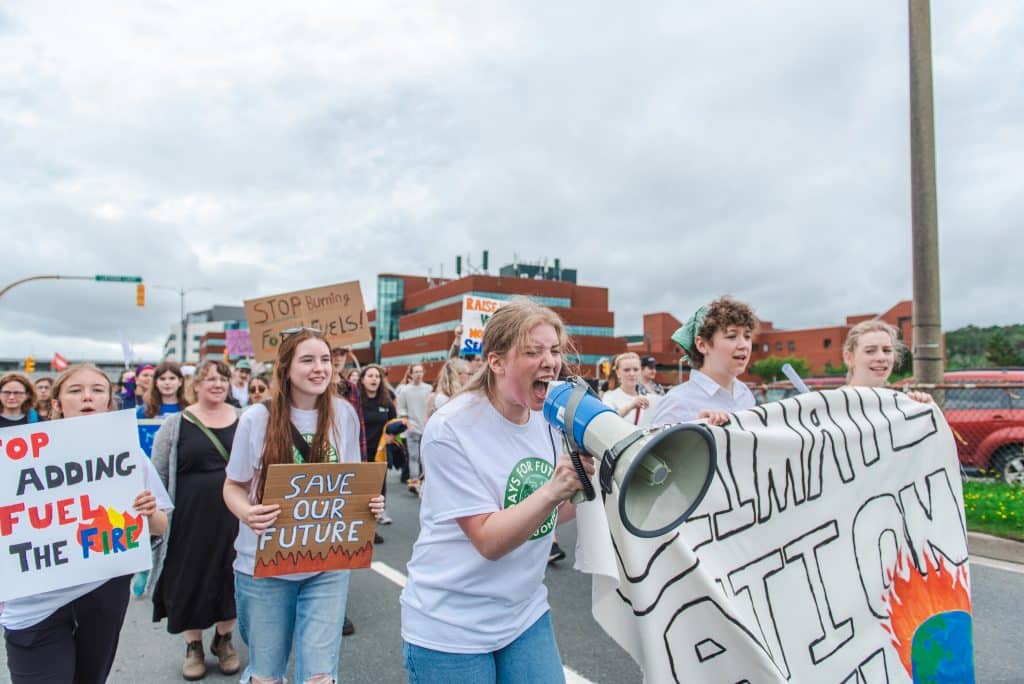
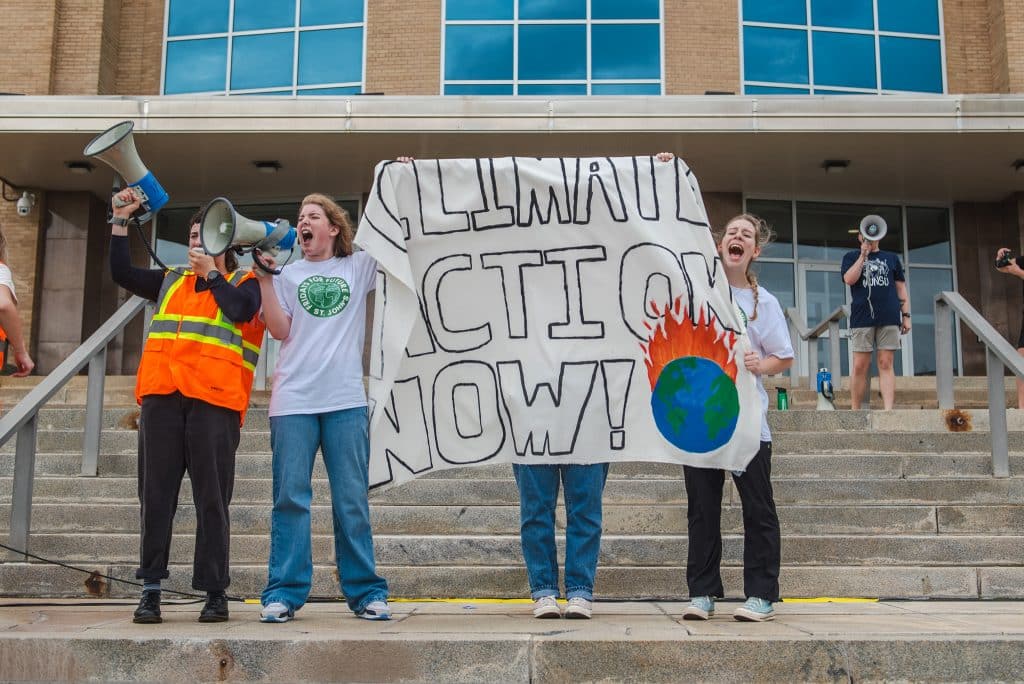
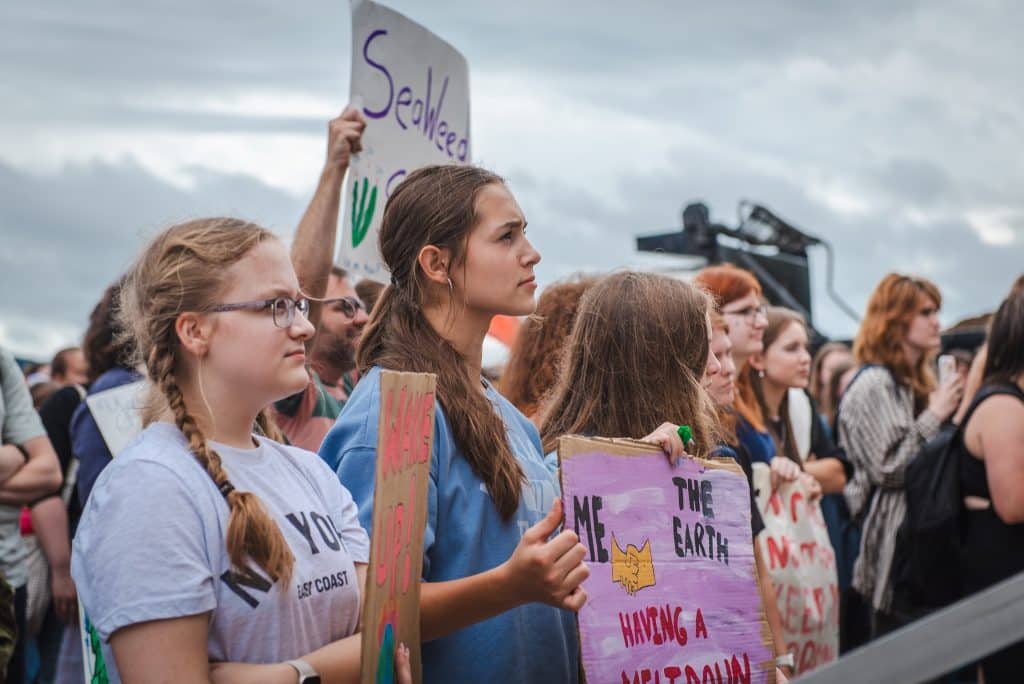
With wildfires still raging across western Canada and post-tropical storm Lee threatening the Maritimes, last Friday hundreds in St. John’s marched from Memorial University to rally at Confederation Building.
Organizers are calling on the provincial government to end public subsidies for fossil fuel projects in the province, including Bay du Nord as well as future exploration. They’re demanding institutions like Memorial University divest from fossil fuel projects, and that fossil fuel companies pay reparations to Indigenous and global south communities and cover the cost of decommissioning existing projects. They’re also calling for increased public investment in community-owned renewable energy projects, and more and better public transit throughout the province.
The protest was organized as part of a global climate strike coordinated by Fridays for Future, a youth-led movement kick-started by Swedish activist Greta Thunberg in 2018. The movement found solid roots in this province, where high school and university students along with community members have put off several protests, including one in St. John’s that drew 8,000 attendees in 2019.
Will you stand with us?
Your support is essential to making journalism like this possible.
Rain held off for most of Friday’s event, which began with a short rally at the University Centre Clocktower. Then about 500 chanting, singing protestors marched along Prince Philip Drive, blocking one direction of traffic as they made their way to the Confederation Building. The hot, muggy temperatures were a fitting backdrop as marchers chanted, “How high are global temperatures? Too damn high!”
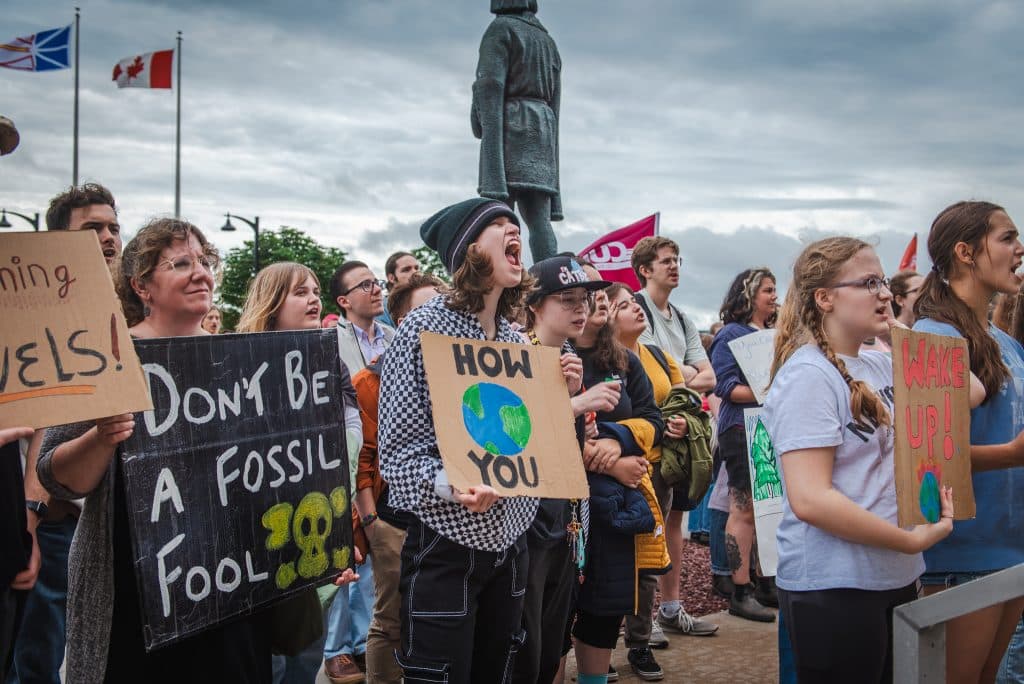
Once they arrived at Confederation Building, there were a series of short speeches along with a dance performance and poetry recitation. While the diverse crowd featured a range of attendees, including union activists, professors, and a handful of politicians, youth predominated, including large groups of junior high and high school students.
“I’m here because I feel that it’s really important for everybody to know about this, because it’s a really big thing and our world is dying,” said 13-year old Evaleigh Williams, a Grade 8 student at Macdonald Drive Junior High.
No climate justice without decolonization
Organizers centred the links between climate justice and decolonization. MUNL student Nicolas Keough opened the rally at the clocktower with a heartfelt land acknowledgement in which he admonished people for low attendance at the August 5 Search the Landfill rally in St. John’s, and reminded them of the September 18 International Day of Action to Search the Landfill. “There is no climate justice without including and highlighting Indigenous voices,” he said.
The fierce and simple chant “Land Back!” was heard frequently throughout the event, and the first speakers at Confederation Building were two Indigenous students.
Emma MacNeil spoke to the ways colonial forestry and agricultural practices have led to environmental degradation and the spread of wildfires.
“Companies and governments bribe Indigenous leaders to bend to their demands,” said MacNeil. “If they refuse to be bought, a smear campaign begins. When we assert our rights to our land, we are met with military and tactical RCMP units with snipers. They laugh and mock us as they take down our red dresses for our murdered women, they smash their way into our homes with axes, and they restrict media access so the truth gets buried.”

“We’re not going to get climate justice until Indigenous peoples across the country, across the globe, are treated with respect and given the rights that they deserve,” said Makaela Blake, an Inuk graduate student. “I’m sick and tired of white men in this building behind me and other buildings across the province […] making decisions for my people, for my home.
“We’re not going to make a better planet for all of us until our Indigenous peoples are respected. We want our rights back, we want our land back. You stole our land, you depleted our resources, you completely destroyed the country…and you still won’t give our land back even though you destroyed it and your resources are almost gone.”
A chant of “Search the landfill, defund the police!” was picked up by the crowd in response.
Equinor’s Bay du Nord project under fire
The controversial Bay du Nord project came under repeated fire as well. Organizers are demanding that the province end all subsidies for fossil fuel projects like Bay du Nord—including incentives for exploration—and that oil companies pay reparations to Indigenous and global south communities and cover the costs of decommissioning existing projects.
Newfoundland and Labrador Federation of Labour President Jessica McCormick attended the event alongside representatives from CUPE, NAPE, Workers Action Network and other labour organizations. She spoke to the impact of climate change on workers, and the need for workers to be involved in policy discussions about how government and industry respond. McCormick recognized that the lure of jobs is often used to make further fossil fuel investment sound attractive to workers, and said it’s another example of government and industry pitting workers against each other.
“I understand the fear and I understand the uncertainty, because there’s a lot of it, and because governments just aren’t talking to workers about it. They want us to be fearful,” she told The Independent.

“They aren’t talking to workers about these really significant wind and hydrogen developments that are happening in the province. We’re being left out of that conversation and we need to be a part of it. We need to be a part at the beginning of those conversations, not a meaningless consultation after the fact. We need to have workers at the table to talk about a just transition, to talk about training and retraining.”
Kassie Drodge, a local organizer with Sierra Club Canada, called on government to stop Bay du Nord.

“You sit there and approve oil and gas projects when you know Labrador is melting,” she said. “Lining your oil buddies’ pockets without promising a future for our youth!”
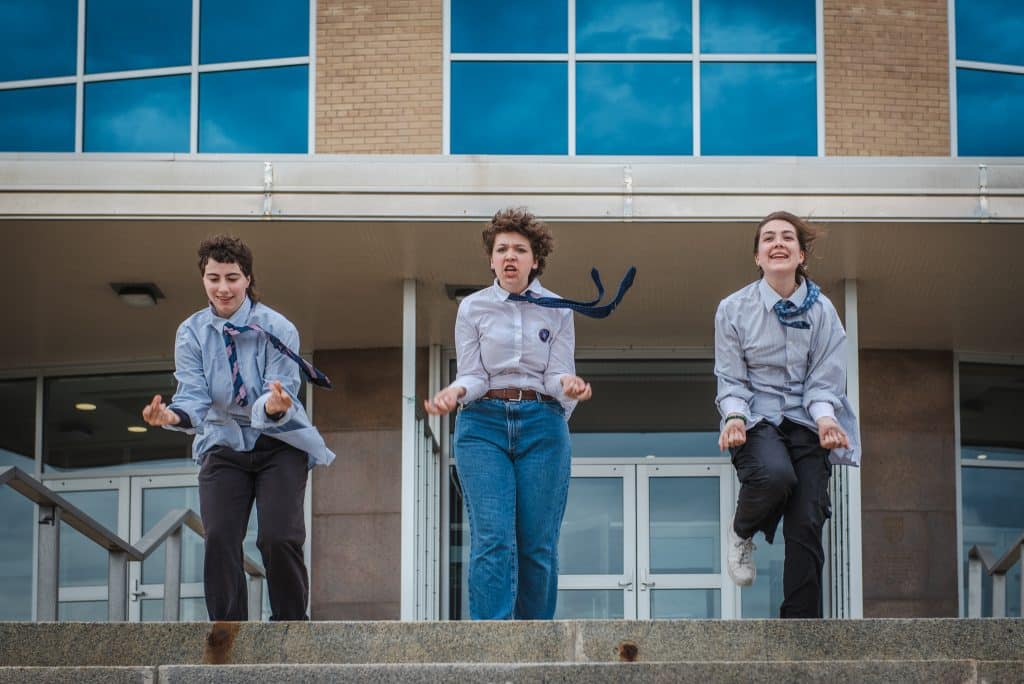
As part of the event, a group of Fridays For Futures organizers dressed as oil company executives and performed a dance in which they satirized the fossil fuel industry’s embrace of green energy as a solution to climate change. The lively performance received an ovation from the audience.
Calls for divestment
Fridays For Future is also calling for divestment from fossil fuel companies; they’re targeting Memorial University in particular. Fossil fuel divestment campaigns have gained traction at several universities in recent years, including Memorial where a succession of organizations have lobbied for divestment. Friday’s organizers want Memorial to cease its investments and partnerships with fossil fuel companies.
Josh Lepawsky, president of Memorial’s Faculty Association (MUNFA), attended the rally. He explained that MUNFA began divesting its own funds in 2015, and has pushed for the University to do the same.
“It sends a signal, but it’s not just symbolic,” he told The Independent. “Even if all you care about is the sheer economics of it, you know you shouldn’t be putting pools of money into an industry that is clearly on the way out. There’s substantial financial risk there. So even just on the basics of pure economics, it makes sense to divest.”
That was a message echoed by sociology instructor Lori Lee Oates.
“Do not believe politicians that tell you oil is good for the economy,” she told the crowd. “The research tells us there’s a net increase in jobs when you move to green energy. Don’t believe politicians that tell you oil is about jobs. This is about government having access to royalty revenues to do what they want with, and they’re mostly spending it on big contractors.”
Dozens of professors joined the rally, including Mahyar Masoudi and a group of his colleagues from the Department of Geography. They carried signs emblazoned with “Geographers for Climate Justice.”
“Geography is about understanding how the geography of the world works, why things are happening, and climate change is a really big part of it,” Masoudi told The Independent. “It’s happening—it’s actually happened—and now we are dealing with the consequences. It’s really time to take action and to make sure that we can do something to not let this get worse than this.”
Organizers took aim not only at Memorial’s ongoing relationship with fossil fuel companies and the institutions that are funding climate breakdown. They called on RBC to be kicked off of campus due to its status as one of the largest funders of fossil fuel projects in the world.
Keough, who got involved with Fridays For Future as a high school student, is now studying for an Engineering degree. He told the Independent that while student groups like Engineers Without Borders and the National Society for Black Engineers have joined the push for climate justice, the faculty as a whole is still deeply imbricated in the fossil fuel industry.
“We actually have sections in our building that have the logos of these oil and gas companies on them,” he said. He said he understands Memorial is in need of money, but said the climate crisis should now take precedence.
“We are actively seeing the country burn, we see flooding in Nova Scotia. It’s beyond the point where you can just accept money from these questionable sources.”
Keough also said students are effectively streamed into work terms with oil companies because they pay so much more than other work term positions. Work terms are mandatory for students in many programs and in order to graduate they often have to take whatever jobs are available — and those are predominantly in oil and gas. Other times students are forced to take the higher paying oil and gas work terms in order to cover the soaring cost of tuition. This is especially the case for international students, he said — many of whom would prefer to explore other more sustainable engineering fields.
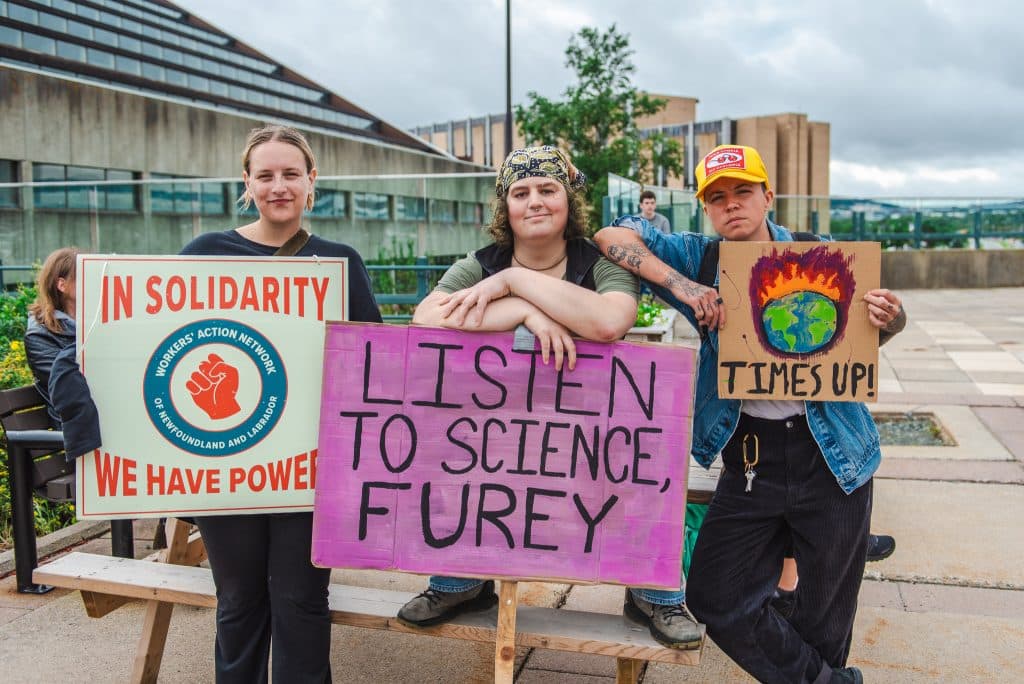
Organizer Sarah Smith first got involved with Fridays For Future while a high school student in Bay Roberts. She now studies business at Memorial and says students feel the same pressures in her department.
“There’s so many work terms in the oil and gas industry and other jobs can’t compete,” she said.
Politicians were the target of the protest and speakers decried their absence, while acknowledging the attendance of NDP MHAs Jim Dinn and Lela Evans, along with interim PC leader David Brazil and Liberal MHA Bernard Davis. Davis, who is the provincial Minister of Environment and Climate Change, spoke with organizers following the rally and agreed to schedule a future meeting with them.
But youth were the predominant presence at the rally. Organizer Rachel Sutton, a 16-year old Grade 12 student at Gonzaga High School, closed the rally.
“I am here because our planet is dying,” Sutton said. “Look at the wildfires burning across our country. Look at the icebergs melting in our Arctic. Look at the floods, the storms, the damage we are facing. And we have done it all to ourselves!
“I stand corrected: my generation has not done this to themselves — those who came before us, and those who came before them—they have done this to our world. Yet it is on our shoulders, the youth, whom the weight of the planet rests upon. We as young people must stand up. We must speak out. We can no longer be silenced. We are out of time.
“Older generations will be long gone by the time the most devastating effects of what we have done to the planet truly come to light. But not us. We will reap what humanity has sown. We did not ask for it. But it is now our responsibility to save this world and we are running out of time. We cannot stand down, we cannot be quiet. We need climate action and we need it now – today, at this very moment. It will be difficult, but we have no other option. We need support from our governments, from our organizations, from our industries, from our teachers, coaches, friends and family. They must be willing to make the hard choices to save this planet, not because they are easy but because they are necessary.
“People say that we haven’t lived long enough to understand the things that we are speaking about, but I think it’s just the opposite – we haven’t lived long enough to deserve the responsibility that befalls us. Yet it is ours for the taking. We must continue to speak out and rise up.”



Author

Related Articles
Access to information: N.L. failed to make public over 1,000 responses in a single year
Province says it’s dealing with an increase in requests, but NDP leader is concerned the mounting problems may be intentional

Memorial University student union walks back plan to close radio station amid backlash
‘I wish CHMR the best,’ Memorial University Students’ Union executive says ahead of vote to defund the campus radio station

INTERVIEW: Avi Lewis says N.L. is ‘ground zero’ for the biggest challenges facing Canadians
The federal NDP candidate says socialism and economic populism are the antidote to unfettered capitalism and the ‘epic market failures’ it has brought