
Entangled: Fragile and complex truths reflected in art
Nasim Makaremi Nia’s new exhibit tells a story of migration, transition, and identity in fantastic animal hybrids and beautifully fragile paper sculpture
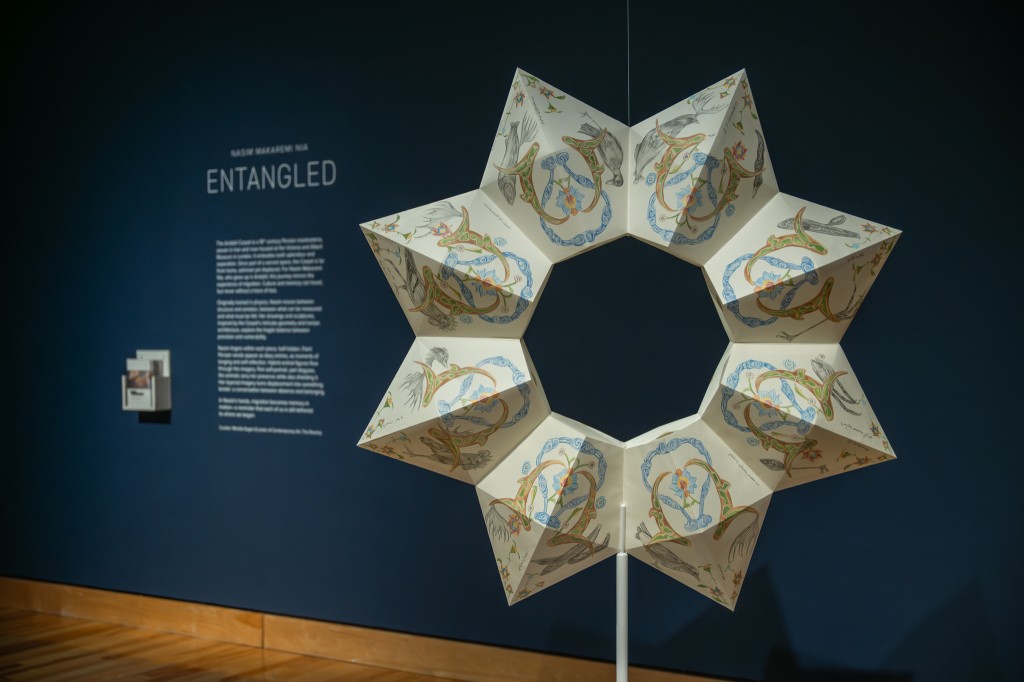
What does a tantalizingly beautiful exhibit at The Rooms in St. John’s have to do with an ancient Sufi shrine in Iran and an Islamic art gallery in London? And how do physics and sexuality enter the picture?
These are just some of the tangled threads inspiring Entangled, Nasim Makaremi Nia’s newest exhibit at The Rooms, which incorporates a stunning collection of paper sculptures inspired by a massive Persian carpet more than 500 years old. In actual fact, the Ardabil Carpet is now two carpets, both pieces having traveled their own journeys along the well-worn highways and byways of colonial art theft.
Makaremi, an artist and art educator now based in St. John’s, grew up in Iran hearing stories about the carpet, the exact origin of which is shrouded in uncertainty; multiple origin stories exist, all of them fascinating. She never saw it. More than a century ago the carpets were taken from Iran by a British carpet dealer. Like other looted, stolen and sold artworks, the carpets can now only be seen in the homes of colonizing countries that acquired them.
Today the larger, better-known carpet is held in the Victoria and Albert Museum in London, while the smaller one is at the Los Angeles County Museum of Art. It was only in recent years that a reproduction was produced and installed in a shrine in Iran, the carpet’s original home.
Will you stand with us?
Your support is essential to making journalism like this possible.
Last year, thanks to a grant, Makaremi was finally able to see the carpet first-hand. Today it sits in the Jameel Gallery in London’s Victoria and Albert Museum, which contains nearly 400 other works of Islamic art: colourful tiles torn from Iranian tombs, North African ceramics, embroidered dresses and shawls. The carpet is the centrepiece of this collection and is displayed in a large glass case (the case itself won an international design award in 2006). The lighting in the room is kept dim to prevent fading; it’s adjusted upward for only a few moments every hour.
As she stood in the dim lighting of the London museum gazing at the 500-year old carpet, Makaremi reflected on the nature of migration and exile. Both she and the carpet shared a common homeland of Iran, yet now reside far from home — she in North America, and the carpet in Europe. It was only there in London they were able to finally connect.
“It was like magic,” Makaremi reflects, remembering the moment she finally came face to face with the carpet. “I was very emotional, it was really a special moment. When I was a child I heard a lot of stories about this carpet, I heard so much about it. But we never saw it.”
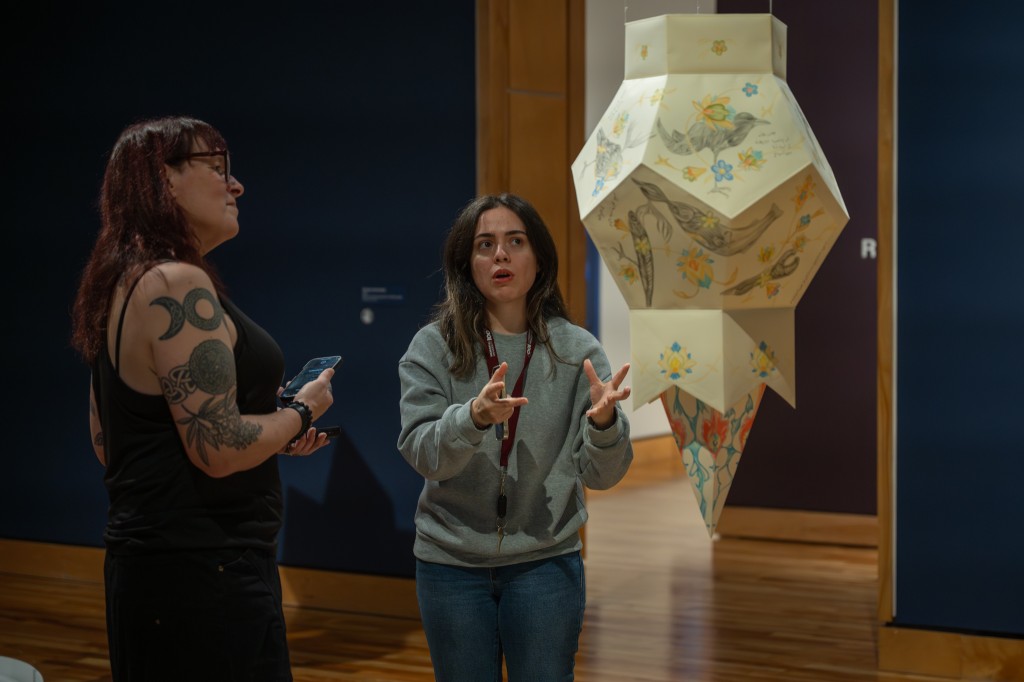
Inspired by the carpet’s intricate geometric forms and the broader motif of migration and journeys represented by their mutual displacement, Makaremi returned to St. John’s and got to work translating the themes evoked by the carpet in contemporary form. She decided to work in paper, a soft medium which reflects the fragility of the 500-year old carpet. In The Rooms, Makaremi’s fragile paper images are suspended and held in place by the tiniest of filaments. Viewers can get so close they might fear the impact of their breath on the fragile piece.
Instead of producing flat paintings, Makaremi decided to construct three-dimensional paper sculptures. She may be an artist, but she also has a graduate degree in solid state physics, and the stark angles and mathematical formulae of her scientific training are never far from mind.
“Physics is always there,” Makaremi acknowledges with a smile. “For these shapes I did a lot of math, a lot of calculating, for the angles, for the sizes. I use a lot of math, especially for these. Physics is important. I don’t always think about physics [consciously] but I will later find that it’s affected my work.”
Hybrid forms, hidden angles
The three-dimensional sculptures serve other purposes too, underscoring the complexity of the motifs Makaremi wanted to convey.
Humans are complex creatures, always in transition. We never look exactly the same to each other, always revealing different, limited angles of our true selves. It’s difficult to fully grasp someone’s essence when so many angles remain hidden. We think we understand someone, but then they turn around and we glimpse a whole new set of angles; the aspects we thought we’d understood about them have shifted too.
Makaremi’s sculptures are like that; the more you walk around them, trying to form a sense of the whole, the harder it becomes. Their shapes are in constant transition, one angle folding into the next; animal figures stretch along multiple panels, morphing into new images with every turn. Each angle absorbs the light differently, the colours and line drawings alternating as they vie for primacy in the observer’s limited field of vision.
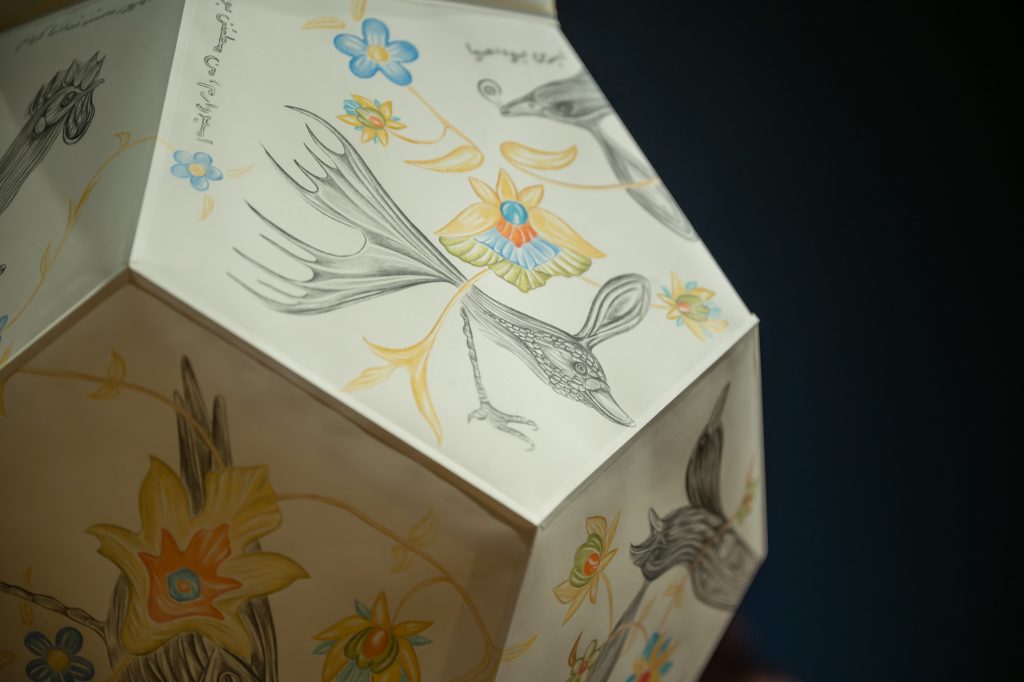
“A couple of years ago I started to work with three-dimensional shapes in my work because I wanted to show the different dimensions of humans’ lives,” Makaremi explains. “When we turn them around we can see many differences, [reflecting] different dimensions of humans’ lives, a kind of complexity. That’s why I decided to put them in three-dimensional images. It reflects a kind of transition.”
Transition is a recurring theme in Makaremi’s work, which features mesmerizing figures: hybrids combining elements of multiple animals, transitioning from one to the next so subtly it’s difficult to pinpoint exactly where the transformation occurs. One figure combines the head of a duck, the ears of a rabbit, the leg of a rooster. Its backside is a pair of moose antlers.
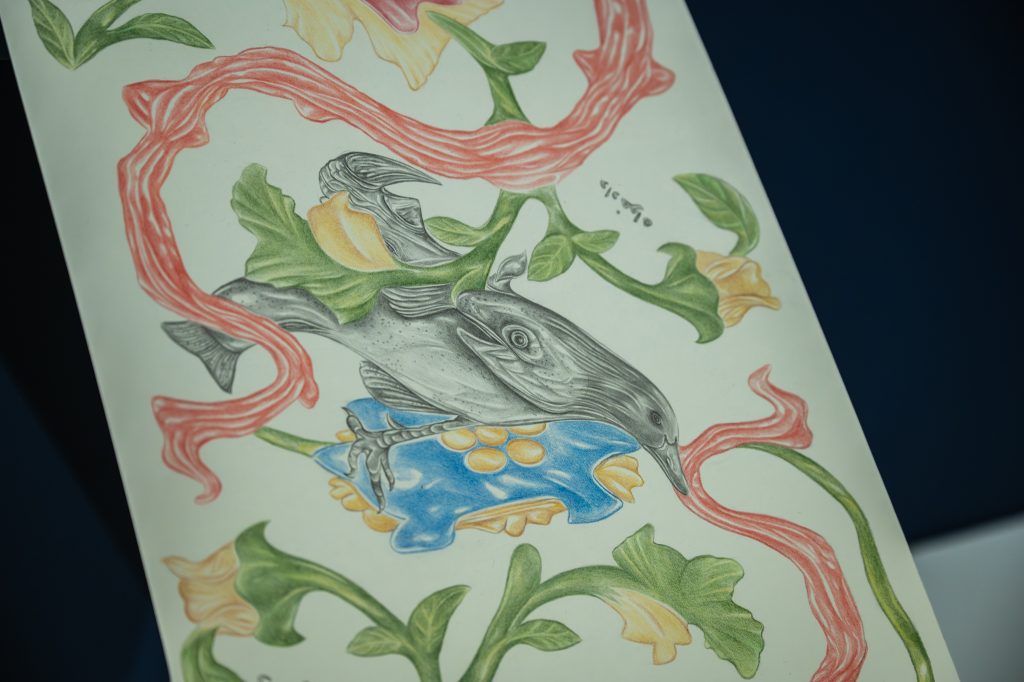
In another, what appears from a distance to be a raven also has the legs of a rooster; its tail reveals itself as that of a fish. Another set of feathers turns out, on closer inspection, to be the snout of a rhinoceros. Look closer still, and you’ll see another fish embedded within the head of the raven. The embedded juxtaposition of figures within figures, the process of discovery, the seamless flow of one creature into the next—all of these combine to create a mesmerizing whole. And while Makaremi says she never embarks on a drawing with the conscious intent to combine certain animals—the combinations and transitions emerge naturally for her through the process of drawing—when she reflects on the finished product, meanings emerge.
“I just start doing them, I never plan like, ‘Today I want to do this, combine this animal’ — no, I just start,” she explains. “Sometimes they surprise me. They just happen while I’m working.”
While the forms Makaremi’s sculptures take emerge naturally through the creative process, the animals have come to possess very specific meanings for her—a sort of vocabulary of ideas which forms a commentary on social and political issues. Roosters are symbolic of patriarchy. Fish and crows are symbols of women. The recurring image of a rhinoceros represents Makaremi herself as an artist. Capelin merge with traditional Iranian carpet patterns, symbolizing her own journey. Rabbits’ ears are symbolic of judgement or gossip. And Newfoundland animals predominate, representing both migration, transition, and home: moose, capelin, salmon, crabs, lobsters. These hybridized figures underscore the complex juxtapositions we all carry within ourselves: the transitional journeys we undertake.
“This is a way to talk about what’s in my head,” she reflects. “I wanted to talk about many things, I wanted to provide critiques about political issues, social issues, about censorship, about discrimination. I wanted to talk about my personal immigration journey as well, which is very important; all of the capelin and moose antlers are a symbol of Newfoundland.”
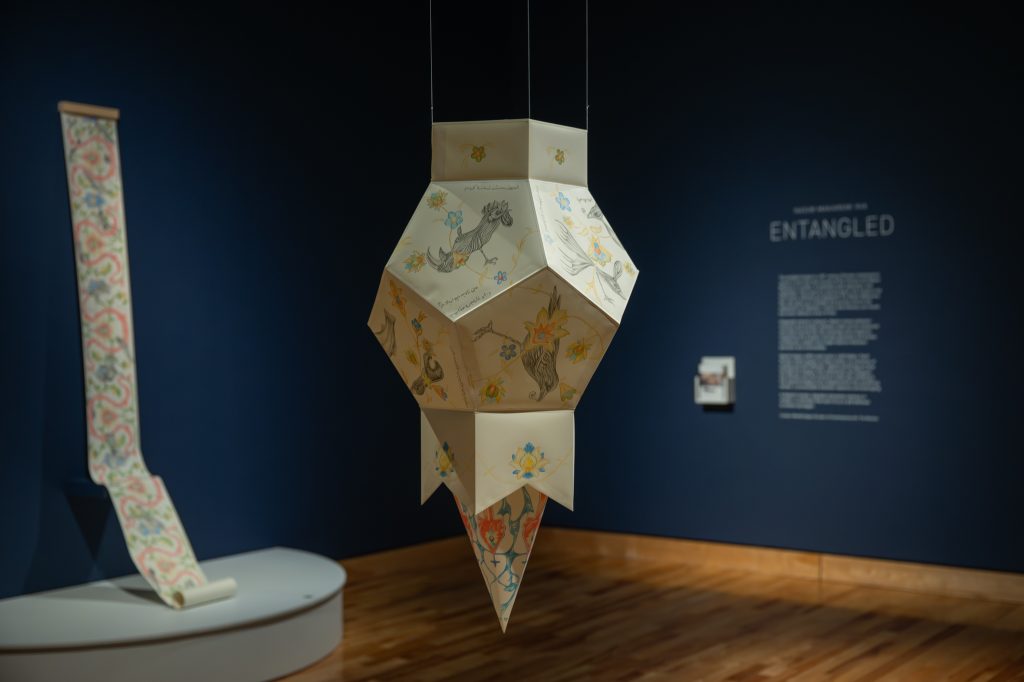
Looking closer, one discovers more than just animals in the drawings. There’s a further, deeper layer: breasts, penises, and vaginas subtly worked into the already complex animal hybrids. The fact they are so thoroughly hidden—some less so than others—is a statement on censorship, on the ways in which sexual identities and realities are so often hidden and buried, recognizable only to those with the ability to look deep. The fragile medium Makaremi chose—paper—was also a deliberate choice, its fragility representative of the delicate tension between freedom, censorship and repression.
“Hiding sexual aspects of humans’ lives is a way to magnify censorship in my work,” she explains. “I’m using censorship in my work to magnify [the issue]. Sometimes [sexual symbols] are very hidden but sometimes they aren’t really hidden, they stick out.
“Art is a safe place to talk about these things, and to have a critique about them. And because of this I decided to have them in layers, because their impact on my life is so complex. So I want to show them in layers, sometimes very hidden, sometimes very obvious.”
Among the animal figures and artistically-rendered geometric borders are brief stretches of handwritten script in Farsi, Makaremi’s first language. The gorgeous writing is a form of art in itself, but Farsi readers might find themselves bemused by the stream-of-consciousness subject matter.
“The notes are very simple, daily diaries,” she explains, translating a few of them. “They say things like ‘Today is cold,’ ‘I need this food,’ ‘I talked with my mom on the phone,’ ‘It’s summer but it’s cold.’ Or sometimes while I was working on this I was watching the news or watching documentaries and I heard something that was interesting to me and I wrote it as a sentence. It’s a capturing of the moment.”
Makaremi’s artwork captures the eye with its beauty of form, but hidden within is more complex content for the active and open mind. It offers new ways of seeing and thinking about recurring motifs in Newfoundland and Labrador art: fish, birds, moose, and more. If art reflects society, this is an exciting hint at where local art (and society) is heading, at the new worlds of wonder and creativity that emerge when a more diverse range of cultural and artistic insights are entangled with the traditional symbols of this place and given free expression (and the respect they deserve in local art spaces).
This juxtaposition of tradition, beauty, and transformational social critique is a characteristic of Makaremi’s work. In 2021 she exhibited a series of sanitary pads and menstrual products embroidered with traditional Persian motifs; also a commentary on censorship and repression. But also deeply, vividly beautiful.
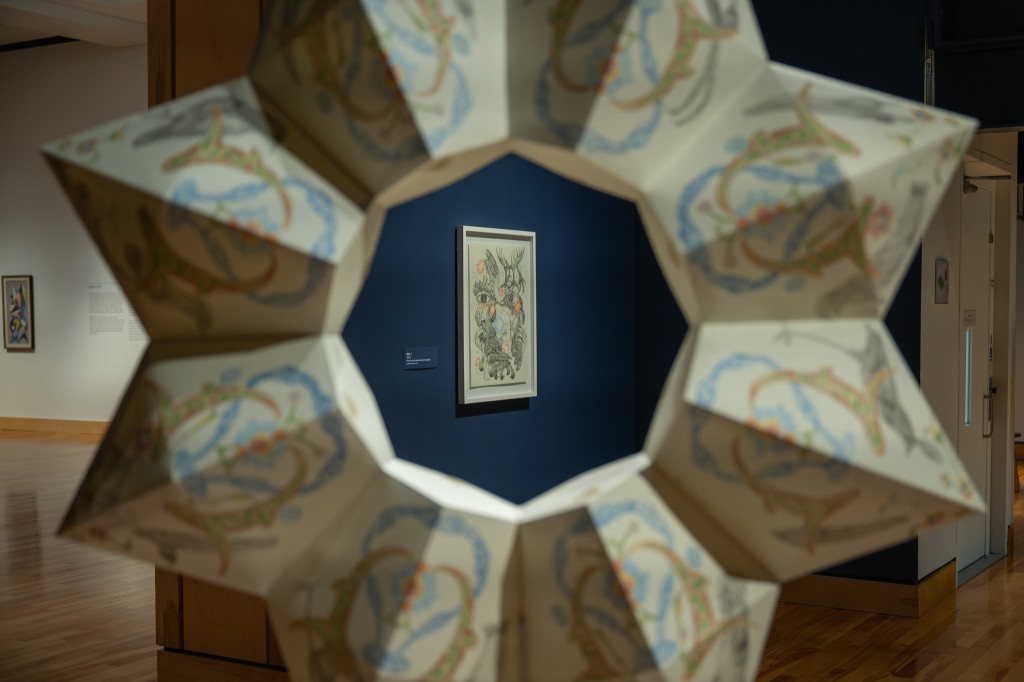
Entangled is a gorgeous exhibit, but doesn’t represent the end of this particular journey. Makaremi recently received a grant to expand her work and produce more paper sculptures based on the Ardabil Carpet.
She’s excited to think about where the journey will take her next. But having lived in Newfoundland for the past five years, she also acknowledges the important ways in which her artistic journey is rooted in the place she’s come to call home. It goes beyond the landscape that inspires her, the animals she incorporates into her art, and even the food that she’s found so unique and delicious. It’s the artistic community that she truly appreciates.
“The art community here has been so welcoming and supportive,” she smiles. “When we have a safe and welcoming community around us, we can do so much more.”
Entangled is exhibiting at The Rooms until March 8, 2026

Author

Related Articles
PCs have no plan to meet ambitious housing targets
Finance minister pins housing hopes on federal funding, says his own portfolio of rental properties doesn’t put him in a conflict of interest
Photos returned to Innu ahead of Labrador exhibit showcasing history, culture
Cultural Guardian Jodie Ashini hopes the archival photographs will help strengthen youth’s connection to Innu culture, and ultimately improve mental health
Can N.L. have oil and gas, and climate targets too?
Finance minister says yes, but ATI requests show there’s no plan for how to do both — and reveal significant unpublished emissions estimates