
‘Goodnight Moon’ and the child in all of us
Artist Matthew-Robin Nye is in pursuit of wonder, and thinks we should be too
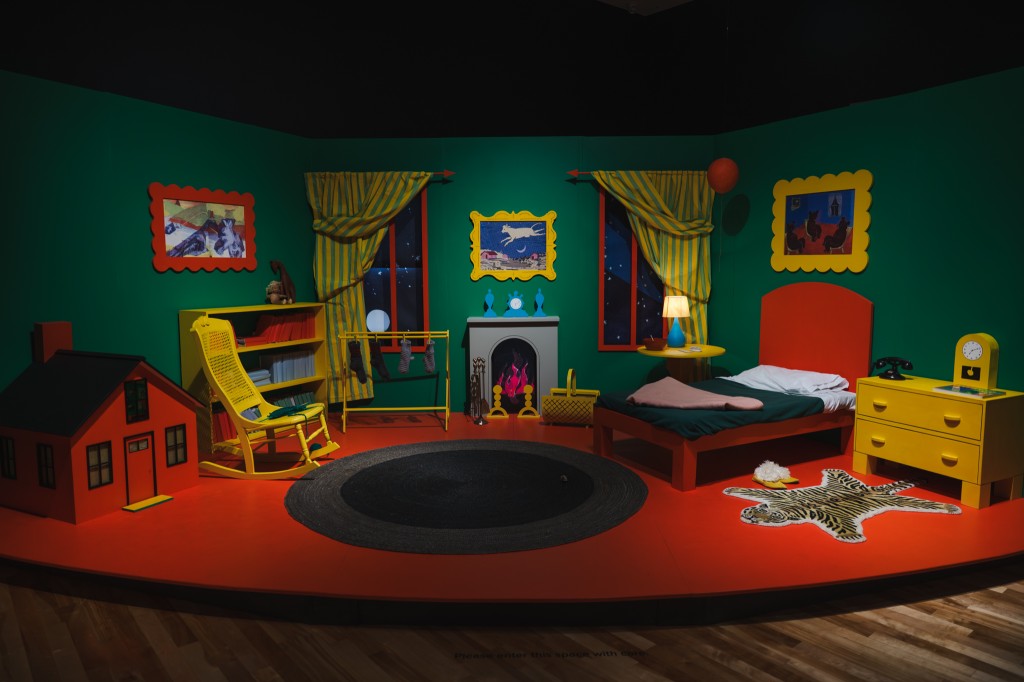
I’ve often thought I must be the only person who never experienced Goodnight Moon as a child.
For millions of people around the world (the book’s been translated into over a dozen languages) it has been a staple of childhood literature since its publication almost 80 years ago.
In a scant 130 words, the book with its bright, repetitive illustrations and anthropomorphic bunny narrator—who bids goodnight to a succession of objects in whimsical rhyming patterns—endeared itself to generations of children and adults alike.
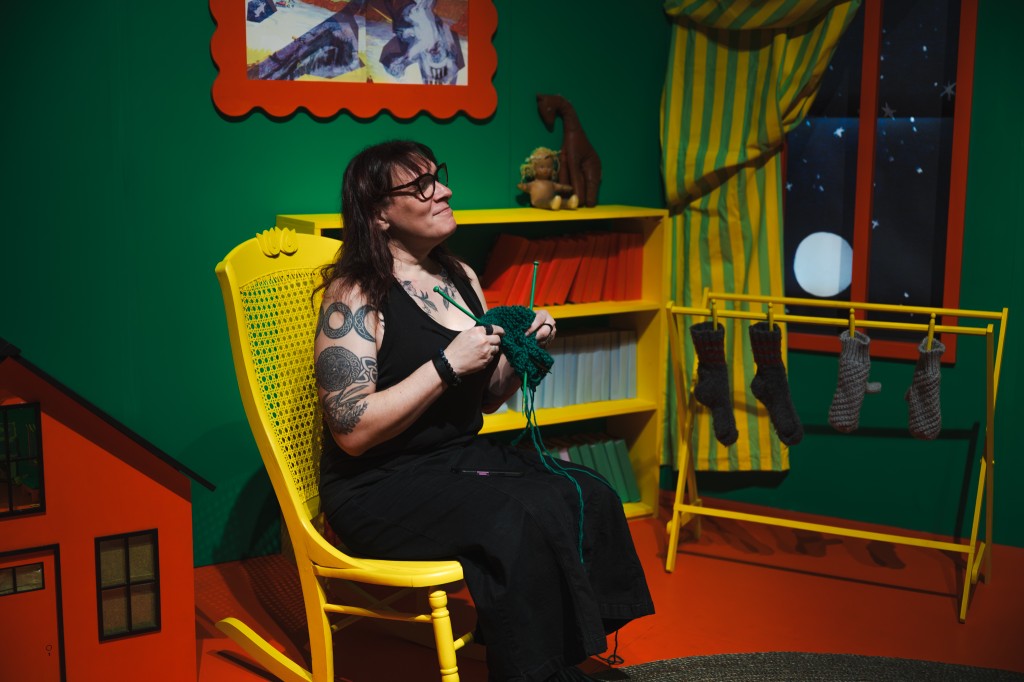
Now, those who dreamed of entering the book’s world, of sitting on the bed or in the rocking chair and bidding goodnight to all these objects themselves can actually do so in a full-sized, immersive set, part of an exhibit titled Goodnight Moon: A Rhythm, A Tempo conceptualized and created by Matthew-Robin Nye (the set itself was constructed by Rob Bird). It was originally produced for an exhibit at Sunbury Shores Arts & Nature Centre in New Brunswick in 2022, after which it exhibited at Beaverbrook Art Gallery in Fredericton. Following that initial run, Nye says the piece was on the verge of being delivered to the dump when renewed interest in the work led to its installation at The Rooms in St. John’s. While its future remains uncertain, it can be experienced there until March 8.
Will you stand with us?
Your support is essential to making journalism like this possible.
The exhibit’s concept had been floating around in Nye’s head for a while. While doing an artist’s residency in New York about 14 years ago he had an opportunity to put together an exhibit, and that’s when it first came to mind. That exhibit was ultimately cancelled but the idea of constructing a piece based on the book lingered. Years later he was approached by a former colleague who was artistic director at the Sunbury Shores Centre, and offered the opportunity to create a project there. Goodnight Moon: A Rhythm, A Tempo is what resulted.
The questions informing Nye’s approach are lofty ones: What makes an artwork? How do we define experience? How do we think about becoming ourselves—becoming an identity—in relation to larger political forces? Nye, a PhD candidate in the Department of Interdisciplinary Humanities at Concordia University in Montreal, studies art and philosophy, and even incorporated the Goodnight Moon project as a chapter of his dissertation.
For Nye, an artwork is more than just a material object. An artwork can be “what makes a space shimmer with activity,” be it “identity, information, [or] the artfulness of an event underfoot,” he explains. “It can be a nascent politics. It has a quality of effervescence, of becoming.
“It’s not really an object, it’s an event, it’s an experience,” Nye continues. “Thinking about how we identify ourselves, how we express ourselves, how our world expands from experience, and then encompasses us — is a way of privileging artfulness, curiosity, wonderment, attunement. Different attentional modes.”
Nye considers his work more of a “proposition” or “experiment.” The sculptural elements it incorporates are beautiful, he acknowledges, but are more “byproducts” of the process. What he was really looking to do was to “supercharge a feeling.”
Nye’s approach to art—as an event, a becoming—is reflected in his recruitment of local artists to engage or respond to the exhibit wherever it travels. At its debut in New Brunswick, Montreal-based drag performer Jordan Arsenault did a half-hour solo performance on the set, dressed up as a bunny; artist k.g. Guttman also produced a set of handmade tools as a performance kit engaging with some of the exhibition’s themes. For its run at The Rooms, Nye recruited Newfoundland and Labrador-based artists as well. In November, Marlene Creates presented a drumming and poetry performance there. And next month, in February, local artists Annette Manning and Daze Jefferies will also perform encounters with the piece.
“My artistic technique, my process, is to set up the conditions, and wait and see,” Nye reflects. “Set up the conditions, do the hard work leading up to it, but then take your hands off and see what happens.”
Nye doesn’t know what the future holds for the exhibit. Its sheer scale renders the set challenging to transport and install, and he has yet to hear back from other galleries he’s pitched it to. While he’s hopeful there will be more uptake and that it’ll be exhibited elsewhere following its run at The Rooms, he’s also considered the very real possibility this might be its final run.
Seeking: child at heart
My first visit to Goodnight Moon: A Rhythm, A Tempo was on opening night. Two other exhibits opened the same night so the galleries were abuzz, but the small space containing the exhibit was almost too packed to squeeze into.
Adults lined the walls, looking on, while about a dozen children clambered all over the set. Several children were simply running back and forth, or in circles, in a seemingly aimless manner. One child, who kept attempting to rally the others to produce a play, periodically turned to address the adults, announcing the forthcoming production. But it was purely aspirational; the scene remained chaotic and the play never emerged. It’s hard to tell what the children thought of it all; their haphazard dashing to and fro suggested they saw it as a massive, unorthodox playground they hadn’t expected to stumble into on a Friday night at an art gallery.
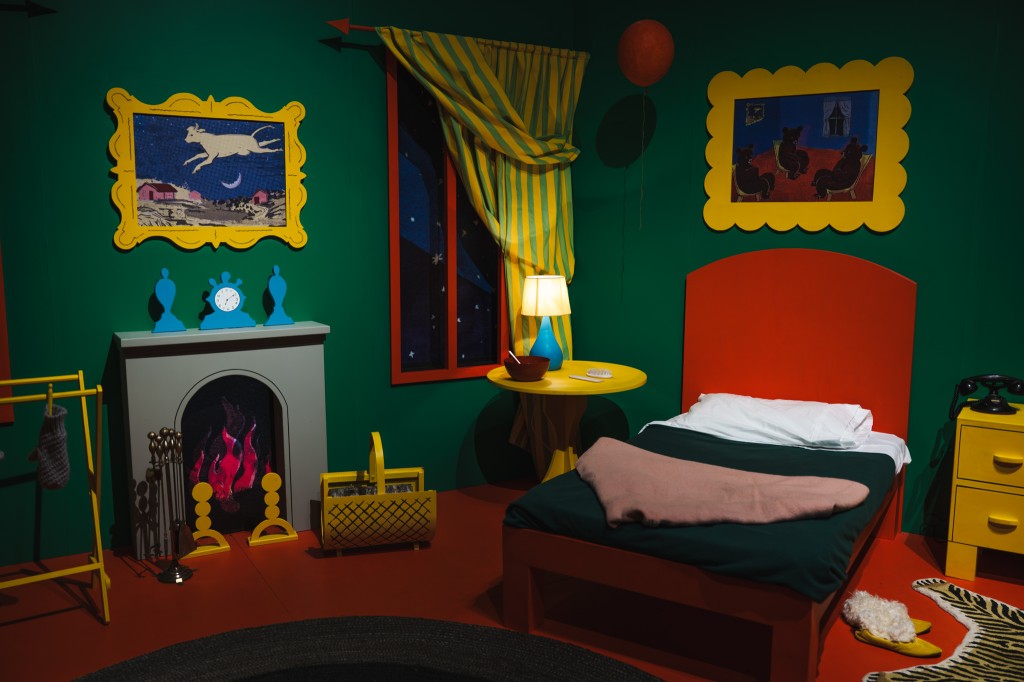
My second visit was with a friend. We strolled in, looking forward to a bit of quiet appreciation of the piece. This time there was a single child on set, perhaps 7 or 8 years old, moving with an entirely different rhythm from the frenzied, hyperactive kids on opening night. The child paced from one end of the exhibit to the other with a sort of graceful reverence, eyes wide and mouth ajar, as though astonished to find themselves inside a beloved storybook. They sat on the bed, picked up a book, peered at the painted-on window and the cow jumping over the moon.
When we entered the exhibit, the kid addressed us as peers. “This is my favourite book in the world,” they said simply, slowly, with a sense of awe. We nodded. The kid pointed out the various components of the set to us: the telephone, the bed, the window. Their grandfather—that quiet, easygoing Newfoundland type—sat on a bench in a corner, smiling awkwardly, ticking his head periodically while observing everything with a bemused expression. The kid continued expositing the set for us, eager to share their appreciation for it. They pointed out the miniature of the set in a corner, something neither of us had noticed on opening night. The child instructed us to remove our shoes, ascend the platform and peer inside.
While the effusive energy of the children on opening night radiated “play,” this child’s energy radiated something entirely different — wonder.
But what about the adults? On opening night, adults lined the walls, almost defensively standing as far from the exhibit as possible while their children swarmed it. They periodically turned to each other, even strangers, for conversation, as though affirming a common identity distinguished from that of their kids, plastered with their backs to the wall.
On my second visit, the only other adult in the room also maintained his distance, sitting on a bench, a silent, reserved expression on his face as he looked about.
Why did none of these adults participate, or even enter the set?
That’s something Nye reflects on. He hopes adults will start taking a more hands-on role. “This is not an exhibition for children,” he says, intriguingly. At least, not children in the specific age-range sense.
Nye draws on the work of French philosophers Gilles Deleuze and Felix Guattari, who distinguish different ideas of childhood. They approach the concept of childhood as representing not a linear development stage—a specific age-range—but rather an approach or orientation to the world. Childhood is an experiential state, a state-of-becoming in which we’re open to new ways of seeing, understanding and experiencing the world around us. It’s indelibly tied to the sense of wonder that enables us to grow, perceive and understand the world. Anytime we enter that stage of wondrously perceiving new things, we are tapping into this abstract experience of childhood; we are growing, becoming anew. This is something we can, and should, experience at all ages.
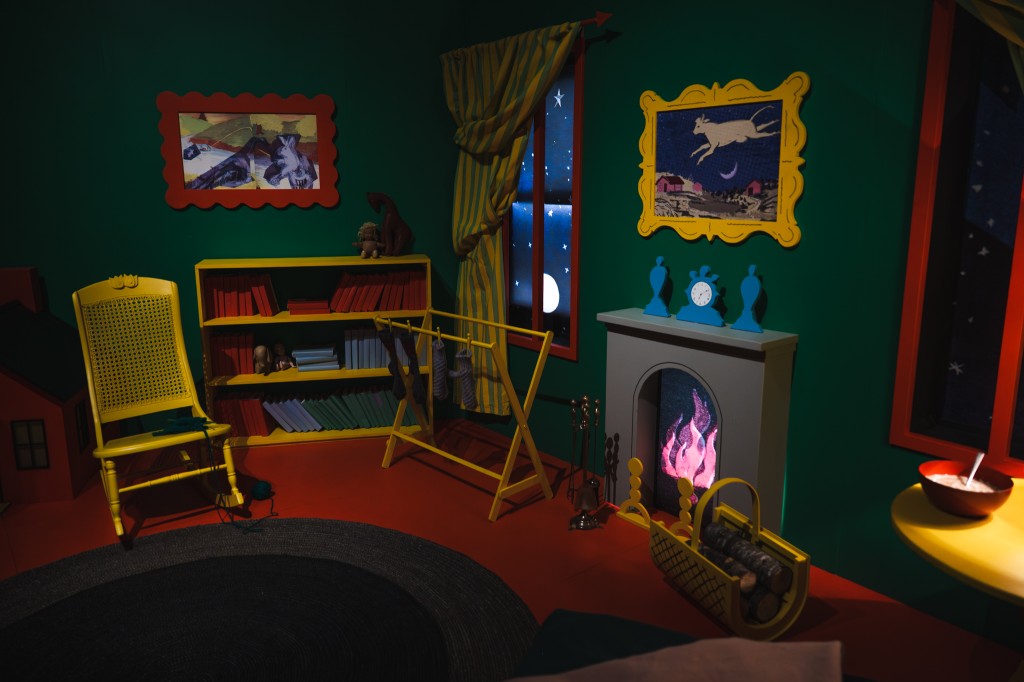
Nye hopes people’s encounters with the exhibit might help catalyze that process of child-becoming, of wonder, in viewers of all ages.
“I think it’s harder for adults to access,” he admits. “You see it in the adults—you see [the force of] habit. I’ve seen adults who don’t have kids walk in, look around, turn and walk away, [thinking] ‘This is for kids’.
“And I’ve seen adults with kids walk in and go, ‘Oh, this is all about you!’ — as though they’re just there for the kids. But that’s not what it is, for me. What it’s trying to do is to restage that [sense of] possibility. It’s providing the platform for an encounter where maybe the person coming into it might find their perceptual field renewed. Goodnight Moon works to produce that wonder.”
For Nye, wonder is political. He’s quick to qualify his definition of politics. “I define political, being political, having politics, as having a concern. It could be a social concern, it could be an ecological concern. We’re always taking an angle on experience,” he says. “Experience is a big thing, and the way we encounter an experience is the angle. How we take that angle is politics. There’s a decisionality in terms of how you angle in on something. That would be the politics. And wonderment is about […] becoming a child of the world; it’s allied to the capacity to be open, to be receptive, the willingness to be moved by something.”
Why is wonder so important?
“Wonder is very closely allied to curiosity,” Nye says. “Wonder generates a response of curiosity. We live in a world of entrainment—algorithmic entrainment, media entrainment—where increasingly we are produced rather than we produce our surroundings.”
Wonder pushes back against that tendency, he says. “To embrace wonder, to engage in wonder, is antithetical to all that.”
He’s not talking about trips to Disney World, he’s quick to emphasize; participating in that kind of mass culture-produced commodity is not experiencing true wonder.
“When I was a teenager, I didn’t have a cell phone,” Nye reflects, thinking through the memory and his words carefully. “And I remember getting on the public transit bus to go home during junior high school in the middle of winter in Toronto. The bus stop at my junior high was just slammed with screaming kids—you know, just the worst for a bus driver—and the bus fills up to take us to the station. And I remembered watching the drops of water, the condensation on the window, in the middle of winter on a bus with a hundred kids on it. The bus would immediately just become this moist, humid environment and condensation would appear on the window. I remember sitting and watching the condensation. Watching dots of water, points of water, connect and flow together on the window. That, for me, was a moment of minor wonder. Wonder is about enhancing those moments. But it’s increasingly difficult to get there.”
Goodnight Moon: a queer, slow-burn classic for all ages
Goodnight Moon was written by Margaret Wise Brown, a talented and driven writer who published over 100 children’s books during her brief life (she died in 1952 at the age of 42), and left behind nearly as many unpublished manuscripts. The book was illustrated by her friend and colleague Clement Hurd and published in 1947. It didn’t do well initially, selling just 6,000 copies. By 1951—the year before Brown’s death—sales dropped so low the publisher considered pulling it from print. The head librarian of the New York Public Library hated it, called it “unbearably sentimental,” and refused to allow the library to carry a copy. Brown even blurred out the udder of the cow in the story in the hopes that might make the book more palatable to the library, but to no avail.
But it became one of those unusual books whose popularity grew over time, spreading by word of mouth and from generation to generation. Interest and sales picked up over time, and by 1970 it was selling over 20,000 copies annually. In 1972, the New York Public Library dropped its 25-year ban on the book and finally acquired a copy. By 2020, Goodnight Moon had been checked out over 100,000 times, and remains one of the library’s top 10 most checked-out books. By 2017, it had sold over 48 million copies worldwide and been translated into 15 different languages.
The book has acquired an almost cult following in the queer community. It’s been called queer in many ways. I ask Nye what makes the book so queer (beyond the queerness of its author, who had long-term relationships with both women and men)?
He explains that one of the ways it deviates from standard children’s literature is that it’s not didactic: it’s not trying to subtly tell children to do something. It’s about experiencing a moment of beauty and wonder, and understanding how that shapes us.
“It doesn’t have a moral,” he says. Historically, much of children’s literature tries to teach children moral lessons: obey your parents, don’t do certain things. Goodnight Moon was one of the most successful of a reactionary wave of children’s literature from the period that pushed back against this idea of children’s literature as needing to be moralizing, he says.
It intrigues him (I detect a note of concern) that the moralizing appears to be coming back in children’s books.
“If you go to a bookstore and look at kids’ books now, the lessons are back. We’ve gone back to before [Goodnight Moon]. Even celebrated children’s books that are being produced now [are] telling and speaking about things they think of as benign, like ‘I’m teaching you to be accepting, I’m teaching lessons, I’m teaching that the arts are okay’. But the lessons are back in there, and that’s interesting.”
Goodnight Moon “has an orientation away from a traditional narrative structure, which generally has a moral imperative to it. That’s one of the first major queer gestures of this book.”
Another way the book queers children’s literature, he says, lies in the fact that “it doesn’t differentiate between a child and an adult. We’re all sort of interpellated within its structure. The evidence of that is that parents love the book as much as kids do, which is unheard of – to have that balance between both generations. There’s something really important there. This is one of the great artworks of the 20th century and it appeals across audiences regardless of age, and I think that largely has to do with the fact that it doesn’t speak to an audience specifically. It doesn’t presume to know what worlds it’s building every time it’s recited.”
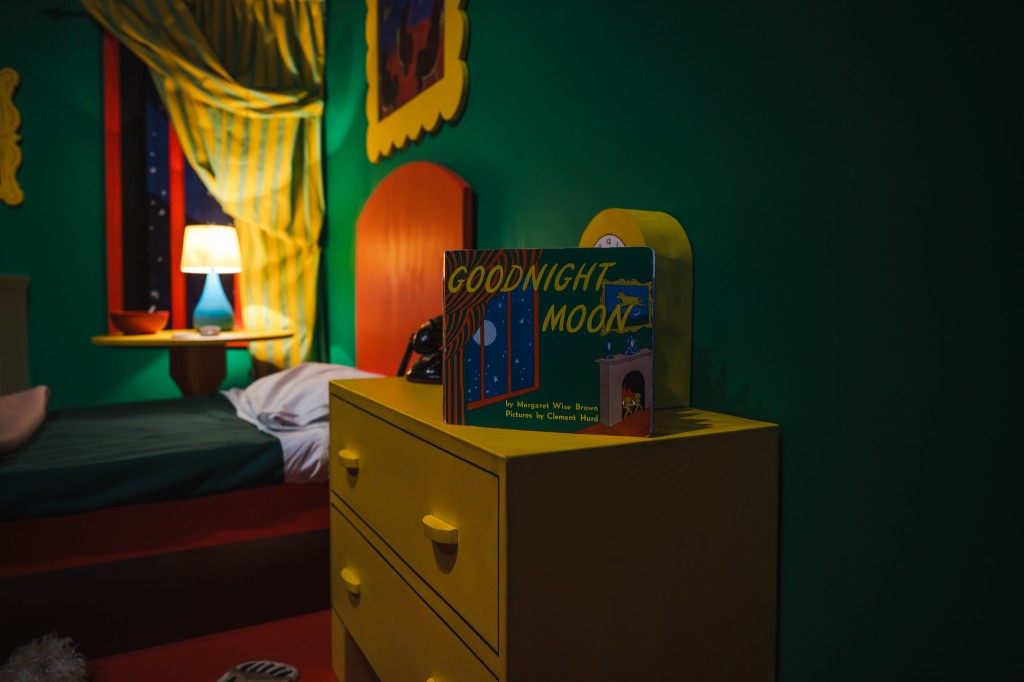
The book is unique in other ways, Nye explains. It was one of the first children’s books set entirely in one place — a single room. This was a very conscious decision between Brown and her publisher. Illustrator Clement Herd came up with the idea of varying the perspective in each scene, while keeping it set in the same single room. All of this was very innovative for the time. Nye likens it to a sort of cinematic gaze, noting film directors like Alfred Hitchcock began deploying the technique in their films soon after.
“The space has a sort of flat picture plane yet contains within it dimensionality, theatricality, a colourful exuberance that defies the logic of taste,” he says. “There’s something that it does performatively. We’ve had so many kids try and step into the book when they walk in.
“Great literature introduces a childhood to the world,” says Nye, drawing again on Deleuzian philosophy. “It doesn’t make the world a child, but it opens up the wonderment experience. It’s a capacity that we all have within us. But that childhood of the world, that capacity for wonderment, is something that systemically diminishes as we grow older. So what the book is doing is opening up wonderment again.”

Author

Related Articles

Gander didn’t protest U.S. ambassador during 9/11 visit, but still sent a clear message to Trump
There were no boos when Pete Hoekstra appeared at the 25th anniversary commemoration. Instead, Newfoundlanders kept their focus on the nearly 3,000 lives lost — and reminded America that Canada will not bow to anyone

Watchdog says it can’t investigate Deloitte over use of AI in $1.6M government report
Internal emails reveal Deloitte helped craft government’s response to The Independent’s investigation
Will declaring an epidemic help end gender-based violence?
Three provinces in Atlantic Canada have made formal declarations — but is that enough to quell violence against women, girls and gender-diverse people?