
Between a Rock and a Marketplace
Childcare and early childhood education are too important to be left to the profit-driven whims of the market. Only a publicly-funded and publicly-managed system will put children, families and workers first
Three trimesters ago, my friend texted to tell me she was pregnant. I knew this was a special moment, so I tried to bite my tongue and enjoy it with her. But because of the work that I do, I couldn’t hold it in: “I’m sorry to even bring this up… but are you on the waitlist for childcare?”
Why is childcare such a lottery? And why can’t anyone you know get a $10-a-day childcare spot? In my work with the Jimmy Pratt Foundation, we see this as a policy failure to uphold a child’s right to education. The solution is straightforward, and proven many times over in countries like Norway, Sweden, France and Iceland: governments need to build more childcare centres and hire more staff to fill them. We need to treat childcare as a public service that puts children, families, and workers first.
Here’s the catch: for too long in Canada, childcare has been approached as a luxury and market commodity rather than a child’s right. As a result, the system we now have is motivated by profit, which means it can and will abandon any child or family that it doesn’t deem profitable. Federal funding gave us $10-a-day fees, but only through select sites. Our system still needs a serious overhaul.
Yes, public services cost money, but upholding the rights of children is worth the cost. And it’s not just the right to education that’s at stake: early childhood education improves health outcomes over the course of a child’s life, and the support that it offers families is a proven preventative measure against abuse and neglect. Affordable childcare more broadly is also a necessary step toward gender equity and ending child poverty.
Will you stand with us?
Your support is essential to making journalism like this possible.
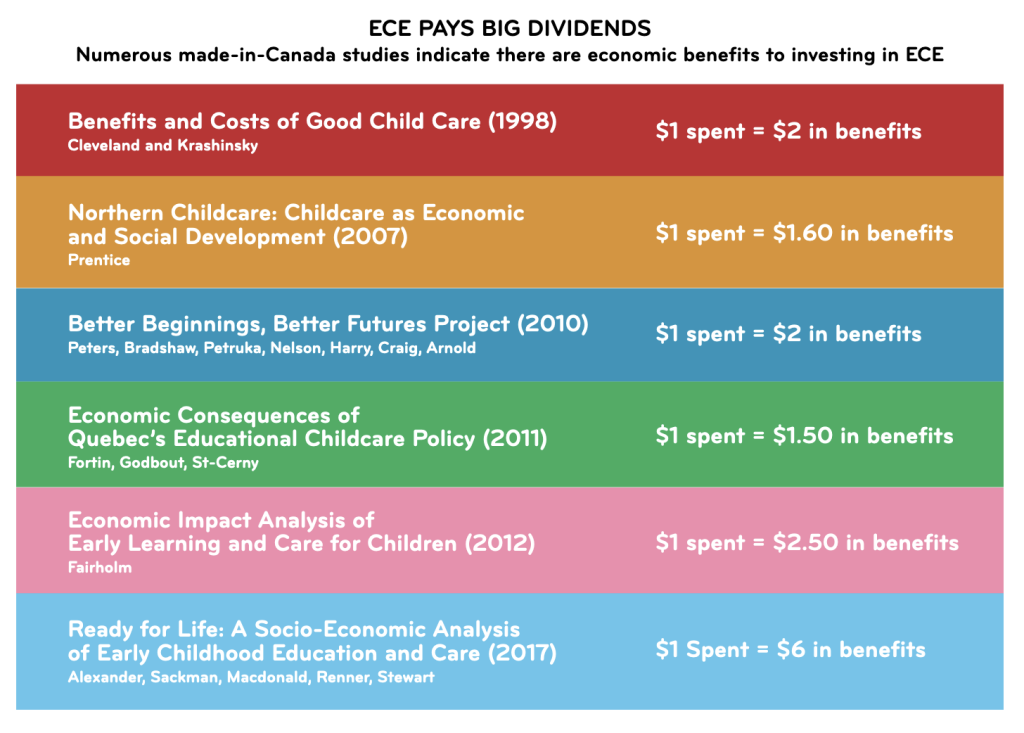
Economically speaking, we can’t afford not to act on childcare. The tax revenue generated by parents who return to work far outweighs the cost of operating childcare services. Governments also save money down the line on costs associated with healthcare and child protection. A universal childcare program that treats childcare as a public service has the potential to create good jobs in every community with young children. It’s the easiest investment a government could make, with the surest returns.
Children have a right to education. We, parents and politicians alike, already support this in our approach to the K-12 school system. While we might worry whether our children are ready, or if they have the right supplies, we always know that there will be a spot for them in kindergarten when they turn five.
We should also extend this commitment to early childhood education. Education in the early years does not happen at desks, however, it is just as foundational to a child’s social and emotional development. Children learn through play, under the thoughtful guidance of Early Childhood Educators. Children need other children around; they also need trained educators, and full-day programs.
Early childhood education can take place in schools, in childcare centers, in regulated family childcare arrangements, or in forest schools. But for the most part, in Canada, education in the early years has been left to the childcare market, and that market has failed us terribly.
Newfoundland and Labrador has the highest proportion of for-profit childcare centers in the country, and still has the lowest enrollment of children two to four years old in early learning programs. All rural areas of the province are considered childcare deserts, and St. John’s has childcare spaces for just 10 per cent of infants. Children with special needs are routinely kicked out of childcare programs, and their families have little recourse.
Ultimately, this is because high-quality childcare is bad business. Educating young children requires many qualified staff, which means that centers use most of their budget on wages. As a result, to make a profit, for-profit childcare centers are more likely to serve children who are “profitable” — able-bodied children without exceptionalities who live in urban areas. Meanwhile, preschoolers are the “moneymakers,” needing fewer staff per child than infants. To cut costs, for-profit centers are more likely to employ less-qualified staff, and cut corners on staff benefits. Many Early Childhood Educators go to work sick because they don’t have any other choice; they can’t afford to lose a day’s wages.

Still, there is some debate about how to meet the demand created by $10-a-day childcare. Childcare business owners often say that with more government support, they could serve more families. Countries like the United Kingdom, New Zealand, the Netherlands and Australia believed them, and provided substantial public funds to private operators to expand. We can learn from their experience: for-profit childcare resulted in lower-quality childcare, and less choice for families as low-quality “big-box” childcare chains bought up smaller centers. In the United Kingdom, where for-profit operators control the supply of childcare, they have successfully lobbied for lax regulations around staff training and ratios of children to educators.
There are certainly individual for-profit childcare operators who have provided high-quality programs in Newfoundland and Labrador, some for decades. Children, parents, and communities would be lost if these spaces were to disappear. But providing funding for existing for-profit spaces is not the same as creating more for-profit spaces.
So what’s the alternative? A publicly-funded and publicly-managed system of early learning and childcare. Our provincial and federal governments must step up and spend what it takes to finish the job. They must put up the capital funding required to build beautiful, safe, and welcoming spaces for every child. Early Childhood Educators must be paid what they are worth, and have paid sick days, paid vacations, benefits and pensions (most do not). While the not-for-profit sector has an important role to play in delivering programs, governments have a responsibility to directly operate childcare where not-for-profit centers do not exist.
Today, Nov. 30, is the National Day of Action for Early Learning and Child Care. Child Care Now is asking Canadians to sign an open letter to the federal government calling for some of these measures.
Newfoundland and Labrador can be a magical place to be a child. Growing up in Newfoundland and Labrador, I got fussed over a lot. One of my theories is that there are a lot more doting seniors in our province than there are children to be doted on. But as my generation contemplates having children of our own, I can see our aging population from a different perspective. Young parents lean on grandparents to fill the childcare gap — and it’s tough luck for those without family nearby. Single parents are even more precarious. Families are more alone than ever. It is not just enough to love our children — we need to respect their rights, and support the families who raise them.
Let’s start with childcare.
Neria Aylward is the Executive Director of the Jimmy Pratt Foundation and a member of the Child Care Now Newfoundland and Labrador Steering Committee. She also sits on The Independent’s Board of Directors.

Author

Related Articles
What would it mean to build a city for kids?
An interview with St. John’s active transportation advocate Ryan Green

It’s time for equity consultants and community organizers to ditch AI
Tools are never neutral, and artificial intelligence has no place in social justice work
The Lobster Trap: Why Atlantic Canada’s golden fishery may be headed for collapse
Greg Mercer’s book exposes how million-dollar debts, climate change, and market forces are pushing harvesters—and lobster—toward the breaking point