
More police is not the solution
We need to challenge the public safety discourse in the provincial election

Public safety has been a dominant theme in this year’s municipal and provincial elections. All three provincial parties, like the municipal candidates before them, are making commitments around public safety.
The Liberals are promising 90 new police officers by 2030, and deployment of the RCMP into rural communities (along with training bursaries for police cadets). Yet as Anton Oleinik recently observed in The Independent, they still haven’t committed to establishing a civilian police oversight board despite being one of the only Canadian jurisdictions without one, and despite multiple high-profile police killings of civilians in this province in recent years.
The Progressive Conservatives are promising 46 new police officers for rural areas of the province and more crown attorneys. In contrast to more spending on police, the NDP are focusing on improving mental healthcare supports and other measures to bolster social programs.
Will these measures solve our problems?
Will you stand with us?
Your support is essential to making journalism like this possible.
Although several Canadian municipalities have increased their police budgets in recent years, there’s little research on whether doing so has any positive effect on reducing crime rates. It’s the sort of thing that sounds like common sense—more police, less crime—but many things that sound superficially sensible are actually not true when we look into them. The research that has been done reveals the correlation between more police and less crime isn’t cut-and-dry. One of the few extensive studies conducted in Canada “revealed no consistent correlation between police funding and crime rates across the municipalities.”
The authors of that study cite another review of 36 American studies on the police-crime relationship that also “gave little evidence that more police reduce crime.”
Either way, when crime rates go down it’s difficult to pinpoint whether it’s more police, or other factors like better housing and reduced unemployment, which actually drive them down. As the authors of the study above observe, changes in crime rates “may have far more to do with factors exogenous to policing altogether, such as changing demographics, expanded opportunities for employment, and shifts in societal values.”
Yet the studies those researchers looked at revealed “strong evidence suggests that police budgets often surge markedly during an electoral cycle.”
Police funding is driven by politics; as another Canadian study showed: “police strength was also positively associated with cities that had municipal police services, higher unemployment rates, and the percentage of conservative voters in provincial elections.”
As the authors of that study reflect, “there may be a disconnect between police strength [as measured through the number of staff] and the actual threats posed by crime.”
It’s little wonder that Canada’s National Police Federation—a lobby group for police—has been campaigning for more police spending in the provincial election.
One outcome that has been observed as a result of more police, is more arrests. Reviews of American studies reveal that “increases in police budgets can result in direct increases in police arrests, especially for lower level violations (e.g. minor drug possession).”
The province’s November 2024 announcement it was contributing $20 million to increase policing in Happy Valley-Goose Bay was met with mixed response, The Independent reported, including concerns that it could worsen the current overrepresentation of Indigenous people in prisons and the justice system.
Researchers are quick to emphasize that more research needs to be done. There’s relatively little research on these relationships, and the majority of it is American. But it’s significant that the studies, including Canadian studies, that have been done show no definitive relationship between more police funding and less crime. The lack of evidence, in a way, is the point: politicians are pouring millions of dollars into policing without any evidence it will have a positive effect. By contrast, they’re often taking that funding from areas where there is plenty of well-established evidence of the social benefits (including reduced crime), like housing, healthcare and education.
Fund the things that actually reduce crime
Which is precisely why candidates and politicians need to think twice about campaign promises to increase policing and police funding. That money has to come from somewhere. Unless governments increase their revenue (which usually requires increased taxes, something all parties have studiously avoided in their platforms), then it means taking money from elsewhere to put into policing.
We’ve witnessed the systemic erosion of our province’s post-secondary education system over the past decade. We’ve seen a housing crisis explode across the province, with demand far exceeding supply when it comes to affordable public housing. Waitlists for mental health care are years-long due to cutbacks to healthcare funding.
“Overall, economists widely agree that investing in education is an efficient public-spending strategy to effectively reduce crime,” observe the authors of one 2023 research article.

The same goes for healthcare. As one American study observed, “men with a history of mental illness are more likely to be incarcerated after losing access to health care.”
That same study considered the ‘cost-benefit analysis’ of increased funding to healthcare, considered from a crime-reduction perspective. Factoring in “reduced costs from fewer violent, property, and drug-related victimizations,” it found that “for every dollar spent on Medicaid, society recoups $2 in benefits,” and that “the benefits of extending Medicaid eligibility to low-income young adults seem to outweigh the costs.” There are other benefits besides crime-related ones, the authors observe, meaning their ‘cost-benefit’ analysis is a conservative one.
And the same goes for housing. As Hope Jamieson thoroughly explicated in The Independent earlier this month, “Canadian studies have demonstrated that investing in solving homelessness by providing housing and necessary wraparound supports is net cheaper than the increased healthcare, policing, criminal justice system, and emergency shelter costs associated with choosing not to adequately fund long-term solutions.”
In a way, previous governments can be held very directly responsible for increases in crime rates in this province because they’ve been cutting funding to the things that reduce and prevent crime. Taking yet more money from those spheres and putting it into policing risks having literally the opposite desired outcome.
Crime and perception
There are reasons the public feels increasingly fearful and unsafe, and they don’t all have to do with crime rates (which across Canada actually decreased last year, although Newfoundland and Labrador itself has experienced an increase).
Every morning at around 5 a.m. the Royal Newfoundland Constabulary issues a report to media summarizing some of the notable cases the force dealt with the previous night. For sleepy-eyed early-morning media staff trying to update the stories on news websites, these provide an easy, ready-made source of content that can neatly be cut-and-pasted into simple stories. They may not be particularly newsworthy, but they are canned content, so it’s easy for overworked reporters to cut and paste from these reports. This is one reason we’re so likely to see a bevy of crime-related stories every morning (a critical read of these media reports quickly reveals that many of them involve individuals cited for very minor offences like owing fines, violating court rules about curfews, or drinking).
The sometimes cozy relationship between media and police is one to be concerned about. Police and media need to maintain an open dialogue because the public has a right to know about crime and policing, and journalists have a responsibility to provide this information in a critical but fair way. It’s important for journalists to do that because the information provided by police needs to be critically assessed and contextualized.
Police have a tremendous amount of power in our society, and this needs to constantly be closely scrutinized, monitored, and investigated as necessary. Journalists should be playing that critical monitoring role, determining what’s newsworthy among police media releases and what’s not, and what requires additional research and context. Coverage of the recent ‘retirement’ of one police media spokesperson from the role and accession of a new media spokesperson reveals just how folksy and friendly the relationship between media and police can become. It shouldn’t. Journalists have a responsibility to treat the relationship critically. It can be cordial but should remain arms-length. It’s difficult to ask critical, hard-hitting questions to people you are too friendly with.
The provincial crime dashboard introduced last year is also a curious beast. Data is always useful, although precisely what the point of it is is unclear. There are more useful things for which we could use dashboards, apps and transparent data access, like waiting times for medical appointments or surgeries. Or maps of notable potholes to avoid whilst driving the TCH.
Of course, police are actively lobbying for increases to their budget. They do so through their lobby groups, like the National Police Federation, which has been flooding social media with ads during the election.
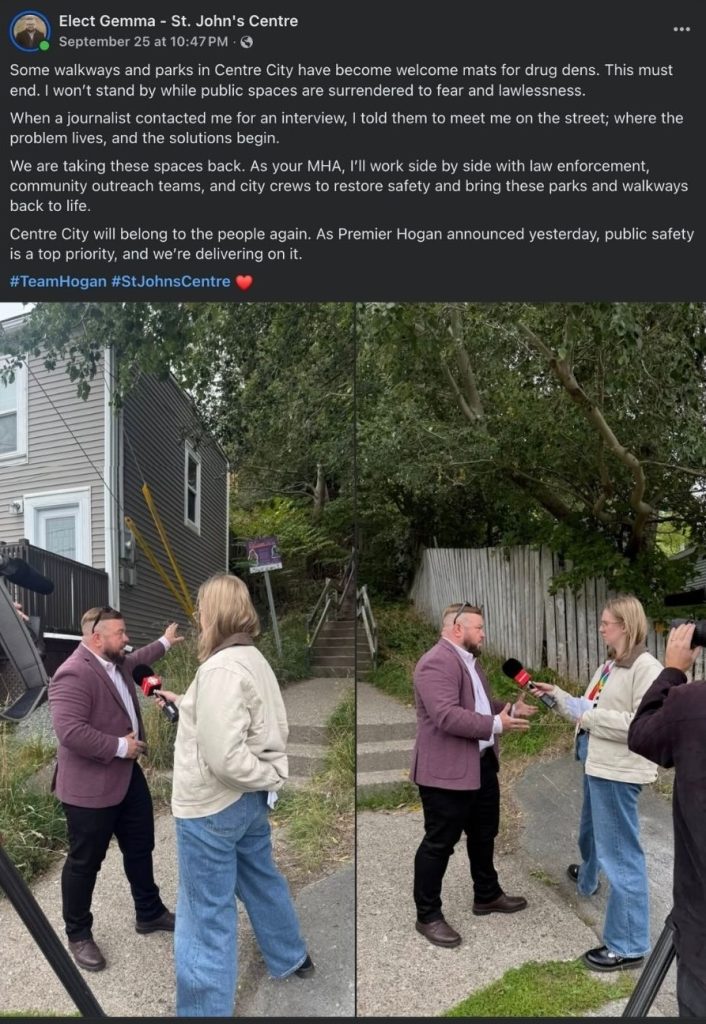
All of this is a potent combination. More crime coverage, more police ads capitalizing on that, an underlying sense of discomfort at the presence of larger numbers of unhoused people in their neighbourhoods on the part of local residents. When a political candidate combines this all into non-evidence-based, vague dedications to tackling crime, other candidates feel pressure to do the same. And suddenly public safety becomes the dominant election discourse at the expense of informed discussion and policy commitments about all the other things that actually could make our cities and towns safer.
Feeling uncomfortable
Candidates, politicians, and voters alike have struggled to articulate how exactly they see the relationship between crime, safety, and the unhoused. It often comes in a vague allusion to growing crime and a need to take back our streets and cities. But take them back from whom?
Everyone we see on our streets has a right to be there. If they’re doing things that make us uncomfortable—sleeping on them, or asking for money—the problem is not actually the people trying to survive on the street; the problem is our own discomfort, and at a broader level the failure of our societal systems to ensure access to housing and healthcare and all of the other things. “Fear of danger far exceeds the actual risk of danger,” explains one researcher.
There’s also a growing amount of research revealing how our brains literally misfire when we encounter unhoused people. Our brains appear to have an innate tendency to dehumanise them and fail to fire up the natural empathic human social instincts. As one social neuroscience researcher explained: “We don’t consider what is going on inside that person’s mind […] Our brains dehumanise homeless people and that’s a very rare, very unusual thing for our brains to do.”
We need to spend less time trying to rationalise our discomfort in the face of the unhoused—justifying homelessness as a threat, as criminality—and more time recognizing and understanding our own discomfort and getting it under control. Lack of access to housing, healthcare, employment are serious problems we ought to be worried about and we ought to act upon. But hiring more police and passing legislation to sweep away encampments or otherwise crimializing unhoused people does nothing to solve the problem of underfunded social programs and the crime they sometimes cause.
Candidates ought to be talking less about diverting funding to police and taking back our streets, and more about how they’re going to fix the problems that actually affect us all. Candidates jumping on a bandwagon about public safety and fueling misinformed public panics is not helpful for anyone. Leveraging our irrational discomforts as a way to gain votes is irresponsible and bothers me far more than the behaviour of someone simply trying to survive on the street.
The more threadbare our social systems become, the more precarious our jobs become, the more wealth inequality grows, the less accessible housing and healthcare and education become — the closer each one of us comes to being that person struggling to survive on the streets.
We all need to do a better job at learning how to cultivate empathy. If that doesn’t work, perhaps our own self-interest ought to be reason to support policies that actually improve society. Sweeping the problems out of sight—along with people whose differences from ourselves makes us feel uncomfortable—ultimately helps no one.

Author

Related Articles
International Women’s Day is not a celebration
How do we build a fighting feminist movement?

It’s time for equity consultants and community organizers to ditch AI
Tools are never neutral, and artificial intelligence has no place in social justice work

External consultant controversy a first test for Wakeham government
After being sworn in as premier Wednesday, Tony Wakeham called right-wing conservative strategist and PC transition team hire Steve Outhouse “one the best political minds in the country”