
‘Bring our Innu children home!’
Sheshatshiu residents demand immediate action on children in protective care as inquiry set to wrap hearings in the central Labrador community.
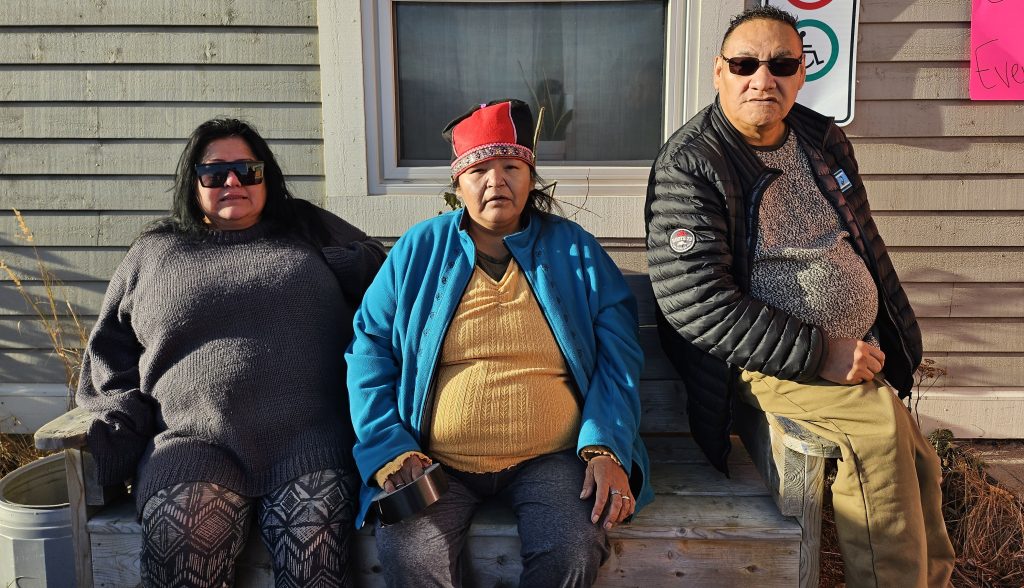
On Thursday residents of Sheshatshiu Innu First Nation gathered outside the provincial Children, Seniors and Social Department office in their community to call for immediate action on the epidemic of Innu children being taken from their families and community.
The demonstration took place next door to the youth centre, where the Inquiry Respecting the Treatment, Experiences and Outcomes of Innu in the Child Protection System is holding its final scheduled community hearings in Sheshatshiu.
Simeon Tshakapesh helped organize the demonstration. The former chief and his wife Ruby told the inquiry Monday about the 2017 death of their son Thunderheart, shortly after which Simeon and other Innu leaders confronted then federal Indigenous Affairs Minister Carolyn Bennett in Toronto to demand an end of the removal of Innu children from their communities.
He says the time it has taken to launch and carry out the inquiry, the time it will take for the inquiry’s commission to file a report, and then the time required for policy or legislative changes, is too long for Innu families to wait given how acute the crisis is. In the past week and a half alone, two young people from Sheshatshiu have died, though their ages and circumstances around their deaths are not yet known.
Will you stand with us?
Your support is essential to making journalism like this possible.
The inquiry has heard from many Innu about how Newfoundland and Labrador’s child protection system has contributed to the overlapping crises of poor health outcomes, addiction and suicide.

While the inquiry is happening, parents and grandparents say they want children returned to their communities, implementation of programs that can support families dealing with trauma, and funding for services to support kids in government custody who have disabilities.
“We need to see something in the interim be put in place because right now, the children are suffering mentally and physically, emotionally, and it hurts profoundly,” Tshakapesh said.
“We want the Innu children to be returned home […] in their own Aboriginal communities and their reservations with their parents so the work can begin and healing begins.”
For decades the Innu have told the provincial and federal governments about the devastating impacts of colonization — from forced settlement and residential schools, to assimilation and systemic racism, to Canada’s reluctance to negotiate a treaty. The Innu have never ceded or surrendered their land to the Crown. All of these things, they say, are intimately connected to the child welfare crisis.
A 2016 study found that Innu communities in Labrador have the highest suicide rate in the country.
Desmond Rich, a social health and cultural coordinator in the community, says the provincial government needs to fund more community support programs for children with disabilities. “If they want to help people, that’s what they need to start doing instead of taking the children off.”
One mother from Sheshatshiu testified this week that her young daughter, who is on the autism spectrum and presently in CSSD custody outside of Labrador, recently told her she was abused. The mother, who sought treatment for trauma and addiction last summer and is fighting to get her daughter back, said she has not been able to get satisfactory information from the department.
Shortly after the protest began Thursday, demonstrators were invited into the Innu Round Table Secretariat building, where Simeon, Ruby and others shared their stories with a CSSD worker and demanded action. Sheshatshiu Chief Eugene Hart attended the meeting by phone from St. John’s.

The Independent was allowed to sit in on the meeting.
Community members expressed their concerns about children losing their connection to their families, communities, language, and identity.
“If you leave them too long, they don’t want to come home,” one foster parent said.
A non-Innu woman, who spoke at the inquiry earlier in the week, joined the meeting. She told the CSSD worker she adopted her foster son after he confided in her that he felt no connection to his biological family or to their community in Natuashish. She said she tried for years to help him stay connected, but with little help from the province.
“The only communication he had with his family was through me, up until he was 16 when, finally, child services let him visit Natuashish,” she said.
Community members also talked about the need for better supports and reintegration programs for children who are returning home after being in the system.
Simeon Tshakapesh told The Independent that when children come back to the communities there needs to be wellness programs to support parents and children who are learning to live together again.
When youth age out of the foster care system, he said, “they send the child home without any counseling for [them and] their parents. They just [leave] you there and expect to fix it for yourselves.”
Ruby Tshakapesh told the CSSD representative that when her child and grandchild were taken from her, she felt like the government was shaming her, telling her she is incapable of taking care of her children.
“They look at me as if I am [on] a blacklist, because I’m Innu, I’m a bad mother, I’m a bad grandma.”
She said other mothers in the community feel similarly.
Ruby stressed the importance of support programs for grieving parents who have lost their kids. “I drank because my son, I lost last year,” she said in the meeting. “I couldn’t bear the pain because there are not enough programs.”
A mother whose child is in the department’s custody said the continued removal of children from the community is “too much,” and that “it’s hurting our children psychologically.”
“How do you expect us to get better if the children and the parents are separated? These programs have to be built in our communities to help the whole family, not separate the family.”
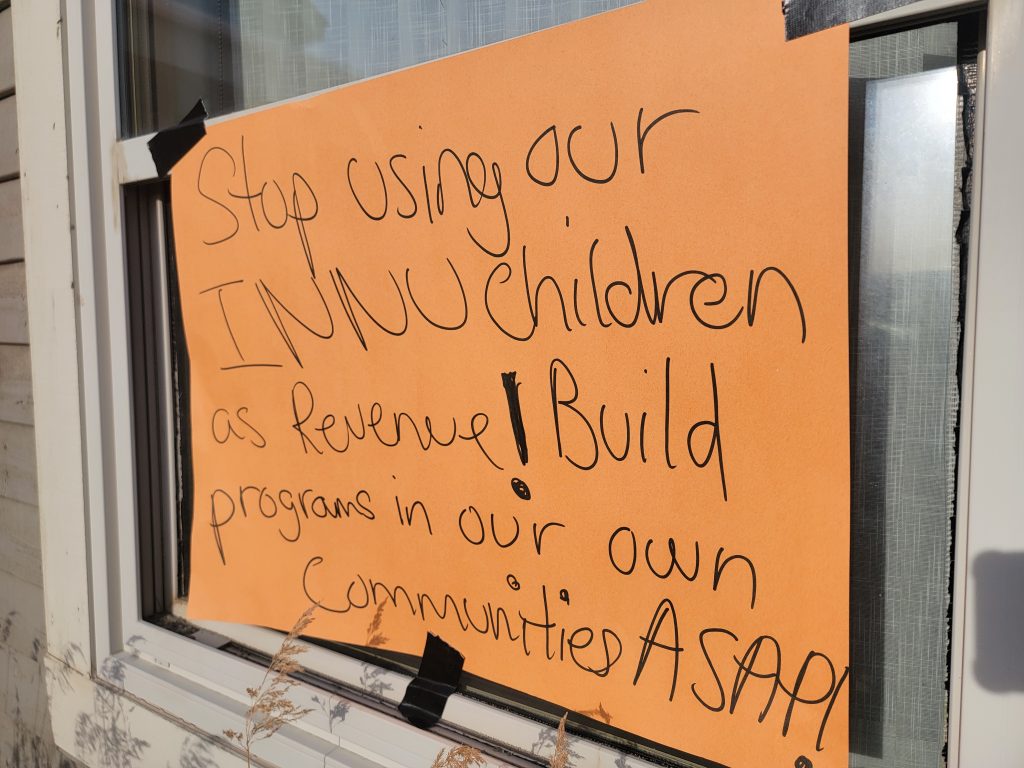
CSSD and Innu Round Table Secretariat staff both acknowledged there’s a lot of work yet to be done, and that they’re actively working to implement measures that will keep children within the community.
“I agree that I work within a system that is systematically racist,” the CSSD representative said. “And I sit here and I’m looking forward to the day when I won’t have a job.”
Chief Hart joined the meeting by phone and asked the community members for direction. They asked him to arrange a meeting between Premier Andrew Furey, CSSD Minister Paul Pike, the Innu Round Table Secretariat, leaders from Sheshatshiu and Natuashish, and Innu Nation leadership so they can discuss changes that need to be made immediately. Hart agreed to make the request. Neither Furey nor Pike were available to media at the House of Assembly Thursday to answer questions.
Earlier this week, the inquiry commissioners announced they requested an extension to finish the final report, which is currently due March 2025 following previous delays. The latest delay comes after head commissioner James Igloliorte stepped down from his position in July for personal reasons. The inquiry is waiting for a new commissioner to be appointed.

Author

Related Articles
The RCMP vs. the media: Bracken trial approaches its endgame
This court case could decide the future of press freedom — and police oversight — in Canada

Accounting watchdog to investigate Deloitte over fake citations in $1.6M healthcare report
Chartered Professional Accountants N.L. is leading the investigation after Deloitte admitted AI was involved
St. John’s teen says community, activism helped her find her voice
13-year-old Nyala Adam was inspired by a local summer camp focused on social justice and cultural inclusion