
Canada Pension Plan Investment managers criticised in St. John’s for investing in fossil fuel companies and those with ties to Israel
Board member says fossil fuel investments total $28-billion, and that no Israel-linked investments amount to complicity in genocide
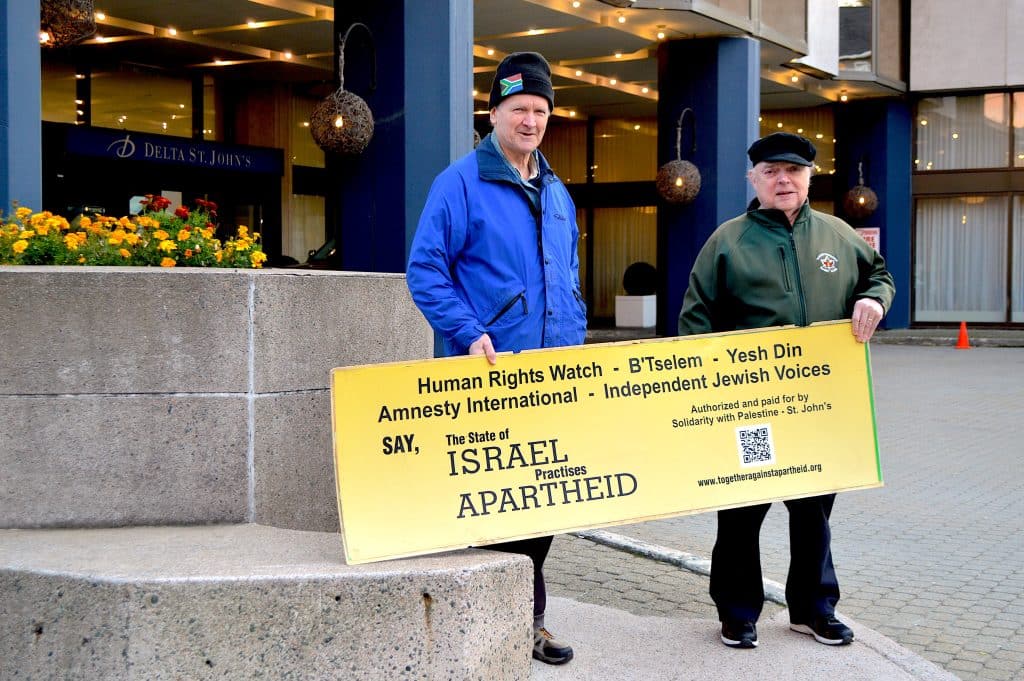
As a setting October sun lit up the Delta Hotel’s orange reflective windows, Kim Bell and Tom Beckett stood outside the St. John’s hotel, protesting the Canada Pension Investment Board meeting about to get underway inside.
“The commonality between fossil fuels and human rights – they’re both moral issues,” Bell said, holding a long yellow sign that read, “Fossil fuels are becoming a moral issue.”
Joining Bell was local Palestine solidarity advocate Tom Beckett, who told the visiting Canada Pension Plan investment managers they should not invest Canadians’ money in companies he believes are doing harm.
“I hope they come up with a divestment plan for their investments in fossil fuel initiatives and their investments in the companies the United Nations has indicated are complicit in the war crimes, ethnic cleansing and genocide in the Middle East,” he explained.
Will you stand with us?
Your support is essential to making journalism like this possible.
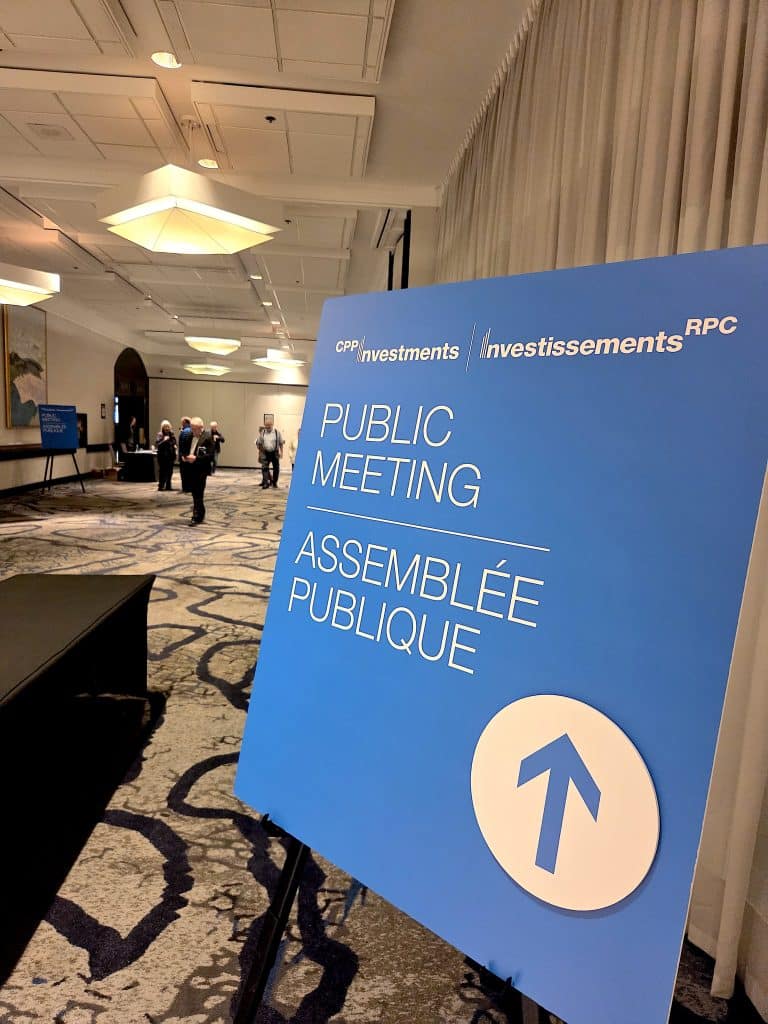
On Oct. 21, members of the Canada Pension Plan Investment Board (CPPIB) – the Crown corporation tasked with managing the Canada Pension Plan (CPP) – stopped in St. John’s for a 60-minute meeting as part of their cross-country public information sessions held every two years. Often criticized for not being long or frequent enough, the meetings represent a rare opportunity to ask questions to the select few who handle investments for Canada’s nearly $900-billion pension fund.

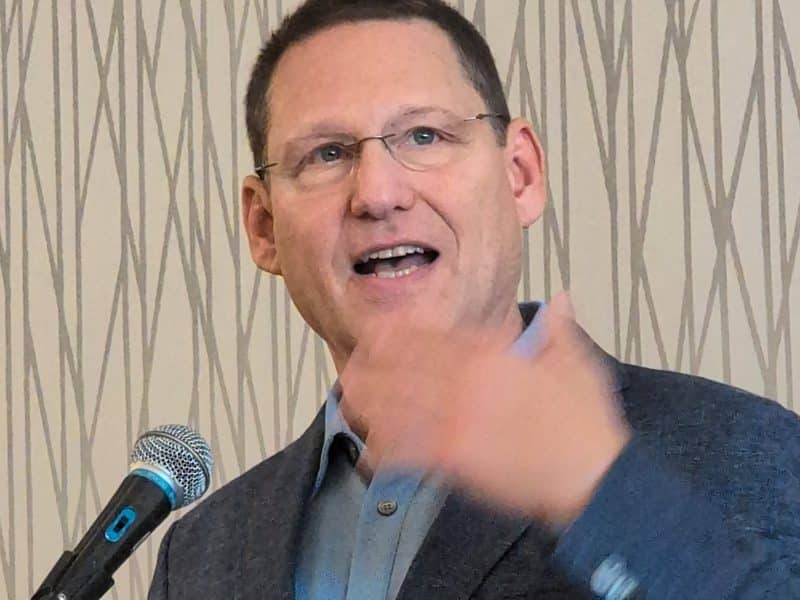
The board sent Michel Leduc to answer questions in St. John’s. Leduc works as Global Head of Public Affairs and Communications and has been with the organization for 15 years. He said they hold the public meetings, “in the best interest of transparency and disclosure.”
About 70 people showed up to the Delta ballroom, filling about half the seats. It was a “good showing,” one worker with the CPPIB remarked.
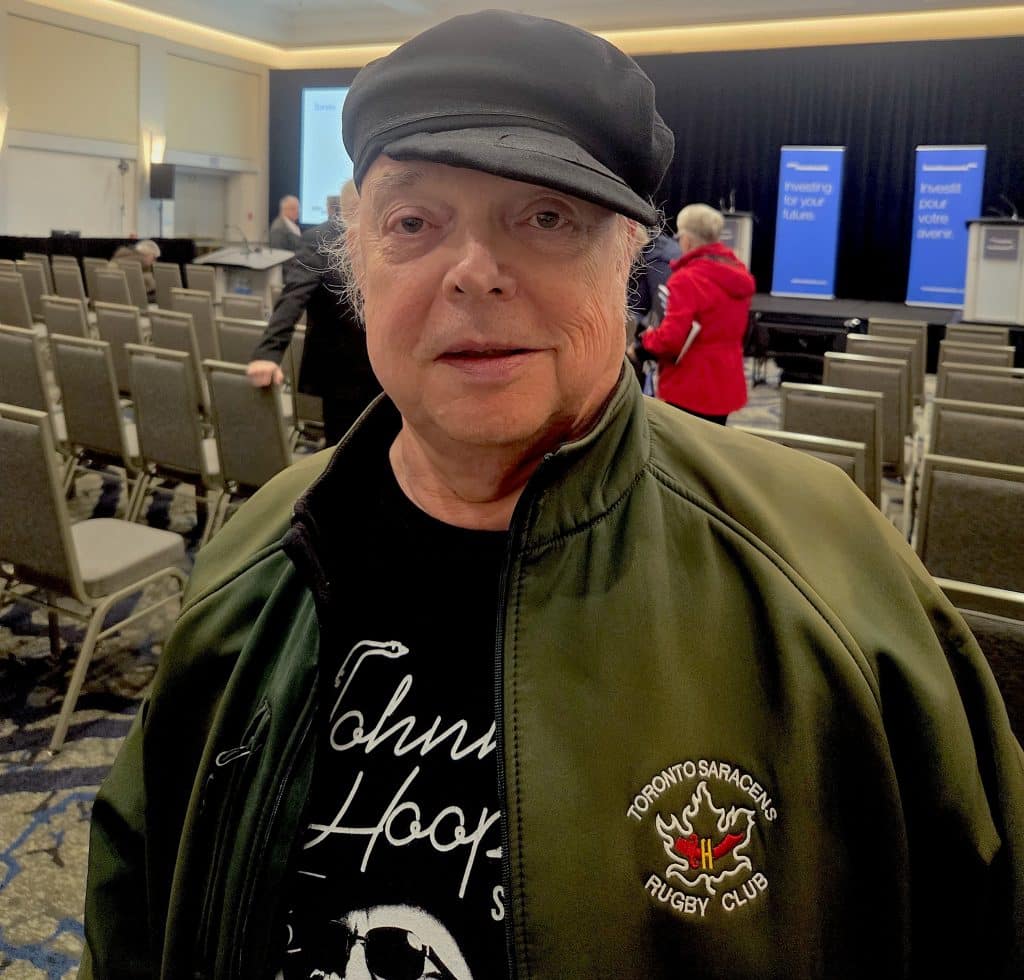
Beckett, who is locally known as a craft beer pioneer in Newfoundland and is perhaps most recognized for being the face of Quidi Vidi’s Calm Tom IPA, showed up to the meeting with serious concerns about the board’s investments in fossil fuel and Israeli companies. The first person to approach the mic, he told Leduc he receives a Canada Pension Plan cheque every month.
“When I deposit that cheque into the bank, I am left with blood on my hands,” Beckett said. “And I look at your board of directors and senior management — their hands are dripping with blood, too.”
“Whose blood?” Beckett propositioned. “Canadians who have died fighting forest fires. Canadians who have been killed as a result of forest fires or calamitous weather. Some of them are contributors [to CPP]. Some of them are retirees receiving pensions,” he continued.
“They don’t get the security that the fund wishes to have. But more importantly, the fund also is complicit with the bloodletting in the Zionist experiments in Gaza, West Bank, Lebanon, Syria and Iran. And the fund is complicit [by] investing in 19 companies that the United Nations has identified as being part of this problem.”
Another man in the audience then shouted, “What’s your question, sir?”
Beckett asked Leduc: “When will you let me keep my hands clean? When will the Canada Pension Plan Investment Board divest from fossil fuel initiatives that create the climate problems, and from those companies supporting the slaughter in the Middle East?”
Leduc thanked Beckett for the questions, calling them both “quite complex.” On the climate crisis, Leduc said the board “wholeheartedly” agrees with “the science, around the data, around the trends of what’s happening in terms of global warming,” telling Beckett and the crowd the board is “seized” with the issue and that they need to be “alive and attentive” to the risks associated with the effects of fossil fuels investment.
Leduc also acknowledged that having a “long-term outlook and being patient,” when it comes to the board’s current $28-billion invested in what he called “conventional energy” companies around the world, can also increase risk over time, he said, “as global warming will continue.” He then told Beckett if the board got out of fossil fuels entirely at this point, it would “slow down the pace to a lower carbon future.”
Leduc said if a massive fund like the one the board manages were to divest completely “midstream,” other companies would continue to prop up the fossil fuel industry, filling a vacuum that the board’s divestment could create. Instead, he said, the CPPIB is focused on the longer game of “whole-economy transition across all sectors.”
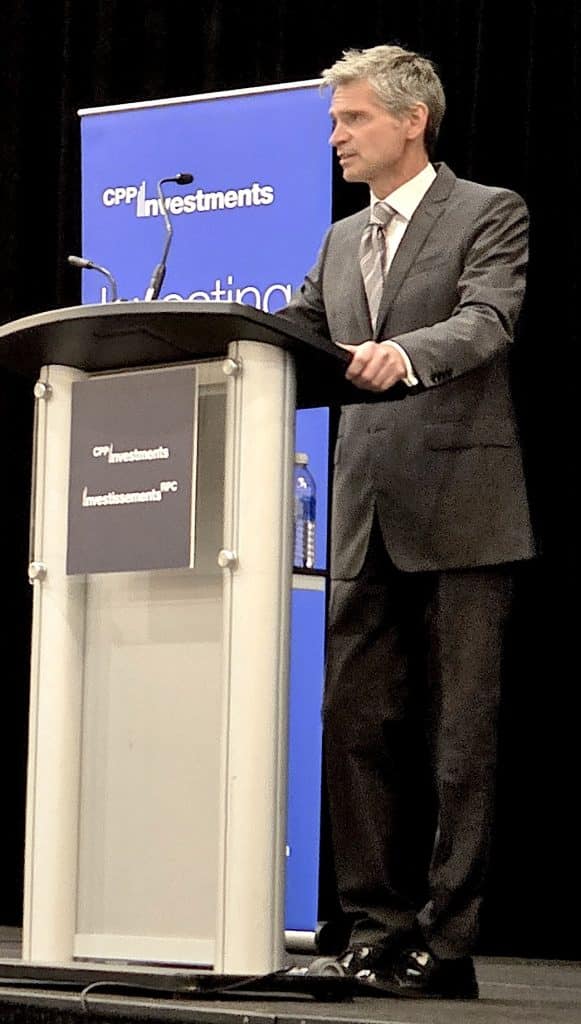
“Divesting from the conventional energy sector removes exactly zero carbon from the atmosphere,” Leduc said.
“All it does is it switches ownership from engaged, influential, powerful, productive capital and switches it to owners who are agnostic, passive, disorganized and can’t do anything. So you could ask for divestment. That will achieve nothing. It will slow down the transition,” Leduc answered.
Leduc said the roughly $28-billion invested in fossil fuel companies amounts to about 3.6 per cent of the Canada Pension Plans’ nearly $900-billion value. He said the board would continue to invest in a world transitioning to “a lower carbon future,” and that it continues to improve how it assesses “climate-related risk” in its investment portfolio.
“We believe companies that actively understand and manage climate-related risks are much better positioned to create value over the long term,” he added. “Nearly 87 per cent of the total portfolio today is weighted toward lower-carbon intensity holdings.”
Leduc did not address Beckett’s concerns about the board’s investments in companies connected to Israel’s occupation of the Palestinian territories – though Leduc would be forced to return to the issue later in the session.
National group critical of Canada Pension Plan’s continued connection to fossil fuels
“They’re out there kind of celebrating the oil and gas investments and saying they’re going to invest more of our pension plan in that,” said Patrick DeRochie, a senior manager with Shift Action, a non-governmental organisation that tracks the climate strategies and energy investments of large Canadian pension plans.
DeRochie pointed out that although the CPPIB established a net-zero commitment in 2022, last year it announced it was abandoning the target. While conservative organisations like the Fraser Institute applauded the board’s decision for financial benefit, the United Nations has continually urged the international community to end fossil fuel production in order to limit global warming to 1.5-2C.
But the possibility of achieving the lower end of that threshold has now become an impossibility, the UN Environment Programme acknowledged in a new report released the same day as the CPPIB meeting in St. John’s.
“Every fraction of a degree will cost lives, destroy livelihoods, deepen inequality, and push ecosystems closer to irreversible damage. But we can still bring warming back below 1.5 degrees by the end of the century,” said UN Secretary-General António Guterres.
“We must make the overshoot as small and short as possible – limiting how high temperatures rise and how long they remain above 1.5,” he added. “That demands an overshoot of ambition: Accelerating the phaseout of fossil fuels and the renewables revolution.”
DeRochie said the Canada Pension Plan Investment Board’s “backslides have combined to see their score plummet over the last few years to be one of the worst performing funds in Canada on climate change.”
In their 2025 Canadian Pension Climate Report Card, Shift Action downgraded the investment board’s rating for a third consecutive year, this time to a ‘D’ rating. The CPPIB now sits in second-last place on that list, behind AIMco, the Alberta Investment Management Corporation, which has consistently received an ‘F’ from Shift, DeRochie said. AIMco “continues to pour billions of dollars” into fossil fuels like oil, gas and coal, he said.
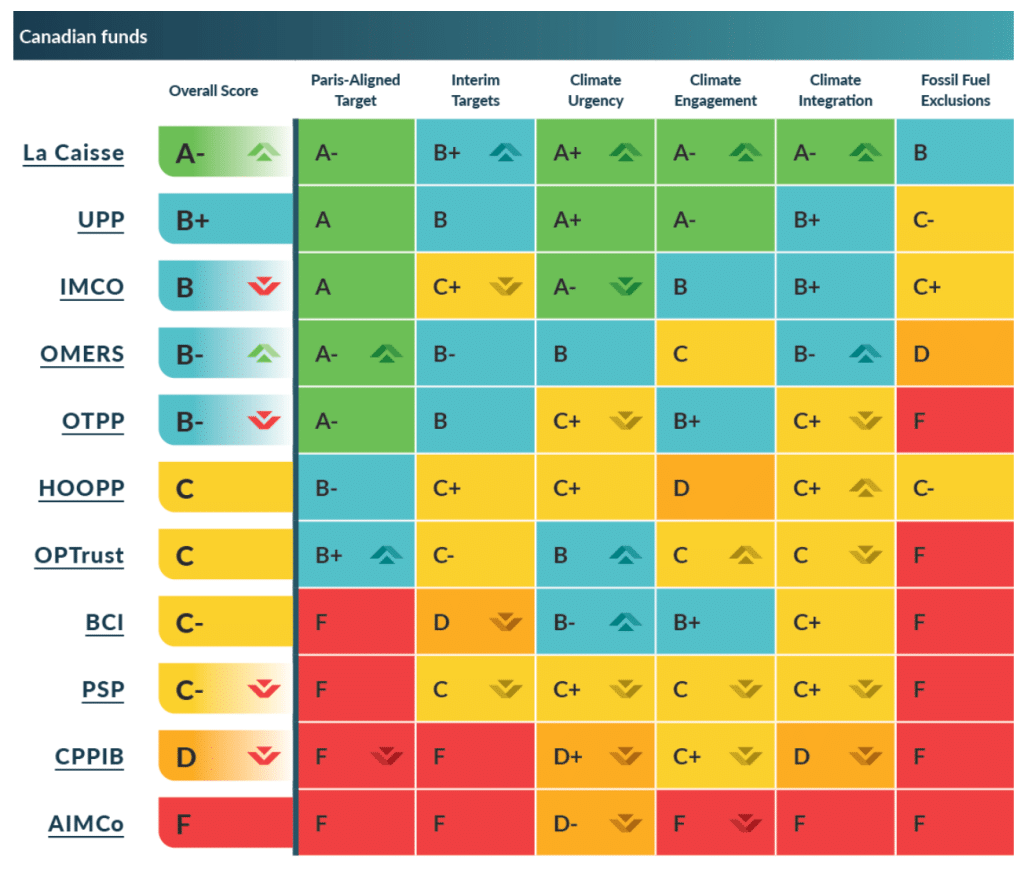
With over $28-billion in fossil fuel assets, DeRochie says the CPPIB continues to invest in companies that add to the climate crisis, which puts the fund’s future and its returns to pensioners at risk. “Adding to the fossil fuel supply in the world is actually counterproductive to their goals because it creates physical risk, it creates transition risks, it undermines their own ability to fulfill their own mandate,” he said.
In October 2025, a group of Canadian youth launched a lawsuit against the CPPIB, alleging the board is putting undue risk on their future, and their future access to the Canada Pension Plan, because of continued investment in fossil fuels.
Represented by lawyers from Ecojustice and Goldblatt Partners, the lawsuit alleges that CPP Investments, “currently lacks adequate measures to manage climate-related financial risks, all while continuing to invest Canadians’ pension contributions in fossil fuels that worsen climate change,” according to Shift.
Group says Quebec pension plan a model example for renewable investment
DeRochie says when he joined Shift Action in 2019, most of the funds the group focused on didn’t have a climate strategy in place. He says today about half of the funds they monitor have made “multibillion-dollar investments” in renewable energy and clean tech, while electrifying public transit.
“We’ve seen most of the funds put out credible climate strategies that are starting to kind of align their entire portfolio with those trajectories,” he said, pointing to La Caisse, which manages the Quebec public pension fund, as a model case.
“They are completely out of coal and oil. They still have a few gas assets that we would quibble with, but they have a very advanced climate strategy that covers their entire portfolio,” DeRochie said, adding La Caisse has achieved strong emission reductions commitments while being “massive investors in renewable energy.”
“They actually own private renewable energy companies and are developing those assets in Quebec and around the world,” he said.
“One of the big differences we see with the Quebec Pension Plan compared to Canada Pension Plan is just the public comments made by their leadership, where [the Quebec Pension Plan] is very clear that they see continuing to invest in fossil fuel expansion as risky, and [that] adding to the fossil fuel supply in the world is counterproductive to their goals because it creates physical risks, it creates transition risk. It undermines their own ability to fulfill their own mandate.”
DeRochie, along with others from Shift Action, have been rallying and encouraging their networks to attend the CPPIB meetings across Canada, accusing board members of failing in their duty to current and future Canada pension recipients.
One man, who identified himself as ‘Roy’ at the microphone, said he hoped CPPIB continued to invest in oil companies like Shell. The international oil and gas giant, which faces multiple lawsuits for contributing to the climate crisis, recently announced it would join Equinor in managing the proposed Bay du Nord offshore oil project with a 30 per cent stake. Roy would not give his last name when later asked by The Independent.
Leduc defends board’s holdings in Israeli-connected companies
At least two other audience members got to squeeze in questions during the approximately 43-minute question and answer session, both expressing concerns that some of the CPPIB’s holdings were too closely aligned with companies flagged by the United Nations as being connected to war crimes or genocide in Palestine.
“You suggested that investments in complicit companies on the UN database from Israel do not mean that the investments themselves are complicit, but Canadian government and international bodies do say otherwise,” one of the audience members said to Leduc.
“The Government of Canada strongly advises businesses not to participate in activities that directly or indirectly support or facilitate settlements in Israel or Israel or associated violence. And this includes, but is not limited to, investment, financial transactions, procurements, purchases and tourism linked to settlement activities,” they said.
“Where investments in complicit companies are in violation of Canadian and international law, can you please advise why you feel that CPP investments are insufficient activity to be deemed complicit?” they asked.
Leduc said the board members “entirely reject the claim that CPP investment is complicit in genocide.
“We are invested in approximately 3,000 companies around the world [and] CPP investments would have exposure to some of those companies,” he continued. “But exposure is not causation, nor is it in any way control of that company. Financial connection is not in any way a link of complicity to some of those activities, and certainly far removed from the horrible, deplorable and indefensible things that are happening in Gaza.”
Leduc said the board members “don’t dismiss credible allegations,” and that they “assess legal, human rights, governance and financial risks.
“As part of our due diligence, we examine each company and each allegation on its facts. We certainly don’t accept automatic guilt. So, you know, hold us accountable for what CPP Investment does, like you’ve done this evening, challenge our decisions, challenge our process. But I would also add, you know, please be cautious about powerful accusations far removed from our activities and what we do on an established fact.”
Beckett said some of Leduc’s answers lacked clarity around the pension plan investments’ connections to Israeli companies, and that the board could be more diligent with its investments so they don’t include “Zionist content.”

Author
Related Articles

May Day Rally Shows New Face of Today’s Labour Movement
Turnout for May 1 march and rally in St. John’s one of the biggest yet in this province

Recimply the Best: Pitch and Pick Competition Winner Aims to Reduce Paper Waste
Recimply won big at Genesis’ annual Pitch and Pick competition last week. The startup is solving the problem of non-recyclable paper receipts.

Coming Home Queer for the Very First Time
For three days in July, queer Newfoundlanders and Labradorians from all over the world celebrated a rural homecoming 30 years in the making.

Liberal MP suggests Carney government may be investigating N.L. offshore acquisition
NDP pushes for federal intervention in acquisitions tied to Israel’s occupation of Palestine, while PCs, Liberals silent on Ithaca Energy’s takeover of Suncor’s stakes in Terra Nova, White Rose and West White Rose oil projects

As Innu exhibit opens in Labrador, Grand Chief says truth must come before reconciliation
Innu Nation Grand Chief Jodie Ashini says it’s disappointing to open the Innu Pakassiun exhibit without the provincial government’s participation, but Innu know their history and who they are
Liberals’ Bill C-39 a wake-up call for Canadians: Avi Lewis
‘Cracks starting to show in the Carney consensus,’ Lewis tells N.L. NDP convention in St. John’s