
N.L. oil industry ‘drawing to a close’, new analysis finds
As government touts new interest from Shell and Equinor in province’s offshore, Memorial University researchers say trends and data point to a sunsetting industry and the need for an exit strategy
As the Wakeham government ushers in what it calls a “new era” for the province’s offshore oil industry, new research out of Memorial University suggests Newfoundland and Labrador’s fossil fuel sector could be winding down, never to return to its former glory.
In a new paper published Nov. 5 in ScienceDirect, MUNL researchers Audrey Parnell and Angela Carter argue growing uncertainty around global oil demand is pushing oil companies to retreat from new projects, signalling the province’s oil sector is likely “drawing to a close.”
Using publicly available data to stack historical trends and milestones against today’s market uncertainty, the authors conclude Newfoundland and Labrador’s oil production is “well past its historical peak and is declining in every project.” With just one oil field – Hebron – having more than half its reserve remaining, Parnell and Carter say even if the proposed and highly controversial Bay du Nord project goes ahead, it would not return “provincial oil production to peak values attained in 2007.”
Earlier this year Canada’s Energy Regulator projected the country’s oil production will continue increasing until 2029 at the earliest, and 2044 at the latest, before going into decline. Parnell and Carter say “corporate activities suggest waning interest” in Newfoundland and Labrador’s “high cost, mature basin, especially at this moment of increasing oil demand uncertainty.”
Will you stand with us?
Your support is essential to making journalism like this possible.
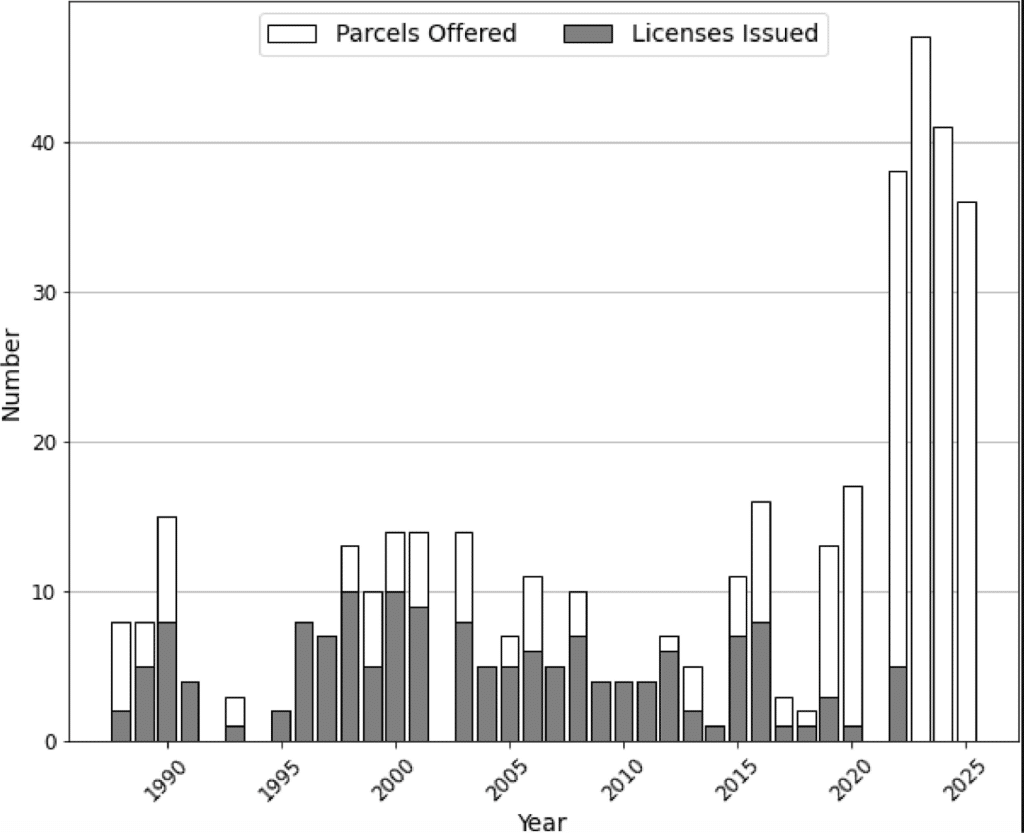
The researchers say two trends from the past decade point to the decline: a marked downturn in the number of exploratory licenses awarded to oil companies; and despite the CNLOR “sharply increasing the number of parcels available.”
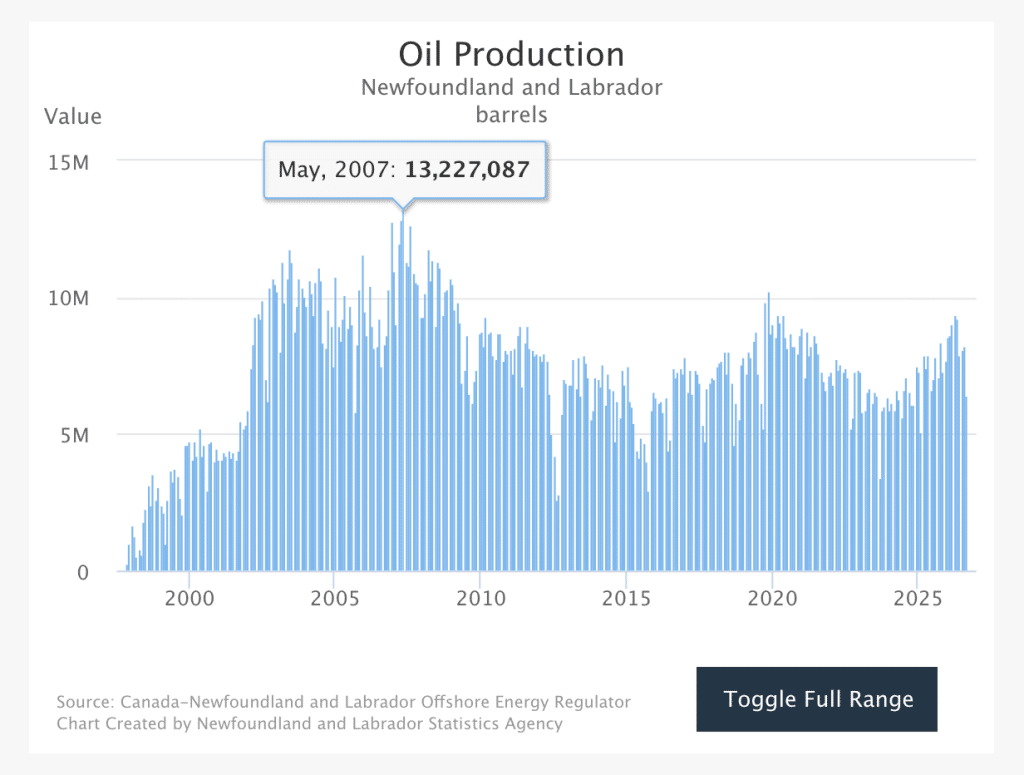
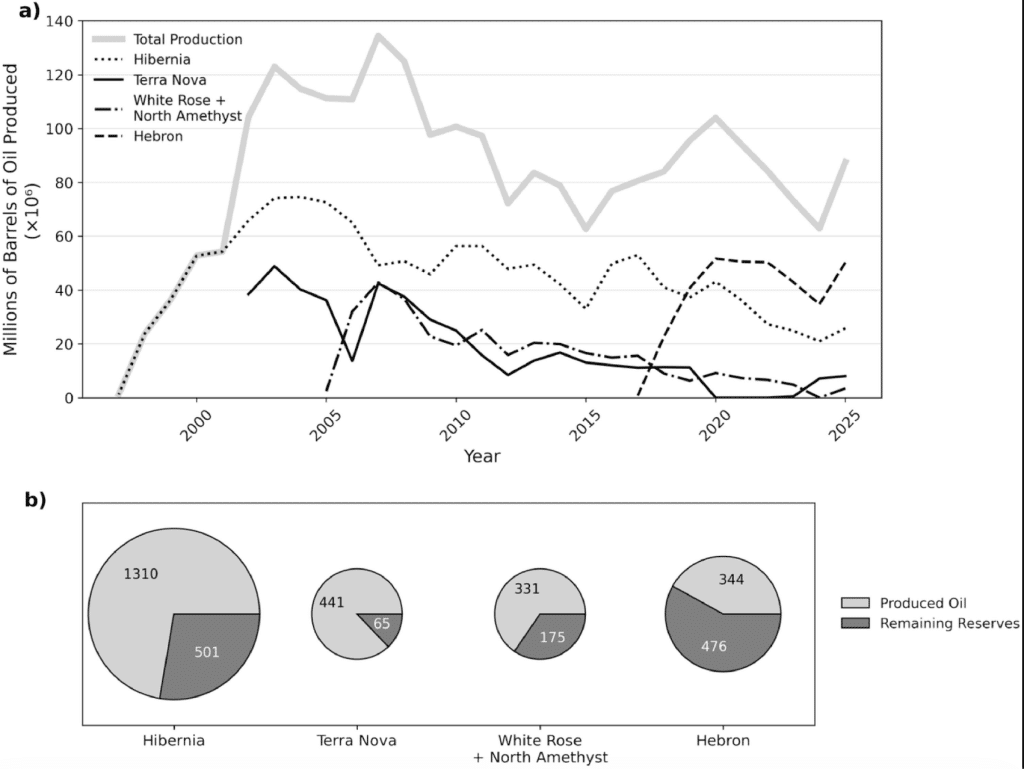
The authors point to provincial peak oil production – about 134.5-million barrels were produced in 2007 – in comparison to the province’s production of 85-million barrels in 2025.
“Although temporary increases in annual production have occurred, notably during the start-up of the Hebron project between 2017 and 2020, production has not returned to earlier highs,” they write.
“As NL approaches its third decade of offshore oil production, three of the four producing projects are experiencing declining production, indicating that the province has moved beyond its peak production period.”
While demand for oil is still strong, the authors say global demand outlooks “are signaling that change is coming,” and that the accompanying uncertainty “is impacting firm investment decisions, even if the demand curve has not yet bent.”
Uncertainty prompting oil companies to pursue safer exploration
While politicians routinely promote Newfoundland and Labrador’s offshore oil as “cleaner” than other jurisdictions’ fossil fuel production, Parnell says this province’s oil “comes with higher development costs.”
To protect their bottom line, Parnell and Carter suggest oil companies can keep extracting from existing fields while becoming selective about new developments. Alternatively, they write, companies may also sell their assets while they still hold value. Last month Suncor Energy announced it is selling its stakes in the Terra Nova, White Rose, and West White Rose projects for $1.2 billion to Ithaca Energy. However, the controversial acquisition has been the subject of scrutiny in Ottawa, where a Liberal MP has indicated it may be under government review.
The researchers also point out that Canadian oil companies like Suncor and Husky are showing less interest in new offshore exploration. “Companies have to spend disproportionately more money on a project here than they would in, say, deep-water Guyana,” Parnell says, referencing the research, which cites ExxonMobil’s activity in Guyana as an example of the competition facing Newfoundland and Labrador’s offshore. Parnell says more accessible oil fields are seen to have less risk.


Between 2020 and 2024 ExxonMobil drilled three unsuccessful exploration wells off Newfoundland, while 18 discoveries were made in Guyana’s offshore during a similar period. The researchers say ExxonMobil plans to spend USD $30 billion in that region by 2030.
“Since 2021 the province has also funded the Offshore Exploration Initiative that reimburses oil companies for drilling second and third wells, up to $30 and $50 million, respectively,” the authors write, pointing to ExxonMobil’s eligibility for up to $80 million in subsidies. “As a result, citizens in NL were helping to cover the company’s exploration costs at the same time ExxonMobil was capturing record-breaking profits.”
While oil revenues remain an important part of provincial budgets annually – offshore royalties for 2025-2026 amounted to $1.7 billion, just over 15 per cent of total revenues – the researchers point out that oil royalties and revenues as a percentage of the province’s GDP is dropping.
Citing the National Ocean Industries Association and the Canadian Association of Petroleum Producers, Parnell and Carter say the oil sector generated about $20 billion in revenues from 1997 to 2020. “Yet the province received only a small portion of the oil’s value, about 14%,” they write, pointing out that as of 2020, “the cumulative value of producers’ sales from oil produced in NL was over $143 billion.”
If global oil demand decreases as the International Energy Agency has projected, and markets respond accordingly over the next two decades, Parnell and Carter say oil-dependent provinces like Newfoundland and Labrador could see 80 per cent or more of their expected oil revenues “evaporate” in the 2030s.
“The trends presented here strongly indicate that oil sector activity in offshore NL is declining across all stages,” they write.
The researchers say the provincial government should be developing an exit plan, which would include capturing more revenue from a “sunsetting oil sector” while shifting subsidies from oil to other low-carbon industries and economic diversification.
Research published day after N.L. announces new interest in offshore
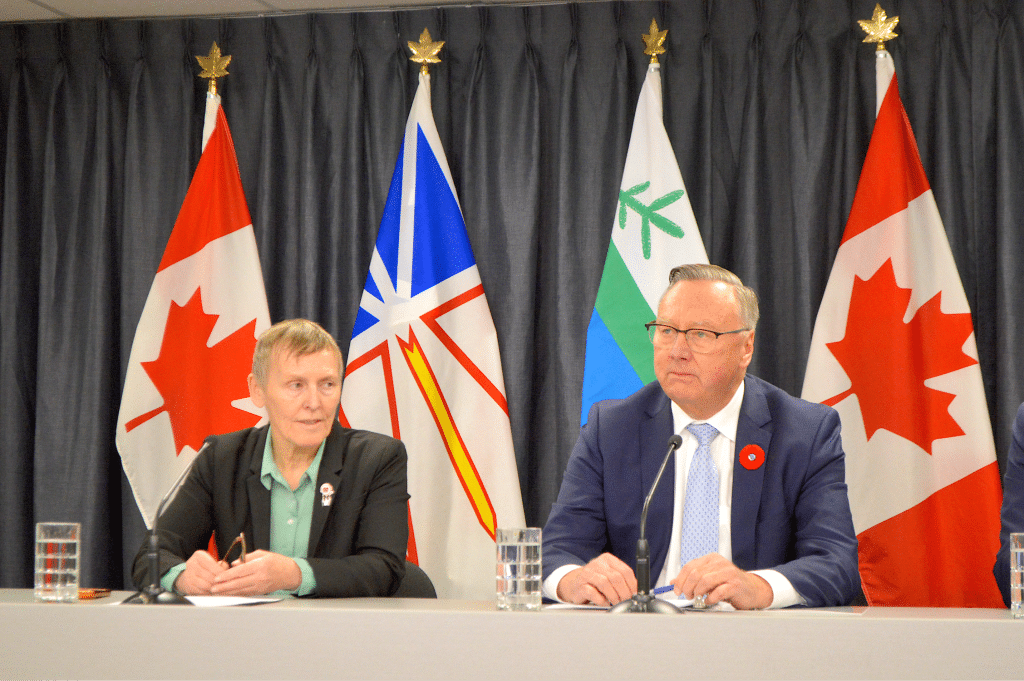
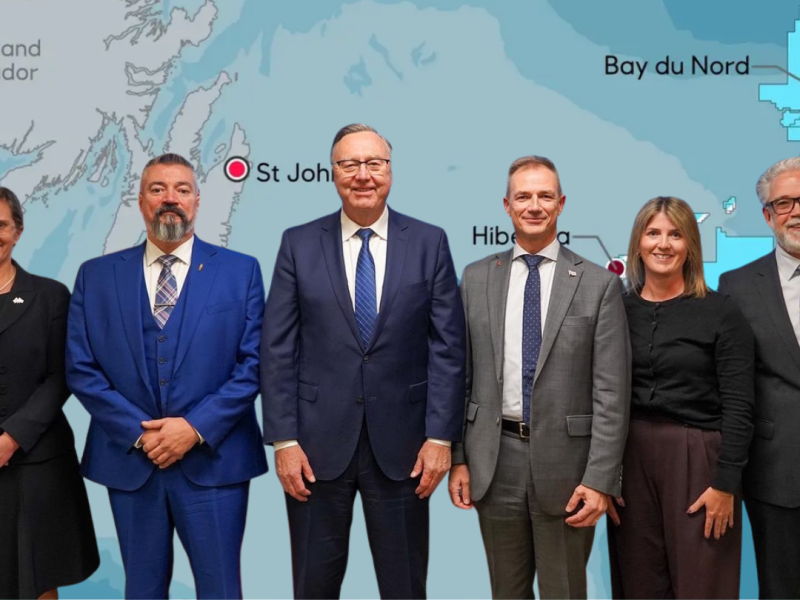
Parnell and Carter’s research was published a day after Wakeham and Energy Minister Lloyd Parrott announced Shell and Equinor had committed to spending up to $240 million for eight parcels of deepwater oilfield hundreds of kilometers east of Newfoundland. The politicians said the news represents a “significant vote of confidence” for the province’s offshore sector for years to come.
OilCo, the province’s crown fossil fuel corporation, spent another $20 million to acquire two parcels with hopes of attracting further investment from oil companies. “Continued exploration activity is essential to identifying future opportunities that can create jobs, generate economic growth and strengthen the province’s energy sector for years to come,” Parrott said.
Parnell says the new commitments could be related to Equinor and Shell’s combined interest in the Bay du Nord project. Last month Equinor announced Shell will acquire a 30 per stake in Bay du Nord and that a final investment decision is still anticipated in early 2027.
“The acreage that Equinor picked up with Shell is around the Bay du Nord development,” Parnell says. “So that makes sense to me that they would pick up the acreage that they wouldn’t want other people to be active [in] as they are developing Bay du Nord.”
Equinor, Shell and Ithaca are all involved in another stalled oil development off the UK coast in the North Sea. The delay in the development of the Rosebank oilfield comes amid deep division in parliament and among labour unions over whether the controversial project should proceed.
Oil industry ‘largely run by corporations, regardless of political will’: Parnell
Last week, Minister of Labrador Affairs Lela Evans told reporters Shell’s renewed interest in the province’s offshore is good for the economy and would help fund greater access to healthcare and affordability measures for her constituents in northern Labrador.
“I will never say turn off the pumps,” she said when asked about the investment. The minister’s comments coincided with an announcement her government will partly subsidise the cost of home-heating fuel for seven remote communities in Labrador.
“How can we afford healthcare [and other services] if we stop producing cleaner oil?” Evans said.
The day prior, in the legislature, Parrott said Newfoundland and Labrador will produce oil and gas “as long as there is an offshore and the world needs it.” The Terra Nova MHA also said he thought Newfoundlanders and Labradorians should be thankful they don’t have an NDP government and accused the New Democrats of being “fully opposed to oil and gas.”
NDP Leader Jim Dinn, who was not in the legislature when Parrott made the remarks, points to his 2022 private member’s bill calling for a just transition plan. Seconded by Evans, an NDP MHA at the time before crossing the floor in 2024, the bill proposed that government “prepare for the coming decline of the fossil fuel industry and make sure that affected workers themselves become leaders of the change,” by supporting workers in transferring their skills to renewable energy industries.
“Actually come up with a plan to transition that protects workers and communities; make sure that we don’t crash out of this economy like we did with the cod fishery,” Dinn says. “We just can’t keep investing and investing when [oil companies] are going to pull out at some point. They’re not going to worry about how much oil is in the ground. They’re going to look at how feasible it is to extract it and where it is cheapest to get it.”
Parnell hopes politicians will use her and Carter’s research to plan for the province’s future. “We’ve kind of done our best with the data that is publicly available to try and maybe paint a picture of the fact that this industry is, number one, largely run by corporations, regardless of political will,” she said.
“At a time when oil companies are making record profits, we recognize that this industry is maybe close to reaching its end […] and we also have to really make sure that, when it comes to abandoning these projects, money has been set aside so there is responsible management of these projects as they reach their end of life.”


Author

Related Articles

May Day Rally Shows New Face of Today’s Labour Movement
Turnout for May 1 march and rally in St. John’s one of the biggest yet in this province

Recimply the Best: Pitch and Pick Competition Winner Aims to Reduce Paper Waste
Recimply won big at Genesis’ annual Pitch and Pick competition last week. The startup is solving the problem of non-recyclable paper receipts.

Coming Home Queer for the Very First Time
For three days in July, queer Newfoundlanders and Labradorians from all over the world celebrated a rural homecoming 30 years in the making.
Environment minister attacks climate reporting, evades reporters
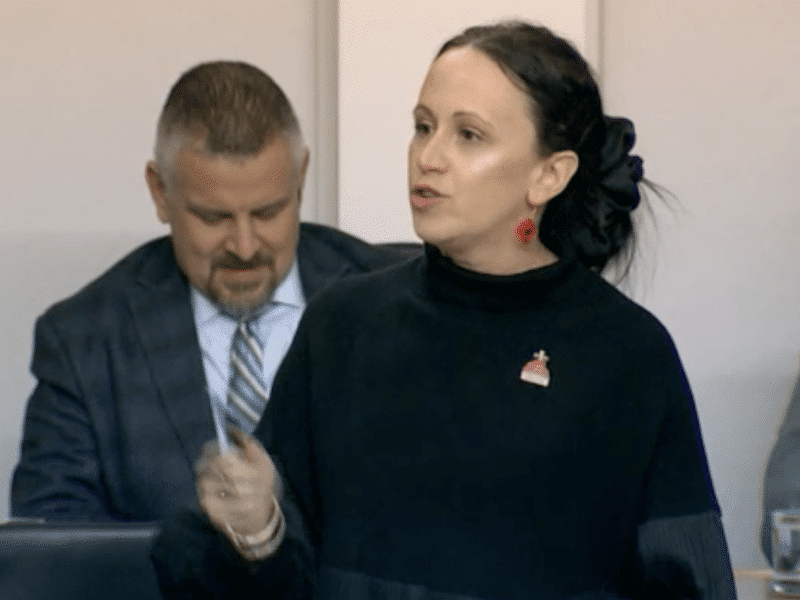
Andrea Barbour’s charges in House of Assembly coincide with announcement of new offshore oil exploration investments worth $260 million

Premier says PCs ‘hoping’ to keep climate change targets
Opposition parties press for more information following The Independent’s reporting, say climate emergency demands more than hope

Residents, supporters protest impending closure of St. John’s transitional housing facility
Housing Minister Chris Tibbs ‘confident’ remaining Horizons at 106 residents will be relocated, but advocates say move could devastate progress made – and with no long-term plan