

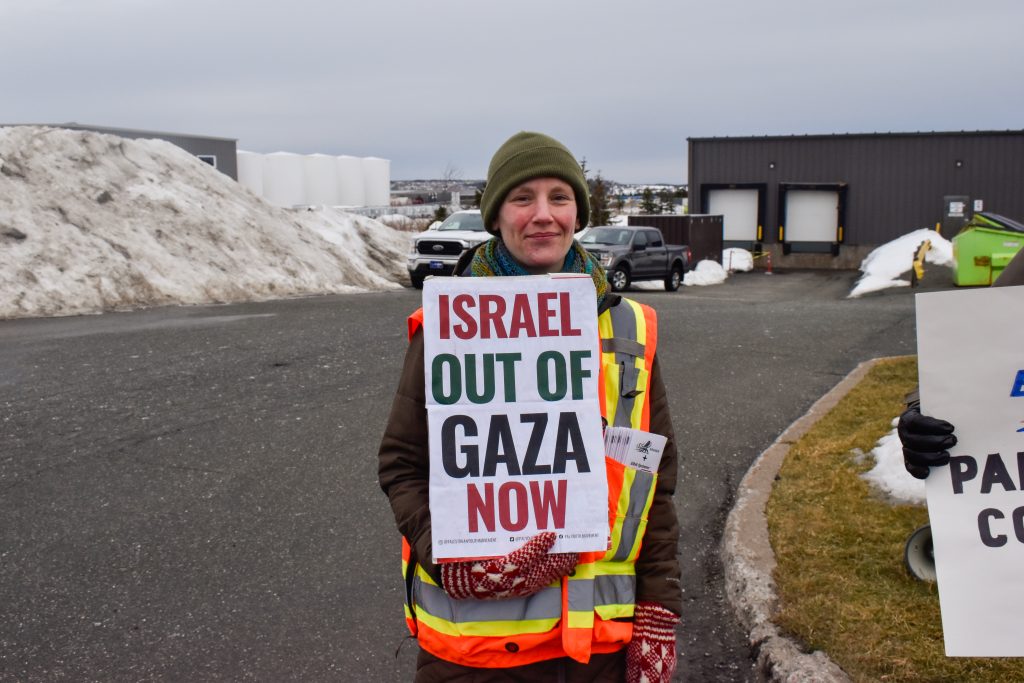
About a dozen peace activists blockaded the parking lot of Kraken Robotics in Mount Pearl Thursday morning, where they gathered to protest the company’s affiliation with an Israeli weapons manufacturer.
“We’re here to disrupt business as usual and demand an arms embargo,” said protestor Megan Hutchings.
The blockade was part of an international day of action organized by global anti-war movement World Beyond War. Representing local groups Palestine Action YYT and Labour for Palestine, Newfoundland protestors were joined Thursday by their counterparts, who carried out actions at Kraken’s office in Toronto and its factory in Halifax.
The day of action came two days after Canadian Lawyers for International Human Rights filed lawsuit a lawsuit against the Government of Canada in an attempt to stop Canadian arms exports to Israel. According to the federal court application, access to information requests have revealed that “Canada has approved an additional $28.5 million in exports of military goods and technology,” since Hamas’ attack on Oct. 7, 2023 and during Israel’s ongoing military bombardment of Gaza.
Additionally, Canada has a legal obligation to control its exports of military goods and technology to countries engaging in human rights violations. The suit claims that permits of military goods to Israel violate the The Export and Import Permits Act, which requires the minister of foreign affairs to consider whether goods and technology could support peace and security or undermine them, violate humanitarian or human rights laws, contravene international conventions on terrorism, transnational organized crime offences, or involve serious gender-based violence or violence against women and children. Canadian Lawyers for International Human Rights says it’s “clear that Israeli forces are committing serious atrocities in the course of its assault on Gaza.”
Will you stand with us?
Your support is essential to making journalism like this possible.

Kraken’s ties to Israeli weapons manufacturers
“We are outside of Kraken Robotics because they are supplying military technology to Elbit Systems,” Hutchings explained Thursday.
Kraken Robotics is a public marine technology company specializing in complex subsea sensors, batteries and robotics systems whose “products, services and solutions are chosen by clients across military and defense, offshore energy and ocean exploration markets and other commercial survey applications worldwide,” according to Kraken’s website.
One of Kraken’s products, KATFISH, enables detailed underwater images of the ocean floor. In 2016 the company announced it had supplied the KATFISH to Elbit Systems, a large Israeli military technology manufacturer that provides “up to 85% of the land-based equipment used by the Israeli military and about 85% of its drones,” according to news reports.
Palestine Action YYT says Elbit “manufactures and produces the majority of equipment and drones used by the Israeli military which it then advertises as being ‘battle-tested’ after being used in attacks on the occupied Palestinian territories.”

The company’s website describes its products as being “battle-tested” and “battle-proven.” Al Jazeera has reported the Israeli army released footage on October 22, 2023, of Elbit’s Iron Sting mortar bomb being used in Gaza and claims that Elbit’s weapons have been tested on Palestinians. Elbit says its Iron Sting mortar was first deployed in May 2021 as a “pre-operational test” during “Operation Guardian of the Walls,” which took place during the 2021 Israel-Palestine conflict, when 256 Palestinians, including 66 children, were killed.
Meanwhile, KATFISH is integrated with Elbit’s ocean drone, Seagull. According to Kraken, the KATFISH “provides remotely operated, unmanned, end-to-end mine hunting operations” that “can detect very small objects hidden on the seabed and enter confined spaces where underwater explosives are likely to be hidden.”
According to an Israeli national defense publication, the Seagull has been used in the war in Gaza and is being used to detect naval mines, subsea infrastructure and submarines. “During the current war, the Navy dealt with Hamas’ underwater and submersible attack vessels,” says an article on the website. “On the day of the massacre, October 7th, the Navy thwarted attempts to enter from the sea towards Israeli territory.”
Naval-Technology.com claims the Seagull “is armed with a remote control weapon system mounted with a 12.7mm machine gun,” and that the “torpedo launching system on the vessel allows the firing of torpedoes against hostile submarines.”
A 2021 Jewish News Syndicate also suggests the Seagull has been used to counter Hamas attacks on Israeli offshore gas rigs off the coast of Gaza.
Kraken’s most recent known collaboration with Elbit systems was in 2022 — a demonstration of KATFISH in “the Royal Navy’s (RN) Wilton Industry Show and Experiment” where Kraken teamed with Elbit Systems UK to test the technology. The news release from St. John’s also notes Kraken “recently delivered KATFISH systems to the Royal Danish and Polish Navies and expects them to be operational in [early] 2023.”

Kraken has also supplied its technology to Elta Systems, an Israeli state-owned aerospace and aviation manufacturer, for Elta’s BlueWhale underwater drone. Elta specializes in the “development of advanced defense and intelligence electronics, including sensors, radars, electronic warfare and communication systems.”
According to Israel Aerospace Industries, the BlueWhale is “an autonomous submarine system designed for high-endurance and stealthy intelligence gathering, anti-submarine warfare, mine countermeasures, and other critical missions operating in open seas, hard-to-access littoral waters and choke points.”
An article published on a British trade organization website in December 2023 calls BlueWhale “a true force multiplier” because of its cost, coupled with its ability to “support conventional submarine forces by performing critical missions with complete autonomy, reduces crew workload, saves lives and improves mission performance.”
According to a Forbes article, the Israeli Navy has concentrated its efforts to monitor Gaza closely. It has control of the Mediterranean Sea, which has a “limited flow of outside weapons, personnel and support to Gaza.” The navy prevents “re-supply of Gaza by sea all along the Gaza Strip from Iran-back proxy groups.”
Israel has used its navy to blockade the Gaza Strip over the past decade and a half, says Hudson Institute Senior Fellow Bryan Clark, adding that “anything substantial coming from the sea is generally intercepted by the Israeli Navy which has a robust surveillance network and patrol craft which operate there.”
Geopolitics contributing to company success
Last month Kraken announced its 2023 fiscal revenues are expected to fall between $66 million and $72 million, “representing top line growth of about 68% year over year,” according to a company press release.
Kraken President and CEO Greg Reid references strong growth in the defence market, where “the macro environment is robust as countries adapt to the new geopolitical norm to monitor and protect critical underwater infrastructure and territories.”

In an interview last year, Reid said “geopolitics has obviously had a big impact on the market,” and that “you’ve got all these geopolitical hotspots, you know, whether it’s South China Sea or whether it’s the Middle East […] you got increased competition for resources and land in certain geographies. So all these things play into countries and navies wanting to have the latest and greatest equipment wanting to be able to protect their national interests.”
“The technology Kraken is using, I think they believe is fairly benign because it’s not a rocket, it’s not a bullet,” St. John’s resident Alice Thorburn said at the blockade Thursday morning. “But parts of weaponry are weaponry.”
The Independent attempted to contact Kraken by phone and email but the company did not respond by the time of publication. Two employees outside Kraken’s headquarters Thursday also declined to comment for the story.
Israel’s blockade of Gaza
“This is a blockade of air, land and sea, and it has been for 16 years,” said Thorburn, “which means that the people of Gaza haven’t been able to adequately feed themselves.”
Amnesty International has characterized the blockade, which was imposed after Hamas won elections in the Palestinian territory in 2007, as “collectively punishing its entire population.” This week Refugees International released a report calling Israel’s siege of Gaza and starvation of Gazans “apocalyptic,” having generated “famine-like conditions” in the strip “while obstructing and undermining the humanitarian response.”
The International Court of Justice is still reviewing South Africa’s application for the court to hear its case that Israel may be committing genocide in Gaza. In January the court issued an interim order calling on Israel to “take immediate and effective measures to enable the provision of urgently needed basic services and humanitarian assistance to address the adverse conditions of life faced by Palestinians in the Gaza Strip.”

The court also ordered Israel to, “in accordance with its obligations under the Genocide Convention, in relation to Palestinians in Gaza, take all measures within its power to prevent […] (a) killing members of the group; (b) causing serious bodily or mental harm to members of the group; (c) deliberately inflicting on the group conditions of life calculated to bring about its physical destruction in whole or in part; and (d) imposing measures intended to prevent births within the group.”
Canadian civil society groups have been urging the Trudeau government to end arms exports to Israel, arguing the exports violate international law. Last month The Maple reported that the Canadian Government authorized $28.6 million of military exports to Israel since October — and that Global Affairs Canada attempted to delay the release of those records in an access to information request.
No more “business as usual”
Police arrived on the scene in Mount Pearl at approximately 8:23 a.m. Thursday and gave protestors 15 minutes to wrap their blockade of Kraken’s parking lot.
“They’re trying to make this a sort of compromise,” said protestor Alec Brookes, who liaised with police officers on the group’s behalf. “Of course the main reason we’re here is to stop people from coming into the office today and doing work that provides weapons and military infrastructure to Israel.”
The protestors eventually agreed to allow cars into the parking lot, but continued picketing for a short time. “At the end of the day, it’s about your safety, it’s about everyone being able to get your message across and people getting to work,” RNC officer Dave Hutchings told the protestors.
“Palestinians have the right to live and even to well-being, and we’re just out here fighting for their right to merely exist,” Brookes said.

Two individuals who appeared to be Kraken employees spoke with police, arguing that protestors should leave because it is private property. They also complained about protestors handing out flyers to employees. Meanwhile, Kraken employees began placing paper hearts in the tinted windows of the building’s front entrance.
“Even as we ship equipment to the Israeli military perpetrating genocide, we have some kind of responsibility to be kind and loving to one another,” Brookes told The Independent in response. “I am unaffected by it. I’m a little disgusted if we’re being honest.”
Megan Hutchings said the protestors “don’t want to shame any workers, but we want to make sure that workers acknowledge that this is an issue and this company and our country really are complicit in genocide.”
Palestine Action YYT plans to continue protesting until there is a ceasefire in Gaza; the group also continues to call for an arms embargo on Israel.
“As long as the genocide continues, we’ll continue to find places to apply pressure to the people enabling it,” said Brookes. “Whether it’s Kraken, or Indigo/Chapters, or just hitting the streets on Water Street, we’ll be here every week and in the middle of the week, trying to do our best for the people of Gaza.”

Author

Related Articles

Meaningful response to homelessness requires more than new builds, says NDP leader
Jim Dinn’s comments come in response to PC’s announcement of 10 new ‘micro homes’ in St. John’s

Muslim community commemorates 9th anniversary of Quebec City Mosque shooting
Anti-hate advocates say there’s still work to be done to combat Islamophobia in the province

PCs invite public input ahead of Budget 2026
The coming provincial budget will be the Progressive Conservatives’ first in more than a decade