
Labrador residents rally against unaffordable airfares
The skyrocketing cost of air travel in Labrador is having impacts across the board
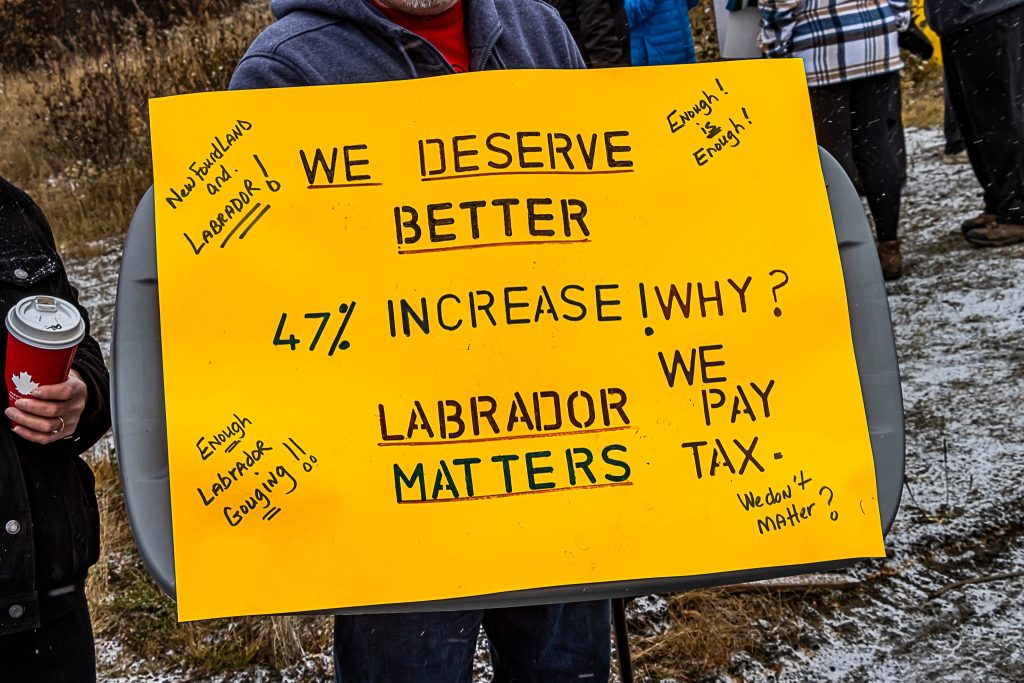
The high cost of air travel in Labrador isn’t new, but it’s getting worse.
According to a report commissioned by the Goose Bay Airport Corporation, the average cost of air travel to and from Labrador’s two major airports in Wabush and Happy Valley-Goose Bay has risen 47.3 per cent and 33.1 per cent respectively since 2019, far above the national increase of 9.2 per cent.
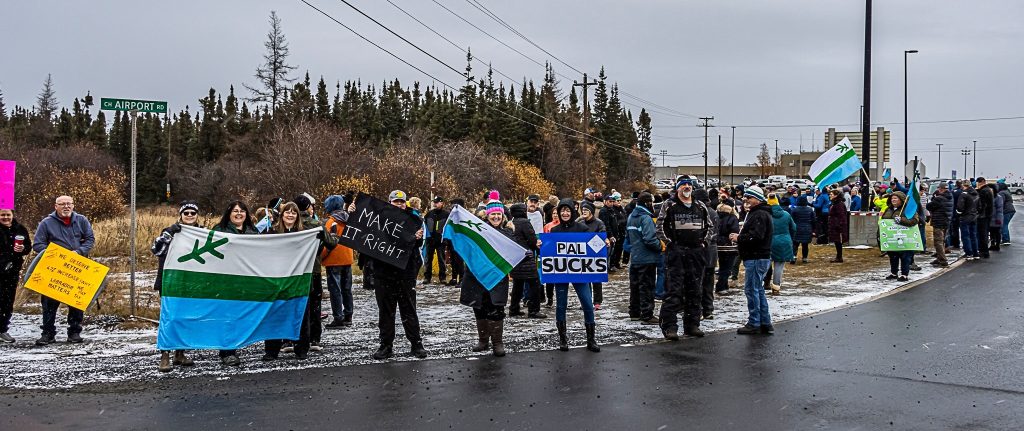
The dramatic rise in airfares, and lack of airline options, are what prompted Dena Churchill Rumbolt, who lives in Labrador West, to organize a rally at Wabush Airport on Oct. 26 and to start gathering signatures, and stories, from people across the Big Land to try to get something done about it.
She said she was happy with how the rally went, and with the dozens of people who showed up in support of the cause.
Will you stand with us?
Your support is essential to making journalism like this possible.
“I was very impressed,” she said, explaining that many seniors were among the attendees. “I hope we don’t have to have another rally, but if we do I expect we’ll get a bigger crowd.”
Churchill Rumbolt said she’s hopeful about a meeting later this week with Premier Andrew Furey and representatives from PAL Airlines, which she has been invited to attend, but is skeptical the government will do anything about it.
“I think they have no other choice but to either have this meeting, pick it apart, and find a solution, or bring in more airlines,” she said.
“Even if they did bring in more they’d still have to deal with the pricing; what we pay here now is outrageous,” she continued. “We’ll see what happens, but I’m doubtful it will accomplish much. At least I’ll have the chance to hear from the airline what their points are, and hopefully ask some questions of my own.”
Petition being presented to legislature
Churchill Rumbolt said the rising cost of airfare came to a head for her this August when there was a death in her husband’s family.
“It was a personal issue that triggered it for me,” she said. “My husband and my brother-in-law couldn’t get out, and the flight — at first it was delayed, then it got canceled, and their mom was dying at the time. When that happened, I think I was just overwhelmed with the emotion of the situation and knowing that we could not get out of here at the last minute. We have very limited resources when it comes to availability and reliability and the cost is just outrageous.”

She took to Facebook with her story and soon found many others with tales of last-minute canceled flights and incredibly high prices. She started a group called Labradorians Deserve Better Air Access, which now has over 1,800 members on the social media platform, and began gathering signatures on a petition to bring to the House of Assembly to try to get the provincial government to step in and do something.
That petition now has over 3,800 signatures and Churhcill Rumbolt said it could have easily topped 10,000 — maybe 20,000 — if the legislature accepted digital petitions.
“A lot of people are 100 per cent backing me on this because it’s not only my story,” she said. “There are hundreds more that I did not know until I started this journey going public on my own personal Facebook page, and then everybody started reaching out to me.
“We should never have to fight for these things. We live here, we pay our taxes here, we pay more than our share with the tax dollars that come out of this community with the mines here. It’s just outrageous [that] the government gets the benefits of the tax dollars from here and we have to fight for things like this.”
MHAs concerned with impacts
The petition will be presented to the House by Labrador West NDP MHA Jordan Brown, who told The Independent that while unaffordable airfare is a longstanding issue, the dramatic rise in recent years has impacted Labrador communities in many ways.
“We’re getting almost 50 per cent more of the cost downloaded onto us,” he said. “It takes a chunk out of your savings, just to go to an appointment, or if you have a relative pass away, or a parent who was very sick and passing and you want to go say goodbye. People are actually foregoing funerals and family gatherings and medical appointments because it’s just out of their budget.”
One of Labrador’s other MHAs, Lela Evans, who represents the district of Torngat Mountains for the Progressive Conservatives, echoed many of Brown’s comments, saying the increased costs have impacted the ability of people in her district to access medical care. While people can get assistance through the provincial Medical Transportation Assistance Program, which covers some of the cost for some of the flights, or from Indigenous governments, not everyone on the north coast does, and it can be a huge cost to travel from the coast for appointments.
Both Brown and Evans said the costs also impact the ability of communities to attract and retain professionals, including teachers and doctors.
“It’s not just about people traveling for healthcare; in Labrador this is impacting our quality of life, and it impacts our communities,” Evans said. “It impacts our ability to recruit and retain professionals and support staff, because when travel is a barrier you’re restricting people’s lifestyle, the ability to be able to travel, the ability to be able to go on vacation, the ability to have your kids travel for sports and training, your ability for people to do professional development.”
Evans said since the communities in her district aren’t connected to the rest of Labrador by road it can be extremely limiting, even without the additional burden of high travel costs. While there is a ferry that services the communities on the north coast, it doesn’t run all year, and in the winter air travel is the only way in and out. Even when the ferry is running, Evans said, a trip to Happy Valley-Goose Bay takes days, not hours, and that isn’t a viable option for residents who need to travel.
Are subsidies the answer?
Asked what he felt could be done to mitigate the issue, Brown said a short-term solution people keep rushing to is the government subsidizing northern airfare. But the idea of giving profitable companies government money doesn’t sit well with him.
“It’s not a long-term solution and that’s where the petition comes in — to have the provincial government form a committee looking at intra-provincial travel, the cost, connectivity, things like that, that we need a long-term solution for,” he said. “It’s not just Labrador impacted by this, there’s a lot more places on the island as well that have lost connectivity over the years.
“Take St. Anthony as an example. They have an airstrip up there, and they’ve seen a reduction in service, and they’ve also experienced a higher cost of travel. They deserve to be a part of the solution as well. So we want that connectivity across the whole province to be looked at. It’s a huge problem right now that we’re less connected than we ever were physically, but yet, in a digital world, we’re more connected.”
Evans agreed the issue needs to be looked at from a big picture perspective but said she was in favour of looking at a subsidy similar to the Regional Air Access Program (RAAP) offered by the province of Quebec. RAAP subsidizes the cost of flights from rural and remote communities into major hubs in the province and under the program, consumers can get between 30 to 60 per cent of their flight cost covered, depending on where they live.
Evans said this type of program, where the cost savings are directly passed on to the consumer, instead of to the airlines, could work at mitigating the impacts.
“A subsidy on the user end, like the one in Quebec, could help make sure the savings are passed on to the right people, not the airlines,” Evans said. “I don’t see why something like that couldn’t work here.”
The Independent reached out to PAL Airlines for comment but did not receive a response by the time of publication.
Evan Careen is a Local Journalism Initiative reporter covering Labrador.

Author

Related Articles

N.L.’s offshore oil could help bankroll a company linked to Israel’s illegal occupation of Palestine
Ithaca Energy’s impending takeover of Suncor’s stakes in three oil projects comes after PM’s promise to ban trade with Israel’s illegal settlements, while Ithaca’s majority owner is named on a UN blacklist for its alleged activities supporting settlements in the occupied Palestinian territories
As Innu exhibit opens in Labrador, Grand Chief says truth must come before reconciliation
Innu Nation Grand Chief Jodie Ashini says it’s disappointing to open the Innu Pakassiun exhibit without the provincial government’s participation, but Innu know their history and who they are

Liberals’ Bill C-39 a wake-up call for Canadians: Avi Lewis
‘Cracks starting to show in the Carney consensus,’ Lewis tells N.L. NDP convention in St. John’s