
Memorial University student union walks back plan to close radio station amid backlash
‘I wish CHMR the best,’ Memorial University Students’ Union executive says ahead of vote to defund the campus radio station
Editors’ note: Justin Brake has taken on a new part-time role as Atlantic Canada investigative journalist for The Independent and Ricochet Media. This innovative collaboration between a regional and national outlet is supported by the Local Journalism Initiative. Brake will continue in his role as The Indy’s editor-in-chief.
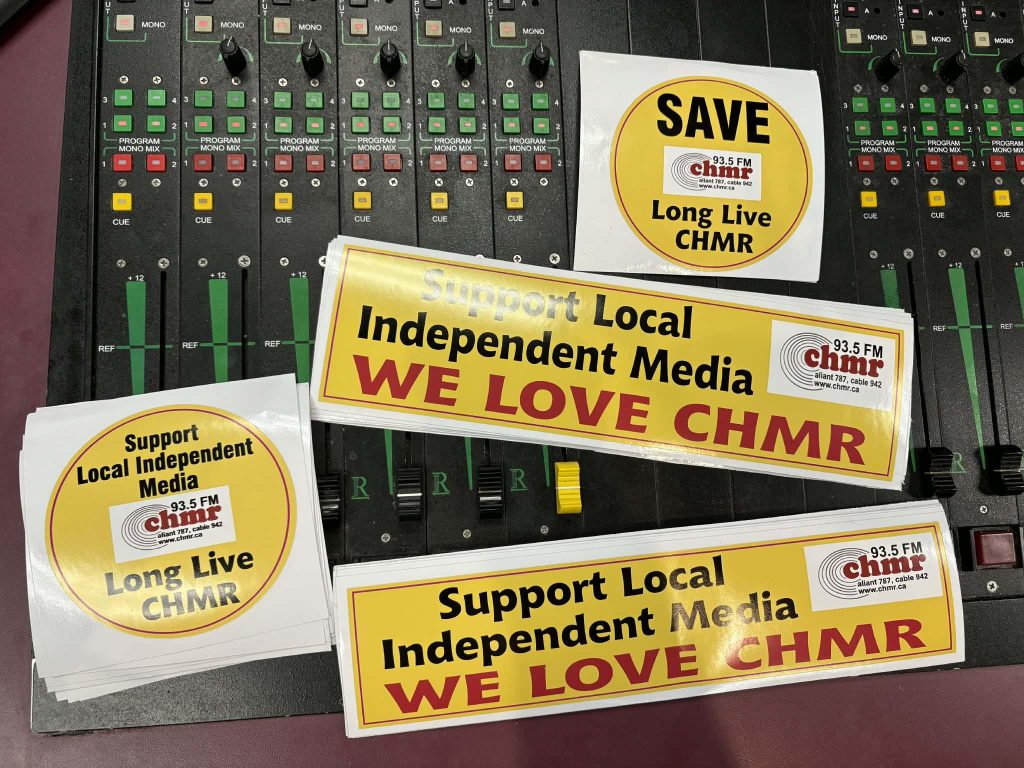
Memorial University Students’ Union is walking back its plan to shut down a campus radio station amid widespread backlash. Following a March 18 board meeting, MUNSU revealed that on April 1 it will vote on a motion to defund and close CHMR-FM, the province’s only campus radio station.
On Monday the union’s director of external affairs said MUNSU is scrapping a clause in the motion that would enable the union to shutter the station. “We will give them the opportunity,” Nathan Gillingham told The Independent in a phone interview Monday, explaining the union feels it has little choice but to sever funding given the union’s financial woes.
The motion as tabled proposes to close the station by Aug. 28, 2026 and redirect a $2-per-semester media levy to the “operations of MUNSU communications” — a move that may violate union rules. In a social media post, the union says CHMR cost $266,188 to operate in the 2023-2024 fiscal year. The station only generated around $71,500 in revenues, says the post, leaving a deficit of almost $195,000. It is unclear if the station’s continued operation would interfere with plans to appropriate the media levy.
Will you stand with us?
Your support is essential to making journalism like this possible.
“This is a grab” says Alex Freedman, executive director of the Community Radio Fund of Canada, which advocates for the community media sector. He says the motion is “dangerous and undemocratic” and any decision on the fee levy should be put to the students in a referendum.
The student union itself claims to have run a deficit of nearly $365,000 in 2025, with projections suggesting an even higher one this year. “This isn’t about targeting CHMR specifically,” Gillingham said. “I fully recognize there is a place for community radio. I fully respect all of the good work that has been done there throughout the many years.

“There just needs to be a lot of operational changes, regardless. So this discussion that’s coming up on [April 1], there will definitely be an opportunity for CHMR to be independent if it is decided by our board that we could no longer have [the station] in our operating budget.”
Some are questioning MUNSU’s motives, however, given how it has handled the situation. “We were blindsided without real consultation,” says CHMR Station Manager Rhea Rollmann, who is also a regular contributor to The Independent. “Something this significant should be preceded by a lot of public dialogue and consultation,” she said, explaining she had a hard time finding MUNSU’s public notice, which was made in a March 18 Instagram post.
Beyond the short timeframe for public discussion, MUNSU’s attempt to shut down the station and redirect its student media fee levy — which totals more than $50,000 annually — to its own operating budget is highly suspicious, says the head of a national community radio association.
Freedman, with the Community Radio Fund of Canada, says in most cases when student unions propose to defund student media, the decision is put directly to the student body.
“If they haven’t conducted a fulsome referendum, I would say that this is a very dangerous and undemocratic position for them to take,” Freedman told The Independent. “This is a student service, it’s not up to the student union to just pull back the money.”
MUNSU’s constitution and bylaws state that, “no Students’ Union membership fee or levy may be removed or adjusted without a referendum favouring the change unless otherwise specified herein.”
But Gillingham says he’s “confident” the 83 undergraduate students MUNSU surveyed — of which he says 13 per cent said they have listened to CHMR — are representative of the station’s usage among the roughly 11,000 students the union represents. Pressed on the rigour and accuracy of polling such a small sample of Memorial’s student body via a multiple choice survey, Gillingham said he is “really confident that CHMR does not have the campus-wide cultural impact that it once did.”
In addition to the survey, Gillingham said MUNSU representatives have been engaging in “informal conversations” with students about the station, and that the findings are the same: CHRM is an underutilized service.
Inside the decision
MUNSU’s bylaws require the union to give two weeks’ notice when it plans to amend its bylaws. That notice was given in the March 18 Instagram post, which notes the union is facing a nearly $300,000 deficit and that the recommendation to shut down CHMR came “after exploring many options for both MUNSU service delivery and the responsible handling of hundreds of thousands of student dollars.”
Gillingham said MUNSU gave the union representing CHMR, the Canadian Union of Public Employees NL Local 4554, sufficient time to propose solutions for the station’s funding. While he didn’t share the proposals, Gillingham said “various options were definitely considered.”
Rollmann, CHMR’s station manager, was head of CUPE Local 4554 at the time of the negotiations between MUNSU and the station last fall. When she took over as CHMR’s station manager last summer, she said she proactively engaged MUNSU to “figure out a path to financial sustainability and then to be self-sufficient.”

The student union’s mind may have already been made up, though. “Immediately, [in] my first meeting with them, they said they wanted to defund the place entirely,” Rollmann recalls. CUPE pushed back, forcing MUNSU to agree to further discussions. Rollmann then met with MUNSU in September, when she “laid out a five-year plan for phasing out [MUNSU’s] funding entirely.
“And they were like, ‘Cool, we’ll discuss this with the rest of the folks and see how this looks and get back to you,’” Rollmann continues. “And then there was nothing until [early] December [when ] they asked for a meeting with CUPE, and basically just said they want to cut the funding.
“So we met with them [in December] and said, ‘Here’s a five-year plan for phasing out funding. How’s this? If this doesn’t work, let us know, we’ll rejig this to find something for everyone.’ And they were like, ‘Oh, interesting. Okay, we’ll get back to you. We’ll review this and get back to you.’ And then nothing from them for four months until they brought this notice at the March 18 [MUNSU board] meeting.”
Widespread support
CHMR, which began broadcasting on FM radio in 1987, is where many journalists in Newfoundland and Labrador got their start, including NTV Evening News Anchor Michael Connors, CBC Power & Politics Host David Cochrane, and many others.
Station alumni, musicians, students and others have inundated MUNSU with support for the station. On Tuesday Shanneygannock singer Chris Andrews posted a video on social media encouraging MUNSU board members to “vote no on closing CHMR,” adding campus radio “promotes local artists, local cultures, and also provides a platform for journalism students to perfect their trade.”
Chimdumebi Damian, a Memorial University student and reporter at CHMR, said the station has been an “integral part” of her “personal and professional growth” because it allowed her to improve her communication skills and “build a growing confidence in myself,” she says in another video posted to social media.
In a statement of support for CHMR, Newfoundland singer Pamela Morgan, who was awarded an honorary doctorate of letters from Memorial University in 2007, said as an artist she “benefitted greatly” from CHMR’s support over the years. “It’s a grave mistake to shut [CHMR] down,” she says. “Yes, listening habits are changing and evolving, but that makes it more vital than ever to include a voice for the marginalized and underrepresented. Things tend to go in cycles, and more people are beginning to seek alternatives to homogenized mainstream media and AI doctored social platforms.
“Teaching students how to use the medium for podcasts to tell their stories is also a vital service to the community and world. Many come from countries where free speech is censored. Shall we also censor them?” Morgan continues. “I beg you to reconsider.”
In recent years CHMR has trained countless Canadian and international students on the airwaves, debuting programs in languages like Ukrainian, Bengali, Arabic, Indonesian and Spanish, to name a few. The Anti-Racism Coalition of Newfoundland and Labrador said in a public statement that, “For Indigenous and racialized students, CHMR has been a rare space to bring their stories to the broader community,” and that it’s “important for the community to support local journalism that brings attention to voices not covered by traditional media.”
Rollmann says the station’s diverse programming has helped international students practice their English-speaking skills, while also offering community members the ability to listen to programs in their own languages. “I think it’s really beautiful when they’re able to tune into local radio or local podcasts and hear locally-produced content in their own first language,” she says.
Rollmann wasn’t expecting the widespread outcry when news of MUNSU’s plans went public. “I think students seeing their own student union cutting one of the few remaining spaces for creators, for arts and creative work, was really the last straw for a lot of folks, both on campus and in the community.”
Gillingham says he appreciates people’s concern for CHMR but notes much of that support is coming from people who are not students and aren’t paying to support the station. “I don’t really care what Hugh Campbell has to say on the matter, all due respect,” he says, referring to the OZFM radio host and CHMR alum who posted a video featuring other colleagues whose careers began at the campus station calling for public support. “If they are fully willing to sustain the service independently, have at it,” Gillingham said. “But as it is currently, just not many students utilize the service. It’s just a fact.”
Support has also come from outside the province, with nationally renowned musicians like Joel Plaskett, Tom Wilson and legendary Canadian rock band 54-40 chiming in on the controversy.
Freedman says MUNSU’s effort is part of a troubling broader trend. “These stations are a critical part of access to local information and student information,” he says. “So I think it’s very dangerous, from a societal perspective, that they would be ultimately undermining media in order to redirect, as it appears from their motion, the funding to their own internal uses.
“This is the students’ money and the students deserve to have a democratic voice in this. And if this is just being sprung on students at the last minute […] it makes me question the intentions,” he continues.
“If they genuinely believe that the students don’t believe in this radio station, then they should ensure a fair process by which the students are informed of what’s going on, informed of the decision, and the radio station has an opportunity to respond.”

Author

Related Articles
Access to information: N.L. failed to make public over 1,000 responses in a single year
Province says it’s dealing with an increase in requests, but NDP leader is concerned the mounting problems may be intentional

INTERVIEW: Avi Lewis says N.L. is ‘ground zero’ for the biggest challenges facing Canadians
The federal NDP candidate says socialism and economic populism are the antidote to unfettered capitalism and the ‘epic market failures’ it has brought

What a Newfoundland community can learn from B.C.’s first major LNG facility
As talk about developing an LNG export project in Newfoundland and Labrador continues, residents have questions — and the answers might be on the other side of the country