
What a Newfoundland community can learn from B.C.’s first major LNG facility
As talk about developing an LNG export project in Newfoundland and Labrador continues, residents have questions — and the answers might be on the other side of the country
This story was originally reported by The Narwhal, here.
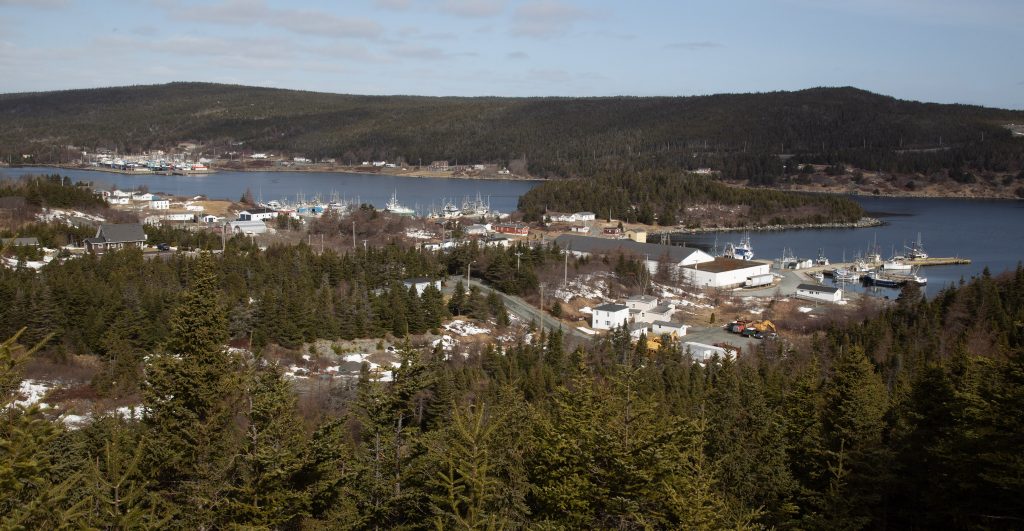
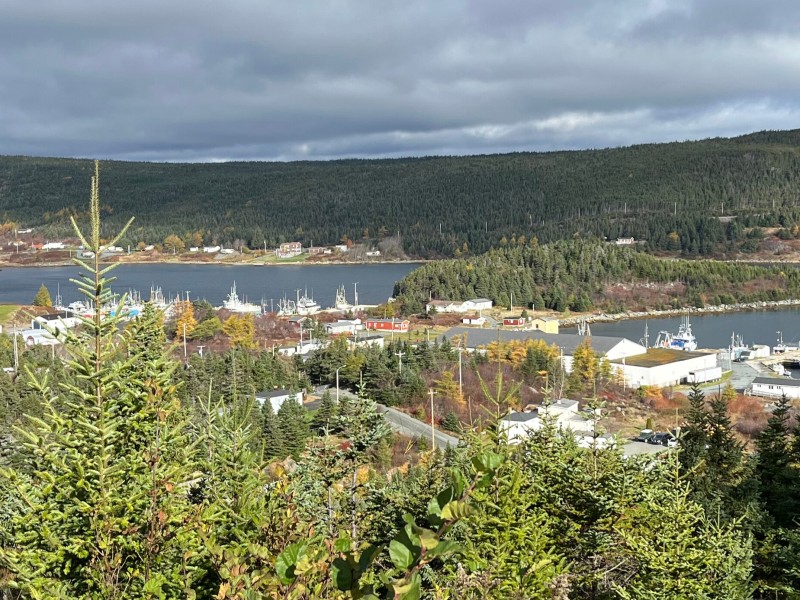
About an hour’s drive from St. John’s, Newfoundland and Labrador, the little fishing village of Fermeuse sits on the shores of a deep harbour, sheltered from the tempestuous North Atlantic. Atop a hill overlooking the village, eight slow-turning turbines harvest energy from the nearly ever-present wind that flows from the open ocean. Generations of fishers have plied the waters off the coast, harvesting cod, crab and numerous other species.
More than 5,000 kilometres away, on the northwest coast of British Columbia, the town of Kitimat, B.C., is newly home to Canada’s first major liquefied natural gas (LNG) facility. LNG Canada started operations here last year, lighting up the night sky with its noisy and bright flare stack and welcoming a stream of supertankers to the deepwater channel that connects the community with pan-Pacific shipping routes. Years in the making, the LNG export project has undeniably changed life for those who live alongside it.
Fermeuse could be facing similar changes.
Will you stand with us?
Your support is essential to making journalism like this possible.
When the Atlantic cod fisheries collapsed in the 1990s — putting more than 35,000 people out of work across Newfoundland and Labrador — many left the village in search of good paying jobs, including in the province’s booming oil and gas sector. Now, as nearby offshore oil developments like Bay Du Nord get a boost from the federal government and the province eyes new revenues from the sector, the sleepy village of around 300 residents could become the focal point for an influx of new industry.


Crown LNG Holdings Ltd., under the name of its Newfoundland affiliate, Fermeuse Energy, plans to develop a swath of the harbour to support several projects, possibly including a liquefied natural gas processing and export terminal. The company is approved for a marine base but has not yet submitted an official proposal for an LNG plant. In late January, Fermuese Energy signed an agreement with Hanwha Ocean, a South Korean shipbuilding company and expert in offshore facilities, to “jointly advance the Newfoundland and Labrador LNG development project in Canada.”
“If the political will and the community support comes along, then we will move ahead with the project by the end of this year or next year,” Swapan Kataria, CEO of Crown LNG, told The Narwhal in an interview.
Valerie Walsh, whose family has lived in Fermeuse for generations, said many in the community are tempted by an idea that “our sons and daughters who moved away for work will maybe move back to Fermeuse” to build the LNG project.
“It’s a sought-after harbour,” she said, explaining it’s protected from the open water and safe for large boats. “It could be really rough in the North Atlantic, but boats can come in here and they’re protected.”
But Walsh is worried residents will be seduced by industry without knowing what they’re really signing up for.
“I don’t know if it’s because the fishery collapse just took the wind out of everybody’s sails and they’re just waiting for the saviour to come along, which is oil and gas,” she mused. “[The company] can make it seem safe. They can make it seem a lot of things. I think this will be the end of the harbour and any natural thing for us. … There will be no whales coming in anymore, no puffins, no fishery, no boats, no anything.”
“I don’t know that the community really understands it.”

Details about the potential LNG project are vague, but the company has said plans could include a 380-kilometre pipeline along the ocean floor, trenched for part of that distance to protect it from icebergs, connecting untapped offshore gas reserves to the village. There, a floating liquefaction facility could supercool the gas, reducing its volume for marine transport to overseas destinations. Kataria said the facility, if built, would process and export up to 10 million tonnes of LNG per year. The company acknowledged an LNG project would bring change to the community and said if anything were to move ahead, public consultations and stakeholder engagements would be held.
“We are only approved for a marine base and I think it’s important to qualify that in order to avoid any future confusions,” Kataria said. “We are certainly there to service the offshore growth in the industry.”
How the LNG project fits into the picture is that those same offshore areas are home to “a lot of gas reserves which nobody is going after,” he said. “We are connected with the industry, and we feel that there is gas which can be monetized.”
‘We don’t know what’s going to happen’: locals question how Fermeuse LNG would impact community
On the north coast of B.C., the massive LNG project was under construction for about five years, employing locals and flooding the community with thousands of out-of-town workers. It now employs around 300 people and will provide the community with $9.7 million in annual taxes for the first five years of operation.
Kitimat residents have experienced months of disruption to their daily lives since LNG Canada started flaring activities in late 2024. Flaring is the burning of excess or waste gas, a normal part of operating a liquefaction facility. In Kitimat, flaring has at times exceeded 90-metre-tall flames, about the height of London’s iconic Big Ben, in part due to an ongoing equipment issue.
That causes light pollution, noise and emissions, as well as releases air pollution. Flaring at LNG facilities releases carbon monoxide, nitrous oxides, fine particulate matter and sulphur dioxide, all of which can have impacts on human health. For its part, LNG Canada in Kitimat says flaring is “safe, controlled and provincially regulated.” But that hasn’t stopped residents there from being concerned.

Walsh said she’s afraid ceding the harbour shores to an industrial hub for LNG and oil development would be a death knell for the villagers’ way of life.
“My father’s from here, his father and his father before that,” she told The Narwhal on a phone call. “We are literally closing the door on our way of life in this harbour if we let this industrial LNG come in.”
Brenda Aylward lives on the other side of the harbour from Walsh, where she raises sheep and grows vegetables while caring for her aging mother.
“It’s a fifth-generation farm and I’ve been involved pretty much my whole life,” she said. It’s a small farm-to-table operation she’s planning to expand — and she wonders what the impacts of an industrial project in the harbour would have on her livestock.
“I have fields that border the ocean,” she said, explaining the farm is just a few kilometres from the proposed industrial site. “Livestock are quite skittish, to noise and to light. Sheep are the most affected because they are the most skittish livestock.”

She said she has questions about how LNG operations and related marine traffic could alter the flock’s grazing and breeding patterns. Research from animal behaviour expert Temple Grandin has shown stress in livestock can cause agitation, increased thyroid activity and spikes in cortisol.
“[Will] I have my lambs when market time comes?” Aylward wondered. “We don’t know what’s going to happen there.”
Fermeuse Energy did not directly address questions about potential impacts and said there will be an opportunity for community members to get answers.
“We certainly understand that there will be questions from the residents of the area,” Stephen Tessier, a spokesperson with the company, wrote in an emailed statement. “We (Fermeuse Energy) are still in the discovery stage and we need to have a handle on actual product and political will in Newfoundland and Labrador in order to proceed.”
Tessier said before the company submits an application, it will conduct engineering and environmental studies.
“Once that happens, there will be public consultations and stakeholder engagements where the residents can ask questions, clarify their doubts and choose to support the project,” he wrote. “We look forward to working with the towns and residents as this project moves forward.”
One of Aylward’s neighbours, Jenny Wright, has similar questions about potential impacts to the community.
“We live right on the water,” she said. “We bought a traditional old Newfoundland home and my husband is a house builder and he’s renovated every last piece of it.”

She suggested the community should be looking at different options to create jobs beyond oil and gas.
“We are right on the East Coast Trail,” she said, referencing a 336-kilometre network of paths and trails, adding the region would be wise to capitalize on a growing tourism sector. “We can develop an economic plan here that is sustainable, like other towns in Newfoundland and Labrador have done, like Petty Harbour, who own their own fishery, have a co-operative plant and developed and promoted small businesses being around there — and then started a non-profit to educate people on the fishery.”

‘We depend on a clean coastline, clean water and a quiet environment’
Before the cod moratorium — an indefinite closure to the fishery implemented by the federal government in 1992 — came into effect, Fermeuse had a fish plant, too, and the harbour still supports an active fleet.
“Pretty soon — the end of March, early April — is the time for the crab boats going in and out,” Wright said. “Our first signs of spring are the fishery is up and going again. And then, of course, the whales that will come in shortly after that.”
She fears an influx of industry in the harbour would change everything.
“I’m exhausted with hearing everybody when they hear the word LNG go, ‘Oh, this is great, oil and gas is going to save us — it’s going to bring back jobs and all the young people, they’re going to come home and we’re going to flourish again.’ We’ve just done this over and over and over again, and we’re not learning from it.”
Walsh has been trying to get information about what the company wants to do — to little avail, she said — and help her community understand what’s at stake.
“Nobody can visualize it,” she said. “I don’t think they understand what it’s actually going to be like, physically, how the harbour will change. LNG is big money — a company can spin it whatever way they want. They can make it shiny and beautiful and never tell you the downsides.”

Kitimat’s story, some residents say, is a cautionary tale some places like Fermeuse can learn from.
“Expect all the promises they make never to materialize,” a Kitimat community member, who The Narwhal is calling James Smith to protect his family from repercussions, said. “And realize they often spend more effort trying to control the narrative than being transparent. You’re dealing with shiny on the outside, rotten to the core.”
Smith sent The Narwhal images of his property taken at night during recent overnight flaring activity.
“[My] house was lit up like daylight and shaking from the noise,” he wrote in a message accompanying the photos. “On top [of that] there was an ear-piercing whistle.”
Aylward, the sheep farmer, shuddered to think of her community changing so dramatically.
“It’s devastating to think that something like that will come to this tiny little place,” she said. “We depend on a clean coastline, clean water and a quiet environment, for our food production and our lives. We do not want or need this here in our community.”

‘We already have the buyers’: Crown LNG says Fermeuse is well positioned to get gas to waiting markets
Kataria agrees building an LNG facility in the harbour would mean significant change for residents of the fishing village.
“It is wrong of me to say that their life’s not going to change,” he said. “If you were looking at a peaceful water view, it is not going to remain the same. People’s expectations that the view is not going to change or the noise levels will not change or the traffic will not change, I think is wrong — because it will change. Industrialization will bring all those things.”
He said while the LNG development is in early stages, bringing industry to Fermeuse means jobs for a community that lost its base economy more than three decades ago.
“If I have the year right, it is 35 years plus [that] there has been no economic upswing in that community,” he said. “Let’s say it was a community of 1,500 people, or 2,000 people, gone down to 300. Do they need jobs? Do they need a change? I don’t know.”
“I think everybody understands that there is a give and take,” he added.
Kataria said he’s optimistic about Prime Minister Mark Carney’s statements in recent months in support of LNG exports, but he hasn’t seen the political will to support an official proposal yet.
If things do move forward, he said the main destination for exports from Newfoundland would be Europe, which continues, for now, to import fossil fuels to replace Russian gas since President Vladimir Putin invaded Ukraine in 2022, but he also wants to tap into India’s “insatiable demand” for LNG. He noted the company could leverage an international loophole to get the gas there.
“There is a mechanism in place on international trading, where we could actually sell the cargo on the high seas to people taking it to Europe, and people bringing it from the other part of the world into Europe. We can take it from there and just hand it over to India.”
These kinds of high seas cargo swapping, or ship-to-ship transfers, are governed by rules set out by the International Maritime Organization — but the process is also used by the likes of the Russian shadow fleet, a cabal of shady shipping operators making vast sums of money by obscuring the origin of oil that would otherwise be heavily sanctioned.

“We already have a licence for importing 7.2 million tonnes in India,” Kataria said, adding the company is currently working on approvals to build a five-million tonne import facility in Scotland.
“We are LNG terminal developers,” he explained. “We are not coming to Canada to … build a project and wait for somebody to come and buy the product from us — we already have the buyers. We’re coming there because we need it. It’s the other way around.”
Lloyd Parrott, Newfoundland and Labrador’s energy and mines minister, told The Narwhal he considers natural gas a “key priority” for the province but he’s waiting on an official proposal for an LNG plant in Fermeuse.
“The department has not received a formal request for support for the Fermeuse energy project,” Parrott wrote in an emailed statement. “Our government will always make time to meet with companies to discuss potential projects that have the potential to provide benefits to Newfoundlanders and Labradorians.”
In Kitimat, Smith warned the promise of benefits may not be enough to offset the impacts of living beside an LNG plant.
“The noise, pollution, traffic and burden on the infrastructure is not worth it,” he said.
For her part, Walsh doesn’t want Fermeuse turned into an industrial hub.
“I just don’t want my community destroyed,” she said. “We’re at a crossroads. We’re caught up in this now. And I just don’t think it’ll be for the betterment of us, the people who live here.”

Author
Related Articles

Gander didn’t protest U.S. ambassador during 9/11 visit, but still sent a clear message to Trump
There were no boos when Pete Hoekstra appeared at the 25th anniversary commemoration. Instead, Newfoundlanders kept their focus on the nearly 3,000 lives lost — and reminded America that Canada will not bow to anyone

Watchdog says it can’t investigate Deloitte over use of AI in $1.6M government report
Internal emails reveal Deloitte helped craft government’s response to The Independent’s investigation

Will declaring an epidemic help end gender-based violence?
Three provinces in Atlantic Canada have made formal declarations — but is that enough to quell violence against women, girls and gender-diverse people?