
PCs under fire for ‘disappointing’ treatment of Black History Month
Celebrated Black community leader and anti-racism advocate target of racist comments after speaking out online
This story contains references to racism and racist comments. Please read with care.
A St. John’s woman is speaking out after facing online backlash and racism for criticizing the provincial government’s lacklustre acknowledgement of Black History Month.
On Feb. 5, almost a week into the 30th anniversary of Black History Month in Canada and more than two weeks after she met with a government official to discuss ways the province could honour Black History Month, Laurabel Mba chastised the PCs over what she says is its underwhelming effort to publicly acknowledge and celebrate the important annual event.
That and a subsequent post prompted both online support and backlash directed at Mba, a well-known St. John’s-based equity and anti-racism advocate and consultant, and host of local Rogers TV program Out of the Fog.
Will you stand with us?
Your support is essential to making journalism like this possible.
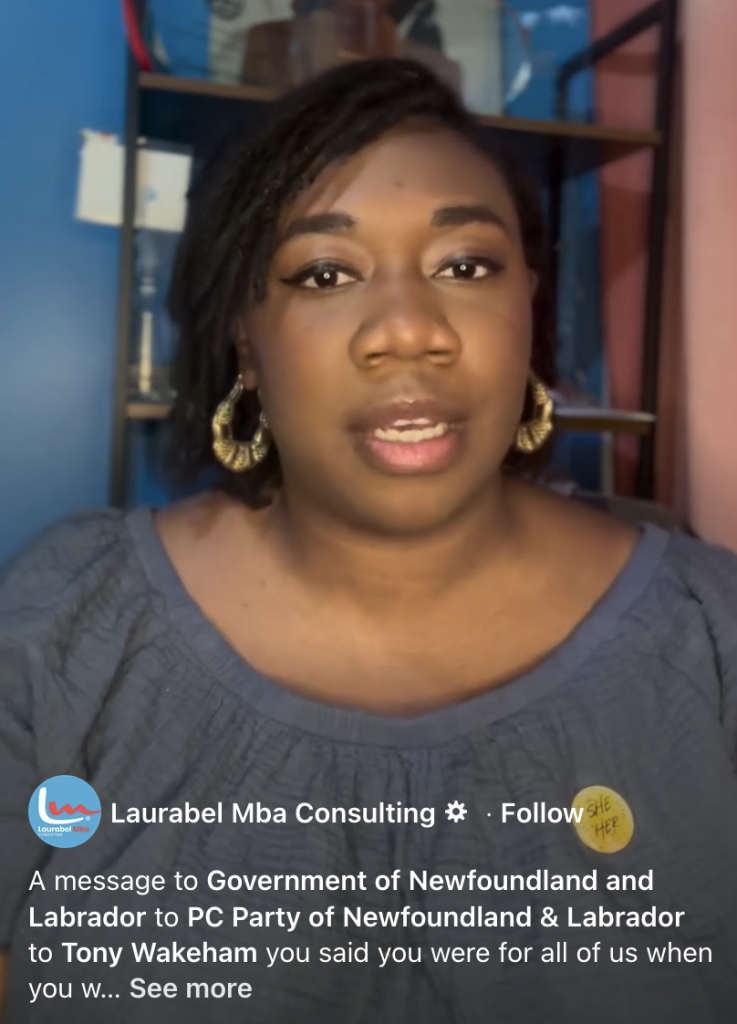
“There has still been no official acknowledgement from the provincial government’s main platforms. No statement. No original post. No recognition coming directly from the highest level of government,” Mba wrote in a Feb. 5 post on her consulting company’s Facebook page.
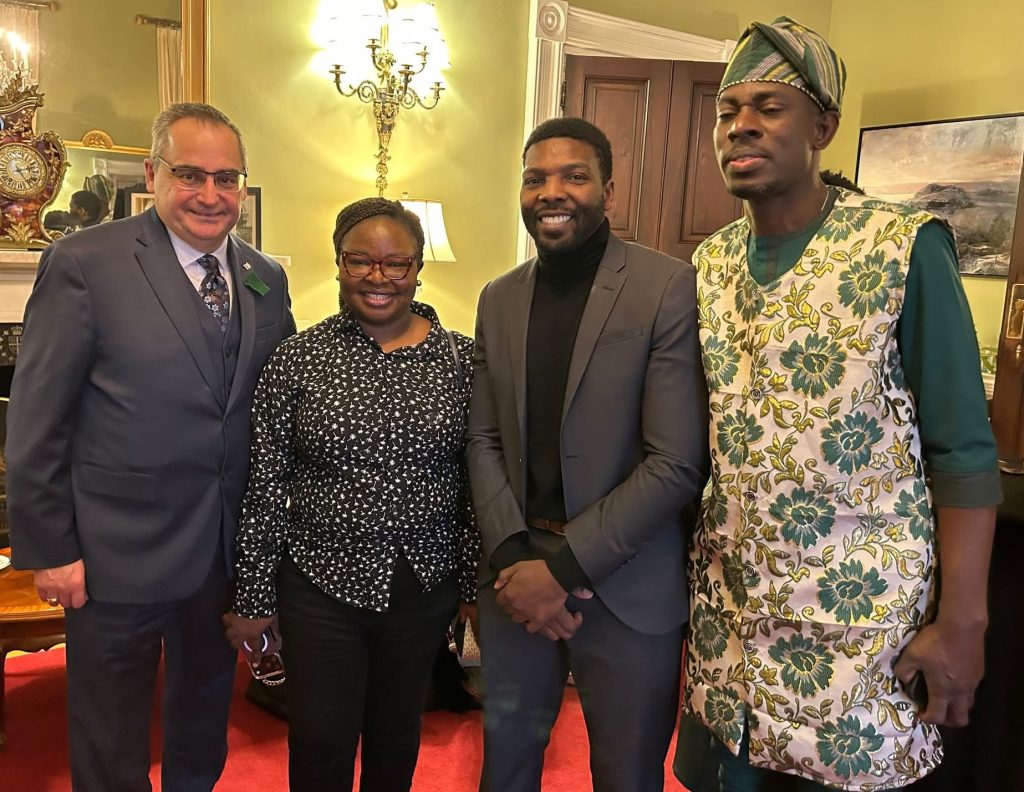
Mba made the comment hours after the province’s Department of Jobs, Growth and Rural Development posted images of Minister Lin Paddock posing for photos alongside members of the local Black community at a Black History Month reception at Government House in St. John’s. “Minister Paddock was pleased to join the Lieutenant Governor in a reception for Black History Month 2026,” the department’s post reads. “Black History Month celebrates the achievements and lasting impact of Black communities throughout Canada.#BHM2026”
That post was then shared on the Government of Newfoundland and Labrador’s official Facebook page. But the government’s copy-and-paste of the Department of Jobs, Growth and Rural Development’s post “is not the same as leadership,” Mba says in her Feb. 5 post. “That is not the same as an official acknowledgement. Reposting a smaller department’s content allows the government to appear present without actually taking a position.
“If this government believes in inclusion, accountability, and leadership, that belief must be demonstrated clearly and publicly,” she continues. “Black communities in this province deserve more than a quiet nod. We deserve acknowledgement that is intentional, visible, and led from the top. Leadership requires courage. This is one of those moments.”
Government slow to delete comments
In response to Mba’s remarks, Facebook users began commenting under the government’s post.
“[S]o what have you accomplished here in Canada besides nothing??” one user wrote, to which another pointed out Mba has worked as an educator, founded a consulting firm, hosted a TV program, and was named one of Canada’s Most Powerful Women by Women’s Executive Network in 2024. She was also shortlisted for the Newfoundland and Labrador Human Rights Award in 2022.
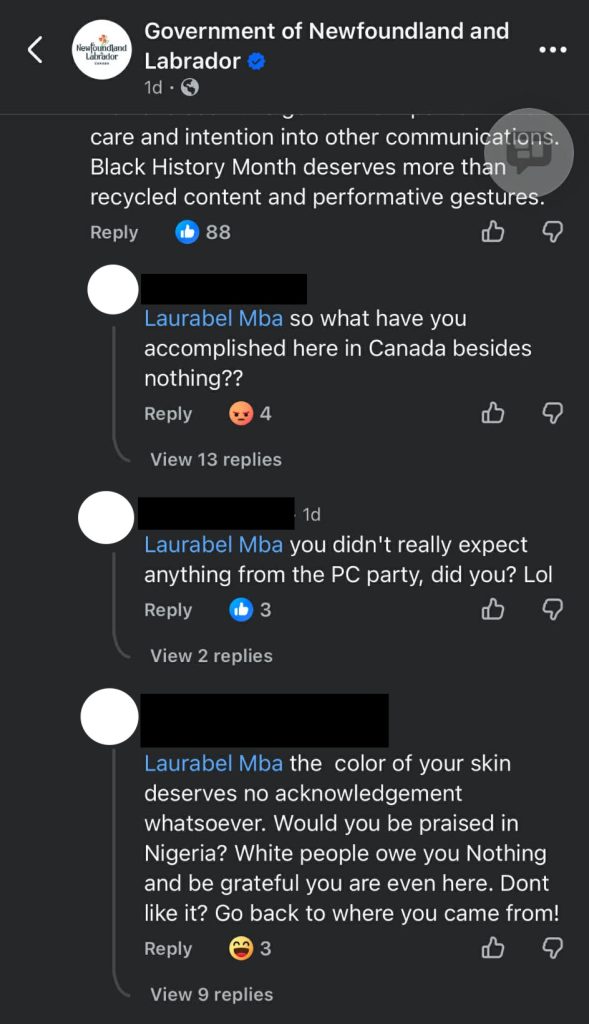
“The [colour] of your skin deserves no acknowledgement whatsoever,” another user posted. “White people owe you nothing and be grateful you are even here. Dont [sp] like it? Go back to where you came from!”
Another user posted: “Send them back to Africa.”
In her direct messages, Mba also received a racist message from a Facebook user alleging she is “here to take advantage of the system and push your [sp] own agenda.” That user also asked, “if black lives matter wat [sp] about the rest of us?”
The racist comments under the provincial government’s post have since been deleted, but Mba says it took the government more than two days.
In a written statement, Wakeham said “[r]ecent online commentary connected to one of our social media posts does not reflect who we are as a province or the values that guide this government.
“I want to be clear: racism and hate have no place in Newfoundland and Labrador.”
Wakeham said Black History Month is a time “to recognize the contributions, resilience, and leadership of Black communities in Newfoundland and Labrador and across Canada.” He noted members of his government have been “engaging with community partners and [are] participating in events throughout February.”
Wakeham’s response a ‘cop out’: Mba
Oluwatoyin Awosanya, a coordinator with Anti-Racism Coalition Newfoundland and Labrador (ARC-NL), says she’s extremely disappointed by the government’s handling of Black History Month, especially given Black people have a strong presence and history in Newfoundland and Labrador.
“They have been here for a long time, and to see that the government is not acknowledging that history, it’s not acknowledging the people that have been part of building this province — it’s very disappointing,” she says.
Awosanya feels some in the province are becoming more open in expressing their anti-Black views. “I think a lot of the time we have experienced microaggressions and subtle racism, but people are getting comfortable with saying not-so-nice things out loud.”
The constant microaggressions Black people face don’t stop during Black History Month, says Khadeja Raven Anderson, founder of Ravensong Consulting NL and co-founder of Black Lives Matter NL.
The month has been a patchwork of experiences and emotions for Anderson. While the community events have allowed her to reconnect with people, she has also experienced microaggressions. She recalls a recent experience in a St. John’s grocery store, where she says two white women accused her of cutting in line, then continued to aggressively confront her as she tried to ignore them.
“We are constantly seeing a growing resentment toward visible migrants who have accents and visibly look like migrants,” Anderson says.
Mba says it was “surprising” and “disappointing” the province didn’t acknowledge Black History Month in a more “reasonable manner” than it did.
In January, she reached out to Premier Tony Wakeham, Tourism, Culture and Arts Minister Andrea Barbour, and the departments of Education and Jobs, Growth and Rural Development, outlining the importance of acknowledging Black History Month, she says.
Someone within the Department of Education advised her to reach out to another contact within the ministry, but when she did, Mba says she didn’t get a response. She then had a virtual meeting with an official from the Department of Jobs, Growth and Rural Development, whom she says told her they would follow up, but never did.
“They are a new government,” Mba says. “It would have given them a chance to continue to build trust with an already marginalized community.”
The Independent asked the Department of Education and the Department of Jobs, Growth and Rural Development for responses to Mba’s communications in January. Neither department responded with answers to our questions.
Mba ran as an NDP candidate in the 2025 provincial election but insists the government’s “recognition of communities across this province is not a partisan issue.”
In his statement, Wakeham thanks the community leaders and volunteers organizing events and hosting conversations about Black History Month. “My government remains committed to fostering communities where people feel welcome, safe, and valued,” the premier says.
“I encourage people to participate, listen, and reflect on how we can continue to build a more inclusive Newfoundland and Labrador together.”
Mba says Wakeham’s statement is “a cop out answer,” pointing to the PC’s comparatively larger efforts to acknowledge Inclusive Education Month, which is also in February. The government has also made multiple—and more detailed—posts celebrating Newfoundland and Labrador musicians nominated for music awards, and in recognizing Education Week.
Confronting racism requires community
Mba says all she was hoping for was a visible and intentional effort from the province to recognize and honour Black contributions to Newfoundland and Labrador in a meaningful way. She points to the federal government’s announcement of the 2026 Black History Month theme, “30 Years of Black History Month: Honouring Black Brilliance Across Generations — From Nation Builders to Tomorrow’s Visionaries,” as a meaningful approach.
She says the province’s Black community is growing and people deserve to feel like the government sees and acknowledges them. “I’ve had people personally reach out to me to say that because of the impact that I’ve been making, they […] feel a little bit safer addressing the lack of representation within organizations they work for,” she says.
Rachel Gilbert, a member of ARC-NL’s advisory team for the organization’s anti-racism literacy project, says despite the province’s failure to meaningfully acknowledge Black History Month, there have been other celebratory events, including the City of St. John’s Feb. 9 flag-raising ceremony at city hall.
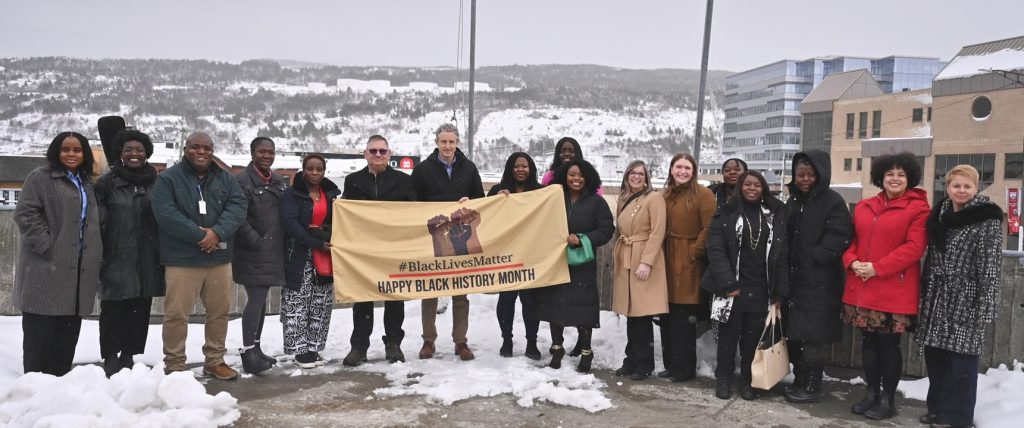
She says these events create safe spaces for Black community members and allies to connect and discuss how to navigate the anti-Black rhetoric growing across North America. “It’s very refreshing to meet with people who are doing this kind of work in this arena,” she says, “because a lot of it can be virtual, especially during the winter.”
At the St. John’s flag-raising ceremony, Anderson was delighted to reconnect with a young girl she met years ago. Once “shy” and “soft-spoken,” Anderson says, the girl was now speaking to the crowd with confidence about her ancestry, and her parents’ and her own experiences with racism.
Mba says thanks to a growing Black community in Newfoundland and Labrador, Black children have strong role models to look up to. “I think we’re finding them in every sector, and they’re increasing the representation, so Black youth growing up here feel like they can be and do anything their hearts desire, and they’re not limited to what their potential can be.”
To confront anti-Black racism though, Gilbert and Anderson say real change must be rooted in education — in every sector of society.
Anderson emphasized the need for structural changes in healthcare, where she says Black people can still face racial profiling. Even getting pain or sleeping medication is difficult, she says. “I can’t just [tell the doctor] I’m having trouble. Nine times out of 10 it’s more pushback.”
She adds there’s often a blanket perception that minorities, especially Black women, are somehow able to power through pain, to power through stress, whether it’s mental or physical,” and that education is needed to ensure that healthcare workers don’t fall into that thought process.
Non-Black Newfoundlanders and Labradorians who want to help create a safe and welcoming environment for Black people must begin with a willingness to learn, says Gilbert. That includes self-education about different cultures and histories, including the many dimensions of local and Canadian history and the important contributions and experiences of Black communities here.
Gilbert says she still hopes the provincial government will acknowledge some of the criticism it has received over its lack of public support for Black History Month and its handling of the criticism and comments on its Facebook post. “I’m hopeful that the provincial government will be a bit more engaged with the Black community this month.”
On Feb. 17, Mba spoke out again, noting in a Facebook post that it has been almost two weeks since she criticized the provincial government over its handling of Black History Month. “[I]n that time I have seen the province meaningfully acknowledge a multitude of events that take place in February with well curated posts [and] well formatted imagery to go along with it yet there is still silence from our […] provincial government’s official social media pages to meaningfully acknowledge Black History Month.
“So I’m going to ask one last time before the month is over,” she continues in the post, tagging the premier and the government’s official Facebook account. “Tony Wakeham and Government of Newfoundland and Labrador, are you going to acknowledge in a meaningful manner 30 years of Black history in Canada or should we just know that you meant something different when you said [‘For all of us’]?”

Author

Related Articles
What a Newfoundland community can learn from B.C.’s first major LNG facility
As talk about developing an LNG export project in Newfoundland and Labrador continues, residents have questions — and the answers might be on the other side of the country

N.L. chief medical examiner has begun tracking gambling as a risk factor in suicides
The OCME’s policy change came nearly a year after an Independent investigation into gambling-related suicides
Province updated public procurement process days after Deloitte AI scandal exposed
Proponents and suppliers are now required to disclose any intended use of AI before the government will award a contract