
The RCMP vs. the media: Bracken trial approaches its endgame
This court case could decide the future of press freedom — and police oversight — in Canada
The lawyers are standing around, casually talking to one another. A dozen or so people in the four rows of public seating quietly chatter to each other. Then, a hefty, clean-shaven middle-aged man with short dark brown hair and a suit enters the courtroom. The room goes quiet.
The man, whose tie is fastened to his shirt with a small golden pin in the shape of handcuffs, sits down two rows directly in front of me, his stiff gaze fixed on the judge’s bench as he tilts his head to the right, and then the left, as if to crack his neck.
John Brewer is the RCMP’s assistant commissioner for British Columbia, and before that he was the top cop in a controversial special unit created to crack down on Indigenous land defence actions and protests.
On this day, he’s set to testify in a lawsuit filed by photojournalist Amber Bracken and digital outlet The Narwhal against the RCMP. Back in 2021, Bracken was arrested while doing her job, and held in prison for three days. It is perhaps the single most extreme example of a pattern of behaviour that has already been found unlawful by courts in two provinces and multiple oversight bodies.
Will you stand with us?
Your support is essential to making journalism like this possible.
Last year, in response to a scathing oversight report, the RCMP commissioner formally apologized to a different journalist (who was detained for eight hours in a 2020 incident) and promised the force would no longer interfere with the ability of journalists to report on their actions. And yet, here in a Vancouver courtroom on an overcast February day, a dozen government lawyers are fighting a somewhat quixotic rearguard action to justify Bracken’s arrest.
The judge enters the room a few minutes after Brewer, and the veteran cop is called to the stand for examination by Crown attorneys representing the RCMP and the Government of Canada. He stands up and makes his way to the front, where he sits to Justice Diane MacDonald’s left, facing the lawyers he’ll be taking questions from under oath.
It’s February 4, more than four years since Brewer led an operation to remove land defenders from a remote area in unceded Wet’suwet’en territory in northern BC. The land defenders, led by members of the Wet’suwet’en Nation’s Gidim’ten House Clan, had reoccupied the area in an effort to enforce an eviction notice from Wet’suwet’en hereditary leaders and prevent construction of the controversial Coastal GasLink pipeline.
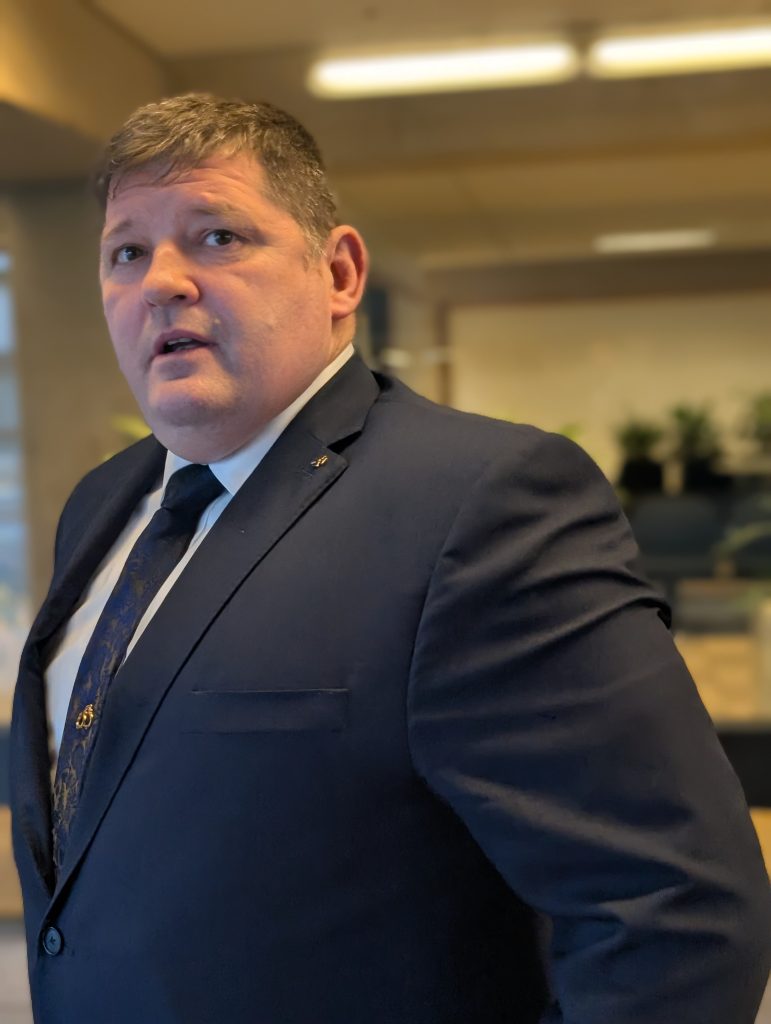
Brewer, who tells the court he’s a member of the Lower Similkameen Indian Band, is not here because he helped force First Nations people from their land. He’s been summoned to the B.C. Supreme Court in Vancouver because officers under his command arrested and jailed a journalist as part of the Mounties’ November 2021 operation.
The actions of Brewer’s team that day are under scrutiny in a landmark case that could go all the way to the Supreme Court of Canada, in the process codifying journalists’ and the public’s constitutional right to press freedom.
A pattern of troubling behaviour
Since early February, several members of the RCMP’s Community-Industry Response Group (C-IRG) — rebranded as the ‘Critical Response Unit’ in 2024 — have testified alongside Brewer, offering an inside look at how the beleaguered regiment conducted itself before, during and after arresting award-winning photojournalist Amber Bracken.
Bracken, whose work has been published in The New York Times, National Geographic, The Globe and Mail, Wall Street Journal and others, was on assignment for B.C.-based independent news outlet The Narwhal when the RCMP arrested, detained and jailed her for four days and three nights, alleging she had violated a B.C. Supreme Court injunction intended to end the Indigenous land defence action.
A month later, on Christmas Eve, Coastal GasLink dropped the civil contempt charges against Bracken and filmmaker Michael Toledano, who was shooting a documentary for CBC and was jailed alongside Bracken. The damage had been done, though. The police disrupted Bracken’s work, preventing her from publishing photos and reporting on a story of major public interest for days — and intensifying the chilling effect on Canadian journalists who cover police enforcement of court injunctions.
The arrest became a flashpoint in a growing pattern of troubling behaviour by Canada’s national police force, which over the past decade has arrested or interfered with numerous journalists documenting police activities.
In February 2020, RCMP officers detained journalist Jerome Turner for eight hours after holding him at gunpoint. Turner was on assignment for Ricochet Media, covering the police enforcement of a Coastal GasLink injunction in Wet’suwet’en territory. A day earlier, the cops removed journalists Jesse Winter and Melissa Cox from the territory, dropping them off and leaving them stranded in various locations; the officers involved reportedly told each they would bring them to their vehicle, which was parked along a service road in the woods.
In the spring and summer of 2021, police restricted media access during enforcement of an injunction intended to end a mass protest against logging in old-growth forests around Fairy Creek on Vancouver Island. More than 1,100 people were arrested during the protests. A coalition of media outlets and press freedom groups challenged the RCMP’s use of “exclusion zones” to control media access to the site, and in July of that year B.C. Supreme Court Justice Douglas Thompson ruled that the force failed to justify its actions.
“[I]n making operational decisions and exercising its discretion surrounding the removal and arrest of persons violating the order, the RCMP will be reminded by the presence of this additional language to keep in mind the media’s special role in a free and democratic society, and the necessity of avoiding undue and unnecessary interference with the journalistic function,” Thompson said.
Four months later, the RCMP disrupted Bracken’s work documenting an important story and put her behind bars.
“As Canada and its democratic and civic institutions contend with and promise to redress their roles in the oppression and dispossession of Indigenous people on their land, journalists have a unique and express duty to bear witness to and comprehensively cover news events of consequence,” the Canadian Association of Journalists wrote in an open letter to then federal Public Safety Minister Marco Mendicino, signed by more than 40 news outlets and press freedom advocacy groups.
“The RCMP must be held accountable for their repeated violations of the rights of media in Canada.”
When journalists have been criminalized for their work covering protests, they’ve either won in court, or charges against them have been dropped. In some cases, the RCMP has even temporarily detained journalists without pressing charges. Regardless how each episode ended, in every instance the police impeded media coverage likely to harm their reputation. In all cases, the targeted journalists work for small independent media outlets which typically don’t have the money or resources to fight back in court.
Until now.
In February 2023, Bracken and The Narwhal announced they were suing the RCMP for damages related to Bracken’s wrongful arrest.
“Amber Bracken’s arrest and lengthy detention by the RCMP not only defied logic, but we believe it broke the law,” Narwhal co-founder and Editor-in-Chief Emma Gilchrist said at the time.
The plaintiffs are asking BC’s Supreme Court to rule on whether Bracken’s liberty rights, and her and The Narwhal’s press freedom rights — protected in Section 2(b) of Canada’s Charter of Rights and Freedoms — were unjustifiably breached.
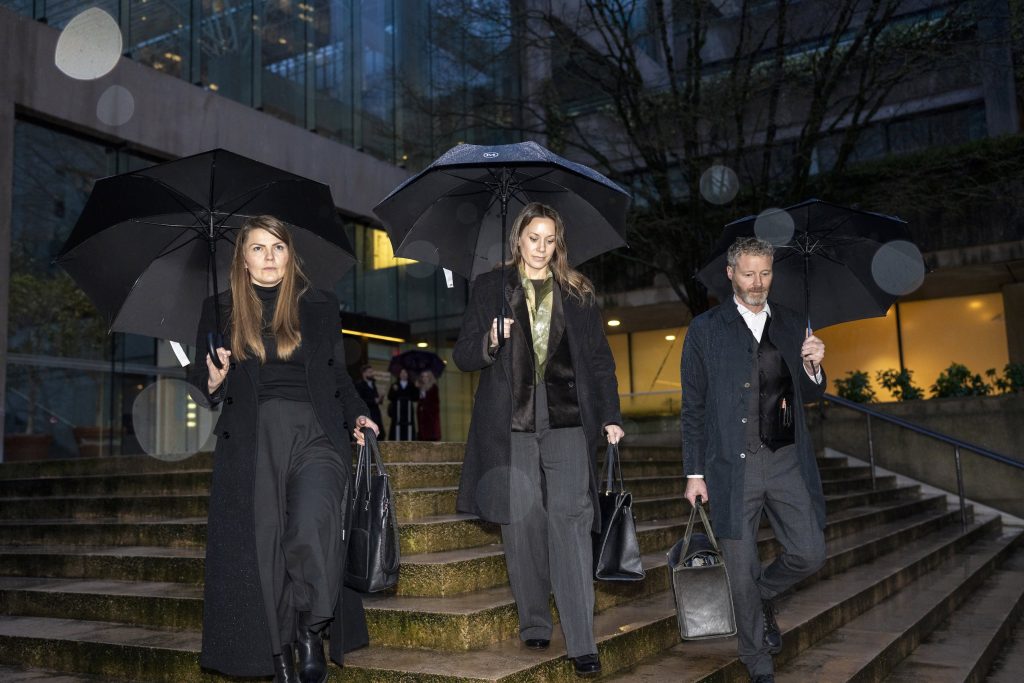
“In a democratic society, those in positions of authority must always be held accountable for their actions. The arrest of Amber Bracken is part of a troubling pattern of RCMP infringing on press freedom,” Gilchrist said. “To not move forward with this case would be to turn our backs on all of the important stories that happen in remote places without the watchful eyes of journalists, due to the chilling effect of arrests like these.”
Governments and corporations have long used the courts for injunctive relief against Indigenous people who protect their land from unwanted development, and police have often enforced those injunctions with remarkable aggression. Late Secwepemc leader Arthur Manuel famously called court injunctions Canada’s “legal billy club” when it came to suppressing Indigenous Peoples who defend their territories and assert their nations’ sovereignty.
In November 2021, miles up a service road in the woods, the RCMP’s enforcement of a natural gas pipeline company’s injunction achieved that, while also turning off the cameras belonging to the only journalists there to provide eye-witness accounts.
The broad arguments
Back in the courtroom, Brewer fields questions from a Crown attorney representing the Government of Canada. He positions himself as an Indigenous person who has been adopted by an elder into another First Nation, because of the good he did there in the course of his policing. He also says he’s neutral when it comes to policing land defence actions and other protests.
A C-IRG gold commander overseeing the operation in which Bracken was arrested, Brewer tells the court the RCMP didn’t have a formal policy at the time for dealing with media in a protest area, but that the force had been accommodating journalists “to the extent possible.” He spoke favourably of the media’s role in society. “The media exists to assist with the public, so the public has a right to know,” he says. “I believe that with all my heart.”
But testimony from Brewer and other RCMP members involved in the operation, reveal the limitations of the Mounties’ interpretation of press freedom.
The Crown’s defence rests in part on the RCMP’s argument that Bracken “went beyond her role as a journalist,” as written in a response filed with the BC Supreme Court in October 2023. By remaining with land defenders inside a tiny house constructed to block the pipeline route, the force says, Bracken became non-compliant with the injunction and relinquished her status as a journalist.
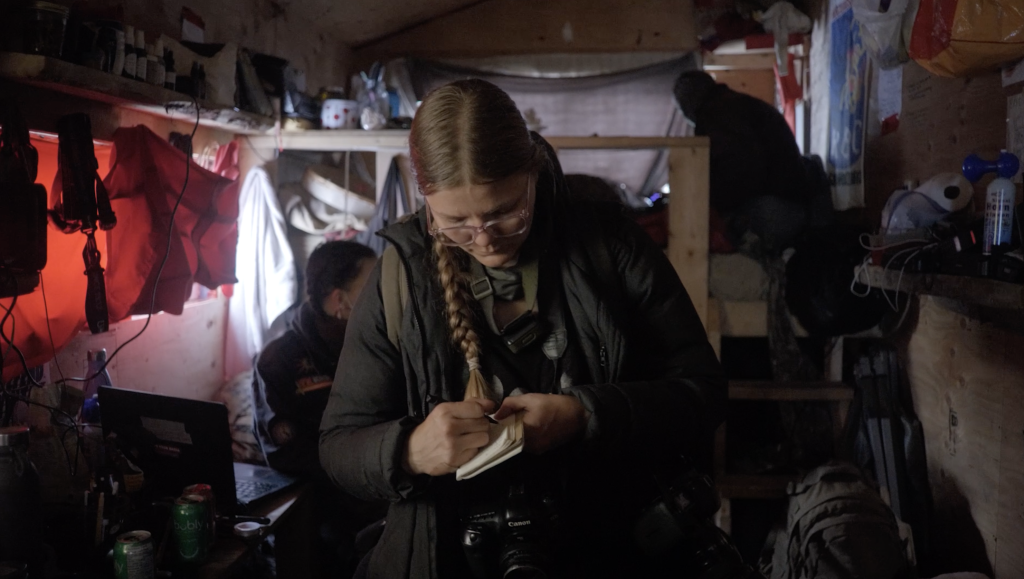
The Narwhal, conversely, maintains Bracken never relinquished her rights and acted professionally and appropriately in the course of her work.
In its October 2023 court filing, the RCMP alleges Bracken was “not engaged in apparent good faith newsgathering activities” at the time, and that she was “aiding or abetting” the land defenders. The words appear to be pulled straight from a 2019 Newfoundland and Labrador Court of Appeal decision.
In that case, I was forced to defend my 2016 reporting from the Indigenous-led occupation of the Muskrat Falls hydroelectric project site in Labrador. After being named on a Newfoundland and Labrador Supreme Court injunction requested by the crown corporation building the dam, I was forced to end my reporting and leave the site. Despite my compliance with the order, I faced civil and criminal charges for allegedly violating the injunction.
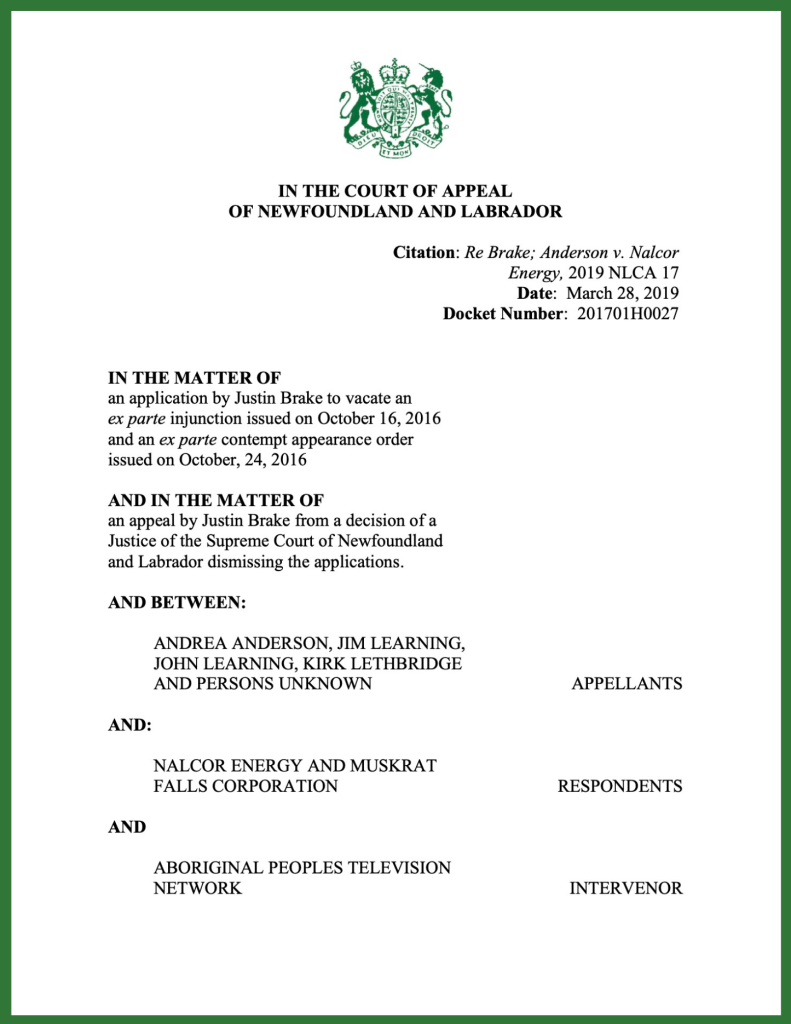
In that legal precedent, now often referred to as the ‘Brake decision,’ the province’s appeals court overturned the lower court’s decision that I had no special standing as a journalist reporting on the event. A three-judge panel declared that the presence of a journalist in an injunction zone is a “material fact” which must be disclosed to the court by a party applying for an injunction. Justice Derek Green, the authoring judge, offered a “non-exhaustive” list of factors to help determine whether a journalist’s presence constitutes a material fact. Among them is the question of whether the person in question “is engaged in apparent good faith in a news-gathering activity of a journalistic nature.” Another stipulates they don’t act in such a way “that could reasonably be considered as aiding or abetting the protestors in their protest actions.”
The law is clear: If a journalist is covering a protest inside an injunction zone, police can’t just interfere with them. My presence at the occupied Muskrat Falls site in 2016, Green writes in the decision, “was contingent on the continuation of the protest. If it dissipated, so also would his trespassing have evaporated.
“To give the injunction order and the contempt umbrella a reach wider than this unnecessarily risks impeding the media function for no good reason with the result that the public would be deprived of access to information of public interest.”
Two and a half years later, how did the decision in my case factor into the RCMP’s actions on the ground in Wet’suwet’en territory when they arrested Bracken and Toledano?
Inside the operation
With the support of Wet’suwet’en hereditary leaders a decade into their pipeline resistance — which at its peak included solidarity protests and railway blockades — members of the Wet’suwet’en Nation’s Gidimt’en Clan reoccupied land where the pipeline was slated to run beneath a river westward toward its endpoint in Kitimat on B.C.’s north coast.
For shelter, the land defenders built a tiny house at what they named “Coyote Camp.” Gidimt’en Clan members and supporters were there to enforce the Wet’suwet’en leaders’ eviction notice against the pipeline company. Attempts by the RCMP to negotiate their evacuation of the camp had failed, Brewer testified, explaining the RCMP didn’t want a repeat of the Fairy Creek protests in BC earlier that year.
On November 15, the RCMP began building its resources for an operation to enforce the injunction. That day, Brewer emailed C-IRG Silver Commander Jim Elliott, saying he wanted to “try and negotiate the road open,” while also preparing for the operation. “We start the buildup for full Ops ASAP,” Brewer said. That email, and other communications cited in this story, were entered into evidence in the trial and obtained by Ricochet and The Independent through an application to the B.C. Supreme Court.
In the late afternoon of Nov. 17, the day before the operation began and two days prior to Bracken’s arrest, 70 to 100 officers gathered for an hour-and-a-half-long briefing at a camp on another forestry road in the area. A powerpoint presentation from that meeting which was entered into evidence includes a slide titled “Contingencies: ‘What if?’” and states: “Journalists and persons from media outlets as defined by Brake 2019 NLCA,” before laying out the five factors in the Newfoundland and Labrador Court of Appeal decision. There are no directives on how to handle media in the powerpoint.
Officers involved in the operation testified that they were instructed not to take notes at the briefings. One member did, however. Of the November 17 briefing, a designated scribe named Sgt. Karen Bach wrote in a notebook entered into evidence: “All parties to be arrested for contempt. No options.” The notes also suggest members were instructed to “arrest media and bring back for [Division Liaison Team] to verify they are.”
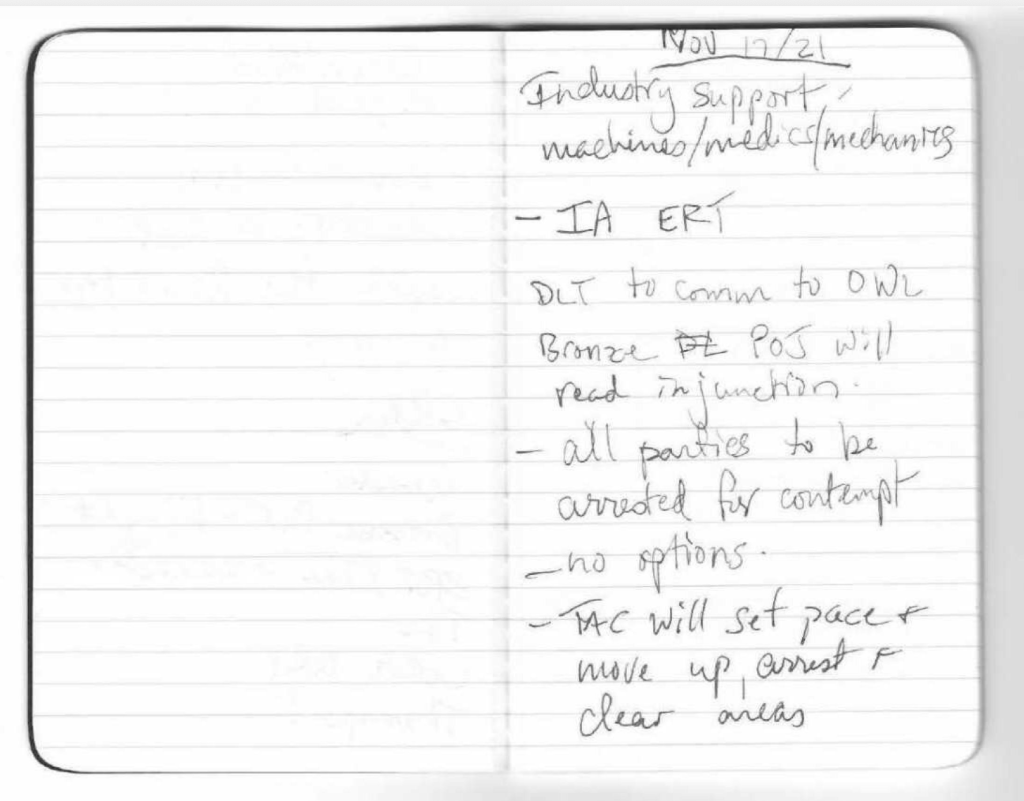
Brewer testified that he doesn’t recall these orders being given at the meeting. He described testing his members’ knowledge of the NL Court of Appeal’s 2019 decision. “It’s my practice to walk around the command and, in essence, test members. ‘Do you know what the Brake decision is?’ For example, […] ‘What do you do if you arrest media?’ And I would expect the answer to be that, ‘If I arrest media, it would be passed up […] through command.”
Cst. Greg Carwithen, who joined the C-IRG in 2018, testified that he was aware of the Brake decision but doesn’t remember if it was discussed during briefings.
On November 18, the day before Bracken’s arrest, the RCMP arrested land defenders who were blockading a bridge on another part of the forestry service road. Filmmaker Melissa Cox, who was gathering footage for Toledano’s independent documentary Yintah, was also detained. In footage played before the court, Carwithen arrested Cox despite the fact she identified herself as a member of the media, offered her credentials, and referenced the Brake decision. “The media does not have the right to break the law,” Carwithen can be heard saying in the video. “The media does not have the right to be wherever they want. There are guidelines and you’re breaking them.” When Cox cites the Fairy Creek ruling in the video, Carwithen says, “This is not Fairy Creek.”
Carwithen testified that he doesn’t remember the events of that day, but agreed he was the one in the video arresting Cox. Cox was released later that day and the RCMP apologized to her. In an October 2024 affidavit, Brewer said he “made the decision to release Ms. Cox” because he “was able to ascertain that the RCMP knew Ms. Cox was in the area. She identified herself as media while being arrested.”
Canadian law protects the ability of journalists to access and report on any matter of public interest as it is essential to the proper functioning of democracy. – Brent Jolly, President, Canadian Association of Journalists
As news of Cox’s arrest spread, concern began to grow that the RCMP was prepared to continue criminalizing journalism. In an open letter to the force the following day, Canadian Association of Journalists President Brent Jolly reminded them of Justice Thompson’s Fairy Creek decision, “which ruled that the RCMP’s practice of employing vast ‘exclusion zones’ [was] not legal,” Jolly wrote.
Jolly, who also emailed the letter to the RCMP, informed them that Bracken and other journalists were on the ground in Wet’suwet’en territory. “I’d like to emphasize that all journalists who are arriving onsite have no intention of interfering with the work of the RCMP in any way,” he wrote. “Canadian law protects the ability of journalists to access and report on any matter of public interest as it is essential to the proper functioning of democracy. It is my sincere hope that journalists will be allowed to do their work, in accordance with the law.”
The same day, November 18, The Narwhal also informed the RCMP of Bracken’s presence. In an email to the force’s media relations team, reporter Matt Simmons specifically told the RCMP that Bracken was at Coyote Camp. “[S]he asked me to relay this information to you, to convey to the officers on the ground,” he wrote. “Can you please do everything you can to ensure that all of the units there are aware there is an accredited journalist on location?”
In both cases, the emails were forwarded to Brewer and multiple other operation commanders prior to the commencement of the Nov. 19 operation. “I can’t recall when I would’ve read them,” Brewer testified in cross-examination by Bracken and The Narwhal’s lead attorney, Sean Hern. “I don’t recall having any of that information prior to the arrest of Ms. Bracken.” Brewer said he had no knowledge of Bracken being at Coyote Camp, and that he believed, without evidence, she was at the Unist’ot’en Healing Centre, which is in another part of Wet’suwet’en territory.
In the early morning hours of November 19, dozens of cops made their way up a service road toward Coyote Camp. They eventually surrounded two cabins, one of them the “tiny house” where Bracken and Toledano were inside documenting Sleydo and the four other land defenders with her. Brewer testified it was his understanding that at approximately 11:30 a.m. that day Insp. Ken Floyd, a bronze commander, read an arrest script out loud to those inside the two cabins, and that multiple attempts had been made to compel the occupants to come out.
Floyd was in Vancouver and scheduled to testify in mid-February. But when the Tumbler Ridge shooting happened, he quickly returned to the area, where he serves as north district commander. He is now scheduled to testify in April during added trial dates.
After no one inside the cabin identified themselves or came out, members of the RCMP’s Tactical Response Unit began breaking into the tiny house, first using an axe, then a chainsaw, to bust through the wooden door. A gun was then pointed through the door at the land defenders and journalists as a police dog outside can be heard barking. The dramatic scene was captured on film by Toledano. After the land defenders are removed from the structure, Carwithen, who was also responsible for Cox’s arrest, takes hold of the backpack on Bracken’s back and starts guiding her toward the door, saying “You’re under arrest.” Bracken immediately replies: “For the record, I’m a member of the media and you were notified that I’m here.”
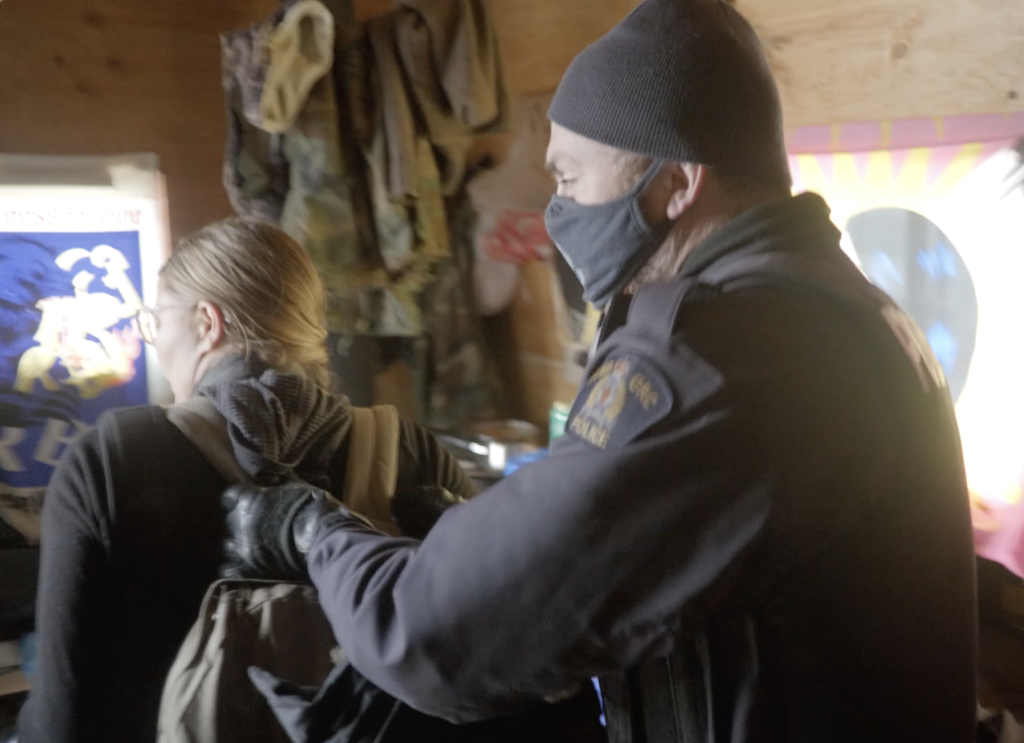
Carwithen continues leading Bracken to the door, then hands her off to two officers who take Bracken away from the tiny house. Toledano is then arrested while identifying himself as a member of the media making a documentary for CBC.
Asked by Hern if Bracken and Toledano stating they are media changed his perspective or his authority to arrest them, Carwithen said no. “ I have instructions to arrest the people that are breaching the injunction inside the tiny house,” he testified. “When I go into the tiny house, I see the people that are in the tiny house breaching the injunction. So there, I formulate my grounds to arrest them. I have zero ability to verify even people’s names or their occupations or anything like that.
“In my opinion, they are arrestable for that offense,” he continued. “If at a later date [it] is determined that yes, they had every right to be in there or not, my belief is that the command triangle or something will make that determination that yes, they actually had legal authority to be in there, or they’re not gonna be charged with that.”
Brewer’s six factors
Brewer testified that Bracken’s status as a journalist was no longer a factor in her arrest after she failed to identify or present herself to police outside the tiny house that day. He testified on Feb. 10 that the RCMP has struggled to incorporate the Brake decision into their injunction enforcements. “ All we had was Brake. I admit it’s not great, but that’s all we had,” he said. “And so […] police officers have to determine, where is the breach? Where does it start? Where does it end? What are those exact activities?”
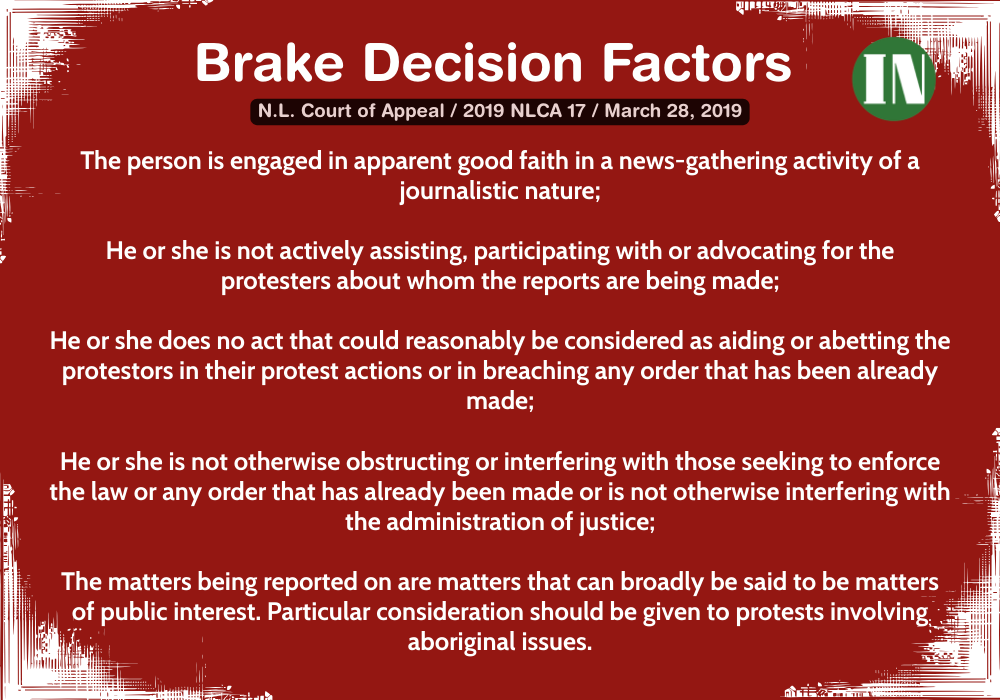
In his affidavit, Brewer cited six factors the RCMP considered when deciding whether to maintain Bracken’s arrest and detention, including that she would have been aware of “media protocols” and the injunction. Under cross-examination, he clarified he was referring to instances “when we ask media to identify themselves and comply with directions from police while we’re in the middle of an operation.” Pressed by Hern on whether this “media protocol” was in any law or regulation, Brewer said, “ I’m not aware of any. That’s why the Brake decision was the only thing we could point to at the time.”
Earlier in his testimony, on February 4, Brewer said determining who is and isn’t a journalist is problematic because, in “this day and age a media person can have a cell phone and that’s all you see,” he said, adding it’s “not our job to mediate who’s media or not.” Rather than determining who is a journalist and who’s not, he testified, under his command RCMP officers were instructed to judge their behaviour. “It’s their actions,” he testified. “Whether they say they’re from one group or another group is immaterial. To me it’s their actions. If they’re acting like they’re there to get a story and are doing that, and are not interfering with our work, or certainly are not, then, overtly complicit with the protestors, such as locking arms with them, then yelling at my police officers — […] If that doesn’t happen and they’re not in our workspace, I’m fine to have them there.”
Bracken’s failure to comply with directions to leave the tiny house was a second factor in maintaining her arrest and detention, Brewer said. A third factor was Bracken’s alleged failure to identify herself as media until after her arrest had been initiated. When pressed by Hern on the contradiction that his decision to release Cox the day before partly on the grounds that she identified herself as she was being arrested, Brewer said the difference between the two was that Bracken had “ample opportunity to, at any time, say through the door, ‘I am media. Media is here.’ Her name. That was not done until after the door is breached, and then after the arrest is affected.”
A fourth factor was the allegation that Bracken “was contributing to a dangerous situation for herself,” Hern read from the affidavit. Asked how Bracken endangered herself, Brewer said when breaching a blockaded doorway, officers “must rapidly assess every single person in there for what threat they may or may not pose,” and that “[t]he more people in that room that are unknowns, the more dangerous that situation is.” Pressed further and asked if Bracken was arrested for “ contributing to a dangerous situation for the officers,” Brewer said she was not.
A fifth factor in maintaining Bracken’s arrest and detention stemmed from a conversation Brewer had with Staff Sgt. Aaron Sproule, a bronze commander in the operation for the RCMP’s Division Liaison Team. Brewer testified that Sproule told him that Bracken had told Sproule her lawyer had said the injunction didn’t apply to journalists.
“How do we release someone that states absolute contempt for the injunction, that it does not apply to them? I would not as a police officer release anybody that says to me, ‘Go ahead, release me,’” Brewer testified.
The sixth and final factor Brewer put forward to the court was an alleged directive from Supreme Court Justice Marguerite Church, who authorized the injunction, to the RCMP on November 18 or 19 that she “wanted all the contemnors to be brought before her,” Brewer testified, saying the information had been relayed to him by Sproule. “My understanding was that Justice Church was becoming dissatisfied with the fact that in the previous enforcement actions [Coastal GasLink] had not brought many contemners to her and that she didn’t feel she had a sense of what was going on with her injunction.”
Brewer said those six factors led him to believe that Bracken “was not doing journalism at the time of the arrest,” and that she “was involved in a breach of the injunction.”
Attitude of ‘disquiet and distrust’ towards media
“ I take it that you could not conceive that the only reason she was in the tiny house was to do journalism,” Hern tells Brewer during Brewer’s final day of testimony on February 11. “What I could not conceive was that a journalist inside an enclosed area would not at least identify themselves as being a journalist in that enclosed area,” Brewer replied.
“And yet the fact is that it was the only place that a journalist could have been to document the newsworthy events of that day,” Hern said, to which Brewer replied: “That is, in my estimation, incorrect,” explaining Bracken could have joined other journalists in notifying the RCMP of their desire to attend the injunction enforcement, then wait to be escorted by police up the service road. “It had been our practice before [to bring] people up to witness, as safely as possible, our arrest and enforcement of peoples in breach of the injunction.”
Brewer then went on to say he wasn’t aware of any journalists who made it to the access control point along the service road in time to be escorted to the site. “Once you shut the road down and operations commenced, there was no further opportunity,” Hern said. The operation that day began at 7 a.m. and ended seven or eight hours later at approximately 3 or 4 p.m., the court heard.
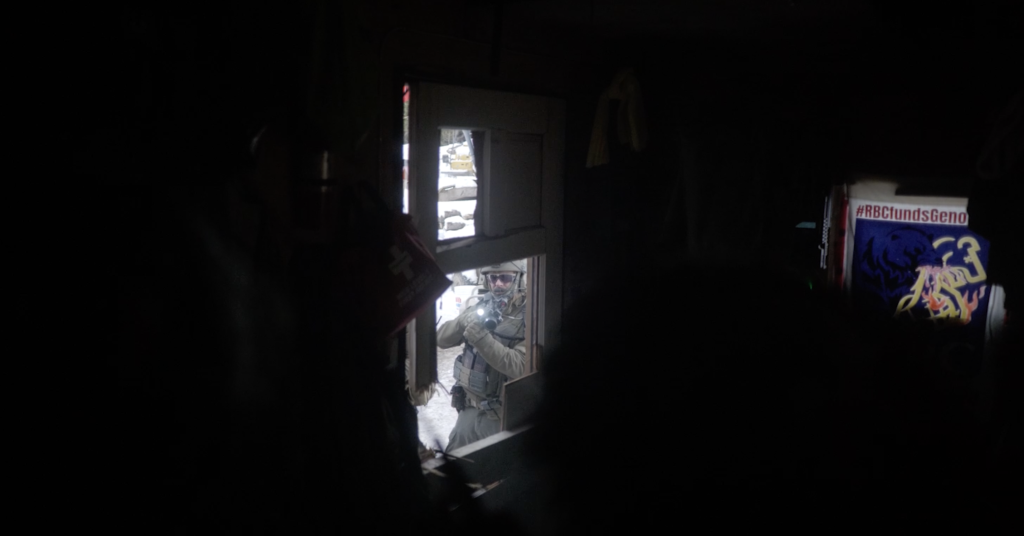
Following Justice Thompson’s Fairy Creek decision just a few months earlier, Brewer said the RCMP had learned “lessons,” testifying that, “if media show up, you know, we will if, if possible, get them access up there. But again, we had to have the people to escort them up and back,” he explained.
The B.C. Supreme Court isn’t the only authority to have reprimanded the RCMP for its failure to respect journalists’ right to document newsworthy events. In December 2024 the Civilian Review and Complaints Commission (CRCC), an independent oversight body for the RCMP, issued a report stemming from a complaint made by Jerome Turner and Ricochet Editor Ethan Cox over the police force’s unlawful detention of Turner in 2020 and interference with his reporting.
“The RCMP approached Mr. Turner and other reporters with disquiet and distrust, relying on coercive powers to exclude, control, and inhibit them rather than take the constructive path of dialogue and mutual respect between two different but equally hardworking groups with equally important roles,” the CRCC writes in its report. “The police always have the option to deal case by case with members of the press where the police have even reasonable suspicion of specific wrongdoing, but it is unreasonable to treat the media as potential adversaries in blanket fashion.”
In response to the CRCC’s investigation, RCMP Commissioner Michael Duheme wrote that he “fully support[s] the Commission’s recommendations that the RCMP should grant freedom of movement to the media so long as they remain outside a very modest buffer zone around things like arrests, and that the RCMP escorts or liaisons (if needed) should not interfere with the media’s freedom of movement unless to the minimum extent necessary if there is an objectively reasonable operational necessity.”
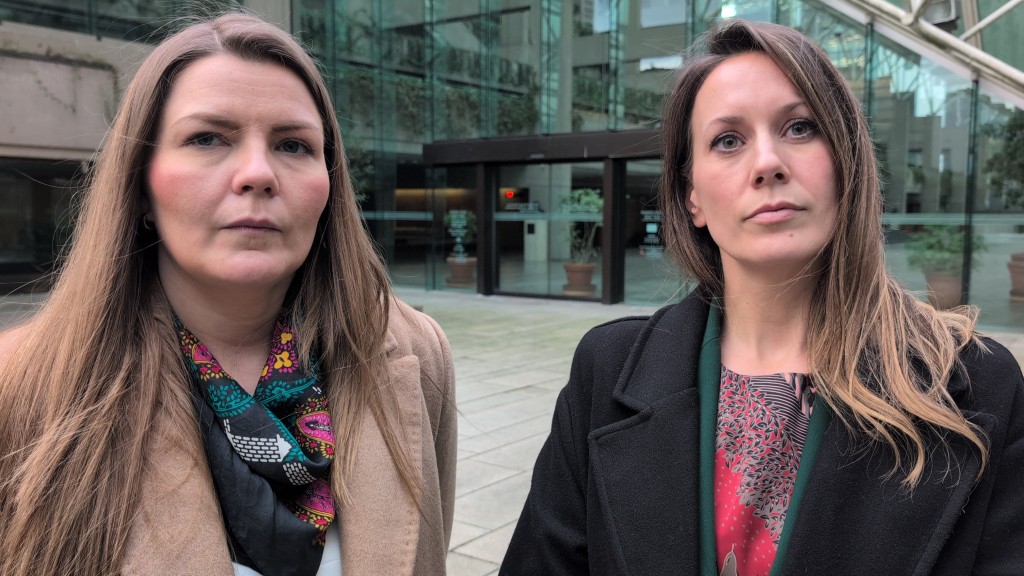
Shortly after the report’s release, the RCMP apologized to Cox and Turner. But Turner, who lives near Vancouver and has attended several days of the Bracken trial, says his acceptance of the apology is contingent on the RCMP’s actions going forward. “ My response to them was basically, I’ll accept the apology as long as they stopped putting hands on journalists anywhere in Canada. I stand by that,” he said on Feb. 6, standing outside the courthouse in Vancouver. “Unless [media are] actually breaking a law or interfering with police, with literal arrests, there should be no reason to tell us where to go, where to stand. I really hope this case leads to something towards that effect.”
From the outset, The Narwhal has been clear that it initiated litigation against the RCMP for the benefit not only of its own reporters, but for journalists anywhere in Canada. Narwhal acting Editor-in-Chief Carol Linnitt, who testified during the trial, told Ricochet the case could lead to a “ more specific articulation of what press freedom actually means, what media rights actually mean, what the right to free press in Canada means — and that would be to the benefit of journalists across the country.”
Linnitt also said the case represents an opportunity for accountability from the RCMP. “We are asking for a determination and a declaration that Amber’s arrest was unlawful, that it was illegal, it was unjustified. That’s also something that would be a protective measure for journalists who are reporting specifically in environments that are controlled by the RCMP.”
Bracken, who has attended every day of the trial’s first five weeks, says the ramifications of the case extend beyond the media. “We’re talking about the freedom of the press and the [Section] 2(b) Charter rights and the right to free expression,” she said, standing next to Linnitt outside the courthouse. “These are not rights that are held in the profession of journalism alone. The 2(b) rights apply to everybody equally.
“It’s not about the journalist, it’s about the journalism. It’s about the right to witness. It’s about the right to have a public record on matters of public interest and public importance,” she continued. “So this isn’t about a niche group seeking special protections. It’s about protecting the right of all Canadians to know and understand and have good information about what the matters of record are in our country.”
Editors’ note: Justin Brake travelled to Vancouver in February, spending a week in court to cover The Narwhal and Amber Bracken’s lawsuit against the RCMP for The Independent and Ricochet Media. This article is co-published with Ricochet.
Author

Related Articles
INTERVIEW: Avi Lewis says N.L. is ‘ground zero’ for the biggest challenges facing Canadians
The federal NDP candidate says socialism and economic populism are the antidote to unfettered capitalism and the ‘epic market failures’ it has brought
What a Newfoundland community can learn from B.C.’s first major LNG facility
As talk about developing an LNG export project in Newfoundland and Labrador continues, residents have questions — and the answers might be on the other side of the country
N.L. chief medical examiner has begun tracking gambling as a risk factor in suicides
The OCME’s policy change came nearly a year after an Independent investigation into gambling-related suicides