
PCs Choose Wakeham to Bring the Pain to Andrew Furey
Progressive Conservatives elect MHA Tony Wakeham as new leader amid calls for party unity—and closer ties with the federal Conservatives

On Saturday the Progressive Conservative Party of Newfoundland and Labrador elected Stephenville-Port au Port MHA Tony Wakeham as its new leader.
Wakeham received roughly 52 per cent of the points on the second ballot, narrowly edging out former PC Party president Eugene Manning, who received 48 percent. Respectively, the pair had 45 per cent and 41 per cent on the first ballot, while Terra Nova MHA Lloyd Parrott placed a distant third at 14 per cent.
Roughly 10,000 people signed up to vote in the leadership contest, and 92 per cent had cast a ballot when polls closed on Saturday afternoon.
“We’re now a significant threat to the Liberal Party of Newfoundland and Labrador,” Wakeham told a cheering crowd during his victory speech at the Sheraton Hotel in St. John’s. “The winds of change are blowing and we are going to take advantage of that.”
Will you stand with us?
Your support is essential to making journalism like this possible.
“The people of Newfoundland and Labrador deserve better,” he added. “It doesn’t have to be this way.”
Political Climate Change
Wakeham is taking control of the PC Party at a critical historical moment.
A little more than midway through the lifespan of the House of Assembly elected in the controversial 2021 provincial election, the province faces a number of mounting crises—symbolized most dramatically by the growing tent city directly across the road from Confederation Building.
An October poll from Abacus Data shows the rising cost of living, healthcare, and housing affordability are the top three issues for Newfoundlanders and Labradorians. An overwhelming majority of those surveyed said the provincial government has been doing a poor job addressing each one. Although the same poll showed Andrew Furey’s Liberals in a statistical tie with the PC opposition under interim leader David Brazil, Wakeham’s Tories will have a lot of room for attack manoeuvres when the fall sitting resumes on Monday.
Present Newfoundland and Labrador politics has been shaped by the close institutional alignment of the provincial and federal Liberals. But since the emergence of the federal Conservative party 20 years ago, the provincial PCs have continually needed to negotiate how closely they would align with their federal counterparts. Relations between the two parties broke down entirely while Stephen Harper was prime minister, and both federal and provincial Conservative parties have struggled to find common ground during the last eight years of Liberal rule in Ottawa and St. John’s.
Since 2015 the NL Liberals have fully tied themselves to the federal party and hewed very closely to Justin Trudeau’s coattails. Furey in particular has stressed his friendly working relationship with the prime minister as a chief political strength for his government.
As long as the Trudeau Liberal brand remained buoyant enough to keep them in power, the Furey Liberals could bank on more or less smooth sailing. But with the federal party capsizing under the weight of its own baggage, Furey may be stuck going down with Trudeau’s ship.
All signs suggest Canada is headed for a major political sea change.
The federal Conservatives under Pierre Poilievre are surging in popularity across the country—including Newfoundland and Labrador. In the last election, Coast of Bays—Central—Notre Dame MP Clifford Small established the party’s first beachhead in the province since Danny Williams’ “Anything But Conservative” campaign in the late 2000s.
A September poll from Abacus has the Conservative Party of Canada at 42 per cent support in the province, up nine per cent in the 2021 federal election. Support for the federal Liberals, meanwhile, has collapsed from 48 per cent in 2021 to 33 per cent today. The NDP holds third at 23 per cent, up from 17 per cent in the last election.
One sign of a tectonic political shift occurring in the province is federal party support among voters aged 18-29. Forty-eight per cent of Gen Z voters voiced support for the federal Conservatives, followed by 41 per cent for the NDP. Just nine per cent said they would vote Liberal.
Kissing Cousins at the Big Blue Wedding
The strength of the federal Tories adds a new edge to the traditionally fraught relationship with their provincial cousins in Newfoundland and Labrador. Outgoing interim leader David Brazil addressed this directly in his remarks to party faithful on Friday night.
Speaking to a packed room at the Sheraton Hotel in St. John’s, Brazil outlined the top three priorities during his time as interim leader. First was party unity: “bringing back the party faithful” and getting younger people engaged. Second was ensuring the party is in a good financial position, and Brazil was chuffed to announce that the party was “pretty well debt free now.”
Forging a new working relationship with the federal Conservatives was Brazil’s third priority and the one he spent the most time discussing.
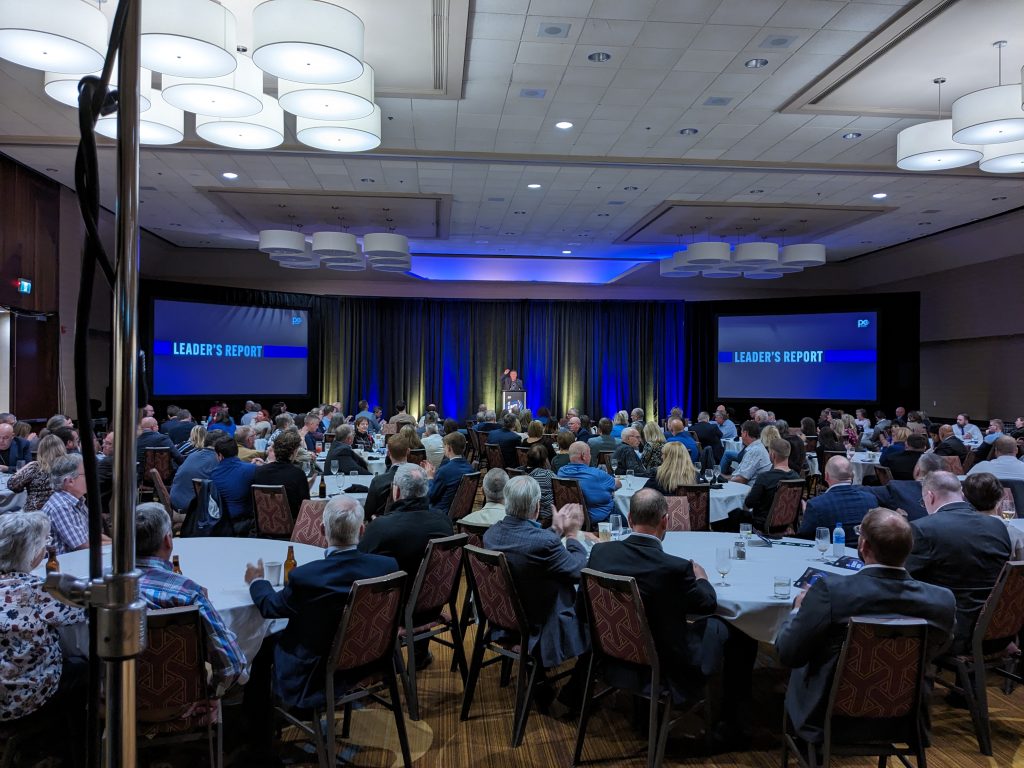
He characterized the relationship with the CPC when he first took over as interim leader in 2021 as though they were “third cousins” — “the cousins you don’t invite to the wedding and don’t invite out for drinks if you’re passing through town, but we’re still cousins and there is a bond there.” He said the provincial Tories set about “educating” their federal counterparts about the issues facing the province, because “to fix things in this province we need national influence.”
The provincial Tory caucus had several productive meetings with Poilievre, who helped the PCs organize a successful fundraiser when he visited the province earlier this year. At that point, Brazil characterized the relationship as “second cousins”: they’re still not invited to the wedding, but more than welcome to come out for drinks sometime.
Brazil said that since then, he has had more meetings with Poilievre—most recently a week ago in Ottawa. He described the meetings as productive and said Poilievre is “open to conversation” about issues like revisiting the Hibernia dividend, joint management of the fishery, “rectifying” equalization to benefit Newfoundland and Labrador, “rectifying” the Upper Churchill arrangement in anticipation of 2041, and—last but not least—that he’ll axe the carbon tax.
“I can say tonight that we’re first cousins with the Conservative Party of Canada now,” Brazil concluded. “They’re coming to the wedding.”
One Big Happy Family?
Leadership campaigns always highlight factional differences within political parties and this race was no different. The Wakeham campaign drew most of its support from the provincial party establishment and the Manning campaign was filled with Millennials more closely aligned with the federal Conservatives. The Parrott campaign was a bit of a wildcard.
Given the stakes of seizing this political moment, each leadership candidate ended their campaigns on Saturday with calls for the party to unite behind the winner.
“We have three highly skilled candidates, three very similar visions, but three very different ways of doing things,” Parrott told the AGM in his closing remarks. “Let’s unify behind whoever the leader is.”
“People don’t care if you’re Progressive Conservative,” he added. “PC stands for People’s Choice.”
“We came in here yesterday with three teams of people,” Wakeham announced. “Tomorrow we’re getting the resources together from those three teams to create an All-Star team that will sweep Newfoundland and Labrador.”
“There are no wrong choices in this race, only different choices,” Manning told the room. “There is far more that unites us as a party than divides us. Disappointment in the results cannot turn into disengagement. It’s time for the division in our party to be over.”
Indeed, one of the few clear policy divergences to emerge during the leadership campaign was Manning signalling support for the so-called “parents’ rights” movement driving queerphobic policies in New Brunswick and Saskatchewan. This stance prompted curler and former St. John’s City Council candidate Greg Smith to publicly retract his support for Manning and denounce far-right influences in the party.
Wakeham and Parrott, meanwhile, were more careful to avoid saying anything that would suggest affinity with social conservatives.
“We need to organize, standardize, and modernize,” Manning concluded. “I have no doubt we will come together and do just that.”
There was a palpable disappointment from his campaign when the final results were announced, but Manning was magnanimous about the outcome.
“People think that the best leader of this party at this time is Tony Wakeham and I fully respect that,” he told reporters. “I’m fully on board that Tony Wakeham will be the next premier of Newfoundland and Labrador.”
Manning was also asked whether he would run as a candidate for the party if Brazil were to vacate his seat, but he demurred announcing any immediate plans for his political future.
Wakeham, for his part, told reporters he would love to have Manning as a candidate in the next election. And he confirmed that he will visit the tent city outside Confederation Building when the House of Assembly reopens this week.
“We’re going to bring this home,” Wakeham concluded. “We’re ready and it starts now.”

Author

Related Articles
Memorial University student union walks back plan to close radio station amid backlash
‘I wish CHMR the best,’ Memorial University Students’ Union executive says ahead of vote to defund the campus radio station
INTERVIEW: Avi Lewis says N.L. is ‘ground zero’ for the biggest challenges facing Canadians
The federal NDP candidate says socialism and economic populism are the antidote to unfettered capitalism and the ‘epic market failures’ it has brought
LISTEN: Justin Brake talks Amber Bracken case & press freedom on CBC Radio’s ‘The Signal’ (with TRANSCRIPT)
An hour-long conversation led by CBC Radio host Adam Walsh, feat. Justin Brake, Geoff Budden, Karyn Pugliese, Brent Jolly and Ethan Cox