
As NDP convention gets underway in St. John’s, will N.L.’s third party prioritize growing rural support?
Former party candidates say it’s a steep hill to climb, but there are ways
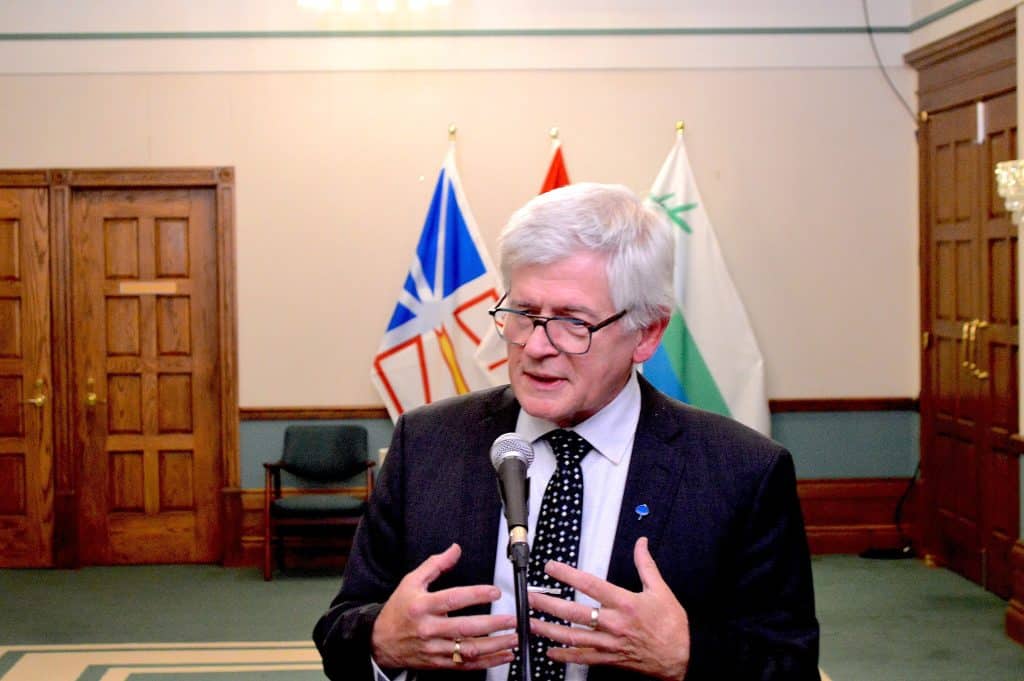
As members and delegates gather this weekend in St. John’s for the Newfoundland and Labrador New Democratic Party’s annual convention, a question likely on the minds of many is how to grow support for a party that has never held more than five seats in the province’s legislature.
Party officials, members and guests will descend on the Holiday Inn in St. John’s to rally party morale, while also voting on a set of new resolutions that will shape the party’s policies and priorities for the coming legislative sittings.
Some of the resolutions put forward deal with youth addiction, strengthening anti-scab legislation, creating a just transition for workers – including meeting the province’s climate targets, removing HST on home heating and children’s essentials, and creating a legislative committee to explore the option of public grocery stores.
No matter which resolutions are passed at the convention, the party still faces one of its most persistent challenges: how to grow support outside the St. John’s metro region.
Will you stand with us?
Your support is essential to making journalism like this possible.
‘Outside the overpass, the NDP is not present,’ says former candidate
“For a lot of people, once you’re outside the overpass, the NDP is not present,” says former New Democrat candidate Joshua Meadus. “We could be on the ballot, but no one [from the party] is ever seen there.”
Originally from Bay Bulls – but who grew up and lives in the Goulds – Meadus works at the Titanic museum and is completing his graduate studies in history at Memorial University. He got involved with the NDP during the pandemic, eventually becoming a member. Meadus says the Memorial University faculty strike of 2023 allowed him to get his first “direct taste of the labour movement.” Heaving grown up in a union household, with his father being a shop steward with NAPE for 20 years, Meadus supported MUNL faculty on the picket line.
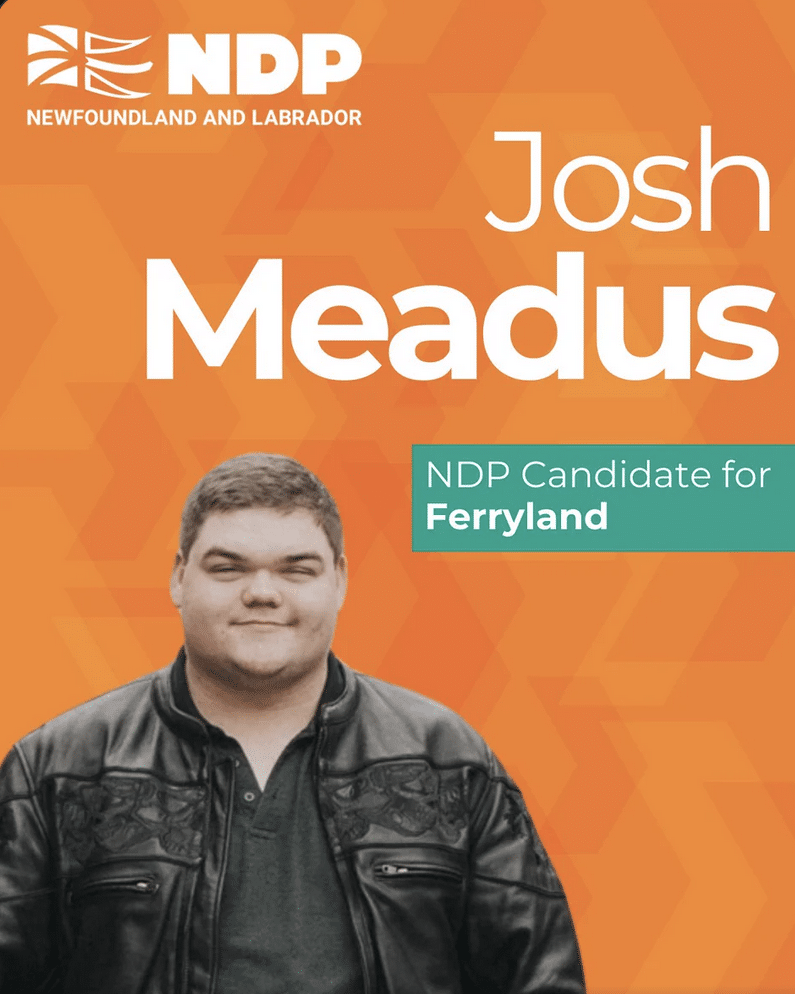
With a taste for workers’ rights in his mouth, Meadus seized the opportunity to put his name on the ballot in his district of Ferryland for the 2025 provincial election, an experience he describes as a “double-edge sword.” While he was excited for the opportunity, Meadus quickly learned that, as a student, he wasn’t able to invest as much time into his campaign as he would have liked.
By no means a swing district, Ferryland is home to current Progressive Conservative MHA and fisheries minister Loyola O’Driscoll and has been a Conservative stronghold for the last 55 years – a reality Meadus was aware of heading into last fall’s election. He would up taking about 250 votes of the approximately 6,600 cast there.
Meadus says rural areas of the province have a sort of “imperial relationship” with St. John’s, a reality he says contributes to the “familial tradition” of political voting that exists out around the bays. “It’s a lot less about policy than, say, skipper voted Tory and his dad voted Tory, so I’m going to vote Tory because that’s what you vote for,” he says. “That’s no dig against anyone out this way – it’s the nature of the beast.”
During the election, Meadus says the stark difference in funding the NDP received compared to the PCs or Liberals dawned on him as he was traveling to Ferryland to sign his candidacy papers. “I was driving for about an hour and a half to two hours and there were signs plastered everywhere for Liberals and Conservatives, just on people’s houses,” he recalls. “And the scale of the difference in volume of money the NDP were working with was very apparent.” Meadus says he never received any signs with his name on them from the party, and that he “never even asked.”
With limited resources, party focused on urban seats
Without a vehicle at the time, Meadus was only able to canvas in the Goulds arae, he says, while relying on word of mouth to have a presence in other parts of the district. Instead, he dedicated most of his time canvassing in St. John’s for NDP St. John’s East-Quidi Vidi candidate Shelaigh O’Leary, who is now one of the party’s two MHAs.
“It’s either you’re building up the core – which is good, St. John’s needs to be built up – or you’re getting accused of forgetting the smaller areas. So it’s a real conundrum,” Meadus says. “We don’t have the kind of coffers and manpower that the main two parties do. The focus was always going to be on those really big swing sweats when it comes to canvassing.”
As the NDP convention gets underway Friday evening in St. John’s, former candidates like Meadus say the party could be making breakthroughs in rural regions by tapping into the “economic crisis” facing residents and engaging more with youth.
“We need to think about things like mutual aid, [and] creating things like crisis centres within our communities where, if someone is on hard times, we can support them,” Meadus says. “Because that’s the heart of the labour and social movements: how do we benefit our communities? So if the NDP can be at the forefront of that, I think that’s a winning position for us.
“The only way forward for us as a party is to really go to people where they’re at. Not in policy when it comes to the outports, but going to people in communities and showing up to events. Not just on a political basis, but on the basis of being a part of the community.”
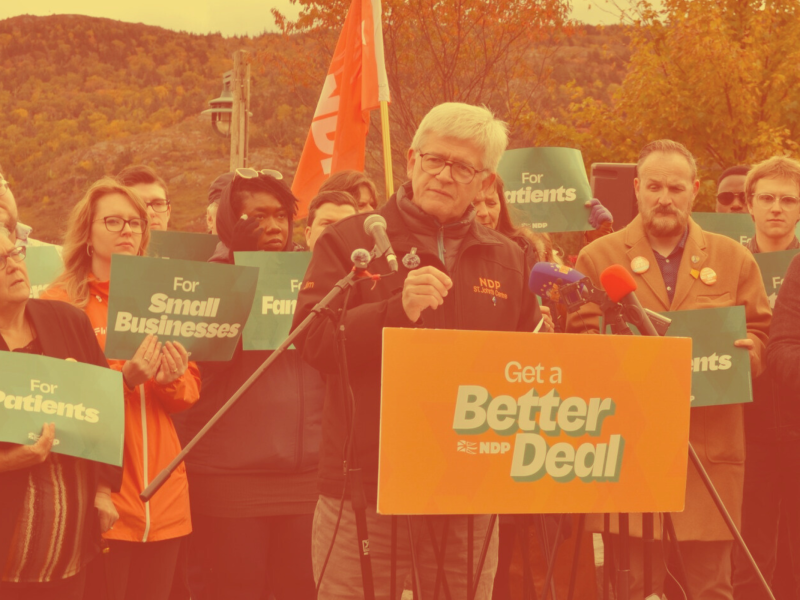
Across the Avalon, a couple hundred kilometers away, Darian Vincent’s experience running for the NDP in the Harbour Grace–Port de Grave district wasn’t much different.
Now living in Bay Roberts, Vincent is about as far away as he can get from where he grew up on Vancouver Island, where he describes the British Columbia NDP as a “powerhouse” and a “viable alternative” politically. He has called Conception Bay North home for a few years now, commuting daily to his job at Costco in St. John’s. He says living around the bay offers him the extra affordability he was looking for.
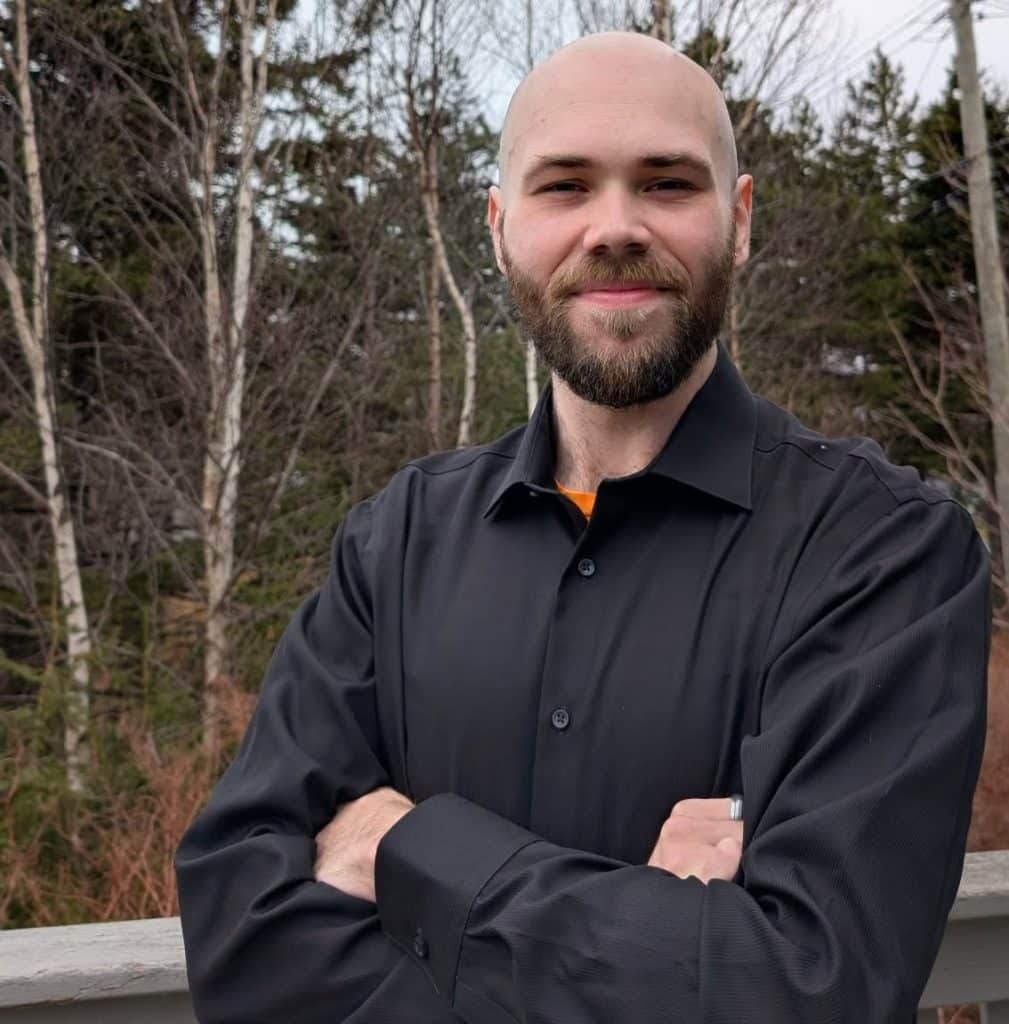
After joining the provincial NDP, Vincent says he was quickly tapped to be a name on a ballot – first for the April 2025 federal election in the Central Newfoundland riding, where he was up against Conservative incumbent Clifford Small. The federal party, he says, was “scrambling to get some names on ballots and asked if I would do it.”
A few months later, with the provincial election approaching, Vincent was asked if he would run for the provincial NDP in the Port de Grave–Bay Roberts district, a Liberal stronghold since Confederation.
“I feel like I saw the writing on the wall pretty quickly,” he recalls, explaining how fast he became aware of the entrenched nature of familial voting that exists in his region. Vincent took just under 2 per cent of the vote with 110 ballots, losing to Liberal and independent candidates, and to Liberal incumbent and former cabinet minister Pam Parsons, who took the riding with 3,750 votes. “I work a nine-to-five job in town, so it’s not like I had the ability to take the time off work to go put in any meaningful effort,” he says. “I would have loved to if I could have.”
In the phone calls and canvassing Vincent managed, he realised the party could be doing more to tap into the youth vote – those who have yet to solidify their genetically Liberal or Conservative destiny. With any success on that front, he says the NDP could have a shot at making inroads in rural areas like his.
“I feel like to make any sort of meaningful movement, you gotta get in on the ground floor with those people who are either very young or those that currently are not voting,” he explains. “I think it’s a lot easier to turn someone from a non-voter into a New Democrat voter, than it is to turn a Liberal or Conservative voter into an NDP voter.”
Mount Scio candidate more than a name on a ballot
In the St. John’s district of Mount Scio, Lauabel Mba was more than just a name on the ballot. The young mother, anti-racism advocate and Rogers TV host made history last year when she became the first Black candidate ever to run in a Newfoundland and Labrador provincial election.
She was hesitant when approached by NDP leader Jim Dinn to run in the election. “I told him originally ‘no’ because I did not think the Newfoundland and Labrador electoral system and province was ready to have a candidate like me,” Mba recalls. “And Jim said ‘no’ [and] that he thought it was the right time.” Mba became one of the most visible NDP candidates during the election and garnered nearly 800 ballots on election day, representing about 18 per cent of the votes in her riding. A year later, she’s grateful for the growth and exposure that came with the experience.
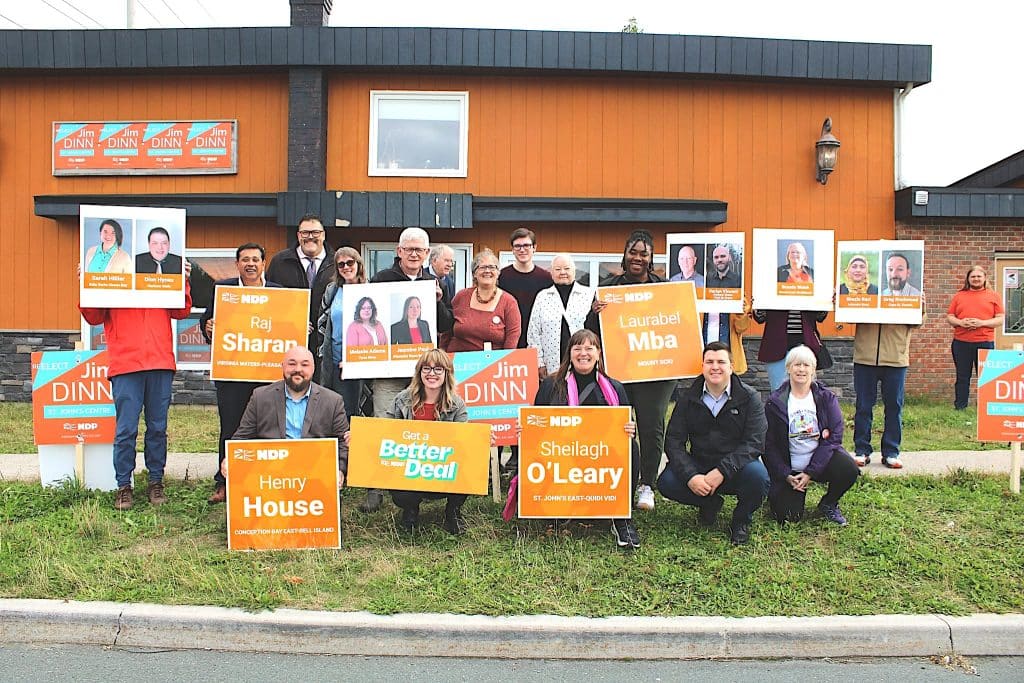
With the need to grow party support a likely topic of discussion at this weekend’s convention, Mba says her experience campaigning last fall revealed a pool of potential future NDP members who are new-Canadians, international students, or first-time voters, who she says were unsure of which party to support. “They were particularly interested in the fact that I was still willing to engage and talk to them about their issues,” she recalls. “And that was important to me because you might not be able to vote now, but I need you engaged for the next election. Even if I don’t win this one, I want you to still feel like your voice matters, that the issues that matter to you.”
Mba says she’s considering a run again for the NDP in 2029. “I know what it’s like to sit with the income support forms on your table, to wonder how you’re going to make it. I really care how our education system works. I know what it’s like to sit in emergency for 12 to 24 hours,” she says. “So if I had the opportunity to stand on the House floor, I would be speaking as someone who knows the lived realities and is advocating for a better Newfoundland.”
At the end of the 2025 election, the NDP maintained two seats in the provincial legislature, the minimum needed for it to have official party status.
Federal NDP leader Avi Lewis among guest speakers
Avi Lewis, who was elected in March as leader of the federal NDP, will address delegates on Saturday morning. Following the New Democrats’ poor results in the 2025 election under the leadership of Jagmeet Singh, in which the party won just seven seats and lost official party status, Lewis campaigned in his leadership bid to restore the NDP to its democratic socialist roots.
During a leadership campaign stop in St. John’s in March, Lewis told The Independent and CHMR, “The way the NDP comes back in a place like Newfoundland and Labrador—in a heavily-unionized province with a [big] resource economy […] is that we actually need to figure out what a 21st century economy looks like where the vast wealth of this country is directed at solving the crisis of everyday life and not shoveling fountains of money upward to the hoarding class, which is sitting on billions and billions of dollars of wealth that doesn’t ever trickle down to us.”

Since taking over as party leader, Lewis has prioritized public ownership of services and resources – including publicly-owned grocery stores – as a way to combat the rising cost of living. He has also advocated for a more equitable distribution of wealth in Canada, including tax fairness and taxing the ultra-rich, and for major investments in a just transition that would see greater federal support for renewable energy development to replace the country’s fossil fuel industries amid a worsening climate crisis.
The former journalist and documentary filmmaker noted last March that Newfoundland and Labrador “is on the front lines of a lot of the crises” Canadians are facing, including the cost of living, and that large resource development projects aren’t the solution. “The Bay du Nord project is not going to help anybody with the price of their groceries,” Lewis said. “These jobs are vague, there’s no promises, they float big numbers. But what we know about these projects is that they create a handful of good-paying jobs that a lucky few get, and those ‘lucky’ few get to work far from home, with insane schedules, miss their kids’ birthdays, just to make a buck.”

Former provincial NDP leader and member of parliament Jack Harris will miss the bulk of this weekend’s convention because he is traveling out of the country, but he hopes to meet Lewis if their time overlaps. “Avi Lewis certainly has the talent and the ability to communicate, and he’s committed to doing the hard work of rebuilding the organization,” he says. “And I fully expect that will take place as soon as we get an opportunity at the federal level to once again go to a vote.”
Past federal leaders have tried repeatedly to build stronger NDP support in the province by visiting St. John’s. In 2011, the late Jack Layton led the party to a record 103 seats in Ottawa, earning the NDP Official Opposition status as part of the “orange wave” that swept across the country. That surge in party support also helped the NL NDP to win a party-record five seats in the Newfoundland and Labrador legislature.
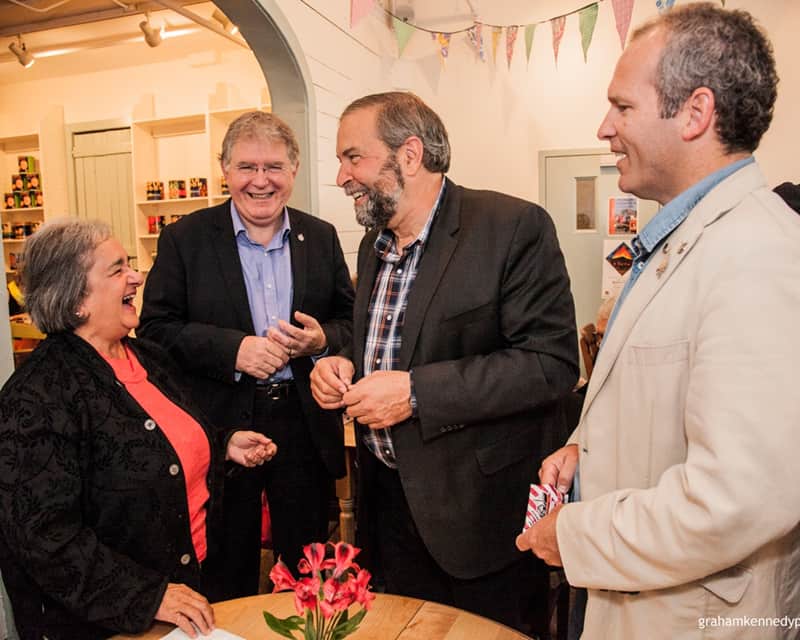
On a 2015 trip to St. John’s, then federal NDP leader Tom Mulclair rallied support for then NDP incumbent for St. John’s South-Mount Pearl, and former Independent editor-in-chief, Ryan Cleary. On that trip Mulclair was forced to apologize for a ‘Newfie’ comment he made 20 years earlier while serving as a Quebec cabinet minister. In the October 2015 election, Cleary lost his seat to Liberal candidate Seamus O’Regan.
Former leader Jagmeet Singh visited St. John’s, where he spent a portion of his childhood, on several occasions. During a visit in 2023, Singh protested alongside grocery workers outside the now shuttered Dominion on Quidi Vidi Lake, demanding better working conditions.
Harris, once a lone NDP MHA in the 1990s, says not unlike the challenges he faced then, and which Lewis now faces at the federal level, Dinn and O’Leary have the responsibility of carrying on the work the provincial party’s membership expects of the NDP, while also supporting efforts to grow the party. “In rural Newfoundland there is almost a greater need for the kind of voices the NDP provides, but we need to build the organization in those communities,” he says.
Asked what his advice to the party would be, Harris said it’s “really to keep up the work that we’re doing,” noting the NL NDP represents “the two most populous districts in the province,” has “two strong MHAs,” and “a narrative and a focus that’s different from the other parties. So I think we have a lot to offer.”
Joining Lewis as guest speakers at the convention are Newfoundland-born Saskatchewan NDP MLA Sally Housser, Newfoundland and Labrador Federation of Labour President Jessica McCormick, CUPE NL President Sherry Hillier, and Memorial University climate researcher Angela Carter.
The Independent will be reporting from the conference throughout the weekend. Stay tuned to TheIndependent.ca, and follow us on TikTok, Bluesky and Instagram for updates.

Author
Related Articles
‘Skepticism and cynicism’ marring public view of Churchill Falls and Gull Island, says researcher
Grand Chief Jodie Ashini says Innu Nation won’t support proposed deal ‘while fundamental issues with the Innu remain unresolved’
Gander didn’t protest U.S. ambassador during 9/11 visit, but still sent a clear message to Trump
There were no boos when Pete Hoekstra appeared at the 25th anniversary commemoration. Instead, Newfoundlanders kept their focus on the nearly 3,000 lives lost — and reminded America that Canada will not bow to anyone
Police should not have fined them over their dog, Quigley, say St. John’s B&B owners
Lesa and Gery Winsor say their 6-year-old Border Collie-Retriever is trained to sit at the end of his driveway; officer told couple RNC gets ‘a lot of complaints about dogs being off leash’