
What will it take for the N.L. NDP to gain voter support?
Party leader Jim Dinn says it’s ‘mystifying’ the labour-oriented party can’t attract more support from workers in one of Canada’s most unionized provinces
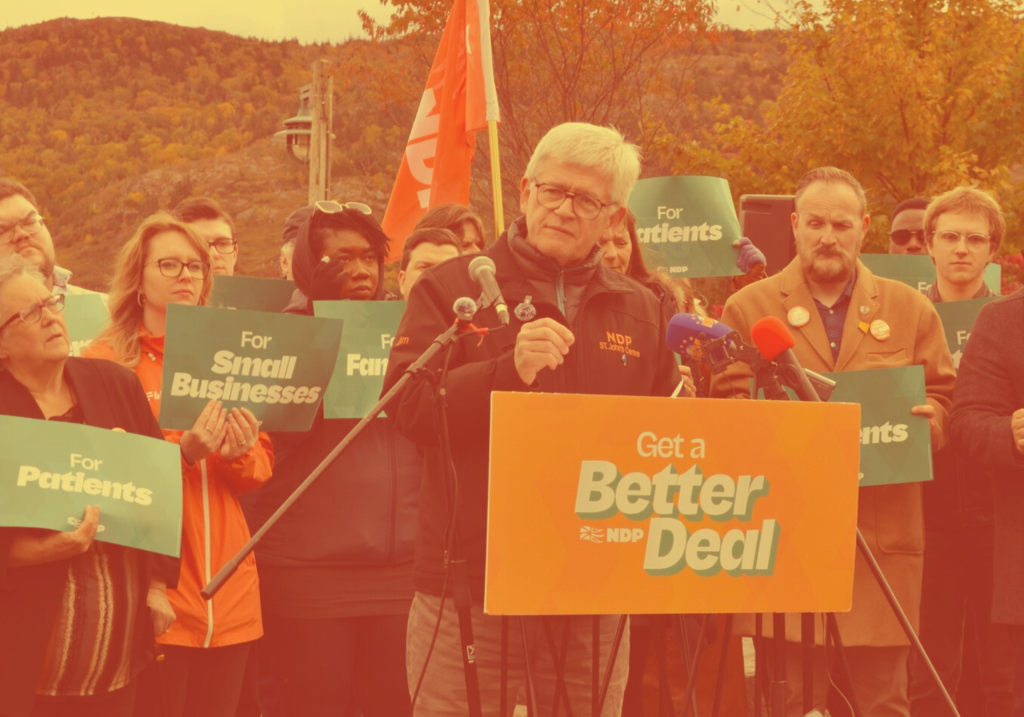
The provincial NDP will soon head back to the House of Assembly with two seats, the same number it had heading into the Oct. 14 general election and the minimum required for official party status.
Party leader Jim Dinn, a retired school teacher and former union leader, calls the outcome “bittersweet” and says the party will be reflecting on its approach to mobilizing voters, especially those outside the St. John’s Metro region.
Dinn retained his seat in St. John’s Centre, which he has represented since 2019, while former St. John’s Deputy Mayor Sheilagh O’Leary took St. John’s East-Quidi Vidi back from the Liberals in what the NDP has long considered one of its strongholds.
Meanwhile, the party lost its seat in Labrador West, where MHA Jordan Brown did not seek re-election and instead ran for and won the mayoral race in his community of Labrador City.
Will you stand with us?
Your support is essential to making journalism like this possible.
The party chose former Wabush town councillor Shazia Razi to run for Brown’s seat, but Shazia—the province’s first Muslim woman to run for provincial office—came in a distant third behind the Liberal and Progressive Conservative candidates. Dinn calls the party’s loss of its sole Labrador seat “disappointing”.
Mobilizing workers and rural voters
If the NDP hopes to regain a seat in Labrador, or make inroads outside St. John’s, it will need to strengthen its focus on rural communities and more clearly distinguish itself from the Liberals and PCs, says former NDP MHA Gene Long.
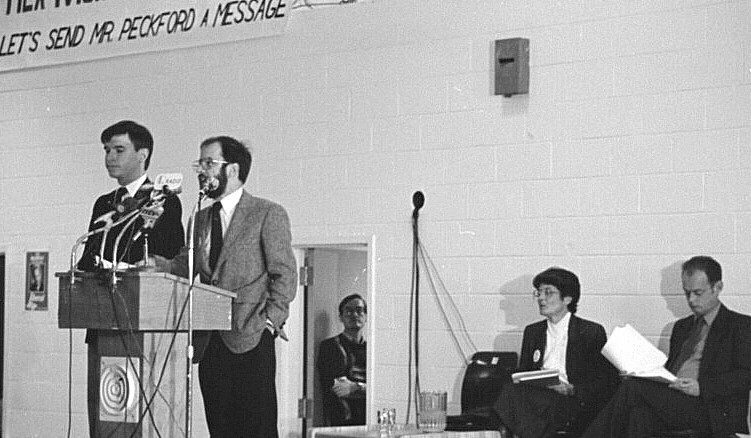
In 1986 Long won the St. John’s East (now St. John’s East–Quidi Vidi) riding in a by-election, making him just the second NDP member ever elected to the provincial legislature. Joining then Labrador MHA and party leader Peter Fenwick, Long maintained his seat for three years, losing in the 1989 general election.
He believes there’s a correlation between the party’s lack of progress since that time and the disconnect he sees between the NDP and voters like him, who want to see more party support for residents who are resisting major resource development projects that could negatively impact their communities and the environment. Long says he feels “a bit lonely politically […] so think about how the people in Port au Port feel, or the Innu youth who are walking across Labrador to protest the [Churchill Falls] MOU. I’m not the only one feeling deserted by the NDP.”
In 1955, Liberal MHA Sam Drover left the Smallwood government and formed the Newfoundland Co-operative Commonwealth Federation (CCF), a democratic socialist party formed by Alberta farmers and unions in 1932 which found success in Saskatchewan when it won a majority government under the leadership of Tommy Douglas in that province’s 1944 election.
Drover crossed the floor after watching the Smallwood administration’s abandonment of workers’ rights and socialist values, but the CCF didn’t win a seat in the ensuing election.
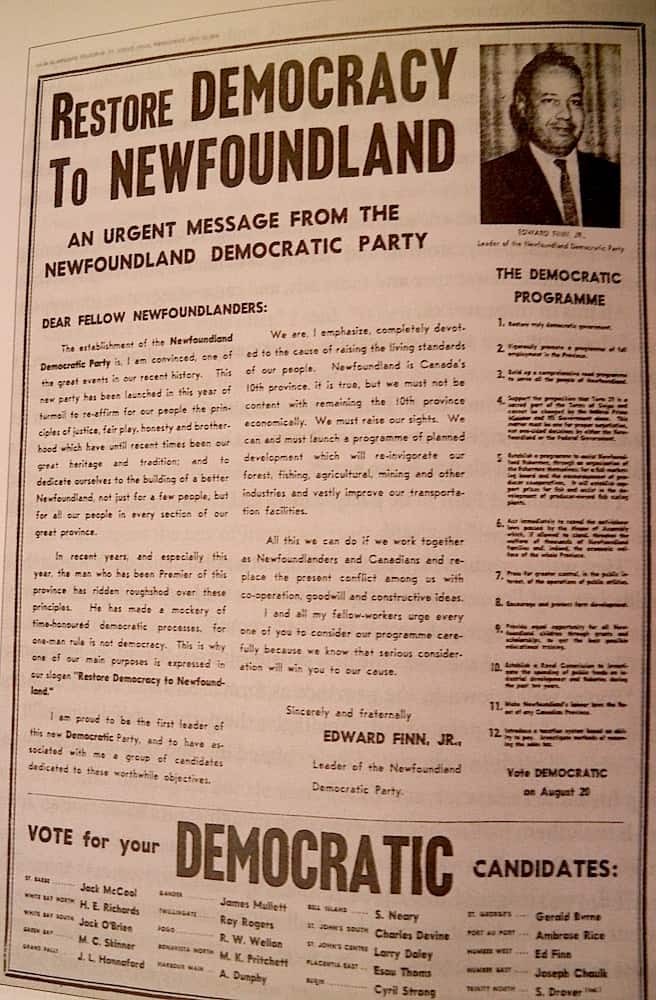
That’s when union leaders recruited Corner Brook journalist Ed Finn to form the Newfoundland Democratic Party as a successor to the CCF. The party was born out of the same discontent with the Liberals government’s disregard for workers, particularly Smallwood’s attack on loggers after he sent in police to end the loggers’ strike in Badger in 1959 then decertified their union.
The Newfoundland Democratic Party was the first provincial NDP party to form after CCF and national union leaders joined forces to form the federal New Democratic Party in 1961, after which time the provincial party changed its name to the Newfoundland New Democratic Party.
It wasn’t until a 1984 byelection when Fenwick, a college instructor, captured the NDP’s first-ever seat in the House of Assembly in the Menihek riding, now known as Labrador West. In the 1985 general election the NDP garnered more than 14 per cent of the popular vote and Fenwick retained his seat.
Earlier this month—40 years and 11 elections later—the party captured just over 8 per cent of the popular vote, almost a decade and a half after earning its greatest showing of support during the 2011 general election when a record five NDP members were elected with 24.6 per cent of the popular vote.
Dinn says it’s “mystifying” that the NDP doesn’t garner more support “in a province that is highly, highly unionized as ours.”
Over the decades the party has continued to receive union support but has failed to mobilize enough of the workers those unions represent. Newfoundland and Labrador consistently ranks as one of the most unionized provinces in Canada. Between 2020 and 2024 it was neck-and-neck with Quebec as having the greatest number of workers unionized by collective agreement (upward of 39 per cent) in the country.
Kelly Blidook, an associate professor in the Department of Political Science at Memorial University, says gaining voter trust, especially in rural areas, “is a real uphill climb” for the NDP given voters’ historical and consistent loyalty to the Liberals and PCs.
Razi says the NDP will have to rethink some of its strategies, but that it has “come a long way” and “worked hard over the [past] four years to get it right.”
Dinn says he is proud of some of his party’s accomplishments in the 2025 election. The NDP released a costed platform early in the campaign, giving media and voters time to scrutinize their policies and how they would be funded. The Liberal and PCs, meanwhile, waited until after early voting had begun, and just hours before the Oct. 8 leadership debate, to share their platforms, giving voters just six days to unpack their policies.
Dinn also points out the NDP ran its first full slate of 40 Candidates since 2015, saying “people in all districts had the opportunity to vote for an NDP candidate.” Notably, the party also surpassed gender parity by running 21 women candidates in the election.
Blidook found the NDP’s campaign “quite appealing,” pointing to the early release of its platform. He said the Liberals’ and PC’s decision to wait “until the very last possible minute” to share their platforms represents “a bit of contempt towards voters” since it gave them little time to see the parties’ “full picture.”
Long and others are critical of the party’s full slate, noting many of the NDP’s candidates live in regions other than those in which they ran.
Missed opportunities
In 2011, the NDP achieved its strongest results ever in the province, winning five seats in the House of Assembly under then leader Lorraine Michael. The win was due to a combination of factors, including the party’s growing appeal locally and a surge in national support amid the “orange wave”. That same year, under the leadership of Jack Layton, the federal NDP formed the official opposition in Ottawa.

Blidook says the provincial NDP had the opportunity at that time to expand its popularity, but instead “squandered” the chance due to infighting. In 2013 four caucus members signed a letter to Michael calling for a leadership convention in 2014, a move Michael told media had blindsided her. Two of the members—St. John’s Centre MHA Gerry Rogers and St. John’s East MHA George Murphy—walked back their opposition to Michael’s leadership, but St. Barbe-L’Anse aux Meadows MHA Chris Mitchelmore and St. John’s North (now Mt. Scio) MHA Dale Kirby resigned from caucus. They eventually crossed the floor to join the Liberal caucus and were rewarded with cabinet seats.
“The broader story for me of the NDP is that when they’ve had the opportunities, they have squandered them,” says Blidook. “They have not managed to make them work.”
The NDP has seen greater success in other provinces, where they’ve formed official opposition or government several times. British Columbia elected NDP governments in 1972 and again 1991, when the party governed until 2001. It then served as the official opposition until 2017, when it won a minority government, followed by consecutive majority governments in 2020 and 2024.
In Saskatchewan the NDP has governed across multiple decades and more recently served as official opposition for the past 15 years. In Manitoba the party has either governed or served as official opposition since 1969, except for two years in the late 1980s when it came third in the 1988 general election. Today the Manitoba NDP hold a majority government under the leadership of Wab Kinew, who became the province’s first-ever First Nations’ party leader in 2017 and Manitoba’s first First Nations premier in 2023.
Christopher Adams, an adjunct professor at the University of Manitoba and author of Politics in Manitoba, says the NDP enjoys popularity in Manitoba because it has a long history in the province, stronger urban support in Winnipeg and northern Manitoba (where unionized, resource town labour is grounded), a policy focus on healthcare and education, strong personal appeal of its leaders, and proven success while governing.
Adams says Manitoba’s Progressive Conservative Party lost popularity after it began shutting down emergency departments in hospitals in 2017 as part of its plan to find “efficiencies,” a move that increased the burden on remaining medical facilities. That situation, combined with the pandemic, led to “a perfect storm” for the NDP to mount a comeback, Adams says.
While Newfoundland and Labrador’s Liberal and PC governments have had their fair share of controversies—most recently the Liberals’ agency nurse scandal and the secret cash benefit for departing cabinet ministers—Dinn says voters continue to elect the parties that have betrayed them.
“I have to say, considering that whatever economic situation we are in in this province—the deficit, the debt, the lack of services—has everything to do with previous Liberal and PC administrations. It is not the function of the NDP, and yet, it seems the voting public will go back and forth between these two parties.”
During this election, the NDP also became the first party in the province to achieve gender parity, with 21 women on the ballot. But Long says the milestone falls short when several of those candidates neither live in, nor have strong ties to, the communities they were vying to represent.
While Blidook commends the NDP for putting 40 candidates on the ballot, he says the party’s weak presence in rural areas makes it hard to find quality local candidates with strong roots in the ridings.
The party’s big challenge, he adds, is to earn the trust of rural voters. But in order to do that, they first have to be elected. “They just don’t have the strength in most parts of the province to even attract reasonable candidates who are local and who are known in the areas that they’re running.”
Competing on ‘crowded terrain’
To attract more support, Long says the NDP needs to prioritize issues unique to rural communities rather than focusing primarily on broader issues like the cost of living, which the Liberals and PCs already hold sway over.
The party “tries to out-position the Tories and Liberals on housing, healthcare and affordability,” he says, “but they’re just tinkering around the same policy issues and failing to break through on those issues, because it’s crowded terrain.”
The federal NDP lost significant support in last April’s federal election after providing the Liberals with a supply and confidence agreement, thereby relinquishing part of its distinct identity. Long says the provincial NDP faced a similar issue by not taking a firmer stand on the Churchill Falls MOU and Bay du Nord. “Jim Dinn was mistaken in somehow thinking it was a good strategy to be so close to Andrew Furey and John Hogan when the voters were going in a completely different direction,” he says.
Long points to the PC’s firm stance against the Liberal’s handling of the Churchill Falls MOU, which worked in the party’s favour on election day.
Razi disagrees, though, and says while the federal NDP was unable to distinguish itself from the Liberal Party of Canada, the provincial NDP has always held the Liberals to account citing the party’s push for the creation of an independent committee to review the Churchill Falls MOU with Quebec.
Given the low odds of forming government, Long says the NDP should shift from grand promises to attainable goals, like doing more to hold the Liberals accountable, speaking up on less-covered issues like salmon farming and rural road repairs, and breaking down complex conversations surrounding Churchill Falls and Gull Island for voters.
“Nobody expects the NDP is going to deliver answers to the housing crisis in St John’s or anywhere else around the province, because they’ve only got one or two seats,” he says.
NDP could have made the environment a central issue
Blidook says the provincial NDP isn’t as outspoken on the climate crisis as its counterparts in other provinces, and that its toned-down rhetoric likely has to do with Newfoundland and Labrador’s deep ties to the oil industry. “The positions of the [province’s] major parties typically tend to still be relatively pro-extraction in oil,” he says.
Long says with Newfoundland and Labrador Premier-designate Tony Wakeham’s recent remark that he doesn’t believe the oil industry played a role in the Newfoundland wildfires last summer, the NDP now has an opportunity to gain support but is “going to have to get serious about offshore oil and climate change.”
Dinn says the party has advanced climate action in the legislature but has found little support from the other parties. In May 2022, the NDP introduced a private member’s resolution in the House of Assembly calling for just-transition legislation to support oil workers’ shift to green jobs and the creation of an Office of Climate Accountability. The motion was defeated with only four members in favour and 31 against.

Long says he would like to see the NDP separate itself from the other parties by taking a bolder stance on Bay du Nord, the Churchill Falls MOU and Gull Island, adding Newfoundlanders and Labradorians need a party that’s innovative and offers radical criticisms of the other two parties and their policies, because “that’s what the times call for. That’s what people are waiting for.”
Dinn says while the NDP is preparing for the fall sitting, there’s also a desire to start looking ahead to the next election.
Candidates who ran in the 2025 election in ridings where the NDP has never seen significant support are “looking to get together, organizing, getting district associations together, and start preparing for the next election,” he says.

Author

Related Articles

N.L.’s offshore oil could help bankroll a company linked to Israel’s illegal occupation of Palestine
Ithaca Energy’s impending takeover of Suncor’s stakes in three oil projects comes after PM’s promise to ban trade with Israel’s illegal settlements, while Ithaca’s majority owner is named on a UN blacklist for its alleged activities supporting settlements in the occupied Palestinian territories
Gander didn’t protest U.S. ambassador during 9/11 visit, but still sent a clear message to Trump
There were no boos when Pete Hoekstra appeared at the 25th anniversary commemoration. Instead, Newfoundlanders kept their focus on the nearly 3,000 lives lost — and reminded America that Canada will not bow to anyone

Watchdog says it can’t investigate Deloitte over use of AI in $1.6M government report
Internal emails reveal Deloitte helped craft government’s response to The Independent’s investigation