
PCs shut down proposal to study high grocery prices
Wakeham government says legislative committee not needed, cost of food to be covered in coming poverty reduction plan
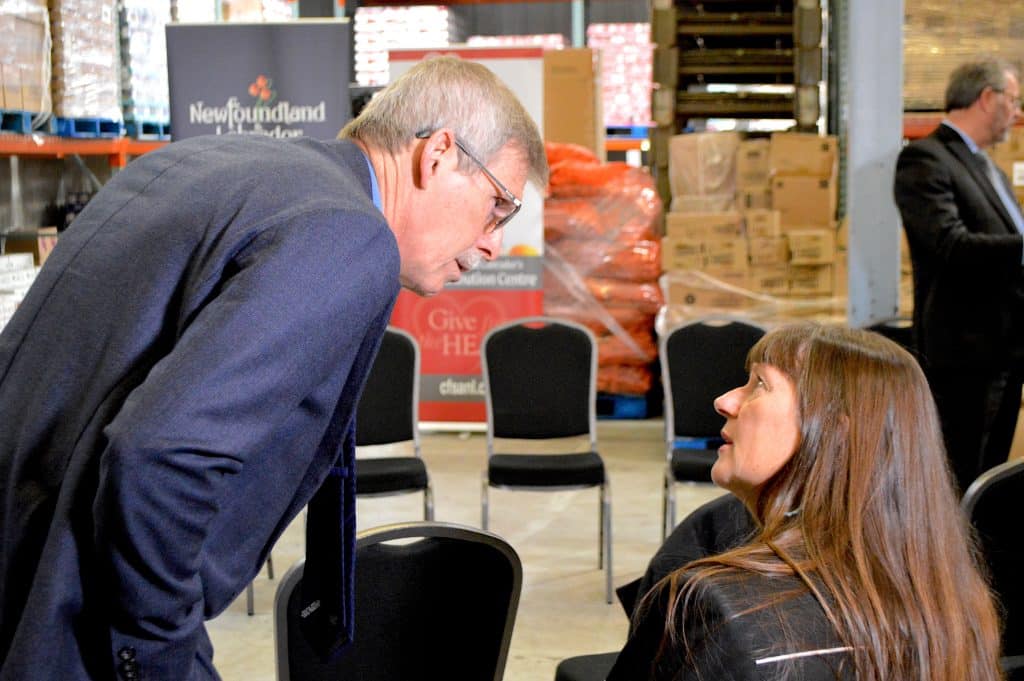
An effort to lower the cost of groceries in Newfoundland and Labrador was shut down by the Wakeham government this week.
The province’s two opposition parties put forward separate private member’s resolutions Wednesday asking the government to strike an all-party committee to study grocery prices. Citing the high cost of living, wages and government transfers failing to keep pace with inflation, and data that shows a quarter of the province’s households are food insecure, a private member’s resolution from NDP Leader Jim Dinn proposed a committee to study the grocery industry and identify ways to reduce the cost of food.
Dinn’s motion suggested the committee could consider ideas like targeted financial supports for consumers, predatory pricing prevention, expanding food bank production, and creating publicly-funded grocery stores.
“I don’t know how many of us here go to the supermarket or corner store and look at the number of items and calculate how many meals we can get out of that,” NDP Leader Jim Dinn said in the legislature Wednesday, “but that is the situation people are facing.”
Will you stand with us?
Your support is essential to making journalism like this possible.
Responding to the resolution, Social Supports and Well-Being Minister Chris Tibbs said the government believes the issue of food affordability doesn’t need an all-party committee because the “challenge is well known.”
Tibbs proposed amending the resolution so that it did not call for an all-party committee and instead would allow the PCs to table a report in the legislation and use its results “to inform the development of a new poverty reduction and prevention strategy.”
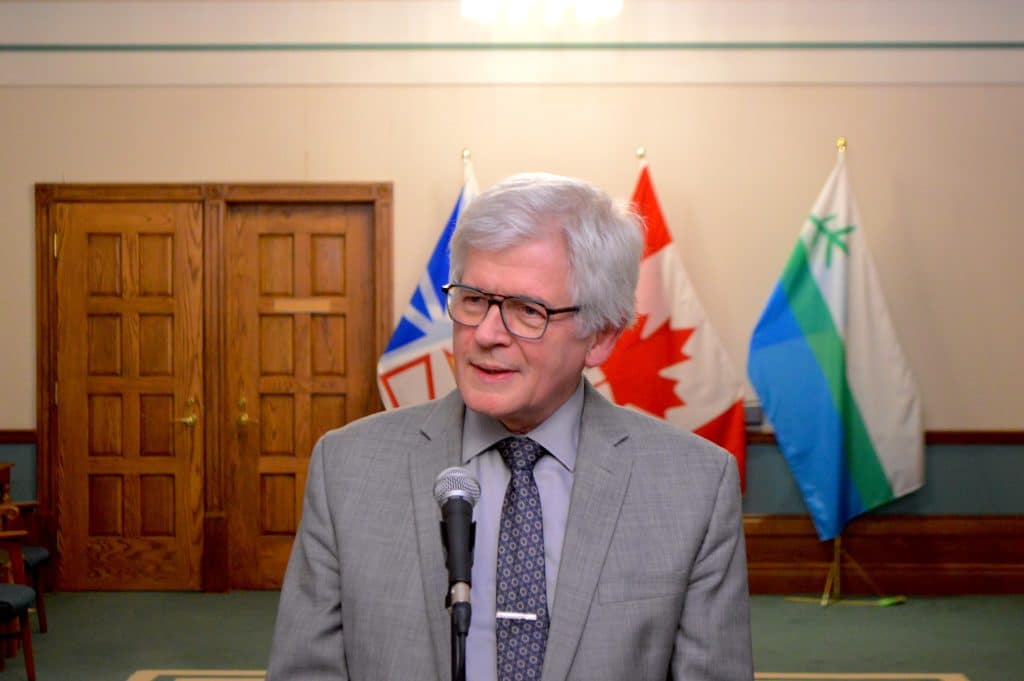
Dinn, the MHA for St. John’s Centre, said the PCs “went out of their way” to try and change the NDP motion, then voted it down. “They could have voted in favour of it – it’s non-binding,” he later told reporters. “They could have come away and said, ‘Yes, we support collaboration,’ and let it just fade out of existence. How is that collaboration?”
Along with her Liberal colleagues, Placentia–St. Mary’s MHA Sherry Gambin-Walsh supported the motion, calling the skyrocketing cost of food a “provincial crisis that requires a coordinated response.”
A former cabinet minister of 10 years, Gambin-Walsh said access to groceries is not just an economic issue but one of “social support, poverty reduction and public well being.” She said the concept of publicly-owned grocery stores should be considered “without prejudging the outcome.
“We need to understand why groceries cost so much, why certain regions face higher prices, and what interventions could make a meaningful difference,” Gambin-Walsh said, citing 2025 federal data that a quarter of people in Newfoundland and Labrador lived in food-insecure households – that number being higher for youth – totaling roughly 137,000 residents.
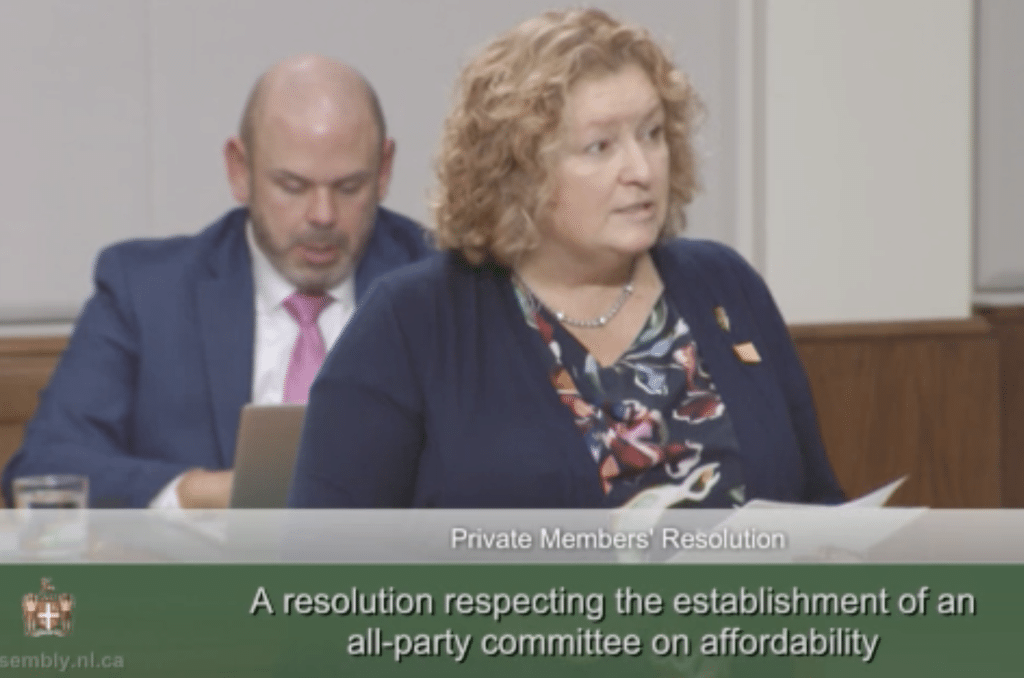
“People deserve more than assistance that allows them to barely get by,” she said. “One-time payments do not address the structural factors driving grocery prices up.”
Inspired by Ontario’s Fair Prices and Tax-Free Groceries Act, last summer Gambin-Walsh tabled a similar bill, the Fair Price and Tax Free Grocery Act. If passed, the legislation would have required the provincial government to “develop a province wide food affordability plan and begin to remove provincial process HST on food and non alcoholic drinks.”
“I don’t believe we need an all-party committee to do that, to sit down and come up with great ideas to fix the people’s problems in this province,” Tibbs said, arguing affordability concerns could be folded into the province’s forthcoming poverty reduction strategy.
“New Democrats, Liberals, and the two independent members voted for the motion,” Dinn said. “The Conservative government did not, defeating the motion.” At present the PCs hold a slim majority in the legislature, occupying 20 of 40 seats. Since the PCs elected independent member Paul Lane as House Speaker, the Mount Pearl–Southlands MHA only votes when he is required to break a tie.
“The inability of this government to put their partisan politics aside and work with all elected members to focus on how to lower the cost of food in this province is extremely concerning and does not help the people of this province afford to feed themselves and their families,” Dinn said.
PCs rule out publicly-owned grocery stores, but finance minister points to potential for co-ops
The following day Tibbs joined Premier Tony Wakeham and Finance Minister Craig Pardy at the Community Food Sharing Association warehouse in St. John’s to announce more than $1.5 million in additional funding for food banks across the province. The Independent asked the cabinet ministers why they voted against the motion if it could have led to long-term solutions to soaring grocery prices and families struggling to put food on the table.
“We like to fix the root causes,” Pardy responded, pointing also to the costs he said an all-party committee could incur. “Whatever we embark upon, we got to make sure we got the financial resources to be able to see it through,” he said. “That is what we are doing with the poverty reduction plan.”
Pardy said the government was “not in a position to entertain” publicly-owned grocery stores and that the government doesn’t “need to strike a committee to know that.”
While dismissing the idea being popularised by federal NDP Leader Avi Lewis, the finance minister said grocery co-operatives, where “dividends [are] returned to the people who shop at those,” could be part of the solution.
O’Leary attends food bank announcement, criticises PCs
St. John’s East–Quidi Vidi MHA Sheilagh O’Leary showed up to the government’s food bank announcement and criticised the government’s rejection of her party’s motion. “I applaud the efforts here for giving money to the Community Food Sharing Association, but it is not the answer,” she said.
O’Leary contrasted the province’s food insecurity numbers and the NDP’s resolution with a PC party fundraiser in St. John’s the prior evening. “I’m just shocked that yesterday that conversation, the denial to have an all-party committee to discuss all the different options that are out there—and then for them to march off to a $500-per-plate dinner fundraiser for the Conservative Party, it’s really quite shocking,” she said.
At the announcement, Community Food Sharing Association General Manager Tina Bishop said her group helps feed more than 15,000 families across 60 food banks throughout Newfoundland and Labrador, including nearly 5,000 kids and 13,000 seniors.
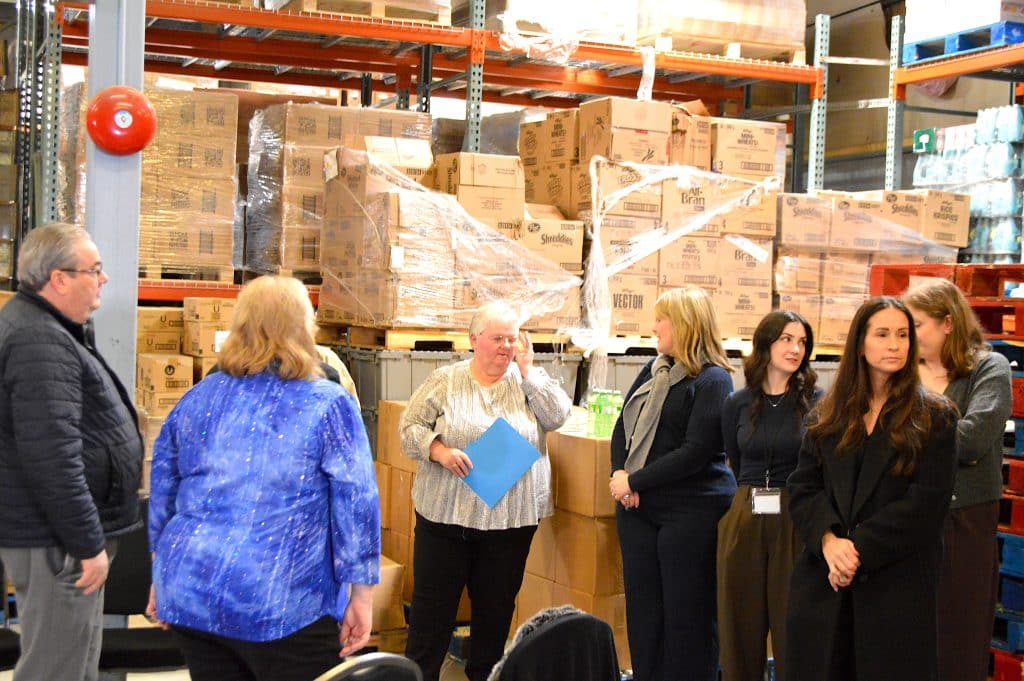
Bishop said the government money will be used to purchase more food for the network to distribute. She also pointed to systemic changes needed to address affordability, like lowering rental costs and changing thresholds so more people are able to qualify for government assistance.
“When people have more money they are going to go out and buy more food, they’re not going to come to the food bank,” she said, applauding the Wakeham government’s recent announcements of new or increased provincial transfers for households with children and seniors.
Earlier this month the Canadian Centre for Policy Alternatives released its 2026 Living Wages report for the Atlantic provinces, showing a growing gap between what workers and families in Newfoundland and Labrador earn, and what they need to meet their basic household needs.
The report’s authors recommend that governments “invest in local, sustainable, affordable food production and distribution, and address food insecurity by improving income security,” the report reads. They also recommend governments “use legislative and regulatory tools to combat anti-competitive practices and price gouging.”
If the PCs are unwilling to tackle the industry pricing side of the equation, they will need to continue initiating government assistance.
“The more money we can put in the pockets of individuals, of families in this province, every bit helps,” she said.

Author

Related Articles

May Day Rally Shows New Face of Today’s Labour Movement
Turnout for May 1 march and rally in St. John’s one of the biggest yet in this province

Recimply the Best: Pitch and Pick Competition Winner Aims to Reduce Paper Waste
Recimply won big at Genesis’ annual Pitch and Pick competition last week. The startup is solving the problem of non-recyclable paper receipts.

Coming Home Queer for the Very First Time
For three days in July, queer Newfoundlanders and Labradorians from all over the world celebrated a rural homecoming 30 years in the making.
New Family Affordability Benefit ‘a band-aid over a broken limb outreach worker
As Wakeham government rolls out social support transfers, critics say PCs not doing enough to address underlying systemic issues
N.L. has widest living wage gap in Atlantic Canada, report finds
More than half of women workers here don’t earn enough to cover basic expenses, while residents of Labrador and the Northern Peninsula have ‘the highest living wage that we have observed,’ says researcher
N.L. oil industry ‘drawing to a close’, new analysis finds
As government touts new interest from Shell and Equinor in province’s offshore, Memorial University researchers say trends and data point to a sunsetting industry and the need for an exit strategy