
Why decades of government neglect of Nain Airport is about more than transportation
Government underfunding and broken promises about the services Inuit would have after being relocated from Hebron to Nain are part of the airport’s legacy
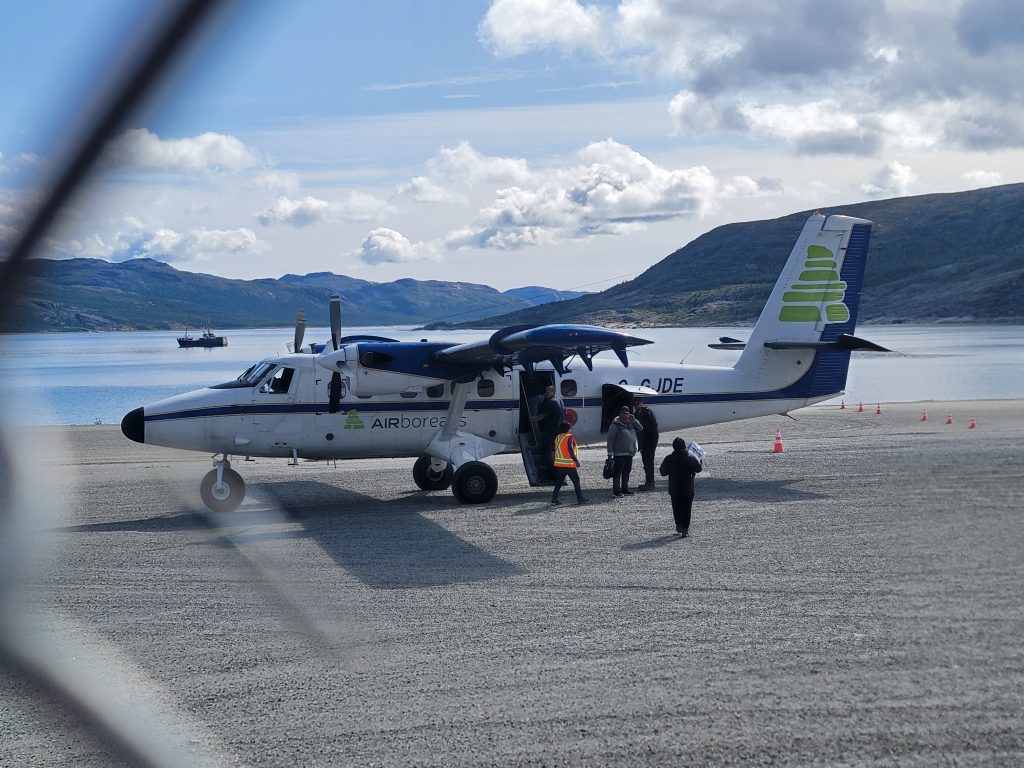
In 2019, Nain, the largest Inuit community in Labrador and Newfoundland, was cut off from access to the outside world for two straight weeks. A communications tower that brings landline, internet, and 3G phone services to Nain broke at the same time as thick fog grounded all flights into the community. Contact beyond the community was limited to satellite phones, a technology not everyone can afford. If someone had a heart attack, a broken bone, or some other medical emergency, they would have had to wait it out, or take the Kamutik W ferry to Natuashish or Hopedale—also on Labrador’s north coast—and then fly from one of those communities to Happy Valley-Goose Bay.
Here’s the thing: it never had to be this way. Nain is in this situation because of choices made by the province, decade after decade.
I moved to Nain in spring 2019. I packed up my Montreal life to move to my ancestral homeland of Nunatsiavut to work for my treaty government as director of policy. My ânak (paternal grandmother) was born on the land at Tishialuk, a small village between Makkovik and Cape Harrison. I had never lived in a place smaller than 150,000 people before I moved to Nain, and being there changed my perspective on the province’s transportation system. It helped me understand that “remoteness” is not a reflection of literal distance between places. It is a state strategy that is inseparable from questions of power and control — what the anthropologist Swargajyoti Gohain calls “selective connectivity.”
Transportation is key to connecting people. The opposite is also true: lack of transportation and lack of support for critical infrastructure imply not caring if people are connected. Put another way: how and where governments invest in transportation infrastructure tells us about who they think are most important to connect to public services and centres of administration, and to each other.
Will you stand with us?
Your support is essential to making journalism like this possible.
Given the community’s size and status as the administrative capital of Nunatsiavut, it would be reasonable to expect Nain to have the best infrastructure in the region. Unfortunately, that’s not the case.
The airstrip in Nain was built in the early 1980s. Before that, float planes landed in the Nain harbour. The current airstrip is 605 m long and just six metres above sea level; its gravel regularly needs to be replaced as it erodes from waves and sea ice. Nain is also the only community on the north coast of Labrador without lights on its runway, meaning flights can only land during daylight hours. Our current airstrip is only one-third the length it should be; a planned new runway will be between 1,830 m and 2,133 m long. However, despite an expedited process and predictions of a 2030 completion date, my experience suggests it likely won’t be finished for a decade.
The current runway cannot accommodate any aircraft bigger than a Twin Otter. In December and January, there are fewer than seven hours a day when flights can get in, depending on weather. In my experience, Air Borealis does not fly if there is any risk of freezing rain, which can pose problems during most of the year in northern Labrador because if it is raining on the ground, that rain can become freezing rain at the elevation where planes fly. Twin Otters can fly in snow, but the weather for most of December 2024 and January 2025 on the north coast was hovering around zero, changing between snow and rain and stopping Twin Otters from flying safely. As a result, the 2024 Christmas season saw just one or two days a week during which planes could safely fly into Nain. Some residents waited up to five days to leave or return to the community.
Meanwhile, in Saglek, about 200 km north of Nain, there is a Canadian Forces Station with a paved airstrip of 1,448 m. No one lives in Saglek year-round; it was a manned radar station during the Cold War. Perhaps as a reflection of public priorities, it seems it was more important for the military to land in Saglek than for planes to land in Nain at night.
The lack of critical infrastructure in Nain has knock-on effects for the rest of the north coast, as most flights to the coast are routed to or from Nain, stopping at other communities along the way, or to Happy Valley-Goose Bay. That makes the Nain airport an entry point to understanding the massive inequalities experienced by the province’s most heavily-populated Indigenous region.
Residents in the dark
Residents of the north coast are often unsure how decisions are made about which flights actually take off from Happy Valley-Goose Bay. Since a significant number of passengers are headed for Nain, if planes can’t land there, they sometimes don’t go at all, meaning flights to other coastal communities en route are also cancelled. People waiting in the Goose Bay airport will often ask people on the north coast to text photos of the weather to help them predict whether the airline will fly, since smaller communities have fewer passengers and it may not be economical for the airline to fly one passenger to the only community with weather good enough for a Twin Otter to land.
Map of Airports east of (and including) Kuujjuaq, and Air Borealis flight routes, including selective runway lengths. Illustration by Patricia Johnson-Castle.

That’s exactly what happened when I was trying to visit my cousins in Rigolet for New Year’s. Since Rigolet is on the Lake Melville side of Cape Harrison, it tends to have different weather than Makkovik, even though the two communities are only about 100 km apart as the crow flies. To my knowledge, I was the only passenger going to Rigolet that day. My cousins said the weather was clear but a little cloudy. After being on weather hold from 7 a.m. until 2:30 p.m. that day, the airline cancelled all flights.
Nain’s bottleneck effect is intensified by its status as the only community on the coast where a Dash-8 aircraft cannot land. A Twin Otter seats fewer than 20 passengers. A Dash-8, on the other hand, can easily seat 68 people. The Dash-8 is also more robust to weather factors like gusting wind. There are significant crosswinds because of Nain airport’s location, which make it difficult for Twin Otters to land, despite their being one of the most maneuverable aircrafts. Notably, Dash-8 aircrafts are commonplace in Canada’s Arctic; they are the aircraft of choice for most communities the size of Nain. Their larger size would offer airlines greater flexibility in combining cargo and people — a normal practice in the north, especially when there is bad weather. Air Borealis, a local airline, would likely continue to keep Twin Otters in rotation because, in future, it could be economical to send a full Twin Otter to a few of the smaller communities and reserve a full Dash-8 for Nain, for example.
The benefits of better airport infrastructure can be seen in Arctic Fresh, a social enterprise grocery store in Igloolik, Nunavut. This grocer charters a Boeing 737-200, which has reduced its freight costs by 40 per cent. The Igloolik runway is 1,248 m long. Longer runways bring down costs and provide flexibility to local businesses.
A quick history lesson
How did we get to the current situation, the consequences of which range from inconvenient to life-threatening for people on the north coast? For answers, we might usefully start with Confederation, and the subsequent eviction of Hebron. In 1959, the Moravian Church and the province colluded to evict the residents of Hebron, then the largest community on the north coast, displacing families and breaking up kinship circles, allegedly to provide better services to Inuit. This scheme was documented in Dispossessed: the Eviction of Inuit from Hebron Labrador (2017) by Carol Brice-Bennett. Where are those services? People with broken bones, or worse, may have to wait days before they can be sent to Happy Valley-Goose Bay for treatment.
The 1949 Terms of Union between Newfoundland and Canada failed to include recognition of Indigenous Peoples despite our obvious existence, leaving us in a strange limbo. The reasoning offered by Newfoundland and Canada was to prevent anyone in Newfoundland and Labrador from losing their citizenship by “becoming” Indians under Canada’s Indian Act. But as Mi’kmaw scholar Bonita Lawrence notes in her contribution to Tracing Ochre: Changing Perspectives on the Beothuk, “without recognition, making claims against the state for treaties, for redress for land theft, even to reclaim the bones of our ancestors, is impossible.”
In the decades after Confederation, Indigenous people became a political football between the federal and provincial governments. As of the 1970s, the federal government transferred money to the province to spend on Indigenous Peoples — $9 for every dollar provided by the province. The two levels of government negotiated what the money would be spent on, and if Indigenous organizations did not lobby, they were likely to be excluded from the decision-making process.
Members of the provincial government were extremely unhappy with Indigenous people who did speak up. As the Labrador Inuit Association became more vocal about issues in our communities, then-Minister of Social Services and Rehabilitation Tom Hickey accused Inuit of “conducting a growing campaign against all white people.” Hickey also blamed the Memorial University Extension Service that provided support to communities through workshops on subjects like governance and accounting.
Perhaps Hickey was just saying the quiet part aloud. The north coast has constantly been overlooked when it comes to all forms of infrastructure. In the 1970s, children from Nain who wanted to finish high school had to leave the community and go to the residential school in North West River. Once again, where were the services that Inuit were promised in exchange for eviction from their homes in Hebron? Reporting from Newfoundland journalist Sarah Smellie in 2022 showed how the provincial government continues to shirk its responsibilities for maintaining homes owned by Newfoundland and Labrador Housing on the north coast.
Remoteness by design
The Nain Airport is the lifeline of the north coast, but the current infrastructure is symptomatic of remoteness by design. The first day of school was delayed last January because teachers were stuck in Goose Bay. Fresh produce, heavily subsidized by the federal government, rots in hangars when planes are grounded. Technicians for phones and internet, the diesel plant that provides electricity, the nurses and social workers who work on rotation—and the list goes on—all rely on being interconnected by air.
Through the success of the Inuit-Crown Partnership Committee, the federal government has started to set aside funding to overcome the massive infrastructure gaps between the Arctic and southern Canada. But even as we suffer now because of the mistakes of the past, this commitment is vulnerable to the outcome of federal elections. The Nunatsiavut Government recently waived the environmental assessment for the new airport to be built for Nain. While the hope is for an expedited process, the project involves many moving parts. Compounding existing uncertainty about funding for the infrastructure, there is no guarantee a new government will not bring massive cuts to support for Inuit communities.
If our transportation system is supposed to connect us, what does it say that this province never cared enough to guarantee a consistent connection for the largest Inuit community?

Author

Related Articles

Meet two of St. John’s local heroes of transportation
Can community members help make walking safer in winter? Megan Clemens and Myles Russell think so

What would it mean to build a city for kids?
An interview with St. John’s active transportation advocate Ryan Green

The business case for public transit in St. John’s
Expanding public transit in the St. John’s Metro region may seem unrealistic, but when you look at the facts and figures, it’s both reasonable and doable