
Meet The Independent’s new publisher!
With a background in the non-profit sector and a deep desire to see independent journalism thrive in Newfoundland and Labrador, Michelle Bush has found a home at The Indy
Earlier this year The Independent learned we were chosen as one of just six small independent news outlets across Canada to be a recipient of the inaugural Journalism Futures Fund, an initiative led by Inspirit Foundation alongside other foundations intended to support and strengthen the capacity of independent media.
This was, and still is, a huge deal for a small but mighty team that punches far above its weight in a struggling Canadian news industry.
With that financial support we have hired publisher, marking the first time we’ve been able to have one since we became a non-profit news outlet in 2014.
Please join me in welcoming Michelle Bush to The Indy! Michelle, who lives in St. John’s, will run the operational and administrative side of The Independent — a great need we’ve had for years and which, given our limited capacity, has often eaten into our ability to produce as much reporting as we would like.
Here are some questions Michelle answered for us so we can all get to know her better.
For years you were deeply involved with the St. John’s arts scene, serving as executive directors for Eastern Edge Gallery and Neighbourhood Dance Works. That’s how most people who recognise your name might remember you. Can you tell us a bit about yourself and your journey to this point in your life here in Newfoundland?
I hail from Toronto, though I lived there for the shortest period of my life (17 years). My background is in the arts; I studied art education at Concordia University and then continued on to complete a Master’s Degree in Studio Arts. While raising my two children in Quebec, mostly Montreal, I developed an artistic practice, the majority being performance sound work with Women With Kitchen Appliances while working in various Montreal artist-run centres. A university friend from Newfoundland asked me to spread the word through my networks of a job opportunity at Eastern Edge. After my daughter gave me permission to – she looked up Newfoundland, decided it was the most beautiful place in the world and told her class we were moving there – I applied for the director position myself.
After over 20 years in Quebec, sight unseen, I got on a plane to St. John’s to run Eastern Edge Gallery. I spent eight exciting years there, learned the ins and outs of not-for-profit arts organizations, helped create the Association of Artist Run Centres from the Atlantic (now called ATLANTIS), sat on national and regional associations, represented Newfoundland and Labrador artist-run culture, participated in juries and committees and, alongside so many other dedicated directors and administrators helped spotlight artists and their work across the Atlantic region.
Will you stand with us?
Your support is essential to making journalism like this possible.
My year and a half as interim director of Neighbourhood Dance Works was a dive into contemporary dance programming and presenting. Dance has always been present in my life, as a dance enthusiast and spectator. It was an enlightening experience connecting with dancers, dance companies and organizations to develop programming for the Festival of New Dance and grow my knowledge and understanding of the dance presenter and producer world.
I then spent a few years working various contracts for artists and arts organizations from communications, outreach, programming, and even a year as an arts editor for a literary journal.
This all was followed by my last decade as a public servant with the federal government, which allowed for some financial and job stability while giving me a better understanding of government agencies, an ability to transfer skills to a completely different work environment, and gain valuable insight and other practical skills.
Moving back into the not-for-profit work environment seems to come from a current deep need to feel purposeful in this world of ours – to do meaningful work towards challenges we face: environmental, social, political as humans sharing a planet and world views with a myriad of beings.
I have now been in Newfoundland for 22 years. It would take a lot to convince me to leave the ocean’s side, the fresh air, the rock and rivers, berries and barrens, ponds and tuckamore, and the people who continue to smile and say hello as I pass by in the street, or on a trail or a ferry.
You’re a newcomer to the news industry, but in some ways that gives you a fresh look at a profession that’s rapidly reinventing itself. What is your take on the state of journalism and news media in Newfoundland and Labrador?
I am definitely a newcomer to the news industry, and though I feel I have kept semi-up-to-date with news items, I confess in recent times I stopped regularly reading the news or listening to the news. A combination of incredibly overwhelming times and increasing difficulty in deciphering the truth chips away at motivation and desire to keep up to date.
The internet was supposed to set us free, give us access to all knowledge, information, and skills so we could be well-informed, critical thinkers with equitable access and the ability to thrive. Navigating this to find a credible piece of information, to find reliable references, to discern between the truth and an opinion, propaganda, a segmented view, an ad, AI or in any way manipulative content has become so painfully time-consuming and frustrating. These obstacles make it hard to trust what is readily available, resulting in little desire to sift through it. The more complicated it became to trust what you were reading, the easier it became to surf social media.
Back to Newfoundland and Labrador – a vast area, an incredibly diverse population with a myriad of needs and expectations depending on the city, town, region, population and even language. How can we respond to such a huge need, especially with the drastic reduction of localised news outlets? I think part of the reinvention of the profession is to slowly and steadily reach out as far and wide as possible and find ways to include communities and individuals so that the issues and news coverage offered is relevant, beneficial, participatory and as current and insightful as possible. The more connections are created across the province, the more trustworthy and worthy of support and readership The Indy will be.
What are some issues you care about but don’t see adequately reflected in local news coverage?
What first comes to mind is the destruction of the province by developers and investors unchallenged by environmental, preservation and community health concerns. They’re being allowed to raze vast areas of nature, areas and buildings of historical importance and urban green space to build for whom, and to what end? There is a slow and continuous destruction of land, community strength and health in the name of capitalistic economic growth and expansion, which in my opinion is short-sighted and leaves out the overall welfare and care of citizens.
I would like to read more about how all issues that are reflected in local news coverage are linked, and how we are witnessing what could be called the gentrification of everything on this planet.
From your perspective, what makes The Independent unique in this province – not only in terms of the stories we cover and how we cover them, but also in terms of what’s possible as we grow?
What I find amazing and exciting about The Independent is its history and longevity. Because of its flexibility, willingness to try new formats, to adapt to changes in journalism, media and news, the possibilities for its future iterations are endless. At any point in its trajectory there has been enough of a core group – supporters, journalists, editors and volunteers – to sustain it and demonstrate Newfoundland and Labrador’s need for it. Through all the changing times, readers, subscribers and supporters have believed in independent journalism and have counted on The Indy as a news outlet dedicated to this province. I mean, that is amazing.
As a non-profit, The Independent remains completely owned by the public, for the public, reporting on issues within Newfoundland and Labrador and reaching as far as resources allow. It also continues to attract journalists with a breadth of experience who are compelled to deliver impactful journalism.
As a mother and a grandmother (with another grandchild on the way!), what keeps you up at night?
The diminishing value of kindness, grace, empathy, care and generosity. The demise of common sense, critical thought, and actions for the common good.
How hard it is becoming to believe in the goodness of humanity, and to hold on to hope. What a world the younger generations are growing up in, raising children in, trying to make sense of and survive in, let alone thrive in.
A world of devices has produced loneliness and promoted individualism while leaving people feeling part of an online community where communication is abbreviated and concentration spans are made shorter.
I am graced with ease of sleep – at times with strange dreams – but these worries mostly take over during my waking hours.
Have you read any books or watched any movies lately that you’d like to recommend?
A book that remains in my mind is A Gentleman in Moscow by Amor Towles, which I’ve recommended to so many friends. I was taken in by the journey, the era, the main characters, the narration and details. There was a flow to the writing, a beauty to each descriptive passage and a deep sense of character. There was also an interesting historical fiction setting. It isn’t a recent book, just one I still think about.
I recently read One day, everyone will have always been against this by Omar El Akkad. I believe we should all read this, listen deeply, and then act to the best of our abilities to end genocide.
I am a big fan of MUN Cinema, which screens every second Wednesday at 7 p.m. at the Avalon Mall movie theatre. The films are curated by Noreen Golfman and include very well chosen foreign and independent, award-winning, and festival hit films. The series just started up again at the beginning of September with Tuner by Daniel Roher, starring Dustin Hoffman and Leo Woodall – a heist film where a New York piano tuner falls into the clutches of a mobster exploiting his safe-cracking potential.
How can Indy readers and supporters contact you?
You can contact me via old school e-mail at publisher@theindependent.ca – and don’t be shy if you bump into me in the street, or in a pond.

Author

Related Articles
Men of N.L.: I want to hear from you!
We’re making a new podcast exploring what it means to be a man in NL today and the experiences that shape men’s lives
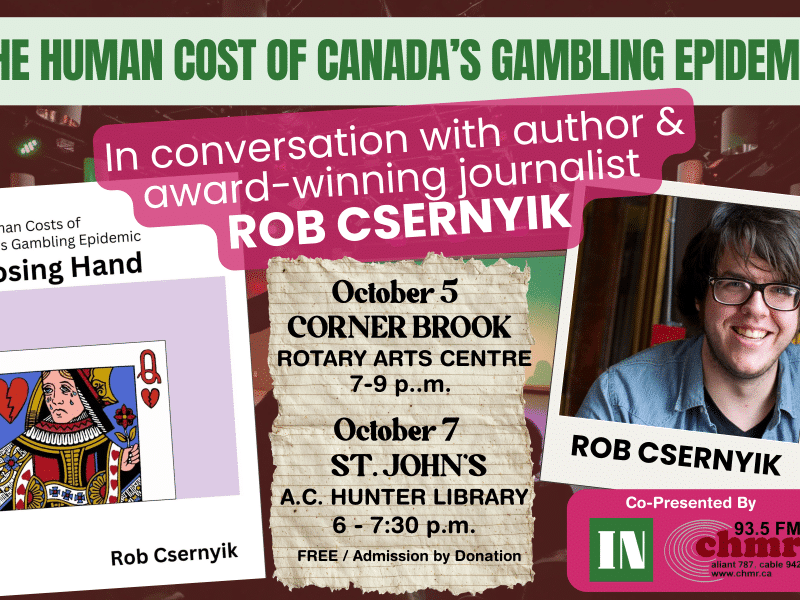
EVENTS: In Conversation with Award-winning Journalist and Author Rob Csernyik
Join us in Corner Brook (Oct. 5), St. John’s (Oct. 7), or online
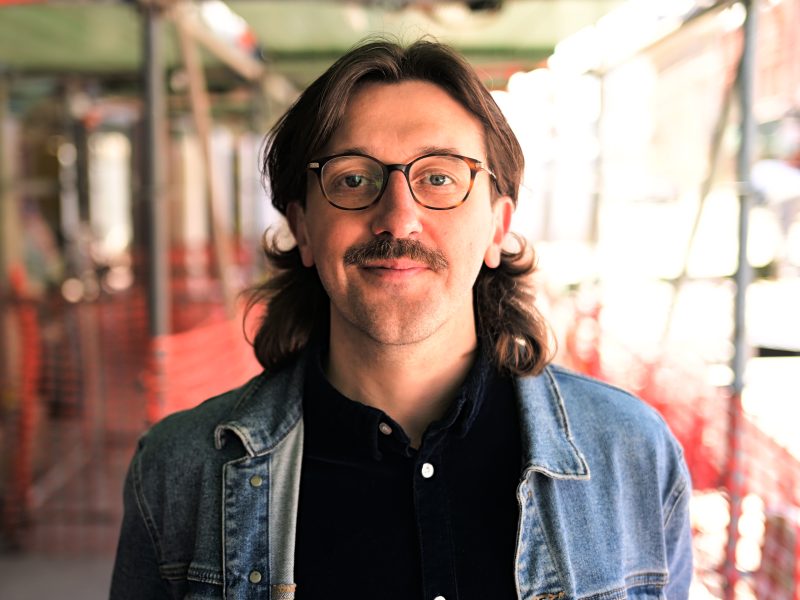
Veteran journalist Kenny Sharpe joins Indy as a reporter/editor in St. John’s
With 20 years’ experience, the Conception Bay North native will cover St. John’s and the Avalon