
What Québec’s provincial election could mean for the Churchill Falls deal
With the separatist Parti Québécois leading in the polls and 29 per cent of Quebecers undecided on who to vote for, anything could happen on Oct. 5, and beyond

The new Churchill Falls Definitive Cooperation and Implementation Agreement (DCIA) may have survived contact with legislative scrutiny in Newfoundland and Labrador’s House of Assembly, and a promised public referendum in the province that Premier Tony Wakeham reneged upon.
But how will it fare against next week’s Québec provincial election?
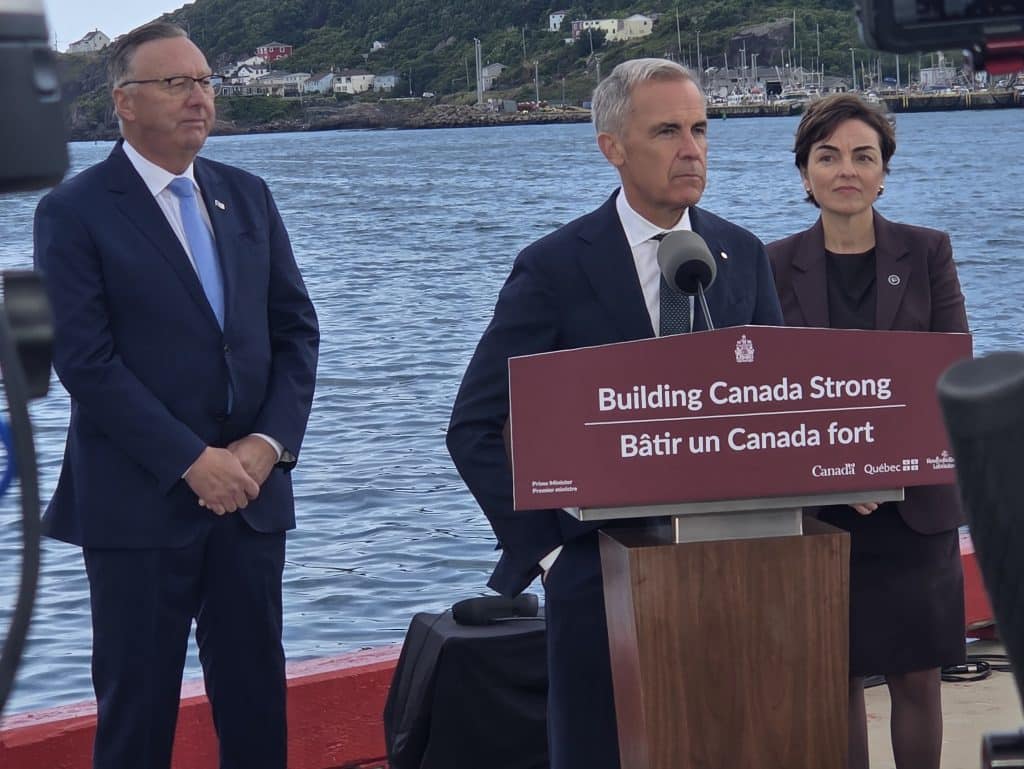
In August, Québec Premier Christine Fréchette stood alongside Wakeham and Prime Minister Mark Carney in St. John’s to announce the new non-binding memorandum of understanding on development of hydroelectric resources on Labrador’s Churchill River.
Supported by the governing Progressive Conservatives and their slim legislative majority, the DCIA replaces a 2024 MOU and the contentious 1969 Churchill Falls Power Contract between the provinces, supposedly promising Newfoundland and Labrador greater revenues while meeting Quebec’s long-term energy needs.
Will you stand with us?
Your support is essential to making journalism like this possible.
The Sept. 17 vote in Newfoundland and Labrador’s legislature came amidst opposition from the province’s Liberal and NDP caucuses, and from Innu communities in Labrador and Quebec. However, the finer points of the new agreement – commonly referred to in Newfoundland and Labrador as MOU2 – still to be negotiated.
On Nov. 17, Québec’s National Assembly is scheduled to reconvene after the Oct. 5 provincial election, with a strong likelihood of a new government assuming office.
This presents an extremely tight timeline for the Wakeham government, which wants the details finalized by the end of the year to secure the deal. Even the initially-penned ratification deadline of March 31, 2027 appears less certain (it can be pushed back if both parties agree) amidst mixed signals from Québec.
So, how likely is it that negotiators from NL Hydro and Hydro-Québec will have to go back to the drawing board? After all, if the 2024 MOU could be unilaterally reneged upon by a change in Newfoundland and Labrador’s government, what could stop a new government in Québec from doing the same to the new MOU?
In no small part, this will be determined by Québec voters, and with five mainstream parties vying for seats in the province’s National Assembly, each with their own policies on Churchill Falls, there is no shortage of permutations.
Where the Québec parties stand on Churchill Falls
If the reigning Coalition Avenir Québec (CAQ) retains power, then the deal should pass without a hitch. But after eight years in power, the once fresh party that defined itself against the old dichotomies of Québécois politics – pitting separatists against federalists – now goes into an election struggling to defend a stuttering economic record, self-inflicted crises in the health sector, administrative imbroglios, and the general unpopularity that comes after such a long time in government.
The CAQ took over from the province’s Liberal party in 2018, whose current leader, Charles Milliard, called for greater transparency during the provinces’ negotiations earlier this year. Immediately following the new MOU’s announcement in August, Milliard said he would “fully analyze it before ratifying it,” but that he would not renegotiate from scratch. However, the Québec Liberals face an equally challenging route to power, after a tumultuous and leaderless period that saw former Trudeau-era minister Pablo Rodriguez defenestrated, and a struggle to appeal to the province’s non-anglophone population.
The call for greater transparency is echoed by Québec solidaire, a left-wing sovereigntist party. In a written statement to The Independent, the party stated: “Unfortunately, Christine Fréchette’s CAQ is keeping information about this agreement under wraps, so it’s difficult to know what it means for Québec.” Whilst many of the more significant details have been revealed by the Newfoundland and Labrador government, both following the August announcement and during September’s legislative session, much still remains undisclosed to the public. The party added: “We want to ensure that the electricity Quebecers pay for remains affordable.”
Québec’s Conservative party has called for partially ending Hydro-Québec’s monopoly, but just like Québec solidaire, even if they are competing for seats, it is unlikely Conservative leader Éric Duhaime will end up as the province’s next premier.
As things stand, that title looks most likely to go to Paul St-Pierre Plamondon, leader of the Parti Québécois (PQ). Speaking in St. John’s, Frechétte alleged St-Pierre Plamondon would “rip up” the MOU. Frechétte’s remarks were made just before the start of official campaigning in Québec, and St-Pierre Plamondon was quick to counter. He decried the lack of publicly available details and promised his government would undertake a due-diligence review, but denied he was looking to entirely cancel the deal. “That’s not our intention,” he said in early September. “The feedback we’re getting from Hydro-Québec – even though there hasn’t been full disclosure or transparency regarding the agreement – is that it seems to be a good agreement.”
Much has been made about the lack of transparency and the need for a review, but Québec’s opposition parties have been reluctant to explicitly state what they are looking for. Québec solidaire, for its part, has identified this dearth of data to highlight the lack of due diligence around projected energy needs.
“The agreement with Churchill Falls is supposed to allow Hydro-Québec to meet Quebecers’ projected energy needs (economic growth and decarbonization). However, these needs were assessed hastily and not substantiated. If industrial growth doesn’t materialize, who will pay the new costs?” the party said in a written statement to The Independent. “A commitment of this magnitude cannot be based on energy demand growth projections that Hydro-Québec hasn’t sufficiently tested publicly. It’s like ordering food for a big party without knowing if the guests will show up: we risk ending up with a lot of leftovers, and the Québécois will foot the bill.”
The party also raised Québec’s export contracts with New York and Massachusetts, with the possibility the province could face “a situation where the energy we subsidize is sold at a lower price through export contracts.”
However, there is a general understanding amongst experts that whilst some points could be finer tuned, in general this is a “win-win deal for everyone,” and that it would be “impossible to get a better deal than this one,” in the words of La Presse journalist Joël-Denis Bellavance, speaking with CBC News in August.
St-Pierre Plamondon “received a briefing already, and he knows the content of that deal. If there’s no deal now, obviously Québec will not have enough energy to meet the demand that is increasing,” Bellavance said. “Churchill Falls represents 15 per cent of overall production of electricity in Québec, so it’s a major piece of the puzzle that cannot be pushed aside without huge consequences.”
What’s more, for understandable historic and economic reasons, Churchill Falls holds far less political salience in Québec than it does in Newfoundland and Labrador. Unlike Newfoundland and Labrador’s governing Progressive Conservatives, the PQ has not made a campaign promise out of the issue – even if the former did renege on its promise to hold a referendum. It’s a referendum of another kind that could derail talks further.
The PQ is an avowedly separatist party that is not afraid to block federal policies it doesn’t like, such as the proposed high-speed rail link between Toronto and Québec City. The party is also known to raise historical antagonism, including previously looking to renegotiate Churchill Falls not with the 1967 agreement in mind, but rather what it sees as the true ‘injustice’: the decision to make Labrador part of the then-Dominion of Newfoundland, rather than Québec.
The PQ is also committed to, in its first term, a third independence referendum. While St-Pierre Plamondon said he would not hold one while President Donald Trump remains in office – which would, in theory, last until January 2029, more than halfway through a hypothetical PQ government. While talk of a referendum has been sparse in recent weeks, the matter still remains part of the party’s platform.
This matters, not only because of the various legal and economic ramifications that could accompany a separatist vote, but because of the role the federal government played in the new MOU. As Alberta and its newly funded pipelines can attest to, holding such a vote is not necessarily a barrier to working collaboratively with this federal government. But with up to $10 billion in federal funding earmarked for Churchill Falls and other potential energy projects between the two provinces – including the Gull Island hydroelectric project, co-funding a new Labrador onshore wind project, and building associated transmission lines – a separatist, or even antagonistic, Québec government could jeopardize this funding.
29 per cent of voters still undecided
The PQ’s referendum policy is deeply unpopular amongst the general public – roughly two-thirds of the population don’t want another vote – but it is testament to the deep unpopularity of the other parties that the PQ still leads the polls. As of Sept. 29, 338canada.com puts the PQ at 30 per cent of the vote, the Liberals at 23 per cent, the Conservatives at 18 per cent, the CAQ at 17 per cent, and Québec Solidaire at 11 per cent.
However, 29 per cent of polled voters are still undecided, meaning anything could happen between now and Oct. 5. What is fixed between now and then are the existing terms of the MOU – ones that a future Québec government may struggle to improve upon.
As Fréchette herself said in St. John’s, “What do [the opposition parties] offer to Quebecers if it’s not this agreement? Where will they find the 10,000 megawatts we are bringing to Québec with that agreement?”
Newfoundland and Labrador has put 50 years of animosity aside to reach a new long-term deal with Québec. It is now up to voters in Québec, and whichever party or parties they choose to form a new government, to decide whether to continue on this collaborative path, or go back to the drawing board.

Author

Related Articles
Hydrogen Hype?
It seems the wind has been taken out of the sails of Newfoundland and Labrador’s wind-to-hydrogen hype. So what does this mean for the province’s renewable energy transition?
Canada must reverse refugee healthcare funding cuts
The cuts are likely to reduce medication adherence, increase hospitalizations, and download healthcare costs to the province
No energy justice with Bay du Nord
Newfoundland and Labrador’s Bay du Nord ambitions are out of step with the dire need to phase out global oil production and the province’s benefits agreement with Equinor underscores the need for a new approach to fossil fuels