
Memorial University cuts continue – without collegial governance, and without transparency
To end the 2023 faculty strike, Memorial University promised a committee and a report on collegial governance, but its administration ended the process
Memorial University is being changed significantly by the current administration and board of regents. As someone who began studying at MUNL in 1989, and who teaches there now, I can confidently say the nature and character of our province’s university is being changed before our very eyes. The past year has without a doubt seen a drastic shift.
This is being done in an environment in which Memorial has collegial governance structures that are still below what is available in other universities across the country. In 2023, Memorial placed last among Canadian universities on a key measure of collegial governance: the number of academic staff representation on the university’s board of directors.
A recent cut to first-year mathematics instruction resulted in a 50 per cent reduction in course offerings – part of a broader effort to lay off contractual professors and increase first-year class sizes. An access to information request published by journalist and activist Matt Barter also shows that Memorial lost 29 professors to early retirement this year. This was in addition to contractual faculty members whose contracts were not renewed.
These losses on the teaching side of the institution have real implications for course delivery.
Will you stand with us?
Your support is essential to making journalism like this possible.
I teach in the Department of Sociology and Criminology – one of the biggest departments in the Faculty of Humanities and Social Sciences – where our teaching capacity was cut by approximately one-third this year as we lost two contractual professors, as well as per-course instructors.
Making it difficult to access courses is what you would do if you wanted to destroy a successful program. Head of the Department of Religion and Culture, Barry Stephenson, has documented how years of hiring freezes and MUNL’s failure to replace faculty members ultimately led to the demise of their successful Master of Arts program.
Graduate students require supervisors, and without faculty to take on the supervision of new grad students, it becomes difficult to maintain enrolment numbers at the graduate level.
In a written statement to The Independent, Memorial says enrolment “drives the number of course section offerings, and contractual teaching positions required at Memorial.” Administrators often assume that if students cannot get courses they will simply do other courses. In reality, students who do not have access to courses they want or need will sometimes choose not to return, or take the semester off. If increasing enrolment and retaining students to graduation is a goal, the university needs professors, course offerings and graduate supervisors to do that.
The university is also selling off its prized Harlow campus in England, and has ended its Frecker program in Saint-Pierre for French language education.

In May, the university’s board of regents approved a budget that required faculties and schools to cut 4 per cent – and administrative units to cut 6 per cent – of their total budget. This came after two auditor general reports raised serious concerns about administrative costs and the growing footprint of buildings, but not about the cost of teaching resources. These most recent losses, on top of a decade of hiring freezes on the faculty side of the institution, are making it difficult for students to access courses; students are also attending first-year classes that are much larger.
The Minister of Education and Early Childhood Development seems okay with the cuts to the education side of the university, stating in January that MUNL needed to “consider everything.” Notably, in the leadup to the 2025 provincial election, Tony Wakeham told MUNL’s faculty association that the PC Party “commits to maintaining Memorial University as a comprehensive public university, that is adequately funded to sustain high-quality teaching, research, and community engagement across all campuses.”
It is a frequent refrain in administrative circles that professor salaries are the highest cost for the university, with little recognition that without professors you cannot bring in tuition and research dollars. We are seen as merely a cost to be cut, rather than an investment in service delivery to our clients, who happen to be students and the public of this province.
After teaching plans were already completed for the 2026-27 academic year, Memorial’s administration announced the early retirement program that ultimately led some faculty members into retirement despite being scheduled to teach in 2026-27. May is very late to be making such changes.
Departments, schools, and faculties had to scramble to meet the needs of students. In an ideal world, teaching plans for an academic year are in place by December of the previous year.
Memorial University Faculty Association (MUNFA) President Erika Merschod has said that students are being sent outside the province to take courses elsewhere to finish their degrees.
Savings from cutting teaching and frontline administrative staff are being used to create a ‘Sustainability Reserve,’ “to provide stability and flexibility to support long-term planning against future uncertainty,” the university said in May. The reserve is valued at $6.3 million, nearly one-third of the value of the $20.85 million that was cut. This means workers have lost their jobs not to balance the university’s budget, but in part to create the sustainability fund, or essentially to put money in the bank.
Notably, $450,000 in spending was returned to varsity athletics this year. That’s enough to pay for approximately four math professors in a year when our mathematics course offerings were cut in half and class sizes were increased. In a province with the lowest math scores – 40 points behind the rest of Canada – department head Ivan Booth said this essentially means our province’s high school students are a grade and a half behind the rest of the country in math skills.
Meanwhile, the university just announced a new mathematics program funded by the Hibernia offshore oil project, which is owned by Exxon and other oil companies. This begs the question: should we be laying off professors and using corporate funding for core program delivery?
“Should we be laying off professors and using corporate funding for core program delivery?”
In a recent VOCM story, Memorial University President Janet Morrison reportedly said, “up to 25 per cent of first-year math students require extra help, and it can become a barrier to their studies.” Shouldn’t this be funded as a core part of our operations, rather than through corporate funding?
After almost a year of being told cuts are necessary, the sustainability reserve was first publicly referenced in a May 21 announcement in the Gazette, after the university’s budget was already approved. While a contingency fund may be necessary, the university did not make clear to the public or the unions on campus that it was the goal of the cuts, until after the board had already approved those cuts. The early retirement program that would result in further losses on the faculty side was announced in the same budget, with hours of notice to faculties.
Memorial’s administration recently announced a $2.7 million surplus for the 2025-26 fiscal year, after cutting last year’s operational budget by $20.85 million. That budget included the elimination of funding for the Harris Centre in St. John’s and cuts to teaching. The Harris Centre had a mandate for public engagement and helping researchers connect their work with the public that funds the university.
The narrative that Memorial is in a deficit position has been repeated by VOCM again and again, and again, even though the budget was approved in May with the deficit closed through cuts. There is room for sustainability fund savings in 2026-27, and $2.7 million was put in the bank last year.
The auditor general noted in her October 2023 report that Memorial had the highest administrative salary costs per student (at $2,369) compared to other medium-sized universities. By comparison, Memorial’s administrative cost per student was $893 higher than the average for universities. While there have been attempts to reduce salaries on the administrative side, we do not know that administrative costs are actually getting lower based on the publicly available budget information.
We do know that Memorial’s administration has been hiring consultants, such as the American Association of Collegiate Registrars and Admissions Officers, to complete a strategic enrolment plan at a cost of nearly $200,000. The university also hired professional services firm BDO Canada – at a cost of $64,000 – to assess five separately-incorporated entities at MUNL to, “ensure consistency and comparability across all entities,” starting with The Works recreation facility. Memorial faculty also recently learned the administration hired law firm McInnes Cooper to lead collective bargaining for the employer side.
In Australia, the turn towards consultants at universities has caused major problems in the country’s university system. One of those firms, Nous Group, has also been tapped by Laurentian University in Sudbury, Ont., where it recommended circumscribing the power of Laurentian’s senate to make recommendations on academic programs. These consultants, who do not know the institution, almost inevitably find a financial crisis, and then recommend cuts to teaching and increases to tuition, as documented in the Australian news.
In May, then MUNFA President Lisa Moores told CBC Radio the faculty union didn’t have input into the 2026-27 budget, or the university’s annual funding proposal to the government. In response, Memorial spokesperson Michelle Osmond said stakeholders were contacted after the budget’s release and, “given the opportunity for additional engagement.”
It’s fair to say that faculty, staff, students, and the public have not been engaged in any meaningful way on what the university’s future should look like – though the administration did spend $80,000 on another consultant to lead a faculty survey. Keep in mind, this is a public university and the only university in the province.
It is also notable that there is an ongoing Faculty and School Structure Review which will likely mean more cuts. There is a consultative process around that restructuring but it looks nothing like a collegial governance process.
Collegial governance means listening and being transparent
The 2023 Memorial University faculty strike centred collegial governance as a key issue. Collegial governance refers to a shared decision-making model which invites stakeholders, such as students and faculty, to have input into the university’s future. It has been a response to the corporatisation of university administrations.
Increasingly, university administrators are people who have never spent time in the classroom and have little connection to what is happening there. Collegial governance helps ensure input from the frontline. It ensures transparency with the people who deliver on the main line of business for the university, as well as from the students who receive those services.
In the faculty union’s collective agreement, Memorial’s promise to address transparency through collegial governance was key to ending the 2023 strike.
A collegial governance committee report was supposed to be completed within 24 months after the strike. When that didn’t happen, Memorial’s Office of Faculty Relations refused to grant an extension. When the faculty union asked Morrison to grant the extension, she was not responsive to the request, nor to follow-up communications, MUNFA said at the time. This shows a lack of interest in input from those who are mandated to deliver on the university’s main lines of business – teaching and research.
In one of her first media appearances following her arrival in the province, Morrison said Memorial needs to “rebuild trust.” She went on to say, “I hope in the way I show up everyday and in my commitment to listening and learning people will see me as a partner in that process.”
If she is not responsive to the faculty union regarding the main issue of the 2023 strike, how can Morrison claim she is listening? How can she expect faculty to see her as a partner? It is difficult to see how this is rebuilding trust. By its very definition, collegial governance means listening.

The promised report on collegial governance is no longer forthcoming. Nor is collegial governance at Memorial University, it would seem. Keep in mind that collegial governance costs the administration and board of regents absolutely nothing, other than an investment of staff time to communicate and listen.
Collegial governance can also lead to better decision making for frontline service delivery, and policies that are much more sustainable for the institution. This is arguably what has been missing and the reason why Memorial has continually experienced crisis and turnover at the senior level. The disconnect between administration and the frontline is very real and arguably getting worse.
The provincial government’s failure to give faculty members, elected by faculty, permanent representation on Memorial’s board of regents prompted the resignation, in June, of the board’s two temporary faculty representatives. In a letter, they said the appointment of faculty representatives who were not elected is “highly unusual” for a university board, and that former Premier Andrew Furey had committed to reforming the Memorial University Act to address the shortcomings.
Current Minister of Education and Early Childhood Development Paul Dinn said earlier this year he has no intention of changing the Memorial University Act to give elected faculty members representation on the board of regents. He has never publicly addressed the resignation of the faculty board members.
The narrative of declining enrolments
Soon after her arrival in August 2025, Morrison announced $20.8 million in cuts, explaining the need to put the university on “stronger, financially stable terms.” Key to her case was a claim of “decreased revenue, largely because of enrolment.”
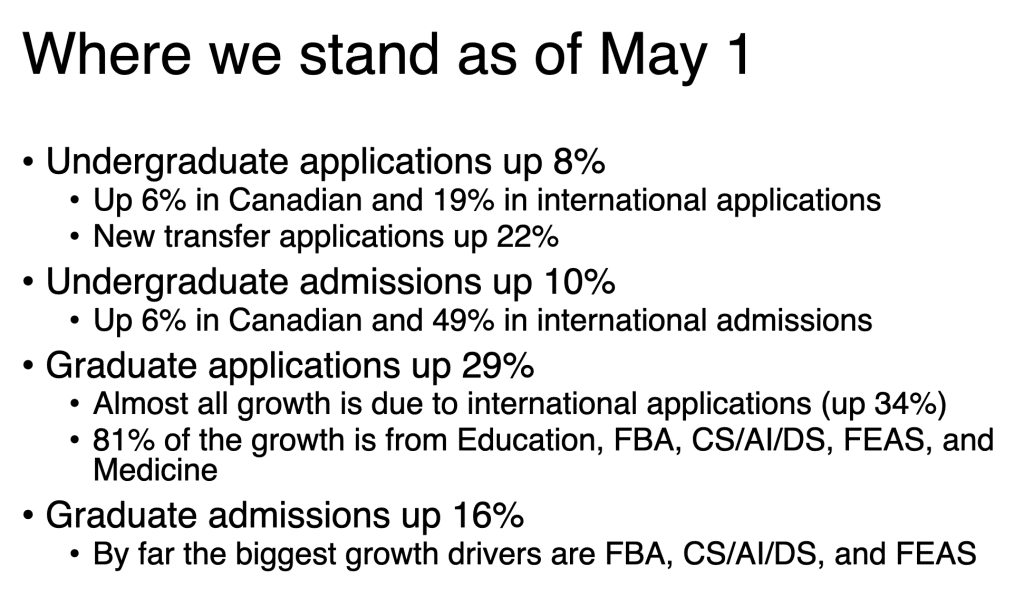
The university senate’s most recent enrolment report, released in May 2026, presents data showing student numbers were rising heading into the 2026-27 academic year. According to the senate, undergrad applications were up 8 per cent, undergrad admissions were up 10 per cent, and graduate admissions were up 16 per cent. The report also notes graduate applications rose 29 per cent. Canadian undergraduate enrolments were up 6 per cent, and international undergraduate admissions were up 49 per cent. Furthermore, the report notes, almost all growth in applications from grad school hopefuls was due to international applications, which rose 34 per cent.
On Oct. 8, the Gazette reported new undergraduate enrolment increased 7.5 per cent this fall, and new graduate enrolment had risen 3 per cent. Total enrolment, however, declined by 2 per cent.
In February, after cutting a series of programs, Morrison told CBC: “The reality is that Memorial has gotten smaller – and not by design. We have about 2,000 fewer students now than we had at our peak in 2021. And the modeling is suggesting that we will get smaller still.”
This modeling, which predicts declining enrolments, has never been made public. The university told The Independent it does not “routinely publish internal planning models.” The loss of undergraduate students was a direct and projected result of the 2022 tuition increases, when new enrolments plummeted by 19.1 per cent in St. John’s the following September, and another 17.8 per cent in Corner Brook.
The administration recommended the tuition increase, projecting that enrolments would decline by 20 percent. The board of regents approved the increase on that basis at its July 8, 2021 meeting. The new tuition framework was implemented only for first year students, and now, five years later, we have full implementation and are seeing the full impact of enrolment decline, year over year.
How can we have transparency when a big part of the reason for the decline in enrolments is being ignored? In October 2025, when asked about the impact of the tuition increase, Memorial Provost Jennifer Lokash told CBC, “we don’t actually see that significant of a decline immediately following” the increase. According to the university’s own data, however, total registration began to decline in 2022 as soon as the tuition increase was implemented.
Interim Registrar Angie Clarke recently told CBC that international recruitment has never been about the money. However, Taqi Yeasir of the Memorial University Students’ Union correctly identified the cause of the loss of international students, as per the the board of regents’ minutes and Memorial’s own data on enrolment, when he noted, “an annual $22,500 for international undergrads can push people toward higher-ranking schools.”
Notably, first-year enrolments increased this year after the tuition freeze was reinstated by the provincial government.
Arguably, we did get here by design and we knew this would be the result of the tuition increase. We can debate whether the administration, or the provincial government of the day, wanted the tuition increased, but this move was made with full knowledge it would shrink the student body. We should not lose sight of that.
Lack of transparency with faculty
Board of Regents Chair Justin Lhada believes the appointment of faculty representatives meets the national standards for faculty representation on Canadian universities’ governing bodies. But a 2018 Canadian Association of University Teachers report on 31 Canadian universities details collegial governance structures that surpass those available to faculty at Memorial University.
Other faculty unions across the country get to elect faculty representatives to sit on university boards, and others have less restrictive codes of conduct which enable faculty representatives to speak more publicly about board deliberations. The former president of MUNFA has also raised concerns around closed sessions in board meetings, which are enabled by the board’s bylaws. Only the provincial legislature can change the Memorial University Act, but the board of regents is responsible for its bylaws and code of conduct. It has the power to make these changes itself.
Morrison arrived at Memorial University during a difficult time. Arguably, what the university was most in need of upon her arrival was reputational repair. There have been years of cuts to funding, tuition increases, Auditor General reports on buildings and management, and national news scandals. The university brand has suffered largely because of administrative problems. Morrison was correct in stating that trust needed to be rebuilt.
Instead of reputational repair, Morrison’s first year was marked by further cuts to faculty and teaching, cuts to the prized Harlow and the Frecker programs, an early retirement program that does not strategically address staffing requirements, a loss of faculty after teaching plans for the 2026-27 academic year were already complete, and a failure to deal with the faculty union that delivers on the university’s main line of business, which is teaching students.
Collegial governance – and by extension, transparency – was the most important issue during the 2023 faculty strike, when 93 per cent of faculty union members voted to go on strike.
Given how unresponsive the provincial government, and Memorial’s administration and board, have been to the faculty union’s concerns, another strike seems to be exactly where we’re headed. This seems to be the only way to communicate with the administration about the problems being experienced on the frontline. However, what is even more concerning is what is being done to our university in the meantime.

Author

Related Articles

May Day Rally Shows New Face of Today’s Labour Movement
Turnout for May 1 march and rally in St. John’s one of the biggest yet in this province

Recimply the Best: Pitch and Pick Competition Winner Aims to Reduce Paper Waste
Recimply won big at Genesis’ annual Pitch and Pick competition last week. The startup is solving the problem of non-recyclable paper receipts.

Coming Home Queer for the Very First Time
For three days in July, queer Newfoundlanders and Labradorians from all over the world celebrated a rural homecoming 30 years in the making.

What Québec’s provincial election could mean for the Churchill Falls deal
With the separatist Parti Québécois leading in the polls and 29 per cent of Quebecers undecided on who to vote for, anything could happen on Oct. 5, and beyond

Hydrogen Hype?
It seems the wind has been taken out of the sails of Newfoundland and Labrador’s wind-to-hydrogen hype. So what does this mean for the province’s renewable energy transition?
Canada must reverse refugee healthcare funding cuts
The cuts are likely to reduce medication adherence, increase hospitalizations, and download healthcare costs to the province