
INTERVIEW: Avi Lewis says N.L. is ‘ground zero’ for the biggest challenges facing Canadians
The federal NDP candidate says socialism and economic populism are the antidote to unfettered capitalism and the ‘epic market failures’ it has brought

Avi Lewis wants to fight fascists, create a national non-profit grocery chain, and reinvigorate our political imagination. He’s got a surprisingly detailed plan for accomplishing these things, and it’s one he thinks will resonate with Newfoundlanders and Labradorians.
One of the five candidates for the federal NDP leadership, Lewis visited St. John’s last week as part of his final campaign swing. He spoke with supporters at Gower Street United Church, where he pitched his effort to move the NDP back to the left of the political spectrum. The NDP will elect its new leader at this week’s convention, being held in Winnipeg March 27-29.
Lewis’s family has deep roots in the NDP and its socialist predecessors. His Polish great-grandfather was a leader in the Jewish Labour Bund, a secular Jewish socialist anti-Zionist movement in eastern Europe in the early 20th century. The Bund was persecuted by the Bolsheviks following the Russian Revolution; that’s when Lewis’s family escaped to Canada.
Lewis’s grandfather David Lewis was one of the founders of the Cooperative Commonwealth Federation (CCF), a democratic socialist movement founded in Calgary in 1932. The CCF ran candidates federally and provincially and formed the first socialist government in North America when it won the Saskatchewan provincial election in 1944. The CCF introduced Medicare in that province and is credited with starting the movement for today’s national public healthcare system. In 1961, the CCF merged with the Canadian Labour Congress to form the New Democratic Party (NDP), with the goal of better popularizing the appeal of socialist politics in this country. David Lewis was general secretary of the CCF from the 1930s to the 1950s, and Avi’s father, Stephen Lewis, led the Ontario NDP in the 1970s.
Will you stand with us?
Your support is essential to making journalism like this possible.
Avi Lewis’s own background lies in journalism and documentary filmmaking, but about a decade ago he started becoming more involved with the NDP. That’s when he realized how far the party had “drifted from its original democratic socialist and populist roots,” he said in an interview with The Independent and CHMR last week.
‘Rigged for the rich’
“I think there’s a real need now for the NDP to return to economic populism,” he continued. “This means insisting on public ownership to solve the crisis that the market has created.”
Lewis’s campaign has been “laser-focused on the cost of living emergency,” he said, explaining he and his campaign have been calling it the “everyday emergency of just trying to get by, in a totally unfair and impossible economy.”
There are identifiable powerful forces behind the crisis, he said. “That crisis of the price of food, the cost of rent and housing, our cellphone plans, and the fact that every sector of our economy is dominated by corporations that collude and price-fix and jack up the price on everything; that is the emergency that most Canadians are facing. Everyone in our economy is facing this staggering inequality and the way the economy is rigged for the rich.”
Lewis is unapologetically socialist, delivering an upbeat, steady-voiced pitch for tackling economic inequality and corporate greed. Could the appeal to economic populism resonate in a place like Newfoundland and Labrador?
Socialism in N.L.?
The party has never really succeeded in building roots in this province, which is surprising in some ways. Newfoundland and Labrador is the most unionized province in Canada and has a unique history with the NDP.
The first provincial NDP party in Canada was born here in 1959: the Newfoundland Democratic Party, as it was called then; it was the successor to a series of union and worker parties that existed in Newfoundland prior to Confederation. The Fishermen’s Protective Union (FPU) was a labour party and political movement that dominated Newfoundland politics in the early part of the 20th century.
The first provincial NDP party was led by the late journalist and trade unionist Ed Finn, who for a time travelled the country with Tommy Douglas, speaking to crowds in union halls and church basements, espousing the benefits of Medicare. Finn led the NDP in two provincial elections in 1959 and 1962, attempting to oust the Joey Smallwood government after Smallwood turned on workers during the infamous logger’s strike of 1958-59 and stripped the International Woodworkers of America’s bargaining rights (the IWA was the union that stepped in to help loggers organize amid terrible working conditions and exploitation).
Finn never won a seat in the Newfoundland legislature, but he lost the two elections he ran in by a narrow margin. Since that time, the provincial NDP’s popularity peaked in 2011 when voters elected five MHAs and the party captured almost a quarter of the popular vote. The party now has two seats in the legislature. Meanwhile, the federal NDP has not been able to break through in this province since longtime St. John’s East MP Jack Harris decided not to run in the 2021 election.
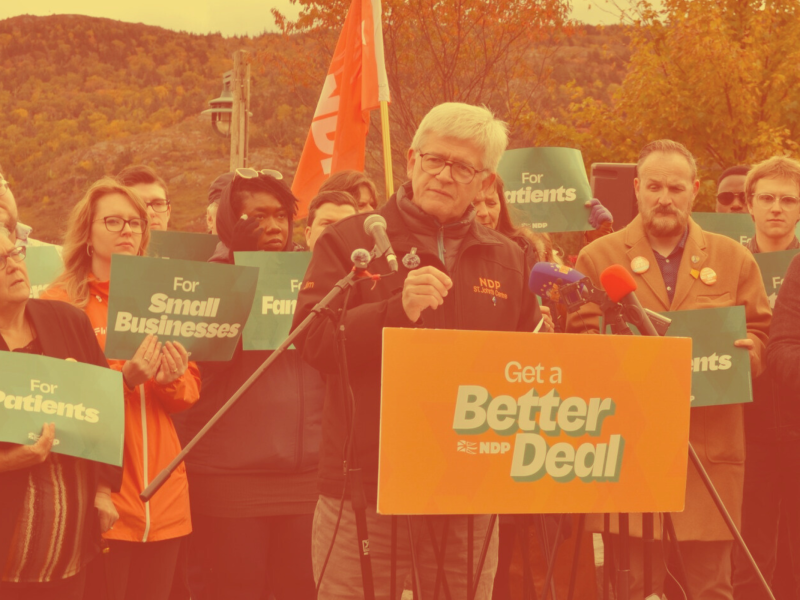
So what are the prospects for the NDP — even a revitalized leftist NDP — in this place?
“The way the NDP comes back in a place like Newfoundland and Labrador—in a heavily-unionized province with a lot of resource economy, most of it dwindling over time as the easy stuff runs out, in a province with a moratorium on cod fishing where everyone knows what happens when a resource crashes—is that we actually need to figure out what a 21st century economy looks like where the vast wealth of this country is directed at solving the crisis of everyday life and not shoveling fountains of money upward to the hoarding class, which is sitting on billions and billions of dollars of wealth that doesn’t ever trickle down to us,” Lewis replied.
“Newfoundland is on the front lines of a lot of the crises that we face,” he continued. “The Bay du Nord project is not going to help anybody with the price of their groceries. These jobs are vague, there’s no promises, they float big numbers. But what we know about these projects is that they create a handful of good-paying jobs that a lucky few get, and those ‘lucky’ few get to work far from home, with insane schedules, miss their kids’ birthdays, just to make a buck.”
Lewis often referred back to his family’s early socialist roots, arguing that movement holds important lessons for the present. “The slogan of the Jewish labour bund — opposing the Zionists who wanted to appropriate Palestinians’ land — was ‘hereness’. That means that our job is to invest in here, where we actually live,” he said.
“I think ‘bundes’ theory makes total sense for Newfoundlanders and Labradorians, because you’ve lost so much to away. And here is where people want to be,” Lewis continued.
“This is the storytelling capital of Canada, and the way people tell the story of this place and tell the story of us and each other and what we’re all going through is one of the reasons I love to be here.”
‘Epic market failure’
A big part of Lewis’ focus is on how the private sector has become dominated by wealthy interests and needs to be reined in.
“We’re in a moment of epic market failure,” he said. “We’ve gone all in on this market model for everything, privatizing public services like healthcare and long-term care, deregulating things so the banks and investment firms can just go wild, making money on exotic derivatives on the stock market. There’s no better example of how we’ve been imprinted and imprisoned in the market mindset than stories on CBC about how Canada Post is losing money. Do we think the ambulance services should make money? Do we think the police should make money? These are fundamental public services which we now see exclusively through a market lens.”
He criticized Liberal Prime Minister Mark Carney’s electoral promises on housing, saying that instead of rolling out a true public housing program, the government has turned housing into a fund for private business.
“It’s working incredibly well for a handful of corporations, but it’s garbage for the rest of us,” he said. “Housing has become a source of real estate speculation and created a bunch of wealth in the Canadian economy that’s all lodged in this one generation that was just lucky enough to inherit or buy homes within a certain period. Homes are not investments, they’re where you live.”
Public solutions
“So what does it look like to actually invest the wealth of our country, and into taking care of each other — in investing in care, in actually having durable infrastructure that protects people and that actually keeps people here?” he said.
“You need a heat pump in every home in Canada. But every time the government offers a little subsidy, the industry just shuffles all the prices around, hoovers up all that money and the prices just get more expensive. But if we had public ownership in an industry like that, and put factories in places like St. John’s or even smaller communities, and create unionized jobs using Canadian steel that we can’t sell to the United States, and slash peoples’ household bills, creating jobs for young people and a whole new industry, you’re actually talking about investing in here.”
Lewis is pitching other public solutions, too: a public developer to hire public construction companies to build non-market housing, and a national rent control program, using the federal government’s financial power (through incentives and penalties) to push the provinces to implement substantive rent control programs.
He also outlined plans for a public option for groceries, with dozens of distribution hubs across the country resourcing publicly-funded grocery stores in every province. He also wants to impose stricter federal regulations on cell phone companies to force down the price of plans and cellphone access.
Lewis says there’s a link between the growing income inequality we’re seeing and the rise of fascism across the world.
“This despair that we feel, and the cost of living crisis, and the stress of trying to get by in an impossible economy, is the fertile field in which fascism takes root,” he said. “It happens in this widespread economic misery and lack of trust in institutions, and lack of faith that anything will ever be better or fair. That’s when people start voting for cartoon strongmen characters.”
By imposing a one per cent tax on the richest one per cent in Canada—and increasing that to two per cent for those worth $50 million, three per cent for those worth $100 million, and on up—Lewis said the government would be able to generate an additional $40 billion per year in public revenue to restore healthy public services across the country.
Oil, gas and climate breakdown
Lewis has a deep-seated background in climate change activism. In 2015, he was part of the movement that produced the Leap Manifesto, a climate change action plan for Canada. In 2019, he was involved with the Pact For A Green New Deal coalition, which also pushed for climate change action policies. As he continues the sustained push for green transition and climate change action policies, how does he see these policies impacting Newfoundland and Labrador, a province which has become deeply reliant on oil, gas and other energy industries?
“We owe oil and gas workers a debt of thanks for keeping the lights on in this country for 150 years,” he said. “I think the NDP, as a workers’ party, is the only party that can be trusted to get off oil and gas and diversify our economy without throwing workers under the bus. That’s what we need to do.”
Lewis is critical of how provincial governments have used oil and gas revenues, arguing they squandered the wealth and gave it back to large corporations in the form of tax cuts instead of using it to provide public services. He said the good-paying jobs that have been created have gone to a relatively small number of people; working conditions have also remained poor for workers who have to shuttle back and forth between Newfoundland and Labrador and Alberta, he noted. Lewis is also a proponent of expanding solar and wind energy.
“The oil industry has figured out how to make a barrel of oil in Canada with half as many workers as a decade ago,” he argued. “So there are way fewer workers receiving those good jobs, and those jobs are getting automated out of existence. And the industry profits are just insane.”
And then there’s “climate breakdown,” he said. “The fires last summer were just terrifying here. That’s going to be the new normal, along with flooding and storms. The weather is getting so unpredictable [and] affecting the agricultural industry, too.”
Lewis is leery of those who see the rising price of oil in the wake of the United States’ attacks on Iran as a potential economic boon for the province.
“Are Newfoundland and Labrador families going to see benefit from that, or are we going to see another inflation spike? Are we going to see a handful more jobs for a few lucky people who get to work in a risky, difficult industry, or are we going to see all of the negatives borne by communities and all of the positives skimmed off by the owners of these companies and their shareholders?” he asked.
“The reason you get so much oil and gas propaganda in this province is because there’s so much money in it.”
Fighting against hatred and transphobia in Canada
As part of his campaign, Lewis has hosted what he calls ‘solidarity sessions’ where he draws on his own background as a journalist to interview activists from around the country about the issues that matter to them. He put off sessions on migrant rights, on the climate crisis, and on workers’ rights. His final session was on trans rights and trans liberation, set against the backdrop of extremely repressive attacks on trans and gender-diverse people by the governments of Alberta and Saskatchewan.
He drew on the arguments of some of the activists he interviewed, highlighting the importance of fighting for trans rights. “Everything about transness disrupts,” he reflected. “It breaks down narratives of conformity, of sameness, it challenges the old patriarchal system where men stood astride the pyramid dominating the planet, and everything has its box to fit into.
“Transness shows that all of society and culture is filled with diversity, with this glorious kaleidoscope of human experience. That’s what scares [transphobes], is people actually being their real selves,” he continued.
“I feel like this is a moment where standing up for the trans community is an existential need for everybody in society. We’ve seen things move so fast these days because of the preoccupation with queerness and transness on the extreme right. That’s where the first attacks come, but they come for the rest of us right away. In Alberta, they used the notwithstanding clause against trans kids, but then five minutes later, in historical terms, they were using it against the right to strike by workers. Trans folks are on the bleeding edge of these attacks on civil rights, on democracy itself, on the precious value of human life. And we are all involved with that struggle.”

Lewis acknowledged that attacks on trans people are coming hard and fast from right-wing governments, and that “we’re not winning right now.” But he believes the majority of Canadians are progressive-minded and decent, and that every Canadian family has members who are gender diverse in some fashion.
Indigenous rights and other priorities
He also flags that Canada is failing in its commitments to supporting Indigenous rights. “We are hurtling backwards in this moment,” he said, noting the “easy parts” of reconciliation—public apologies—have been done, but the substantive work of reconciling land rights and resource ownership is under threat.
“Federal and provincial conservative parties everywhere are going down a rabbit hole of residential school denialism and fear mongering,” he said. Lewis is calling for “nation to nation negotiation” along with “free, prior and informed consent for Indigenous communities around resource projects.”
“There’s an infrastructure gap for Indigenous communities when it comes to housing, running water, roads. There’s tens of billions of dollars in public investment that we should be making yesterday, immediately. It’s the money that’s missing, and instead the federal government is still fighting Indigenous rights in court.”
Lewis’ platform is broad; he also calls for electoral reform, specifically a system of democratic proportional representation to replace Canada’s first-past-the-post system. He believes the NDP, if it can succeed in holding the balance of power like it has done in recent years, can restore “coherence” to the political system.
He’s also not afraid to criticize his own party, and sees a shake-up of its approach to politics as key to rebuilding national support. He believes the NDP has become too centralized in recent years, and wants to give local and regional branches more autonomy to build support and campaign in the ways they know will resonate best with local voters. He also wants to build a stronger youth contingent. His event in St. John’s attracted a predominantly older audience, which he said contrasted with events he’s held in other provinces, but he believes the policies he’s pitching will attract youth concerned about their futures.
“Young people are triply affected by all of these difficulties in our economy and our society,” he said. “They’re carrying the weight of climate anxiety, knowing that the climate is breaking down in real time. Being in an economy that has nothing to offer to young people whatsoever except the knowledge that they’ll never own a home, that there are no jobs.
“I think what a lot of young people on our campaign have found is that we live in really terrifying times, there’s a lot of bleakness and horror out there, and the antidote to horror and despair is action. We actually feel better when we’re organizing and doing this work.”
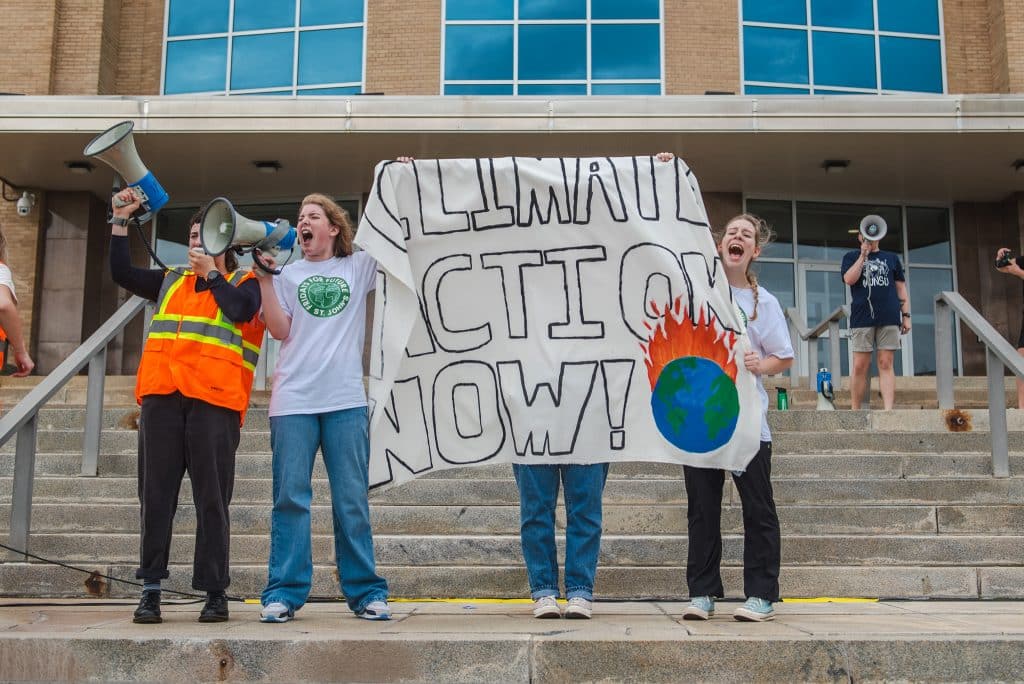
Lewis is critical of how the NDP treated Palestine solidarity activists in recent years and doesn’t mince words on the subject. “I believe that a real, deep majority of Canadians is shocked and horrified by the genocide in Gaza,” he said.
“I think our moral fibre as a country is being challenged by two different Liberal governments, under Trudeau and Carney, that have given mixed message after mixed message on the most basic item of morality in politics. International law is super clear: genocide is the ultimate crime. And Israel is committing it. Canada should be doing everything in its power to stop it. We can cancel trade deals, we can recall ambassadors. We need a real two-way arms embargo on Israel. We have to be doing way more.”
Lewis sums up his pitch by reiterating that he feels Canada’s most easterly province is also in many ways the province on the front line of challenges facing Canadian society.
“This part of the country really is ground zero for so many of the issues that everyone is facing,” he said. “The cost of living emergency, climate breakdown, the questions about oil and gas and resource development, remote communities and how they relate to urban centres and the rest of the national economy.”
He reflected on some of the film work he’s done in recent years, exploring a genre he refers to as ‘democratic futurism’, depicting hopeful, alternate futures through film. He believes this is precisely the spirit needed to restore people’s faith in democratic socialist politics, and in the future itself. He said we need to be doing this in all the spheres in which we engage, from electoral politics to filmmaking to video games.
This descendent of Jewish Labour Bund organizers, who chose the Italian WWII-era anti-fascist folk tune Bella Ciao as his campaign song, alternated between hearkening to the idealism of early 20th century socialist organizing on the one hand, and the potential for futuristic digital forms of political creativity on the other.
“There is such a need to unleash the political imagination, and that means addressing all parts of culture, not just nerdy politics,” he said. “The intersection of gaming and all those other alternative world-building environments, to locate politics within them makes total sense from a left-wing point of view just as much as the right-wing manosphere and all those much scarier manifestations.
“It speaks to the importance of culture, of music, of joy, self-expression, silliness, fun in doing politics.
“We need movements that bring joy back into our lives and where our politics is not compartmentalized away from our video game fun, for instance. We really believe in bringing it all together.”
With files from Lauren Pitre.

Author

Related Articles
What a Newfoundland community can learn from B.C.’s first major LNG facility
As talk about developing an LNG export project in Newfoundland and Labrador continues, residents have questions — and the answers might be on the other side of the country

N.L. chief medical examiner has begun tracking gambling as a risk factor in suicides
The OCME’s policy change came nearly a year after an Independent investigation into gambling-related suicides
Province updated public procurement process days after Deloitte AI scandal exposed
Proponents and suppliers are now required to disclose any intended use of AI before the government will award a contract