
People dying in the streets, advocates say, as PCs draft new poverty reduction strategy
With poverty skyrocketing in St. John’s, frontline workers plea for stable funding, better income supports and adequate housing

While the provincial government gathers input for a new poverty reduction strategy, advocates are calling for the swift implementation of policies and legislation as families across the province continue to struggle and unhoused people are dying in the streets of St. John’s.
“A lot of people have died, and very little is done in any capacity to save their life,” says Shane Reed, who has lived rough in St. John’s and knows firsthand what it’s like to be on the streets. “People just feel so beaten down they don’t even want to connect anymore.”
Reed, who is originally from Alberta, had a good job and was married, says the isolation and sense of abandonment many experience urgently needs to be addressed. “It should be a God-given right to have our basic needs taken care of and know we’re cared for and that we’re not alone.”
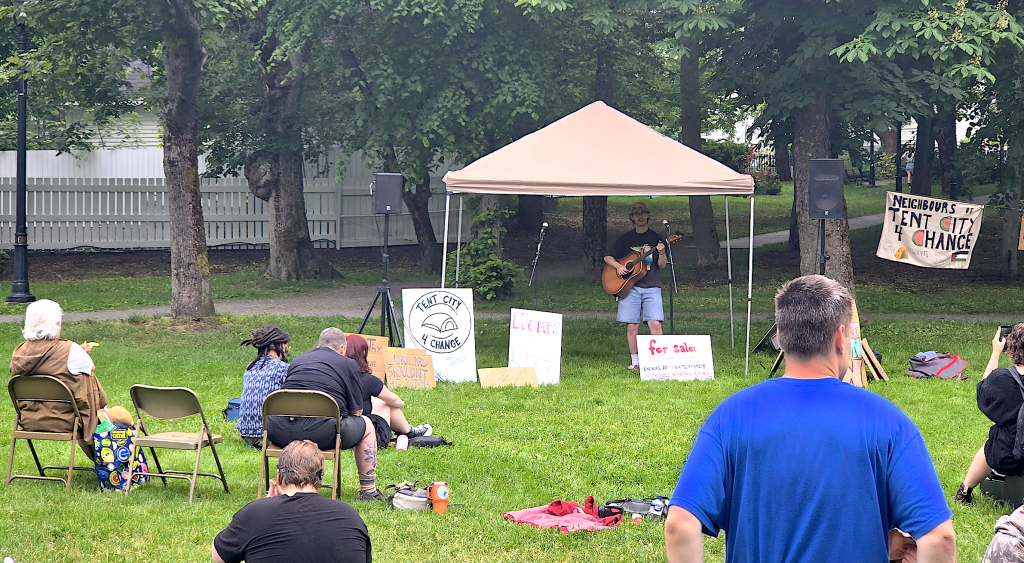
In 2024 Reed found himself living in the Tent City for Change encampment established on the Colonial Building lawn next to Bannerman Park. “I just didn’t know where to turn, and all of a sudden Tent City pops up,” he recalls. The new community, supported by nearby residents working under a mutual-aid model, “made me get involved and care again,” he says. “And it certainly rebuilt my heart to a level where I’m actually out there fighting everyday for people even though I’m dealing with cancer myself.”
Will you stand with us?
Your support is essential to making journalism like this possible.
Under then Premier Andrew Furey, and against the advice of Canada’s federal housing advocate, the Tent City encampment was dismantled in May 2024 by government workers and police officers who covered their faces as residents filmed them.

Reed says the eviction was traumatic for many at the encampment, and that any new poverty reduction strategy should include the idea of ‘green zones,’ sanctioned safe housing where residents can avail of services and wraparound supports.
In New Brunswick, the City of Saint John is experimenting with green zones, which it describes in its homelessness strategy as City-approved and provincially co-funded “transitional housing sites” that serve as “stepping stones to permanent housing.” Green zones “provide safe clean housing alternatives that include units with beds, heat, electricity, site security, washrooms, limited food service, wrap around supports and skills development opportunities,” according to the strategy, Housing for All.
The Government of Newfoundland and Labrador’s displacement of unhoused residents at Tent City was followed by the conversion of a former hotel near the city’s airport to a transitional housing facility. Citing costs, Tony Wakeham’s PC government will close the facility in December but is promising to rehouse its roughly 75 residents and the dozens of others on its waitlist.
Mutual aid offered direct, meaningful impact
Despite Tent City’s traumatic end, Reed attributes progress he’s made in his life to a volunteer he met there, the late Christopher Forsey, who he says was a shining example of the impact outreach can have on those experiencing poverty and homelessness.
“I was so caught up in my own darkness, and then here comes this big, wonderful stranger. He just looked at me with his big caring eyes and said ‘it’s OK to hurt,’” Reed recalls.
He says Forsey asked him a question no one else had. “I hadn’t heard ‘How can I help?’ in over 20 years,” he says, holding back tears.

“Chris basically asked how I got in the situation I was in and I gave him a rundown of it all. And I mean, I could see his heart breaking in front me. But he showed me he actually cared and that people were out there to help. So from that point on it was pivotal in my life, a turning point. It was almost like the universe spun in the opposite direction because I had never known kindness on that level.”
At one time, Reed spent four months of one of the coldest winters sleeping under a picnic table shelter in downtown St. John’s, he says. Now he’s returning the kindness Forsey and other Tent City volunteers showed him by helping with mutual-aid efforts on the streets.
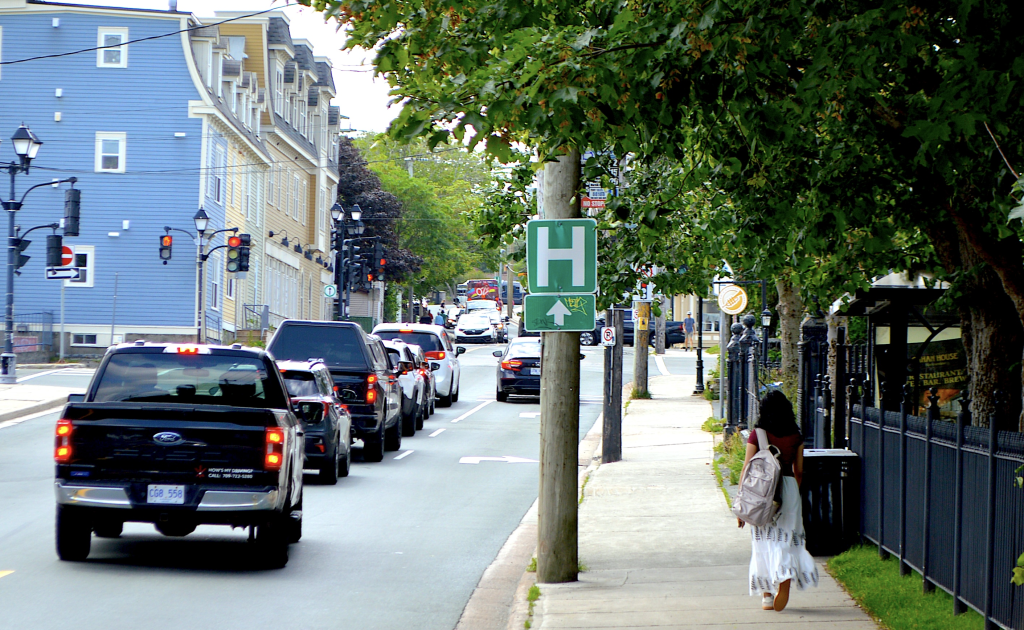
According to End Homelessness St. John’s, which runs Horizons at 106, upward of 600 people were experiencing homelessness in the capital city at the end of June, representing what may be the highest numbers ever recorded.
The organization provided updated data to The Independent which show the problem continuing to worsen. Based on the group’s evolving data collection methods, it says a minimum of 900 people experienced homelessness in 2022. That number rose to 1,400 in 2024. And a minimum of 1,500 were homeless throughout 2025.
“Over the past few years, homelessness in St. John’s has increased by 60 per cent, while investment in housing and essential supports has not kept pace,” says End Homelessness St. John’s Director Doug Pawson. “Without sustained investments in solutions such as supportive housing, more people will continue to experience homelessness, and the systems, organizations and frontline staff intended to support them will face even greater pressure.”
Pawson says the actual number of people experiencing homelessness in St. John’s is much higher than what his organization can report at any given time, due in part to the difficulty of documenting known cases. Anecdotally, Reed agrees the number of people experiencing homelessness is on the rise. “I know many people out there have gotten so much worse,” he says.
Reed says on any given day he’s out helping others find shelter, or simply chatting with them. Though he now has a roof over his head, he describes his living situation as precarious and keeps a tent handy just in case.
Outreach groups say need for help skyrocketing
Reed tells the situation on the streets of the province’s capital in the shadow of the Wakeham government’s work on a new 10-year poverty reduction strategy.
Outreach groups in St. John’s point to data showing poverty – not just homelessness – is skyrocketing.
Shelby Arnold, a coordinator with Thrive, which provides outreach and services to those experiencing homelessness, says indicators show sharp, in some cases exponential, increases in the number of people seeking help. The influx has “been more challenging” on the organization’s staff, she says.
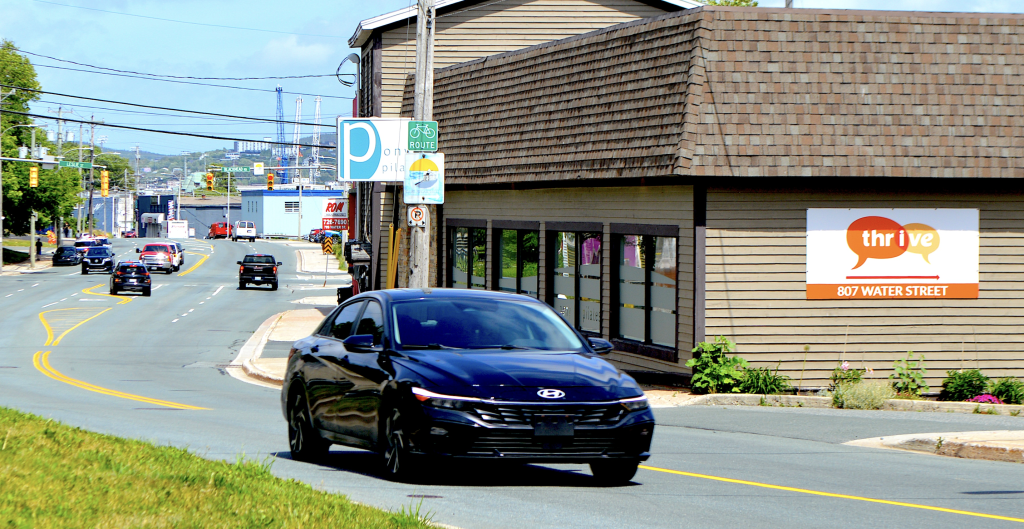
Thrive generally tracks its data based on ‘contacts’ – meaning a person who returns for support five times in a single week counts for five contacts. Approximately 750 people sought support from Thrive in 2023. In 2025, that number rose to about 1,200 individuals. In terms of the group’s work and the goods and services it provides, the number has risen substantially from 9,562 contacts in 2023 to nearly 28,000 in 2025, in part because of the expansion of Thrive’s downtown outreach team.
Meanwhile, the organization says its drop-in programming rose from 3,000 visits in 2023 to 10,700 in 2025.
Thrive’s outreach team, Street Reach, offers bottled water, food, and supplies to unhoused residents in the city’s downtown. It also connects people with shelters, but Arnold says people are sometimes denied because the shelters are full. “For people who are unhoused, if you get released from hospital and you’re essentially palliative, what are you being released to? A shelter bed? It’s quite sad,” she says. “It’s an injustice for sure.”
Arnold, who has worked with Thrive for 10 years, says policymakers need to realize things are dire. Though numbers are on the rise, she says, the resources Thrive receives remains virtually unchanged. “I think all of us have that broader advocacy lens about wanting to push for services like ours to be less needed, not more needed,” she explains, “moving away from poverty alleviation to actual poverty reduction.”
Calls for universal basic income and support linked to inflation
Arnold wants the province to seriously consider a universal basic income and adequate, multi-year funding for groups on the front lines, like Thrive. She says that kind of meaningful change would make a material difference in people’s lives.
“At the end of the day the resources need to be in the hands of the folks who have the least,” she says, referring also to working families, students, single parents, and seniors who are living on or below the poverty line.
Arnold and other outreach workers have been pleading with the provincial and federal governments to link income support with the annual rise in inflation. Single adults who qualify for income support currently receive about $561 per month to cover their expenses. They may also be eligible for another roughly $500 towards the cost of rent, which has also sharply increased in recent years.
Arnold says in her opinion it seems like those who make the least, or who need income support, are the ones who need to continuously prove they’re in need, while navigating a complex government system where support can be cut off at any time.

“It’s hard to hear of more barriers being added rather than fewer,” says Arnold. “We all deserve autonomy. Nobody comes along and tells you or I how to spend our money. People who are receiving income support, or those who are panhandling, are finding ways to string together whatever few resources they can, but their spending is policed.”
The amount of support individuals and families receive is “observed from the government’s perspective,” Arnold continues. “They cut them off or put blocks on people’s accounts to verify their income. And it just feels like there’s so much investment in keeping people in poverty rather than really addressing the root causes.”
Advocates say costs of poverty can no longer be ignored
When the House of Assembly reopens in the fall, Dan Meades hopes to see poverty-reduction legislation on the order paper first.
Meades has spent the last decade helping run the Transition House Association of Newfoundland and Labrador, a network of about a dozen support homes from Nain to Happy Valley-Goose Bay, and Gander to the Avalon, which primarily help women and single-parent families chart a path to a better future.
Based on his studies, research, and previous work in western Canada, Meades has become a go-to expert in poverty reduction policy.
“Ethically ending [homelessness and poverty] is the right thing to do, but economically, we can’t afford to ignore this problem any longer,” he says. “The costs to the provincial government through the justice system, the education system, and the health system alone is exponentially more than the cost would be to just solve these problems.”

“If you got a leak in your boat, the first thing you do is you stop the water from coming in,” he says. “And I’m hopeful that this government understands that.”
Like Arnold, Meades wants to see income support linked to inflation as a way to plug the hole, so that “poor people don’t get poorer every year.” That policy alone, he says would be the “most basic step to reduce poverty.”
In 2023 some groups applauded poverty reduction measures brought in by the then Liberal government, including a proposed 300-per-cent increase to child benefit payments, while extending them to the first five years of a child’s life. The Liberals also expanded the province’s food lunch program and launched a basic income for seniors between 60 and 64 years of age.
Meades says the Liberals’ failure to link income support with inflation is an opportunity for the PCs to make a lasting difference. “Any plan that doesn’t include changing the income support structure and indexing it to inflation—really we’re missing the lowest hanging fruit, easiest, most impactful thing they could do,” he says.
Meades says during his time doing poverty reduction work in Alberta and British Columbia, significant attention was given to the poverty reduction strategy implemented under former Progressive Conservative Premier Danny Williams, including measures linked to inflation.
“We watched the strategy really closely and I still think today it was one of the best ever written in Canada, and the outcomes were really clear. Poverty rates decreased, the depth of poverty decreased,” Meades says. “The targeted populations in that strategy saw an increase in their standard of living and their ability to meet their basic needs.
“Measuring poverty reduction is really quite easy,” he adds. “Like, did poverty reduce, or did it not?”
Meades says progress made over the past decade has essentialy been rolled back, evidenced by the boomerang effect seen in the federal government’s Covid-19 pandemic-era payments, known as the Canada Emergency Response Benefit, or CERB, which had positive impacts while it was being implemented, followed by negative drawbacks once it ended.
“People could afford rent, food – they could afford back-to-school clothes,” he recalls. “In lots of ways it was a very prosperous time for people who were able to access CERB,” he adds, explaining the program could be viewed as a model example of how poverty reduction could look when governments provide people the money they need for essentials.
“Since that benefit disappeared, we’ve seen poverty rates all across the country not just go back [to what they were], but rebound up in a really negative way,” says Meades. “And Newfoundland and Labrador has been a part of that.”
Fairer wages and adequate social housing
In addition to linking inflation with income support, Meades says workers need fairer wages and the province must provide adequate housing.
Pointing to damning revelations from the province’s auditor general that the Newfoundland and Labrador Housing Corporation has not been keeping up with a rising demand for social housing needs over the last decade, Meades refers to the situation as “public policy creating homelessness.”
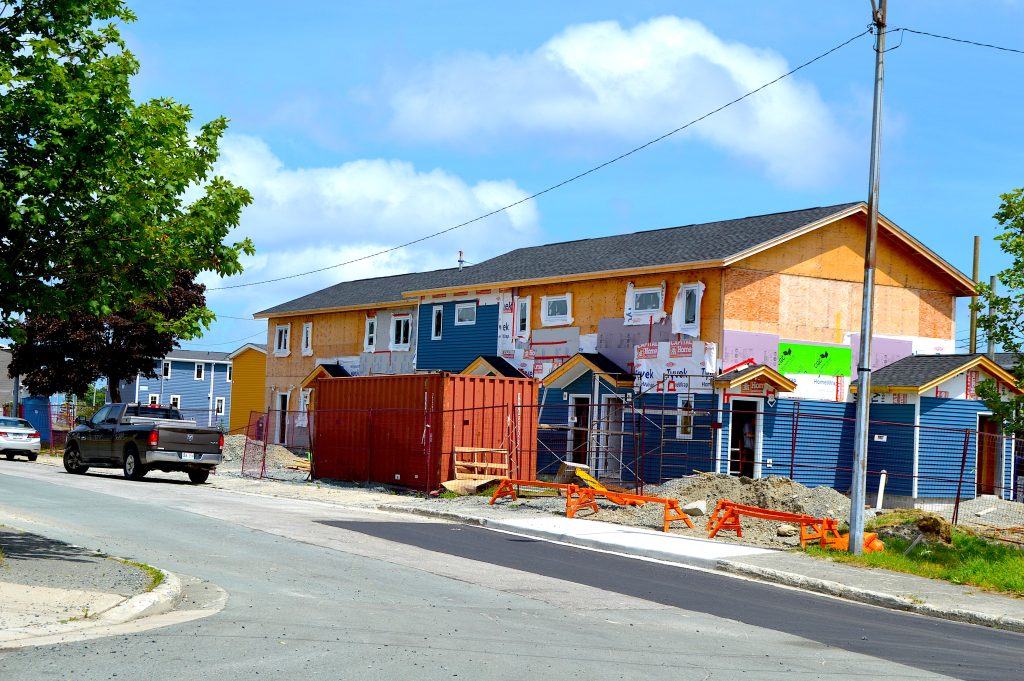
“When you have the renter of last resort [NLHC], in a housing crisis, that is decreasing the amount of housing stock, these are public policy choices that are causing our neighbours and our friends to suffer.
“That is what poverty looks like,” Meades continues. “And the sad part is, every single day that goes by between the election and when they do the simplest poverty reduction measures – indexing support, having a real conversation about what the minimum wage should be, really changing the housing situation – the problem gets worse.”
In May, The Independent reported on the construction of at least three new social housing projects in the St. John’s region, totaling about 100 new units, some of which are ready for tenants.
On July 16, the province announced 33 new affordable rental housing projects are being launched across the province at a cost of $31 million, and that, in the second-round of the provincial Affordable Rental Housing Program, 650 homes are expected at a cost of more than $60 million.
Observers are sceptical that the PC’s goal of building 10,000 new housing units by 2030 is attainable. Despite tens of millions of dollars being directed toward housing, it’s unclear if the new units will have any meaningful impact on the NLHC’s 2,600-person waitlist.
Newfoundland and Labrador Auditor General Denise Hanrahan said in her March 2026 report that this time last year the NLHC had 12,198 people living in 5,248 units. Another 222 homes were vacant and 72 units were unavailable for use. Some 1,523 new individuals were added to the public housing waitlist, bringing the total to 2,603 and representing a 71-per-cent increase over the four year audit period.
“I am extremely concerned about the Corporation’s ability to support the people and families it serves,” Hanrahan writes in the report.
If increased income support and a minimum wage that’s closer to a living wage, accompanied by sufficient public housing, are a first step toward meaningful poverty reduction, Meades says step two should involve targeting specific demographics with unique needs, like seniors, Indigenous communities, refugees and other new Canadians, and single-parent families.
“Single moms are so vastly overrepresented in poverty that it is an unbelievable opportunity for us to solve that problem,” Meades says, explaining that when struggling single parents are supported in meeting their families’ basic needs, “the outcomes of their kids get exponentially better, if you decrease their poverty rate.”
More kids need help, says advocate
“We won’t be able to keep up at a certain point,” says Danielle Seward, who runs the Single Parents Association of Newfoundland and Labrador.
Seward says she sounds like a broken record, repeating a phrase over and over in her more than three years leading the organization: that more and more single-parent families, mostly single-mothers, are needing the help the association provides.

“To say demand has grown on our system since I’ve been here is an understatement,” she says.
Seward points to applications for the association’s back-to-school supplies program, which she says have already doubled for 2026. Last year the charity sent about 1,000 book bags from St. John’s to Labrador to help alleviate added back-to-school costs on single-parent families in the northern part of the province.
When school is out during summer months, by-appointment visits to the organization’s food bank increase because students are out of school and in many cases not availing of food support programs administered through the education system.
The Single Parents Association customizes grocery hampers to accommodate children with complex needs, those who eat Halal meats, and those with other dietary requirements. The association even has a partnership where uneaten hospital food is redirected to its clients. “They’re packed with nutrients like cod, salmon, chicken, you name it. Vegetables and protein that a parent can’t necessarily afford, they are excellent lunches for kids,” says Seward.
In the first half of 2026, 169 new families have come to the single parents association for help, which translates to roughly 109 new children, she explains. “When demand goes up you need to source extra fundraisers and get extra donations in your pocket. But the economy has been equally difficult on donors themselves,” Seward adds. “You know folks have less to give as it is, so it’s really a perfect storm when you kind of look at it.”
Though it’s only summer, Seward is thinking ahead to the holiday season. Her organization typically helps 800 kids in the month of December, but she says last holiday season alone they helped provide for around 1,400 children. “I truly believe that nonprofits are the fabric of society that try to keep everything together,” Seward says, adding groups like hers are “here for emergency support when someone needs it.
“My only fear is that the reliance on nonprofits is going to create a time in the future where we’re not sustainable anymore, until actual government programs are in place to curb some of these issues.”
Minister says help is coming, but won’t commit to inflation-linked income support
“The provincial poverty rate is one of the things that keeps me awake at night. It’s 10.4 per cent,” Minister Joedy Wall told The Independent in a July 15 interview. That’s about 55,000 people, but advocates have told The Independent the number of Newfoundlanders and Labradorians experiencing some form of poverty is closer to 25 per cent.
Wall knows he has one of the most pressing portfolios in government. A former mayor of Pouch Cove and past group-home worker, he’s now the Minister of Social Supports and Well-Being, Housing, Poverty Reduction, and the Status of Persons with Disabilities.

The minister would not commit to linking income support to inflation but said it’s on the government’s radar. He said he has also discussed with Finance Minister Craig Pardy the PC’s election promise to “implement multi-year core operational funding to community groups.”
On housing, Wall blames the problems at Newfoundland and Labrador Housing Corporation on successive Liberal administrations. When the PCs formed government last fall, he said, upward of 350 social housing units needed repairs. The government has since hired more than 20 workers to do the deferred maintenance. “We need to do things differently because we need to do better, no doubt,” he said, calling his remark an “understatement”.
“I know the premier always says, ‘In God we trust, and for everything else we rely on data,’” he continued. “We know our housing numbers, we know our wait lists, and we know the level of infrastructure […] that we need to build.”

Written public submissions and an online questionnaire to help inform the new poverty reduction strategy are open to the public until Aug. 31.
When asked about the short window between the end of August and the House of Assembly’s fall sitting – and if Newfoundlanders and Labradorians will see a poverty reduction plan made into legislation come the fall – Wall spoke optimistically. “It is my goal,” he said. “And I have a really solid dedicated team who are committed to poverty reduction and prevention strategy.”
Calls for politicians to listen to those directly affected
From the hallways of politics that control the public’s money, to the communities in need of stronger support, Shane Reed hopes the PCs will allow the perspectives and ideas of people with lived experience, like himself, to inform the province’s new poverty reduction strategy.
Reed says he has written down in a book ideas about how things can be improved, including a grant system for unemployed residents to help build a neighbourhood of modular homes that use solar power, wind turbines and a gravity-based rainwater system.
“Whatever government comes up with, it’s got to be sustainable,” he says – not just environmentally, but a plan that will endure through changing governments.
“Let’s face it,” he says. “Who are the most innovative people in the world? They are the people that got nothing.”

Author

Related Articles

May Day Rally Shows New Face of Today’s Labour Movement
Turnout for May 1 march and rally in St. John’s one of the biggest yet in this province

Recimply the Best: Pitch and Pick Competition Winner Aims to Reduce Paper Waste
Recimply won big at Genesis’ annual Pitch and Pick competition last week. The startup is solving the problem of non-recyclable paper receipts.

Coming Home Queer for the Very First Time
For three days in July, queer Newfoundlanders and Labradorians from all over the world celebrated a rural homecoming 30 years in the making.

As Innu exhibit opens in Labrador, Grand Chief says truth must come before reconciliation
Innu Nation Grand Chief Jodie Ashini says it’s disappointing to open the Innu Pakassiun exhibit without the provincial government’s participation, but Innu know their history and who they are

Liberals’ Bill C-39 a wake-up call for Canadians: Avi Lewis
‘Cracks starting to show in the Carney consensus,’ Lewis tells N.L. NDP convention in St. John’s
As NDP convention gets underway in St. John’s, will N.L.’s third party prioritize growing rural support?
Former party candidates say it’s a steep hill to climb, but there are ways